Korea and Japan · Volume 52, The Koikuchi Line, the Kombu Coast and the Kaiseki Counter
Unagi no Kabayaki
Edo
Illustration
- Time
- 40 minutes
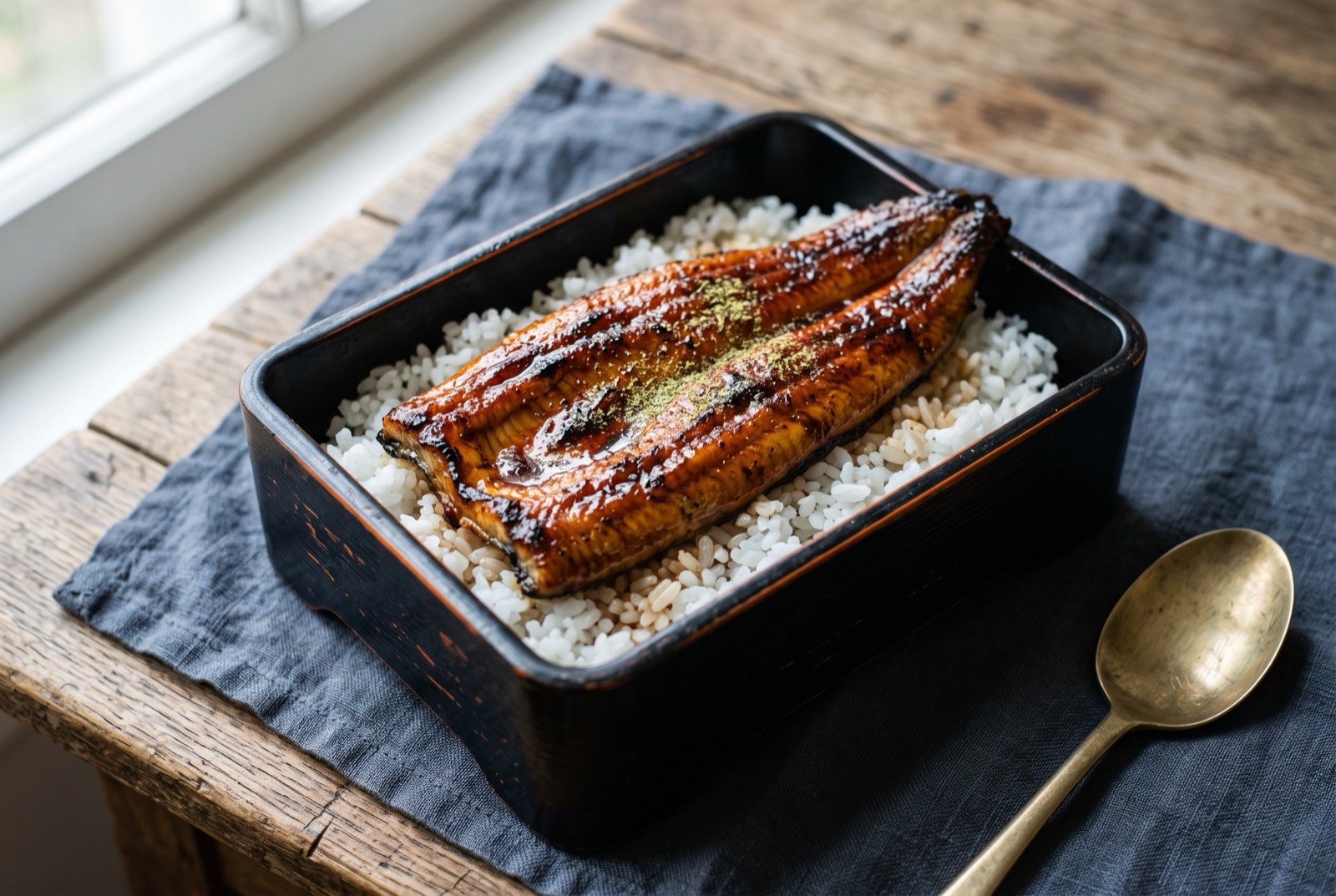
Kabayaki reached close to its modern form by the mid Edo period: earlier eel cookery simply grilled the fish whole, and the Edo development split it along the back, removed the bone, skewered and grilled it plain first, then steamed it before a final glaze and grill pass, a technique inseparable from koikuchi soy's own development in the same period and region. Tsukudani, the soy simmered preserved food this same eel technique sits beside, has its own origin story tied to Ieyasu directly: fishermen of Tsukuda village, Settsu, gave the future shogun provisions during his flight after the Honnoji Incident in 1582, and he later settled around thirty three of them on reclaimed Edo Bay land that took the village's name.
As tradition built it
The Kanto method
Serves 4. About 40 minutes.
Ingredients
- 4 fresh eel fillets (or a good UK substitute, see Sourcing)
- 150 ml koikuchi soy sauce
- 150 ml mirin
- 50 ml sake
- 40 g sugar
- to serve steamed rice, to serve
- to taste sansho pepper, to finish
Method
- Simmer soy sauce, mirin, sake and sugar together until reduced by roughly a third, into a glossy tare.
- Skewer the eel fillets flat to prevent curling and grill briefly over high heat, skin side first, just to colour.
- Steam the grilled eel, covered, 15 to 20 minutes, until the flesh is fully tender.
- Return to the grill, basting repeatedly with the tare, building layers of glaze rather than a single coat (rung 6).
- Serve over rice, the tare's own pan juices spooned over, finished with a scatter of sansho pepper.
What a modern chef changes
The Kansai method, run as a deliberate named contrast, not a substitute
Rung 4, stated directly
Method
- Cook a second portion the Kansai way, opened from the belly, grilled directly and continuously with no steaming stage, for a genuinely crisper, chewier result, and serve the two side by side, since the whole point of rung 4 is that this is a real mechanical fork, not a matter of taste alone.
- Build the tare with an aged usukuchi note for the Kansai portion specifically, a small proportion of pale soy stirred through the final glaze so its lighter salt profile lets the eel's own flavour, rather than the sauce's, carry the dish, a chapter's own extrapolation rather than a documented Kansai practice.
- Rest both portions briefly before serving, five minutes under foil, since a kabayaki eaten the instant it leaves the grill has not had time for the glaze to properly set against the flesh.