Asia · Volume 55
The Korean Peninsula
The Jang, the Ferment and the Divided Table
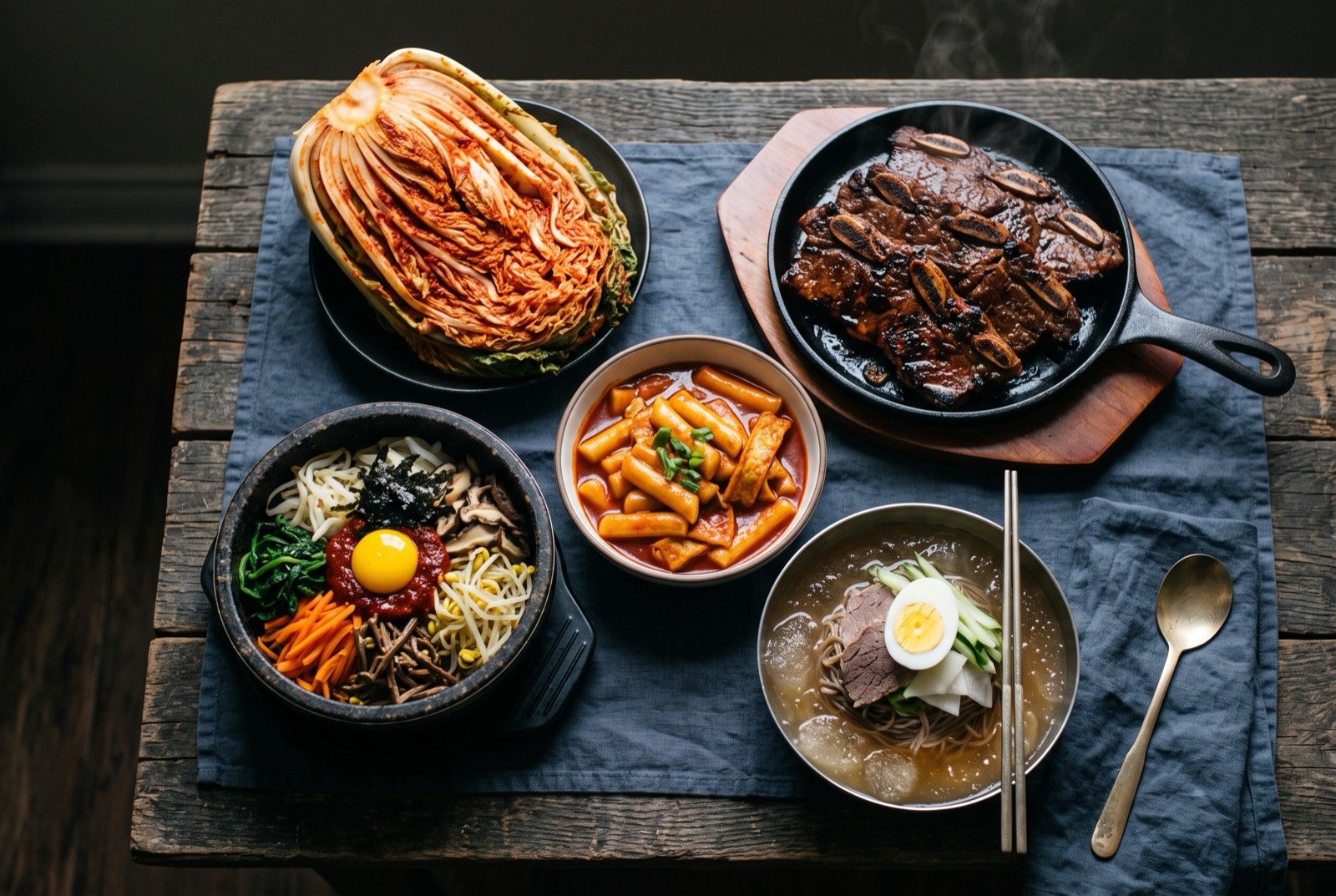
One peninsula, one ecological base of monsoon rice, seafood and a koji-driven fermentation grammar, and one modern history that split it into two food worlds that no longer share a border, let alone a table. This chapter treats South Korea as it is actually cooked and eaten today, in real regional variety from Jeolla's abundant banchan to Gyeongsang's saltier restraint, and treats North Korea honestly: not with invented certainty about a country almost nobody can research directly, but through the documented pre-division tradition both halves inherit, and through what refugee testimony, international agencies and a small number of named defectors can actually establish about food on the other side of a border that has now been closed longer than it was ever open. Every dish as tradition built it, then what a modern chef would change.
Sources and review · What this chapter does not assert · How we research · Spotted something wrong?
A Sense of Place
Korea's food logic starts from a single, load-bearing fact: this is a fermentation nation before it is anything else. Rice and fish are the ecological base, as they are across most of monsoon Asia, but what actually organises a Korean kitchen, north or south, court or farmhouse, is the jang trinity, doenjang, gochujang and ganjang, all three descended from the same dried soybean block, meju, and the onggi jars that let them breathe while they age. A Korean meal is not built around a single sauce the way a French one is; it is built around three interdependent mother sauces made months or years in advance, then drawn on daily, the way a baker draws on a starter rather than mixing fresh yeast each morning. Kimchi runs on the same logic, not a single national pickle but a whole regional grammar of salt, chilli and fermented seafood calibrated, province by province, to how fast the local climate will spoil a jar of cabbage.
That regional grammar is real and well documented for the south. It is genuinely, structurally thinner for the north, and this chapter says so throughout rather than papering over the gap with invented specificity. South Korea has seventy years of living field research, government food-science institutes, and a population that still makes its own kimchi every November. North Korea has none of that available to an outside researcher: no live fieldwork is possible, and everything in this chapter about food north of the DMZ passes through the hands of a defector's memory, a journalist relaying state media, or an international agency working from limited, state-mediated access. Both facts are simply true of the same peninsula, and a chapter that pretended otherwise, smoothing the north into equal specificity with the south, would be a worse and less honest book than one that names the asymmetry directly.
The south: five food regions with one climate logic underneath them
Kimchi style tracks temperature, not taste preference, and this single fact explains most of the regional variation that follows. Warmer southern provinces ferment faster in the heat, so they salt harder, season more heavily and reduce the amount of liquid in the jar itself, since a wetter kimchi sours faster; colder regions can afford a lighter hand. Jeolla-do, the south west, is the country's rice bowl and its most abundant table: a fertile, well-watered plain and a tidal west coast that yields shellfish and seaweed on a scale the rest of the peninsula does not match. Its kimchi runs spicy, salty and jeotgal-heavy, its banchan spreads are famously the most generous in the country, and, per a serious Korean cultural-affairs source, that abundance is not only ecology. Medieval aristocratic clans here kept cultural ties to the capital's refined dining customs, and Jeolla's relative distance from central royal authority during Joseon let out-of-favour or retired scholars pursue a genuinely leisured table, poetry, drink and good food, without courtly regulation looking over their shoulder. Gyeongsang-do, the south east, sits on a narrower seasoning palette by comparison, heavy on anchovy jeotgal and salt, restrained in nearly everything else, and that restraint is not simply poverty: the same source frames it as an articulated value, tied to the region's stronger historical association with Confucian scholarly culture, letting an ingredient's own flavour show rather than dressing it in abundance. Chungcheong-do, between them, keeps a salt-forward rather than jeotgal-forward hand and a markedly milder, cleaner style. Seoul and Gyeonggi carry the court's own restraint, refined rather than rustic. Gangwon-do, the mountainous east, leans on dried squid and East Sea fish where inland provinces reach for soy.
The north: a thinner record, honestly stated
Pyongan province, including Pyongyang, is consistently described, in what sourcing exists, as deliberately mild, neither spicy nor salty, a proud, expansive regional self-image shaped by centuries of overland trade contact with China, and unusually wheat and buckwheat forward for a Korean region given long, cold winters. Hwanghae province, further south and ecologically closer to central Korea than to the far north, sits on the Yeonbaek and Jaeryeong plains, one of the peninsula's grain baskets, its food described as hearty, plain and generously portioned rather than decorative. Hamgyong province, the far north east, is the most distinctive of the three: heavy garlic and chilli, a fermentation tradition built around fish rather than soy or vegetables alone, and a food culture that travelled south, imperfectly and by force, when its people did (see The History in Layers). Kaesong, the old Goryeo capital, is the one clear exception to this chapter's honesty about thin northern sourcing: as a former royal capital and Korea's great historical merchant city, its cuisine is genuinely, specifically documented, inheriting court elaborateness and layering a wealthy trading-city character on top, and a live South Korean heritage project is actively working to reconstruct it on exactly that argument.
A table of regions, logic and dishes
| Region | Defining logic | The dishes that carry it |
|---|---|---|
| Jeolla-do | jeotgal abundance, generous banchan, aristocratic table culture | kongip-kimchi's Jeolla cousins, Jeonju bibimbap, gat-kimchi |
| Gyeongsang-do | restraint, doenjang-forward seasoning, Confucian scholarly value | kongip-kimchi (soybean leaf), a spare seasoning hand |
| Coastal Gyeongsang (Tongyeong) | fish-based jang against inland soy-based jang | Tongyeong bibimbap, myeoljang |
| Pyongyang and Pyongan | mild seasoning, wheat and buckwheat | Pyongyang naengmyeon |
| Hamgyong (pre-division; now via refugee Sokcho and Ojang-dong) | fish fermentation, potato starch (colonial-era industry) | Hamhung-style bibim-naengmyeon, abai sundae |
| Kaesong | Goryeo court elaborateness, merchant wealth | bossam-kimchi, sinseollo, joraengi tteokguk |
The History in Layers
One kingdom, one royal table, genuinely documented
The Joseon dynasty (1392 to 1910) ran a documented, textually attested royal food system, not a folklore reconstruction, and this is the best-sourced history in the whole chapter. The king's daily meals, the surasang, were a twelve-dish service laid across three physical tables, the main table, a side table, and a hot-pot or grill table, with two kinds of rice, two soups and two stews offered so the diner could choose. It survives as more than description: the Wonhaeng eulmyo jeongni uigwe, the court's own illustrated record of an eight-day royal progress in 1795, lists hundreds of dishes served across those eight days with real recipes and quantities, and is cited as a primary source in peer-reviewed Korean nutrition-science journals today. Royal court cuisine was designated South Korea's Important Intangible Cultural Property No. 38 in 1971, and its recognised tradition-bearer institution, the Institute of Korean Royal Cuisine, keeps that documented lineage alive as a living, certified craft rather than a museum piece.
The wound: thirty-five years of Japanese colonial rule
Japan annexed Korea in 1910 and ruled it until liberation in 1945. This chapter treats that occupation as what it was for Korea: extraction and suppression, not a shared culinary heritage with the Japanese volumes elsewhere in this atlas. This is not a chapter about Japanese cuisine's own history, and it does not read Korea's thirty-five colonial years as a unifying moment with the neighbouring Honshu, Hokkaido-Kyushu or Okinawa volumes; it reads them as a rupture that Koreans, north and south, still name directly when they talk about this period. The one specific, well-documented food-system trace this research could confirm concretely is industrial: Japanese colonial-era investment established potato starch production in Hamhung specifically, giving that region an unusual local supply of potato starch as a noodle-flour substitute, the very supply chain that later produced the noodle now marketed, largely by refugees rather than by Hamhung itself, as Hamhung naengmyeon (see The Dishes, Twice). Beyond that one traced thread, this chapter did not research colonial-era food policy in the depth the subject deserves, rice requisitioning for the Japanese domestic market and its effect on Korean diets is a real and serious history that a fuller treatment would need to address directly, and this chapter says so rather than gesturing at it without real sourcing behind the gesture.
Division, war and the food that came south in people's memories, not in writing
Liberation in 1945 split the peninsula at the 38th parallel; the Korean War (1950 to 1953) hardened that line into the DMZ that still stands. What this did to food culture is not abstract. The December 1950 Hungnam evacuation carried large numbers of civilians from Hamhung and the surrounding Hamgyong region south by sea as UN forces withdrew, and those refugees, settling above all in Seoul's Ojang-dong district and in the east-coast town of Sokcho, opened restaurants naming dishes after the hometown they had lost access to. What resulted, documented honestly by a South Korean government-affiliated cultural archive under the title "The Hamhung naengmyeon that doesn't exist in Hamhung," is a genuine, roughly seventy-five-year-old South Korean diaspora tradition in its own right, not an unbroken continuation of what Hamhung itself cooked. The same pattern produced abai sundae in Sokcho, a Hamgyong-style blood sausage renamed after the refugee village Abai Maeul, whose most famous local version is stuffed into squid rather than pork intestine, because squid, not pig, was what the Sokcho coast actually offered newly arrived refugees. Pyongyang naengmyeon followed the same road in reverse: Pyongyang-origin refugees who fled south, particularly through the Euljiro area of Seoul, opened restaurants recreating the dish from memory, and what a Seoul naengmyeon house serves today is a Southern lineage roughly as old as the division itself, not a live transcript of what Pyongyang eats now.
The Arduous March, and the honest limits of what can be known north of the line
North Korea's food history since 1953 cannot be researched the way South Korea's can, and this chapter states that as a finding, not an excuse. The most serious documented shock is the Arduous March, roughly 1994 to 1998, a famine following the collapse of Soviet trade subsidies, a severe 1994 flood, and broader systemic economic failure, during which public food rationing effectively stopped for large parts of the population; widely cited, though not independently re-verified in this chapter's own research, demographic estimates put excess famine mortality above ten per cent of the population in the worst-hit period. Lee Ae-ran, who defected in 1997 and became the first North Korean woman to hold a doctorate in food and nutrition, now runs a Seoul restaurant, Neungna Bapsang, staffed by fellow defectors, and published an English-language memoir in 2025 describing both her family's history and the famine directly. Her testimony is one person's memory, credentialed and serious, but singular, and this chapter does not present her most extreme recollections as general historical fact, only as what one defector's published account reports. Present-day figures from the World Food Programme and the Food and Agriculture Organization put somewhere between a third and over half the North Korean population as food insecure in recent assessments, the agencies' own numbers disagreeing meaningfully by year and methodology, itself a fact worth stating plainly as evidence of how imprecise even the best international data on North Korea is. What the North Korean state itself stages around food, showcase restaurants like Pyongyang's Okryu-gwan, home of the naengmyeon Kim Jong-un and Moon Jae-in ate together at the 2018 inter-Korean summit, should be read as exactly that, a curated performance for domestic and diplomatic audiences, not evidence of how ordinary North Koreans eat; even Okryu-gwan itself has been documented breaking from official price controls to charge real market prices amid shortages, a detail that undercuts the theatre more than it confirms it.
The modern moment, south of the line: hansik goes to Michelin
South Korea's own recent food history runs in almost the opposite direction, toward international recognition rather than isolation. Yim Jung-sik opened Jungsik in Seoul in 2009, trained in Western fine-dining kitchens in New York and Spain, and is repeatedly credited as the pioneering figure in a loose but real movement Korean food media calls modern hansik: domestic ingredients and technique combined with contemporary skill and a chef's own creativity into something familiar yet new. Michelin's own guide arrived in Seoul in 2016; by 2026 the city carried forty-two starred restaurants, and Netflix's Culinary Class Wars has, per Korean trade press, measurably changed domestic demand for serious cooking in the years since. This chapter treats that movement in full in the Technique Ladder below, since its real content is technical, not merely a headline about stars.
The Flavour Arsenal
The jang trinity, and the meju that underlies all three
Everything Korean seasoning does starts from meju, a dried, fermented soybean block, and the three jangs it produces: doenjang, a fermented soybean paste, earthy and pungent almost to sourness; ganjang, Korean soy sauce, salty and savoury, literally the liquid drawn off the same batch that produces doenjang; and gochujang, a fermented chilli and soybean paste, sweet-heat. Where a Western Korean-inspired product isolates gochujang alone, a gochujang wing sauce, a gochujang mayo, it strips away the doenjang and ganjang counterweight that traditionally balances it in a real Korean kitchen, a structural gap no amount of a single good gochujang can close on its own.
Ferments and preserved proteins beyond the jang trinity
Jeotgal, salted fermented seafood, is kimchi's other defining ingredient family: saeujeot (salted shrimp) and myeolchi-jeot or its liquid form aekjeot (fermented anchovy) carry the savoury depth a Western "cabbage in chilli paste" kimchi is missing entirely. Cheonggukjang, a fast-fermented soybean paste distinct from doenjang in every respect that matters, ready in roughly three days rather than months, using natural rice-straw inoculation of Bacillus subtilis rather than the slower, milder brine fermentation doenjang relies on; its own name is contested between a popular folk story crediting Qing-dynasty China and a documented eighteenth-century Korean source recording it as 戰國醬, "wartime jang," developed specifically because it fermented fast enough to feed soldiers.
Chillies and their calibration
Gochugaru, Korean chilli flakes, come coarse, for kimchi, where a slower-releasing texture clings to cabbage without muddying the brine, and fine, for stews and marinades, where it needs to dissolve without leaving visible flake. Heat runs roughly 1,500 to 10,000 Scoville units depending on variety and crop year. Sunchang, in Jeolla-do, functions as a quality and provenance marker much the way a wine appellation does, and the region's named Grand Masters, tenth-generation makers with documented centuries-long family lines, are cited directly by Seoul's top kitchens as their own sourcing standard.
Leaves and aromatics
Kkaennip, perilla leaf, appears both fresh, as a wrap and a distinct flavour note unrelated to Italian basil despite the leaf-shape resemblance, and pickled into its own kimchi. Mustard leaf (gat) carries Yeosu's celebrated Dolsan-style kimchi, a genuinely late-arriving regional star, the cultivar only reaching the island in 1954 and staying locally known for thirty years until a bridge connected Dolsan to the mainland in 1984. Soybean leaf (kongip), cured for roughly a month in brine, makes a genuinely distinctive, non-cabbage regional kimchi in Gyeongsang, stiffer in texture than perilla, nutty rather than green in flavour.
Starches and staples
Short-grain rice underlies almost everything, but the peninsula's noodle culture runs on three quite different starches with real regional identity: wheat and buckwheat in the north, especially Pyongan, buckwheat specifically defining Pyongyang naengmyeon's noodle; potato starch, a Hamhung-area speciality traceable to colonial-era industrial investment there; and sweet potato starch (dangmyeon), the base of japchae. Glutinous rice underlies both gochujang's traditional sweetness and festival rice cakes.
The Technique Ladder
The argument, from inside
Cho Eun-hee, who leads the food studio at Onjium, the Seoul cultural research institute built around three studios of food, clothing and housing near Gyeongbokgung Palace, and who holds Korea's own Important Intangible Cultural Heritage certification for Joseon royal court cuisine, gives this chapter its clearest statement of what elevation actually means here: "Korean food does not follow trends; it showcases a philosophy of life accumulated over centuries." On what modernising a dish should actually change, she is explicit that it is not the dish's physical appearance: she prioritises "the attitude towards ingredients, balance, temperance, seasonality and the dignity of the dining table" instead. Jin Seon-joo, another Seoul chef working at this level, states the same discipline from the production side: "a Korean chef must clearly understand for themselves how jang is made," and personally makes his own meju rather than buying it in. This is the technique ladder's real spine: not novelty, but doing the traditional mechanism with more precision and more patience than a home kitchen usually allows, the same idea that runs through every volume of this atlas.
Rung 1. Seed the jang, don't start cold
Kwonsooksoo, a two-Michelin-star restaurant in Apgujeong, serves abalone and caviar dressed in a soy sauce reportedly decades old, continuously replenished rather than made fresh each time, a percentage of the mature, living ferment carried forward into every new batch, the same principle as a sourdough mother or a solera sherry system. What a cook does with this rung. Reserve a portion of any finished, mature ferment, a kimchi brine, a doenjang, a well-established gochujang, and seed it deliberately into the next batch rather than starting cold every time; this needs no equipment beyond a labelled jar and the patience to keep doing it across years, which is the actual barrier, not the technique itself.
Rung 2. Hold kimchi's fermentation temperature deliberately, not by kitchen accident
Peer-reviewed Korean food science on kimjang-style kimchi shows Lactobacillus sakei predominating at the traditional fermentation range of 5 to 9°C, with storage around minus 2°C; a separate controlled study found that at 4°C, the bacterial strains that "produce beneficial substances and flavour" dominate, whereas 10 to 15°C shifts the balance toward a strain associated with rancidity and tissue softening as fermentation proceeds, alongside measurably faster sugar consumption and acid production. A UK kitchen typically sits well above 15°C. What a cook does with this rung. A Big Green Egg is irrelevant here, but a dedicated fridge or a sous vide bath held at a stable low single-digit temperature is exactly the equipment that reproduces the flavour-preserving, texture-preserving end of this range, a genuinely precise, numbers-backed claim rather than the vague "ferment somewhere cool" advice most Western kimchi recipes offer.
Rung 3. Make meju at home, and give it the months a factory jang skips
Traditional gochujang uses naturally occurring mixed moulds fermenting meju powder over six to twelve months; factory versions use single cultured strains, often compressed to a day or two, and frequently add corn syrup or wheat gluten to fake the body and sweetness slow fermentation would otherwise build. Traditional doenjang is just soybeans and salt, aged months to years; commercial versions are often bulked with wheat, alcohol or MSG on a fraction of the timeline. What a cook does with this rung. Cook and mash soybeans, form them into bricks, and dry them somewhere controlled, a dehydrator on its lowest setting stands in reasonably for the traditional straw-hung farmhouse rafter, letting the surface mould and, more importantly, the Bacillus bacteria doing the real interior work colonise it naturally; then commit to a realistic home ageing timeline of six months to two years for the paste that follows, not a factory's two days.
Rung 4. Dry-age deliberately, and know why it differs from wet-ageing
Peer-reviewed comparison of dry- versus wet-aged Hanwoo beef shows dry-ageing, at 2 to 4°C with 65 to 85% humidity, producing "beefy and roasted" flavour compounds that wet-ageing, vacuum-sealed at roughly 1°C, does not; wet-ageing instead develops "bloody, serumy, metallic and sour" notes, both methods increasing flavour concentration but through genuinely different chemistry, dry-ageing through real moisture loss and surface microbial activity, wet-ageing through purely enzymatic breakdown in a sealed environment. What a cook does with this rung. A Big Green Egg's ceramic body holds stable low humidity and temperature reasonably well for short, controlled dry-ageing of a primal cut in a dedicated fridge, and the same chemistry that makes Hanwoo dry-ageing prized applies directly to UK beef; a genuine humidity-controlled fridge, not just "the fridge," is what separates ageing from spoiling.
Rung 5. Grind gochugaru fresh, and choose the grade the dish actually needs
Buying whole dried Korean chillies and grinding to a specified coarseness in a dedicated spice grinder is the direct equivalent of buying whole spices over pre-ground: the volatile oils that carry gochugaru's aroma degrade from the moment it is milled, and a jar of unknown age sitting on a UK shop shelf has usually lost real character by the time it reaches a pan. What a cook does with this rung. Grind coarse specifically for kimchi, where the flake needs to cling to cabbage without dissolving into the brine, and fine for stews and marinades, where a visible flake reads as a fault rather than a feature; treat the two grades as different tools, not one ingredient in two textures.
Rung 6. Understand onggi as a principle, and stop pretending there is an easy substitute
Onggi's fermentation function depends on genuine materials science: during firing, bound water evaporates from the clay body, leaving micro-pores thousands of times too small for water molecules to pass but large enough for oxygen, letting a ferment breathe controlled amounts of air while staying sealed against liquid loss. This is the one rung in this chapter's whole technique ladder that this chapter states honestly has no real UK substitute. A dehydrator, a normal ceramic crock, a Kilner jar, none replicate onggi's specific fired-clay porosity, and claiming one does would be overclaiming exactly the kind of thing this atlas exists to avoid. What a cook takes from this rung instead. Choose a vessel deliberately for what each specific ferment needs, a loosely lidded, "burped" glass jar for something that wants partial air exchange, a fully sealed vacuum bag or airlocked crock for something that wants none, rather than defaulting to one method for every ferment regardless of what it actually calls for.
The Ferment and Preserve Bench
1. Meju
The dried, fermented soybean block underlying doenjang, ganjang and gochujang alike. Clean soybeans are soaked overnight, boiled thoroughly, mashed and formed into fist-sized or brick blocks, spaced with mugwort or straw between them for airflow, then dried and fermented in a warm place until the surface turns yellow, before a final hard drying in direct sun. This chapter's research found genuinely conflicting timelines across sources, weeks for inoculated or commercial meju, roughly two months' drying plus ten to fifteen days' post-ripening fermentation for slower, wild-fermented home methods, and states that range honestly rather than collapsing it into one false figure. A useful correction worth carrying into the kitchen: mould is only a minor, surface-level actor in meju fermentation, the real work is done by Bacillus bacteria colonising the interior, invisible to the eye.
2. Doenjang
Meju blocks are submerged in salt brine, historically at a ratio of roughly 1 mal of meju to 5 doe of salt, and left in an onggi jar exposed to sunlight, the brine topped up with more salt as it evaporates, until the paste is fully matured. The exact final ageing duration was not pinned to a single figure in this chapter's research; several months up to a year or more is commonly cited before jang-gareugi, the day the liquid ganjang is finally separated from the solid paste.
3. Ganjang
The liquid drawn off the same brined-meju batch that produces doenjang, historically at a ratio of meju to salt to water of roughly 1 to 0.6 to 0.7 to 2, fermented in brine at 18 to 20% salinity for 30 to 40 days before being drawn off and boiled down to concentrate it. Grades by age: thin, pale soy sauce, aged one to two years, for soup seasoning, what is commonly called guk-ganjang today; medium jang, for stews; and deep, dark soy sauce, aged five years or more, historically used in a more medicinal context.
4. Gochujang
Soybean flour, chilli powder, glutinous rice flour, a light soy sauce (cheongjang) to bind and roasted sesame powder, historically in a documented ratio of roughly 1 mal soybean flour to 3 hop chilli powder to 1 doe glutinous rice flour, matured in direct sun. Traditional troubleshooting, worth keeping for its honesty about failure modes rather than only a target ratio: too much sesame makes it greasy, too much glutinous rice flour turns it sour, too much chilli makes it excessively hot. A minimum ageing of six months, improving with longer maturation, is widely repeated in Korean cooking culture.
5. Cheonggukjang
Soybeans soaked ten to twenty hours, boiled soft, wrapped in rice straw and kept warm for roughly three days until sticky fermentation strings appear, a hard contrast with doenjang's months-to-years timeline, relying on natural rice-straw inoculation of Bacillus subtilis rather than a slower brine ferment. Its own etymology is genuinely contested between a popular folk story crediting Qing-dynasty China and a documented historical source recording it under a name meaning "wartime jang," developed to feed soldiers quickly; this chapter treats the origin as unsettled rather than picking a side.
6. Makgeolli
Milky, low-alcohol fermented rice wine, traditionally unpasteurised and genuinely alive, distinct from the pasteurised, shelf-stable, often fruit-flavoured versions that dominate export markets. A real craft revival is underway even in the UK, not only in Korea, worth naming here as evidence this fermentation culture is actively growing rather than only being preserved (see Sourcing in Britain).
Sourcing in Britain
Verified September 2026. The UK has a genuinely well-established Korean grocery trade, unlike much of this atlas, and this section reflects that reality rather than a thinner one. Where a supplier could not be fully confirmed, that is said rather than smoothed over.
The ranked list: what decides great from grim
- Gochugaru origin, Korean-grown versus Chinese-grown relabelled. The single most consequential, least visible substitution available. Two mainstream UK retailers admit Chinese origin directly on their own product pages, Sous Chef's house-brand gochugaru states plainly "Product of China," and Yau's Foods states its powder is "Grown and harvested in China for export to Korea." Genuinely Korean-grown gochugaru exists: Haetnim Maeul's 100% Korean Cheongyang gochugaru, Korea's hottest cultivar, ships to the UK via Gochujar Global.
- Gochujang, Grand Master jangdok-fermented versus mass-market factory paste. Jungdam, a UK-based curator of artisan Korean jang, sells gochujang by Cho Jung-hyun of Sunchang, one of only two of Korea's 83 government-recognised Food Grand Masters certified for gochujang, fermented over a year in earthen jangdok pots. Flag: at time of writing this and Jungdam's Kisoondo ganjang show as sold out; a small curator's stock comes and goes, and this should be checked rather than assumed. Reliable mass-market alternatives, genuinely fine everyday gochujang rather than corn-syrup slop, include O'Food (Chung Jung One) via Sous Chef and CJ/Bibigo via Ocado.
- Doenjang, the ingredient panel as the cheapest quality check available. Sous Chef's own doenjang lists hydrolysed soy sauce and the flavour enhancers disodium guanylate and disodium inosinate, exactly the industrial shortcuts standing in for months of real fermentation. Genuinely traditional, jaerae-sik doenjang has essentially no reliable, verified UK retail presence at time of writing; the closest found, Q-rapha via Etsy UK, could not be independently re-verified in this research. Say this plainly rather than dressing up a "traditional style" branded factory product as equivalent.
- Fresh napa cabbage and Korean radish. No UK mainstream supermarket stocks these; New Malden, Surrey, is the one reliably strong UK option, a destination trip rather than a mail-order solution, one of the few places in this atlas where "go to a specific London suburb" is genuinely the correct advice.
- Fermented seafood, saeujeot and myeolchi-jeot or aekjeot. This chapter's weakest sourcing point: near-certainly available in person at New Malden's full-service Korean supermarkets, but no specific UK retailer product page could be confirmed online. Visit or phone Korea Foods or H Mart directly rather than trust a search.
- Ganjang used for its correct purpose. Guk-ganjang (soup soy sauce) and jin-ganjang (dark, all-purpose) are not interchangeable; Sous Chef sells them as distinct products, so there is no excuse to reach for generic soy sauce.
- Genuinely fresh, unpasteurised makgeolli. Sooldanji, brewed live in London (SE1) by Taeyeol Kim, £15.00, plus a home-brewing kit and nuruk starter culture for readers who want to ferment their own, a genuinely different category from Kooksoondang's shelf-stable, flavoured canned lines, both legitimately Korean but not the same drink.
Physical shops
New Malden, home to the largest Korean population in Europe, is the essential destination. H Mart, Unit 1, Leigh Close, KT3 3NW, the original European flagship, opened 2011, full-service with a fresh produce section, seafood counter and prepared banchan. Korea Foods Cash & Carry, Unit 5, Wyvern Industrial Estate, KT3 4PH, the UK's leading Korean food importer, warehouse format, bulk sizes, onsite bakery and kitchen. Korea Foods' retail arm, Seoul Plaza, reaches beyond London too, branches in Liverpool, Bournemouth, Reading, Oxford, Manchester, Leicester and Peterborough, the best-documented UK-wide footprint of any Korean grocer found. Oseyo, the H Mart group's separately branded pan-Asian retail chain, distinct from the single New Malden "H Mart," runs twenty stores including Manchester, Birmingham, Sheffield, Newcastle, Cambridge and Guildford. mr.kimchi, London SW19, is a genuinely UK-made artisan kimchi maker operating since 2013, "100% naturally fermented," worth naming specifically as UK-made-to-standard rather than imported.
Online
Sous Chef, Oriental Mart, Starry Mart and WaNaHong all confirmed live and well-stocked for everyday Korean staples during this research. Named retailers that could not be confirmed and should not be repeated as fact: "Seoul Sisters" is a US skincare brand, not a UK grocer; "Kim'C Market" is US-based, not UK; "Time For Kimchi," previously a Brighton Korean deli, now resolves to what appears to be a hijacked spam domain, evidence the business has likely closed rather than a current option.
Kit substitution, honestly
Nothing in a reader's existing kit, sous vide, dehydrator, Big Green Egg, high-power blender, chinois or spice grinder, substitutes for onggi's actual function, a breathable ceramic wall that lets a ferment respire. A large food-grade glass jar with a loosely fitting lid, burped daily, is the realistic UK substitute most Korean-American and Korean-British food writers recommend; handmade Korean onggi is available via Etsy UK at real but variable cost and shipping time, worth using where a reader wants the genuine article rather than a substitute.
Voices and Sources
From inside the tradition, South Korea
- Cho Eun-hee, Onjium, Seoul. Certified holder of Korea's Important Intangible Cultural Heritage for Joseon royal court cuisine, and this chapter's clearest voice on what elevation should actually change: not a dish's appearance, but the attitude behind it.
- Kang Mingoo, Mingles, Seoul. Seoul's only three-Michelin-star restaurant as of 2026, trained under both Cho Hee-sook and Buddhist temple cuisine, treating jang as the foundation determining flavour outright.
- Yim Jung-sik, Jungsik, Seoul and New York. The founding figure of the modern hansik tasting-menu format, and the first Korean restaurant outside Korea to hold three Michelin stars.
- Cho Hee-sook, Hansikgonggan, Seoul. Called the "godmother of Korean cuisine," Michelin's inaugural Mentor Chef Award winner, and the shared teacher connecting several of the names above.
- Jin Seon-joo, Serasé, Paradise City. Makes his own meju and works directly with farmers preserving heritage crops, on the explicit argument that fine dining should feed back into agricultural survival.
From the North, and about the North, honestly categorised
- Lee Ae-ran, Neungna Bapsang, Seoul. A North Korean defector, the first North Korean woman to hold a doctorate in food and nutrition, and this chapter's single most credentialed voice on North Korean food, though a singular one whose testimony this chapter does not treat as representative of a whole society.
- NK News, the specialist English-language outlet on North Korea, cited where its reporting could be accessed, and flagged where a relevant piece was found but could not be fully read due to a paywall.
The UK diaspora
- mr.kimchi, London. UK-made, hand-crafted, naturally fermented, a real answer to the question of what genuinely UK-produced Korean fermentation can achieve.
- Sooldanji / ATO, London. Live, unpasteurised makgeolli brewed in the UK, evidence this cuisine's fermentation culture is actively growing here, not only being imported.
The gaps, named
No named chef, restaurant or technique tradition describable as "North Korean-influenced fine dining" was found anywhere in this research, in either English or Korean. This is stated as a genuine finding, not a smoothed-over absence.
Things this chapter has deliberately not asserted
- Any single, precise ratio for Jeolla's or Gyeongsang's banchan dish counts, beyond the well-supported qualitative claim that Jeolla's table is genuinely more abundant and Gyeongsang's more restrained. A hard comparative dish-count figure was not found.
- That Gyeongsang food is measurably saltier than Jeolla food by sodium content. One sensory-panel-style source suggests the two regions rate similarly on raw saltiness, with the real differentiator being jeotgal intensity and seasoning richness rather than salt percentage; this chapter states the supported claim (richness and complexity) and withholds the unsupported one (raw saltiness).
- What "gam" refers to in Haenam's gam-kimchi. Most likely persimmon, but this is an unconfirmed guess this chapter has chosen not to present as fact.
- Jeonju bibimbap's specific rice-cooking method, which this chapter's research could not distinguish reliably from Jinju's separately documented method; the two are not asserted as identical.
- A documented "royal court bibimbap" or shaman-ritual (gutbap) origin for bibimbap, a thread this research went looking for specifically and did not find, and now believes is probably not a real documented lineage separate from the golddongban court-naming material this chapter does assert.
- Cheonggukjang's etymology as settled, either the popular Qing-China folk version or the "wartime jang" correction; the correcting source is a serious industry publication citing named historical texts, not a peer-reviewed etymological study, and this chapter presents the dispute rather than a verdict.
- That South Korean Pyongyang naengmyeon restaurants preserve a more "authentic" buckwheat ratio than noodles served inside North Korea today, beyond noting this as informed commentary; no source presented an actual side-by-side compositional analysis.
- Any specific detail of Japanese colonial-era food policy beyond the one traced thread, Hamhung's potato-starch industry. Rice requisitioning and its effect on Korean diets under occupation is a real and serious history this chapter did not research to a standard it could responsibly assert further detail from.
- The most extreme scenes from Lee Ae-ran's published memoir, as representative or established general fact about North Korean society, rather than what this chapter states them as: the testimony of one credentialed defector.
- A precise figure for how many North Koreans are currently food insecure. WFP and FAO figures disagree meaningfully by year and methodology; this chapter gives the range and names the disagreement rather than one false-precise number.
- A named, dated South Korean source for the specific Uijeongbu naengmyeon lineage, though the general pattern of Pyongyang-refugee-founded naengmyeon houses as Seoul's most historically continuous surviving lineage is well supported elsewhere.
- The exact current UK availability of onggi in mid-size, 5 to 7 litre, formats, or the current stock status of any single named UK curator's specific product; this section names the right retailers and the right products to look for, not a guaranteed live inventory, since this research found stock at the genuinely excellent tier is real but intermittent.
Seed the jang, don't start cold
Kwonsooksoo, a two-Michelin-star restaurant in Apgujeong, serves abalone and caviar dressed in a soy sauce reportedly decades old, continuously replenished...
Hold kimchi's fermentation temperature deliberately, not by kitchen accident
Peer-reviewed Korean food science on kimjang-style kimchi shows Lactobacillus sakei predominating at the traditional fermentation range of 5 to 9°C, with...
Make meju at home, and give it the months a factory jang skips
Traditional gochujang uses naturally occurring mixed moulds fermenting meju powder over six to twelve months; factory versions use single cultured strains...
Dry-age deliberately, and know why it differs from wet-ageing
Peer-reviewed comparison of dry- versus wet-aged Hanwoo beef shows dry-ageing, at 2 to 4°C with 65 to 85% humidity, producing "beefy and roasted" flavour...
Grind gochugaru fresh, and choose the grade the dish actually needs
Buying whole dried Korean chillies and grinding to a specified coarseness in a dedicated spice grinder is the direct equivalent of buying whole spices over...
Understand onggi as a principle, and stop pretending there is an easy substitute
Onggi's fermentation function depends on genuine materials science: during firing, bound water evaporates from the clay body, leaving micro-pores thousands of...
The dishes
- Baechu Kimchi Nationwide
- Kongip-kimchi Gyeongsang-do
- Doenjang-jjigae Nationwide
- Jeonju Bibimbap Jeolla-do
- Tongyeong Bibimbap Coastal Gyeongsang (Tongyeong)
- Galbi Nationwide
- Tteokbokki Nationwide (street food)
- Pyongyang Naengmyeon Pyongyang and Pyongan
- Hamhung-style Bibim-naengmyeon Hamgyong (via refugee Ojang-dong and Sokcho)
Sources and review
- Researched
- 12 sources cited
- Reviewed
- Not yet reviewed from inside the tradition
- Cooked
- Not yet cooked and reported
Where this volume comes from
3 research briefs on file for this volume, researched to the rules on How we research. Published 3 September 2026. Last changed 8 September 2026.
The brief's own account of its sources
Of the substantive sources cited above, the strongest tier, government and academic Korean sources (the World Institute of Kimchi, the Rural Development Administration, the Korea Heritage Service, the Academy of Korean Studies' national encyclopaedia, the Korean Traditional Knowledge Portal, the National Institute of Korean History's history portal), carries a clear majority of the load-bearing claims for the jang trinity, kimjang, the province-by-province kimchi classification, and Joseon royal court cuisine.