Asia · Volume 56
Jeju Island
The Haenyeo, the Black Pig and the Kingdom Before Korea
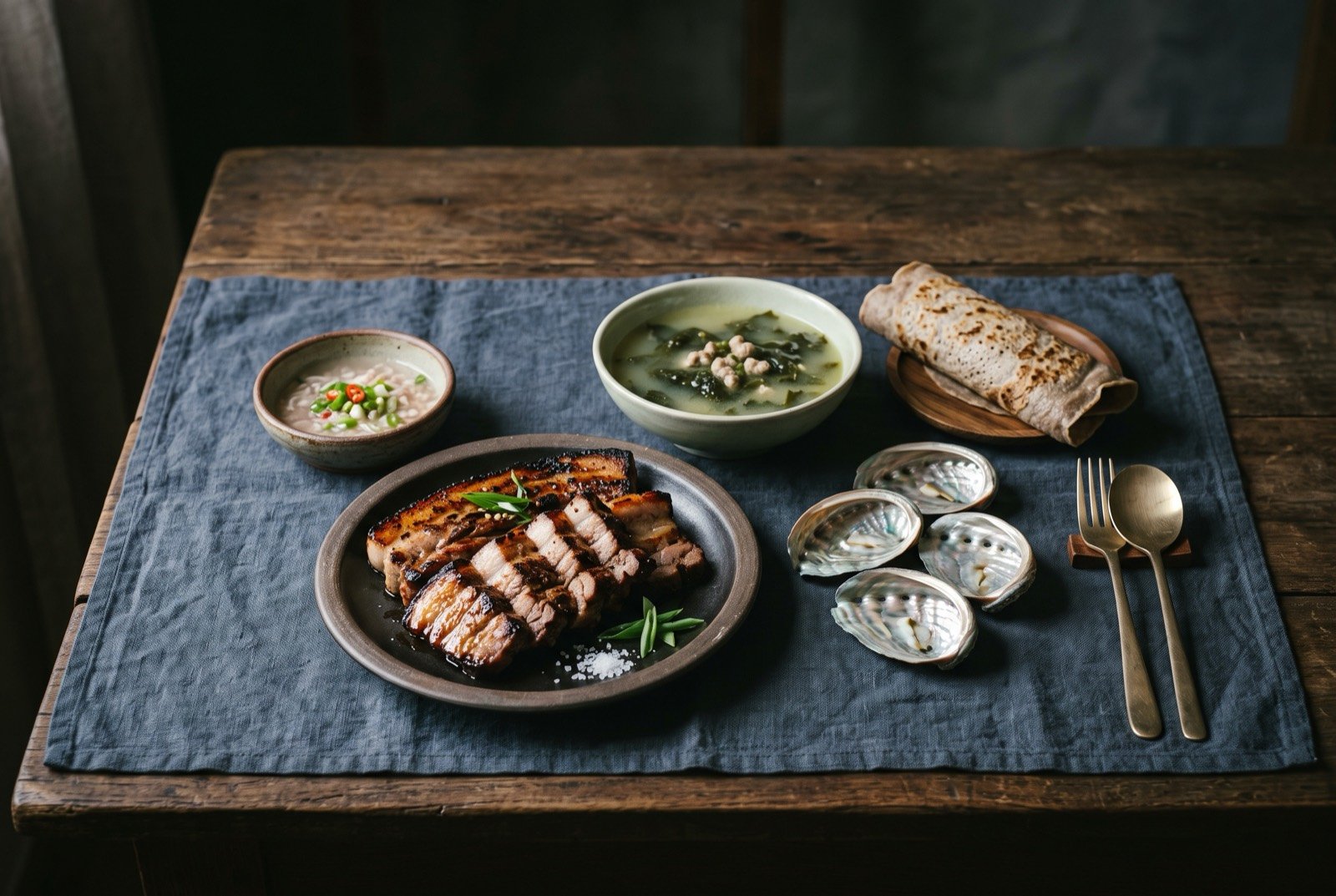
An island that was its own kingdom for close to a thousand years before Korea absorbed it, with volcanic soil too poor and porous to grow the rice that fed the mainland, and a coastline worked not by a fishing fleet but by free-diving women who hold UNESCO recognition for the way they do it. Tamna was a real, separate state, and its food logic, no rice, barley and buckwheat instead, a pig fed differently, a catch brought up by hand rather than by net, still runs underneath the island's table today, and every dish as tradition built it, then what a modern chef would change.
Sources and review · What this chapter does not assert · How we research · Spotted something wrong?
A Sense of Place
Say the honest thing at the start: this is a small volume, ecologically and historically. Jeju is one island, roughly the size of Bali, and its food tradition is thinner in documented depth than the Korean peninsula's own, thinner again than most volumes already written in this atlas. That thinness is not this chapter failing to look hard enough. It is what a genuinely poor, genuinely isolated island produces: a repertoire built from what the volcano and the sea actually gave people, not from a court kitchen, a trade emporium, or a wealthy merchant class writing down its own recipes. The chapter says this plainly rather than padding the gap with invented colour, and the two things that do give Jeju a real claim to its own volume, rather than a chapter inside the Korean peninsula's, are named honestly rather than assumed: a documented separate kingdom, and a documented, UNESCO-recognised way of working the sea that has no real equivalent on the mainland.
The kingdom first. Tamna existed as a distinct polity on Jeju from roughly the third century CE to the early twelfth, close to a thousand years, its first appearance in a historical text the Samguk Sagi's Baekje annals, entry for 476 CE. It submitted to Silla as a tributary state in 662, and to Goryeo in 938, but tributary submission is not annexation: Tamna kept a hereditary ruler, the seongju, and real local autonomy for another century and a half. Only in 1105, under Goryeo's King Sukjong, was it formally stripped of tributary status and reorganised into Tamna-gun, a directly administered territory. Even then the hereditary line and a degree of local self-government persisted. This chapter treats "annexation" as the two-stage thing the record actually shows, submission in 938, absorption in 1105, rather than one clean date, because collapsing it into a single moment erases exactly the slow loss of sovereignty that makes Tamna's story worth telling at all.
The sea, second, and just as load-bearing. Jeju's coastline has been worked for at least three hundred years by haenyeo, free-diving women who hold no breathing apparatus and dive on a single breath for abalone, turban shell, sea urchin and a specific seaweed the island calls mom. Their culture, the diving itself, a shamanistic ritual to the sea goddess, and a body of work songs, was inscribed on UNESCO's Representative List of the Intangible Cultural Heritage of Humanity on 1 December 2016, Korea's nineteenth such inscription. This is not folkloric colour. It is a documented occupational culture with its own grading system, its own communal architecture, its own labour history, including a genuine anti-colonial uprising in 1932 that this chapter treats with the weight it deserves, and its own present-tense crisis: the divers are old, few, and getting fewer, and this chapter says so with real numbers rather than treating haenyeo as a museum piece.
The ecology that ties both together. Jeju is volcanic, and its soil shows it: light, porous, wind-blown ash mixed with abundant rock, genuinely unsuitable for paddy rice. Where the Korean mainland organised its whole food system around rice, Jeju could not, and grew barley, millet, buckwheat, sweet potato and beans instead. Naked barley remained a staple into the 1970s. In Jeju dialect, plain white rice was 곤밥 (gonbap), "fine rice," eaten only at ancestral rites, because it was not grown locally and had to be bought in. That single fact, that Jeju's most basic mainland Korean staple was a rare, ritual food here, is the clearest single marker of how different this island's food logic really is, and it is why barley, millet and above all buckwheat, not rice, carry this chapter's starch story.
| Element | What organises it |
|---|---|
| Staple starch | Barley, millet, buckwheat, sweet potato; not rice, which had to be imported and was eaten mainly at rites |
| The fat and the animal | Heuk-dwaeji, Jeju's black pig, raised historically over a combined latrine-and-pen structure |
| The catch | Haenyeo free-diving for abalone, turban shell, sea urchin and mom seaweed, graded by depth and experience |
| The binding structure | Batdam, dry-stone field walls protecting crops from wind, dating from roughly the Goryeo period |
| The social logic | A poor, harsh, historically looked-down-on island cuisine, only recently recognised within Korea as having real cultural value in its own right |
A word on sourcing, stated as plainly as this atlas states it everywhere: this chapter's research was conducted substantially in Korean and, where findable, in Jeju dialect (제주어), against Jeju provincial press, Korean national press, Korean government heritage bodies, UNESCO's own bilingual documentation, and Korean academic and encyclopaedic sources, not against Western food blogs or tourist listicles, which were deliberately excluded as the basis for any factual claim. Where a claim rested only on a single source, or on a folk legend rather than a documented history, this chapter says so inline rather than smoothing it into settled fact.
The History in Layers
Before the record: the archaeology, honestly separated from the legend
Archaeological work at three sites, Gosan-ri, Neolithic, Samyang-dong, Bronze to early Iron Age, and Yongdam-dong, early Tamna period, supports a reconstructed pre-state diet of barley, soybeans, millet and red beans, supplemented by shellfish and seaweed, with cattle, horses, chickens, pigs and dogs raised as livestock. This is a real continuity, a grain-plus-shellfish subsistence pattern that is also, recognisably, what shaped Jeju's food into the twentieth century. What the archaeology does not support is any of today's named dishes. Almost nothing on a modern Jeju table can be dated with real evidence to the pre-Goryeo Tamna period specifically, and this chapter treats any claim of an unbroken, dish-level "ancient Tamna cuisine" with real scepticism, the same scepticism this atlas has applied to romanticised ancient claims elsewhere.
The Mongol century, and what it actually left behind
The strongest documented pre-Joseon food change belongs not to Tamna's independent centuries but to the thirteenth and fourteenth century, after Goryeo had already absorbed the island. In 1276 the Mongols established a horse ranch at Susan-pyeong in eastern Jeju, releasing 160 Mongol horses; the ranches went on to raise cattle, camels, donkeys, sheep and even roe deer. A Yuan overseer was posted to the island, and Mongol garrison troops and colonist-farmers settled to run the pastures for roughly a century and a half. Korean sources state plainly that Mongol influence runs thick in Jeju's meat-eating culture, its meat soups, and its alcohol, crediting the garrison period with introducing a Mongol-style sausage, dried and jerky meat, and distilled liquor to the island. This chapter treats the general shape of that claim, real Mongol presence, real horse and livestock ranching, a plausible transmission of distillation technology, as well supported, while flagging that the one academic paper found specifically on Tamna-Mongol food culture could not be read in full during this research, so the detail should be taken as directionally sound rather than exhaustively verified.
Buckwheat's arrival on the island is best placed in this same window, roughly seven hundred years ago by Korean sources, which lines up with the Mongol century rather than predating it. A popular story holds that a resentful Yuan official deliberately introduced buckwheat because it is hard to digest, hoping to sicken the islanders, who instead paired it with radish and turned it into bingtteok, defeating the plot. Korean sources reporting this story label it explicitly as 속설, folk legend, not history, and this chapter repeats that label rather than smoothing the story into fact. The more defensible claim underneath the legend, that buckwheat reached Jeju during Mongol-era contact and that radish's digestive enzymes offset a genuine property of unhulled buckwheat, buckwheat being hard to digest, is real food chemistry attached to a real rough date, even if the poisoning anecdote is decoration.
Tribute, and the honest cost of being a prized supplier
Joseon Korea prized almost nothing from Jeju more than its citrus. Tribute quotas are documented from 1052, a hundred units a year under Goryeo, and citrus arriving at the Joseon court was significant enough to trigger its own royal examination, the hwanggamje, held in celebration of the fruit's arrival. This status is easy to romanticise and this chapter refuses to. The Yeongjo Sillok, 1748, records Jeju villagers deliberately pouring boiling water on their own citrus trees to kill them, specifically to escape the crushing tribute obligation attached to owning one. Tribute burdens fell across categories, horses, citrus, abalone, tilefish, mushrooms, medicinal herbs, onto herders, orchard workers, and the very abalone divers and haenyeo who feature so centrally elsewhere in this chapter, and the burden was severe enough that many tried to escape their assigned duties outright. Citrus, in other words, was for much of Jeju's documented history a state-extracted burden on the people who grew it, not a beloved local delicacy, and this chapter states that plainly rather than letting a modern marketing story about Jeju oranges stand in for the real history.
Joseon Jeju's other well-known role, as a place of political exile, does not connect to food history the way it is sometimes assumed to. The best-documented case, the calligrapher Kim Jeong-hui, exiled roughly a decade, shows the dependency running the opposite direction from what a romantic version of the story implies: it was ordinary village commoners, not the Jeju magistrate, who fed and sustained exiled scholars, and the exiles depended on local villagers for both food and basic practical knowledge of the island's climate and terrain. No evidence was found in this chapter's research that exiles introduced dishes or food practices to Jeju; what they received was survival knowledge, not a role as culinary tastemakers, and this chapter names that gap rather than inventing an influence that the record does not support.
Colonial rupture, and the divers who fought back
Japan's 1910 to 1945 colonisation of Korea reached Jeju as extraction and suppression, exactly as this atlas's own scoping insists it be treated, a wound inside Korea's story rather than any kind of shared or unifying inheritance with Japan. Jeju's haenyeo carry the clearest single documented instance of that extraction, and of resistance to it. From the early twentieth century, haenyeo travelled seasonally off island for paid diving work, first to Busan and Ulsan, then up Korea's east coast and abroad, to Japan, to Vladivostok, to Dalian and Qingdao, a pattern driven partly by Japanese mechanised diving operations depleting local grounds and partly by the wider economic exploitation of Jeju labour under colonial rule. In 1930 and 1931, Japanese officials of the haenyeo cooperative bought the divers' agar-agar catch at roughly half the market rate, and the haenyeo organised collectively in response. Their demands, set in December 1931, were the abolition of the government-controlled cooperative, a reassessment of catch pricing, and the removal of the Jeju governor from his dual role as head of that same cooperative. The main demonstration, 7 January 1932 at the Sehwa-ri market, drew around three hundred Hado-ri haenyeo; across the whole movement, December 1931 to January 1932, an estimated seventeen thousand people took part across roughly two hundred and thirty gatherings, described in Korean sources as the largest women-led anti-colonial movement in Korea and the largest fishing-community movement nationally in the period. This belongs in the chapter as real political history, not as background colour to a diving costume.
The word "haenyeo" itself is a product of this same period. It only became the standard term after 1980; the older, indigenous Jeju dialect self-description is 좀녀 or 잠녀 (jomnyeo/jamnyeo), still used by older divers today. A widely circulated Western tourism image of haenyeo working bare-breasted is, this chapter states plainly, a documented fabrication: Korean academic textile research describes a traditional diving costume, 물적삼, a short jacket, and 물소중이, a skirt-style garment with shoulder straps specifically designed to prevent breast exposure, and roughly ninety five per cent of the "nude haenyeo" images still circulating are misidentified photographs of Japanese ama divers, a confusion traceable partly to colonial-era postcard imagery and named by a 2019 Jeju Women and Family Research Institute report as a live problem in the island's own tourism marketing.
The barley hill, and an honest class history
As Korea modernised through the twentieth century, barley became the national shorthand for hunger, "the barley hill," the annual gap before the new harvest when stores ran thin. That symbolism applied to Jeju with particular force, because the island had no rice-growing alternative at all: barley, millet and buckwheat were not a rustic seasoning on top of a rice diet, they were the whole of it. A recent academic study of Jeju food culture, co-authored by the Korean food historian Joo Young-ha, states directly that Jeju's regional food was historically perceived as coarse, 거칠다, and that it has taken until recently for Korean scholarship to find real cultural value in it rather than dismissing it as simply poor. This chapter treats that honestly rather than reaching past it for a more flattering story: Jeju's food is not ancient palace cuisine rediscovered, it is the food of a genuinely hard island, and its dignity lies in what people did with very little, not in a fictional prestige it never had.
The present, and a crisis that is ecological as much as it is cultural
Jeju haenyeo numbered 2,371 at the most recent count, down from 4,377 a decade earlier, a fall of nearly forty six per cent. Sixty three per cent of active divers are seventy or older, and one recent year certified only twenty three new haenyeo nationwide against annual losses now running at roughly two hundred a year. Divers themselves, surveyed directly, cite marine environmental change, specifically 갯녹음, a whitening or barren-ground effect stripping rocky reef of the kelp and seaweed cover that abalone, turban shell and sea urchin all depend on, as their single biggest difficulty, ahead of low income. Jeju's provincial government has committed over twenty three billion won across twenty nine support programmes this year, including dedicated medical funding for elderly divers, real evidence that this is treated as a live emergency rather than a slow, accepted fade. Set against that decline, a real if still small elevation is under way elsewhere on the island: a handful of named chefs building modern menus around Jeju pheasant, Jeju wheat and Jeju seafood, and, most documented of all, a dining concept, Haenyeo Kitchen, built explicitly and only from that day's haenyeo catch, founded because village haenyeo product was being sold off cheaply for export rather than valued at home. This chapter reads that concept, and the honest gap around it, in full below.
The Flavour Arsenal
Heuk-dwaeji (흑돼지), the black pig. Jeju's defining animal, and one this chapter treats with more nuance than "ancient heritage breed" alone. A native black pig population survived in remote mountain districts into the late twentieth century, and in the late 1980s the Jeju Livestock Promotion Institute began a pure-line breeding programme from just five surviving animals. Later cross-breeding and genetic fixing work through the 2000s and 2010s produced today's commercially available stock; the underlying native genetics are real and Jeju-specific, but the pork on a modern Jeju grill is the product of a deliberate late-twentieth-century breed-stabilisation programme, not an unbroken traditional herd farmed the same way for centuries, and this chapter says so rather than letting "heritage breed" imply more continuity than the record shows.
The dot-tongsi (돗통시), verified true rather than myth. One claim that does survive scrutiny intact: Jeju pigs were historically kept in a combined outhouse-and-pen structure, a basalt-walled enclosure where human waste fell directly to the pigs below, the resulting mixed waste and barley straw becoming the compost that made barley farming possible on the island's poor volcanic soil. This was not a marginal curiosity. As late as 1969, ninety five per cent of all toilets recorded on Jeju, over fifty two thousand of them, were dot-tongsi structures. The practice ended only after a toilet-modernisation campaign in the late 1970s. Today's version of the story, told as an ironic joke, that the pig was too refined to need its own separate toilet, inverts what was in fact a poverty-driven, functionally necessary arrangement.
Jeonbok (전복), abalone; gujaenggi (구쟁기), turban shell; seong-ge (성게), sea urchin. The three staples of the haenyeo catch, and worth keeping distinct from generic "Jeju seafood": hairtail, small sea bream and anchovy, also common on the island's table, are boat and net catch, not free-diving catch, and this atlas is careful throughout not to blur the two. Turban shell carries a genuine technical constraint worth carrying into any kitchen: its salivary gland contains tetramine, a toxin, and must be removed after boiling, before the flesh is eaten, a real food-safety engineering problem with a documented traditional solution rather than a folk superstition.
Mom (몸), a specific seaweed, not a generic word. Jeju dialect for mojaban, a gulfweed, and the defining ingredient of momguk below; this is not "seaweed" in general, it is one named species, harvested by haenyeo through the winter and traditionally sun-dried and stored for use at weddings and funerals.
Buckwheat, barley and millet, the starches rice could not be. Barley, especially naked or hulled barley, remained a staple crop into the 1970s. Buckwheat, arriving with the Mongol-era window above, is Jeju's most distinctive starch today, and the island grows the largest share of Korea's national buckwheat crop by province. Millet, called omegi in this context, was the island's dominant summer crop and the base of its two named alcohols, below.
Myeoljeot/melchoet (멜젓), fermented anchovy sauce. The standard dip for grilled black pork, sometimes warmed on the grill itself with chilli and garlic worked through it, and, in a documented Jeju-local variant, finished with a pour of Hallasan soju simmered briefly into the mix.
Hallabong, named honestly. Jeju's best-known modern citrus is not ancient. It was bred in Japan in 1972, smuggled into Korea in 1987, first grown on the mainland in Jeolla-do, and only reached Jeju in the early 1990s, receiving its geographic-indication registration as late as 2015. It belongs in this chapter's arsenal as a real, current Jeju crop, but not as evidence of an old citrus tradition; the older, genuinely tribute-documented citrus history belongs to different, less internationally marketed varieties.
Okdom (옥돔), tilefish. So central to Jeju's own idea of "fish" that ordinary usage once let the plain word 생선 mean okdom specifically, with every other species called by its own name. Peak season is December to February.
Bejigeunhada (베지근하다/배지근하다). A genuinely Jeju-specific dialect word, the deep, rich flavour of a long-simmered meat broth, applied to momguk and jjeopjjakppyeguk below, and a term worth a reader knowing, since it names precisely the quality this chapter's pork broths are chasing.
The Technique Ladder
Six rungs, each a real, sourced mechanism from Jeju's own kitchen, none borrowed from a French or Japanese tradition that happens to look similar.
Rung 1. Straw-fire searing, a controlled two-stage smoke and finish
짚불 (jipbul), straw-fire searing, sears black pork over burning rice straw rather than charcoal, valued specifically for the smoke character and the particular crust it builds, distinct from ordinary charcoal grilling and documented enough that whole restaurants brand themselves on the technique alone. This is the cleanest indigenous ancestor this research turned up for a Big Green Egg treatment: a fast, intensely aromatic first sear followed by a separate, controlled finish, which is exactly what a two-zone Egg setup already does, high direct heat first, then a move to gentler, indirect heat to finish the interior without burning the crust a second time.
Rung 2. Long, deliberate boiling for texture, not just doneness
Dombegogi's method calls for boiling black pork noticeably longer than a standard bossam, specifically to render out more fat and leave the meat with a chewier, more resistant texture, the opposite instinct from most Western boiled-pork cookery, which treats a long boil as something to avoid. Jeju's own tradition treats extended boiling as a deliberate textural choice, and a reader working from this chapter should resist the urge to pull the pot early.
Rung 3. Buckwheat-flour slurry as the indigenous thickener
Momguk and jjeopjjakppyeguk both finish a long pork-bone broth by stirring in a buckwheat flour slurry at the end, a genuine, named traditional thickening technique distinct from a roux or a cornstarch slurry, doing the same structural job a French velouté's flour-butter paste does, but built from the one grain the island actually had. A high-power blender lets this technique go further than the original hand method: buckwheat flour whisked directly into hot broth tends to clump, but blended into a small quantity of the broth first, then returned to the pot, it disperses evenly and finishes silkier than the traditional hand-stirred version.
Rung 4. Immediate-catch handling as a freshness discipline
Mulhoe and hoe both depend on speed as much as on the fish itself: squid bought live at the harbour and sliced within minutes, sea cucumber understood to toughen the moment it is cut and rested, are documented Jeju practices built around a real, sourced understanding of how quickly raw seafood texture degrades, functionally the same discipline a modern kitchen would formalise with a cold chain and precise timing. A chinois-strained dressing, made in advance so nothing delays the cut-to-plate window, is the honest modern extension of this rung, not a replacement for it.
Rung 5. Engineering around a genuine toxin, not around a superstition
Turban shell's tetramine constraint, boil first, then remove the salivary gland before the flesh is eaten, is a real technical problem with a documented traditional solution. A sous vide bath, held at a temperature and time proven to denature the toxin before the gland is removed, gives a kitchen precise, repeatable control over exactly the same safety step the tradition already solved by eye and experience.
Rung 6. The long reduction as recovery food, not garnish
Haenyeo Kitchen documents a twelve-hour reduction of red sea cucumber, traditionally eaten by haenyeo to restore body heat and energy after a day's diving, cooked down slowly until it concentrates into something close to a gastrique or a dark, savoury syrup. No professional kitchen outside that one concept was found doing this deliberately as a plating element, which makes it exactly the kind of traditional technique this atlas exists to take seriously rather than pass over: a real, long, patient reduction, built for stamina rather than show, worth finishing under real control rather than treating as a curiosity.
The Ferment and Preserve Bench
1. Omegi-sul
Jeju's own fermented alcohol answers a question the rest of Korea does not have to ask: what do you ferment when you have no rice? The answer is millet, called omegi in this context, Jeju's dominant summer crop. Steamed millet dough is worked with nuruk and left to ferment; the clear liquid that can be strained off the top is omegi-cheongju, and the cloudy liquid left behind is omegi-sul proper, a takju-style drink roughly analogous to mainland makgeolli but built on a completely different grain because rice was never an option here. It is designated Jeju Provincial Intangible Cultural Heritage, its production transmitted only to certified successors.
2. Gosori-sul
Omegi-sul, distilled, using a still called a gosori in Jeju dialect. This is plausibly one of the very few Jeju practices with a real claim to genuine pre-Joseon antiquity, since distillation technology across Korea is widely credited to Mongol transmission in the thirteenth and fourteenth century, the same window this chapter has already traced for Jeju's buckwheat and its meat-and-alcohol culture more broadly. Also designated Jeju Provincial Intangible Cultural Heritage. What this chapter has not established with full confidence: the direct academic paper making this Tamna-Mongol distillation link could not be read in full during this research, so treat the connection as plausible and well aligned with the wider Korean distillation history, rather than settled beyond doubt.
Sourcing in Britain
The honest headline, as elsewhere in this atlas where a cuisine's core ingredients simply do not travel: generic Korean pantry staples are easy in the UK; anything genuinely Jeju-specific is not, and in one case, the black pig itself, there is a structural reason it never will be.
What is genuinely easy. Gochujang, doenjang, Korean chilli flakes, Korean rice, sesame oil, dried seaweed and bottled or canned makgeolli are all straightforwardly available, in person or online, from H Mart (New Malden, and online at hmart.co.uk), Korea Foods (also New Malden, wholesale and online) and Oseyo, the UK's largest Korean grocery chain by footprint with twenty branches nationwide. Buckwheat flour needs no special sourcing at all: Doves Farm's UK-milled wholegrain buckwheat flour is on the shelf at Sainsbury's, Tesco and any decent health-food shop.
Fresh sea urchin is the one genuinely bright spot. Sashimi-grade uni, Canadian or Japanese rather than Korean, is available from The Fish Society and Fine Food Specialist by mail order, and from Yutaka frozen. This is a real, obtainable, Michelin-adjacent ingredient, and worth naming as this chapter's single highest-leverage authentic buy: it will not be the exact species a haenyeo brings up, but it is genuine, fresh, sashimi-grade Pacific urchin roe, not a compromise dressed up as one.
Abalone exists, but not as haenyeo-caught product. Fresh Australian abalone is available from The Fish Society and, as a trade product, from Classic Fine Foods; canned Korean abalone is available via H Mart. No haenyeo-caught, or even Korean-caught, fresh abalone was found anywhere in the UK, and none should be assumed to exist.
Heuk-dwaeji cannot be bought here, and there is a real reason beyond simple absence of an import chain: Jeju maintains strict controls on livestock entering and leaving the island specifically to protect the black pig's genetic purity, and even in Korea the true heritage bloodline is rare enough that it is barely sold commercially outside Jeju itself. The honest UK substitute is Large Black pig, the only British breed entirely black-skinned, a genuine Rare Breeds Survival Trust Priority breed with the same well-marbled, self-basting richness heuk-dwaeji is prized for. Black Orchard Farm in Carmarthenshire, the largest Large Black breeder in West Wales, is a real, contactable source, supplying, among others, the Head Chef of Hakkasan Mayfair. State the substitution plainly on the page: this is the nearest honest equivalent, not the same animal.
Hallabong cannot be bought fresh in the UK. The nearest honest substitute is a supermarket tangelo or ugli fruit, both, like hallabong, hybrid mandarin crosses with a comparable sweet-tart profile, or blood orange where colour and acidity matter more than the exact citrus family.
Korean sea salt is real, with one trap worth naming. A widely stocked product called "Korean Solar Sea Salt Flakes" is in fact UK-manufactured, a flavoured salt blend, not a genuine import; the real thing, Wang Korean Salt, coarse sea salt genuinely sourced from South Korea's Sinan tidal flats, not Jeju specifically, is sold by Korea Foods.
Makgeolli, including a genuinely UK-made fresh version. Sooldoga, the UK's first Korean makgeolli brewery, near Elephant and Castle in London, brews Sooldanji, a fresh, unpasteurised makgeolli from Korean rice and nuruk, and supplies it to Michelin-starred restaurants and five-star hotels. This is a better everyday choice than bottled, pasteurised supermarket makgeolli, and worth seeking out specifically.
Kit. Nothing in this chapter demands equipment beyond what the reader already owns. A Big Green Egg run in two-zone mode is a genuine, well-matched fit for the straw-fire searing logic behind geun-gogi. Nothing else in this chapter needs specialist kit beyond a dehydrator, a chinois and a high-power blender, all already assumed.
Ranked, ingredients that decide great from grim
- Fresh uni, genuinely obtainable at sashimi grade, and worth seeking out specifically rather than substituting.
- Fresh, UK-brewed makgeolli from Sooldoga, over bottled supermarket versions.
- Large Black pork, named plainly as a substitute for heuk-dwaeji, not a stand-in pretending to be the same animal.
- Genuine Korean sea salt from Korea Foods, over any UK-blended product carrying a Korean-sounding name.
- Everything else this chapter has named as unobtainable, true haenyeo-caught abalone, Jeju-specific buckwheat, fresh hallabong, stays honestly unobtainable, and is named as such rather than quietly substituted without comment.
Voices and Sources
From inside the tradition
- Kim Ha-won, founder of Haenyeo Kitchen (해녀의 부엌), a graduate of the Korea National University of Arts' acting programme, who built a documentary-theatre dining concept from village haenyeo catch specifically because that catch was being sold off cheaply for export rather than valued at home. The clearest, best documented example this chapter found of haenyeo food being deliberately taken seriously and partly elevated, now expanded internationally to Singapore.
- Woongchul Park and Bomee Ki, the husband-and-wife team behind Sollip in Bermondsey, London, a Michelin-starred restaurant; Park opened the first fine-dining restaurant on Jeju Island before returning to London, a real, checkable Jeju connection, though Sollip's own menu is Korean-European fine dining generally rather than a Jeju-specific repertoire, and this chapter is careful not to overstate the link.
- Douglas Kim, chef-owner of Jeju Noodle Bar, New York, the first noodle restaurant in the United States to hold a Michelin star, named for the island. This chapter names him honestly as a diaspora chef who built his restaurant's whole identity around the Jeju name and elevated Korean noodle technique to Michelin level, not as a chef whose documented menu is built from Jeju-specific ingredients or technique, since that stronger claim is not supported by what this research could find.
Scholarship and institutions
- Joo Young-ha, the Korean food historian whose co-authored study for the Jeju Studies Research Center states directly that Jeju's regional food was historically perceived as coarse, only recently gaining recognition for its real cultural value, the strongest single named academic voice behind this chapter's honest treatment of Jeju's poverty history.
- UNESCO's own bilingual documentation for the 2016 inscription of the Culture of Jeju Haenyeo on the Representative List of the Intangible Cultural Heritage of Humanity, fetched directly rather than through secondary reporting, the primary source for the grading system, the transmission channels, and the ritual and song traditions named throughout this chapter.
- The Digital Jeju Culture Encyclopedia (디지털제주문화대전), run by the Academy of Korean Studies, a solid academic reference for Jeju food history and dialect terms throughout this chapter's research.
The gap, named plainly
No named Seoul restaurant or diaspora chef beyond the two named above was found building a documented menu specifically and traceably around haenyeo-sourced ingredients as a defined category, as distinct from Jeju seafood sourced through ordinary commercial channels. No English-language, Jeju-specific cookbook exists; the closest is a single chapter's worth of material inside a wider pan-Korean cookbook. This is stated as a genuine, confirmed finding rather than a search failure, and it is a large part of why this chapter is shorter and more cautious than this atlas's better-resourced volumes.
Things this chapter has deliberately not asserted
- That haenyeo diving represents an unbroken thousand-year-plus continuous tradition. The institution is solidly documented from the early eighteenth century, with a single earlier legal reference from 1105 proving something like it existed then; the roughly six hundred year gap between those two points has no documentary record, and this chapter does not paper over it.
- That haenyeo traditionally dived bare-breasted. This is an actively documented Western tourism fabrication; the traditional costume was specifically designed to prevent breast exposure, and most circulating images of "topless haenyeo" are misidentified Japanese ama divers.
- That any specific named Jeju dish can be dated to the Tamna kingdom before its absorption into Goryeo. The strongest pre-Joseon food history this chapter found belongs to the thirteenth and fourteenth century Mongol garrison period, after Tamna had already lost its independence, not before.
- That dombegogi's cutting-board serving method originated because haenyeo divers had no time to plate food properly. This widely repeated explanation comes from general-interest press rather than an ethnographic or academic source, and is reported here as a folk explanation, not verified history.
- That bingtteok's radish-and-buckwheat pairing defeated a Yuan official's deliberate plot to poison the island with indigestible grain. Korean sources reporting this story label it explicitly as folk legend, not history.
- That any exiled Joseon-era scholar sent to Jeju introduced a dish or food practice to the island. The documented dynamic runs the opposite direction: exiles depended on local villagers for food and survival knowledge, not the other way round.
- That hallabong is an old or traditional Jeju fruit. It was bred in Japan in 1972, reached Korea in 1987, and only arrived on Jeju in the early 1990s.
- That a chef named Park Min-ho serves a nine-course Jeju tasting menu with sous vide abalone and hallabong beurre blanc at a restaurant called Mint. This claim could not be corroborated by any Korean-language source found and is treated as an unverified, possibly fabricated search artefact.
- That "Jeju Kitchen" at The Shilla Jeju serves a three-preparation black pork course spanning Korean, Japanese and European technique. This could not be independently verified against the hotel's own listings or Korean press.
- That Terreno, a Michelin one-star restaurant, retained its star after relocating from Seoul to Jeju in 2023. Michelin stars are location-specific and formally reassessed; this chapter could not confirm current status.
- Precise depth figures for the hagun, junggun and sanggun haenyeo grading tiers beyond a single regional newspaper source. The existence and internal logic of the three-tier system is UNESCO-confirmed and solid; the specific metres given for each tier are singly sourced.
- A Jeju-specific historical sea salt tradition. Only general Korean national salt history could be found; no source specific to Jeju's own salt production was located, and this chapter does not invent one.
- The exact scale and dates of the early twentieth century haenyeo out-migration to the Korean mainland and abroad. The broad pattern is well corroborated across Korean sources; precise numbers by year and destination are not.
Straw-fire searing, a controlled two-stage smoke and finish
짚불 (jipbul), straw-fire searing, sears black pork over burning rice straw rather than charcoal, valued specifically for the smoke character and the particular...
Long, deliberate boiling for texture, not just doneness
Dombegogi's method calls for boiling black pork noticeably longer than a standard bossam, specifically to render out more fat and leave the meat with a...
Buckwheat-flour slurry as the indigenous thickener
Momguk and jjeopjjakppyeguk both finish a long pork-bone broth by stirring in a buckwheat flour slurry at the end, a genuine, named traditional thickening...
Immediate-catch handling as a freshness discipline
Mulhoe and hoe both depend on speed as much as on the fish itself: squid bought live at the harbour and sliced within minutes, sea cucumber understood to...
Engineering around a genuine toxin, not around a superstition
Turban shell's tetramine constraint, boil first, then remove the salivary gland before the flesh is eaten, is a real technical problem with a documented...
The long reduction as recovery food, not garnish
Haenyeo Kitchen documents a twelve-hour reduction of red sea cucumber, traditionally eaten by haenyeo to restore body heat and energy after a day's diving...
The dishes
- Momguk Jeju Island
- Jjeopjjakppyeguk Jeju Island
- Heuk-dwaeji geun-gogi Jeju Island
- Dombegogi Jeju Island
- Jeonbokjuk Jeju Island
- Seonggeguk Jeju Island
- Mulhoe Jeju Island
- Bingtteok Jeju Island
Sources and review
- Reviewed
- Not yet reviewed from inside the tradition
- Cooked
- Not yet cooked and reported
Where this volume comes from
3 research briefs on file for this volume, researched to the rules on How we research. Published 3 September 2026. Last changed 8 September 2026.
The brief's own account of its sources
Part One (haenyeo). Roughly 30 distinct sources, drawn from about 20 search queries, 14 in Korean plus targeted English follow-ups on the UNESCO nomination file and the topless-diver myth specifically. Roughly 22 to 25 of the sources actually cited are Korean-language, in-tradition, or Korean-institutional: Jeju provincial press (제주의소리, 제주일보), national Korean press (한국일보, 서울신문, 세계일보), Korean government heritage bodies (국가유산청/heritage.go.kr, ncms.nculture.org), Jeju cultural encyclopaedias, and UNESCO's own bilingual ICH documentation fetched directly.