Korea and Japan · Volume 56, The Haenyeo, the Black Pig and the Kingdom Before Korea
Dombegogi
Jeju Island
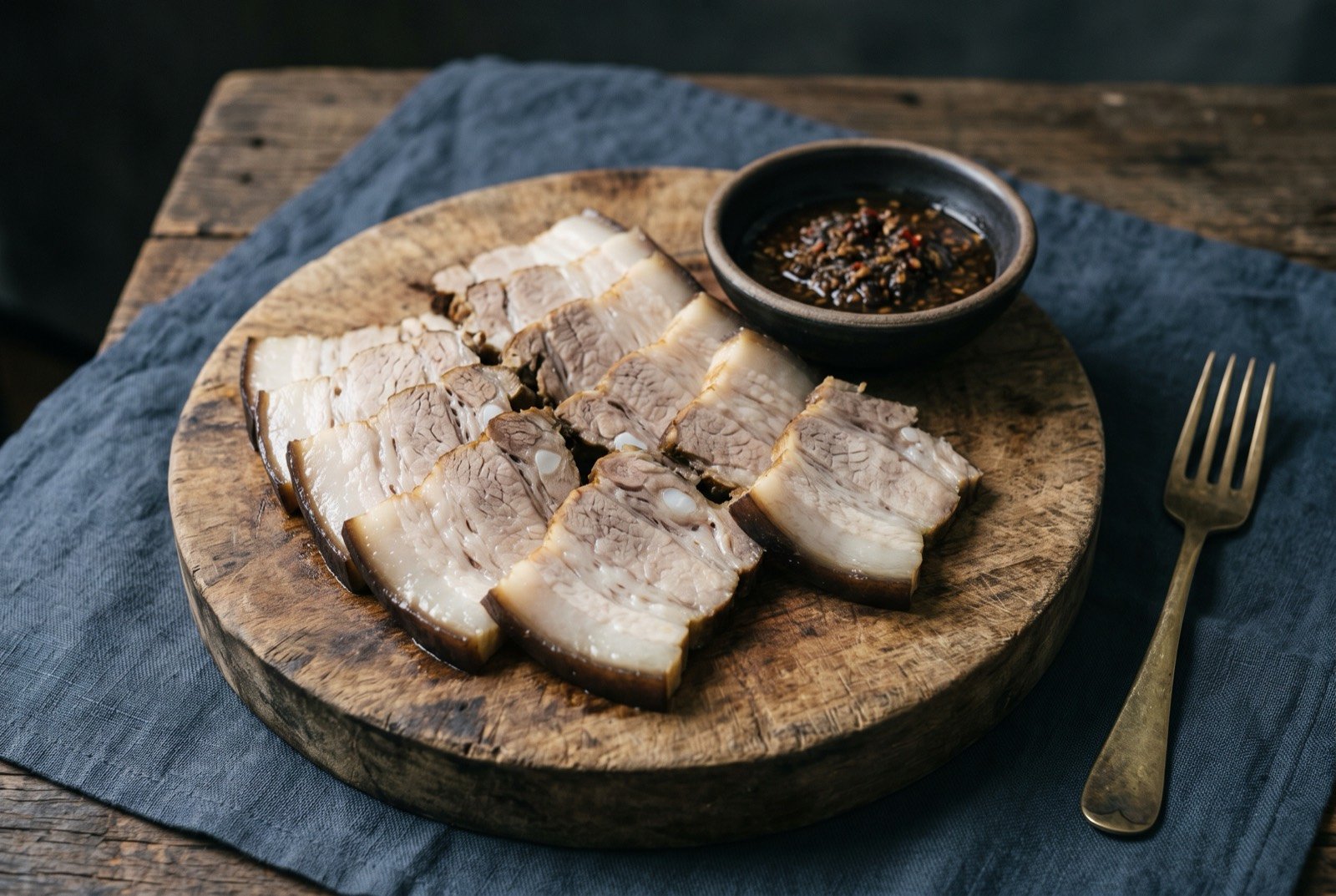
An illustration of the dish, not a photograph of it cooked.
- Time
- 2 hours
- Reviewed
- Not yet reviewed from inside the tradition
- Cooked
- Not yet cooked and reported
Boiled black pork, sliced on a wooden board (dombe) and served straight from it.
Boiled noticeably longer than a standard bossam, rendering more fat for a chewier texture, then sliced on the cutting board it was prepared on and dipped in myeolchi-jeot.
As tradition built it
Serves 4 to 6. About 2 hours.
Ingredients
- 1kg black pork belly, whole
- to cover water, to cover
- 2 spring onions
- 4 garlic cloves
- 1 tbsp doenjang
- for dipping myeolchi-jeot, for dipping
Method
- Simmer the black pork belly, whole, in water to cover with the spring onions, garlic and doenjang for 1.5 hours, longer than a standard bossam boil, until the meat has given up much of its fat and taken on a firmer, chewier texture rather than falling apart.
- Lift the pork out and rest for 10 minutes.
- Slice thickly directly on a wooden board and serve straight from it, with myeolchi-jeot for dipping.
What a modern chef changes
The long-boil texture held under precise control.
Rung 2
Method
- Simmer at a genuine, checked 90°C rather than a rolling boil, holding that temperature for the full 90 minutes with a thermometer, since a true boil risks toughening the outside before the fat inside has fully rendered, while a controlled near-simmer renders evenly through the whole piece.
- Rest the boiled pork briefly in its own hot cooking liquid, off the heat, for 10 minutes before lifting out, allowing residual heat to keep working without further toughening, then proceed to slice as in the tradition above.