The Indian subcontinent · Volume 24, Nepal, Bhutan, Ladakh, Sikkim and Darjeeling
Momo
Pan-Himalayan, Tibet through Nepal, Bhutan, Ladakh, Sikkim and Darjeeling
Illustration
- Time
- 1 hour
- Researched
- Researched from 116 sources in the brief
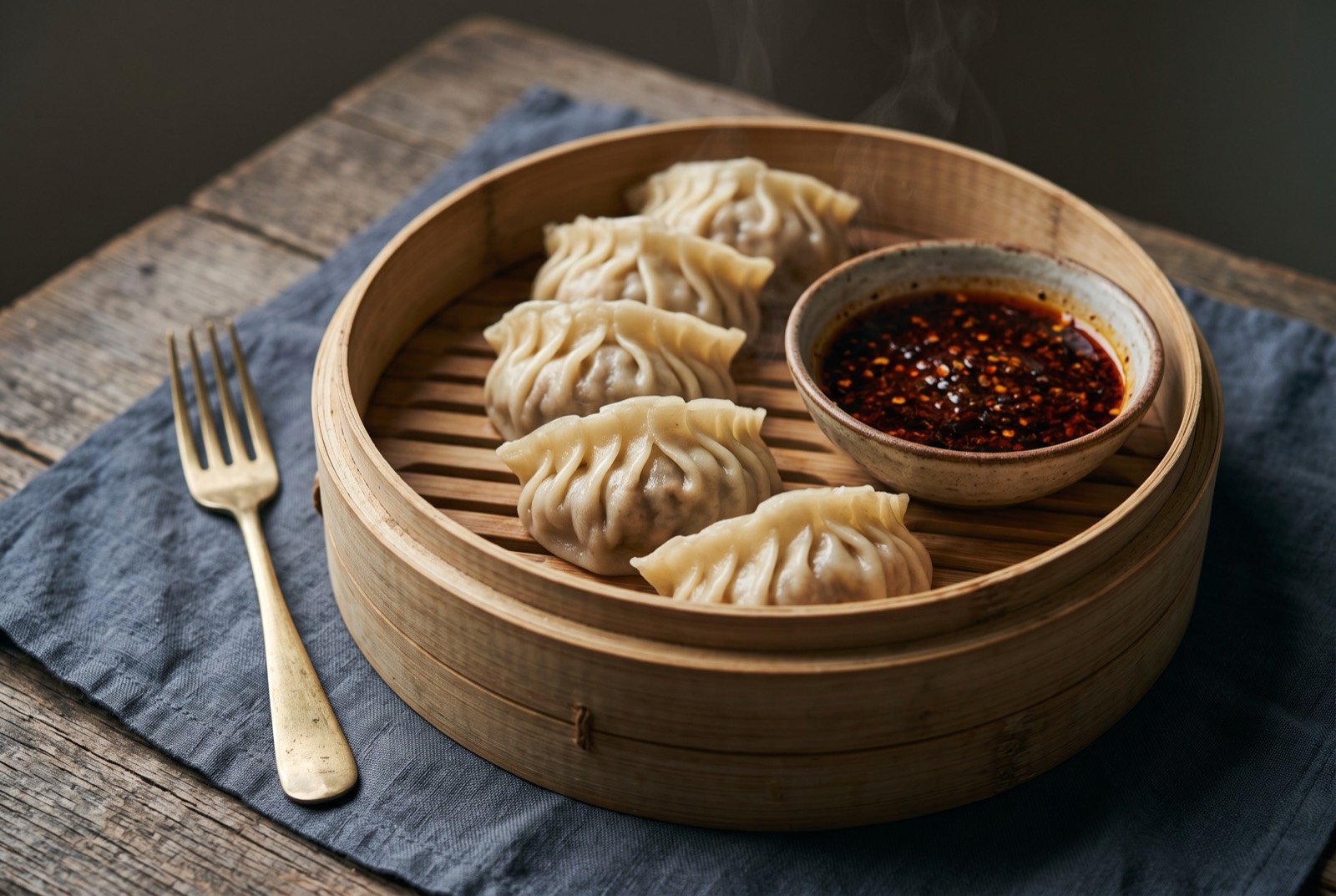
The pan-Himalayan dumpling, claimed and cooked from Tibet through Nepal, Bhutan, Ladakh, Sikkim and Darjeeling alike, has become, almost by accident, the international shorthand for "food from this whole region," which is exactly why it belongs here rather than in any single sub-chapter: this is its home volume, and the good version and the bad version differ by a small number of controllable decisions, not by mystery.
As tradition built it
Makes about 20 dumplings. About 1 hour, plus resting.
Ingredients
For the dough
- 300 g plain flour
- about 150 ml water
For the filling
- 400 g minced meat (buffalo, mutton, chicken or pork, all traditional depending on place and community)
- 1 small onion, finely diced
- 2 tbsp grated ginger and garlic
- 1 tbsp soy sauce, or, more traditionally still, fermented soybean paste
- a small handful chopped coriander
- a pinch a pinch of timur
- to taste salt, to taste
- a splash a splash of water or stock
For the dipping sauce
- to taste tomato, garlic, chilli and timur
Method
The dough
- Make a plain dough from the flour and water, kneaded smooth, and rest it, covered, for at least 30 minutes, the rest relaxing the gluten enough to roll thin without tearing.
The filling
- Combine the minced meat with the diced onion, grated ginger and garlic, soy sauce or fermented soybean paste, coriander, timur and salt, working in a splash of water or stock until the mixture is loose and slightly wet rather than dry.
Shaping and cooking
- Roll the rested dough into small rounds, thinner at the edge than the centre, spoon in the filling, and pleat closed into the traditional crescent or round-topped shape.
- Steam over rapidly boiling water 8 to 10 minutes until the dough is translucent and the filling cooked through.
- Serve with the dipping sauce of tomato, garlic, chilli and timur, and, in Ladakh's Buddhist kitchens specifically, sometimes in a clear broth rather than dry.
What a modern chef changes
A precisely hydrated dough and a basted filling
Rung 1
Method
- First, hydrate the dough precisely, weighing water to flour at a fixed 50 per cent ratio rather than by feel, and roll each wrapper to a measured, even thickness with a pasta roller, edges thinned by hand afterwards, removing the single biggest source of variation between a good momo and a stodgy one.
- Second, build the filling around a proper stock reduction rather than plain water, a rich, gelatinous reduced bone stock folded through the meat cold so it melts during steaming and bastes the filling from within, the same soup-dumpling logic used elsewhere in the wider region applied honestly to a Himalayan filling.
- Third, finish a portion of the batch not by steaming but by pan-searing the base after steaming, a hot, dry pan for the last 90 seconds, for a textural contrast between soft top and crisp base within the same dumpling.
- Fourth, make the dipping sauce's chilli oil from scratch with fresh, not dried, dalle khursani where obtainable, infused slowly at low temperature to preserve its fruit character rather than only its heat.