Asia · Volume 24
The High Himalaya
Nepal, Bhutan, Ladakh, Sikkim and Darjeeling
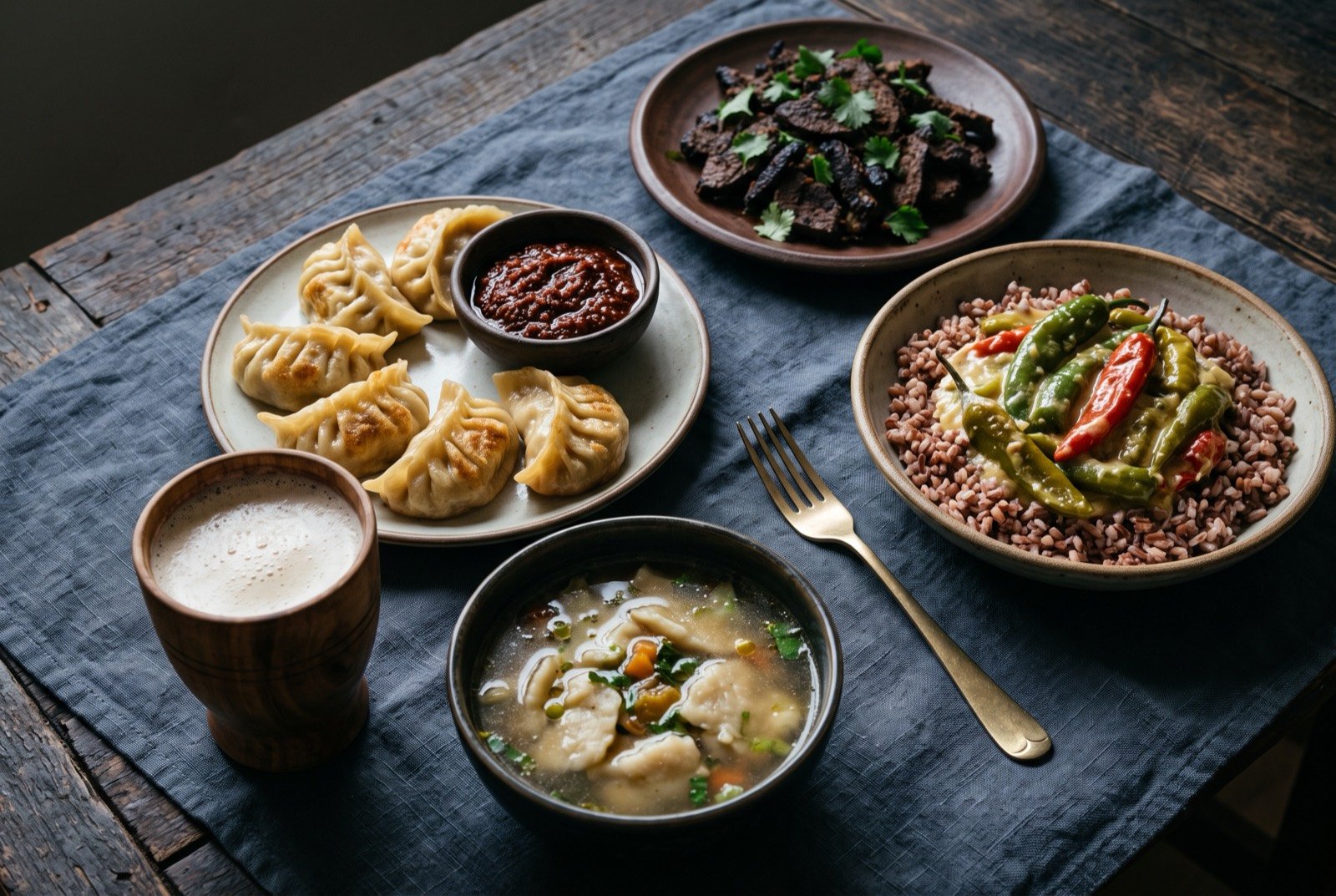
Nepal, Bhutan, Ladakh, Sikkim and Darjeeling, taken seriously. Not one Himalayan culture behind one label, but a border-crossing ecology, an altitude line where rice gives out and barley and buckwheat take over, a yak-dairy culture and a Tibetan Buddhist ritual calendar, that argues for one chapter more than any political map does, and this chapter says plainly where that argument is weaker than it looks, and every dish as tradition built it, then what a modern chef would change.
Sources and review · What this chapter does not assert · How we research · Spotted something wrong?
A Sense of Place
Altitude is the organising fact. In the Kathmandu Valley, at roughly 1,400 metres, rice paddies terrace the hillsides and a Newari feast table can run to two dozen dishes. Climb into Ladakh's Indus valley, above 3,000 metres and often much higher, and rice becomes an import carried in by truck; what actually grows is barley, alongside a scattering of vegetables coaxed through a short, brutal growing season, and the food is built around what keeps: dried meat, dried apricot, fermented bread, churned tea. Bhutan sits in between geographically and does something unusual with it: its river valleys, Paro, Punakha, Wangdue Phodrang, are low enough and irrigated well enough to grow a red japonica rice that was the country's staple for centuries, while its higher districts fall back on buckwheat, the same grain Sikkim and Darjeeling's Bhutia and Lepcha communities depend on. Sikkim and Darjeeling are not one ecology so much as one migration history laid over two different ones: Darjeeling is a hill district of Bengal, administratively nothing like Sikkim, but both were populated from the nineteenth century onward by the same wave of Nepali-speaking hill migrants, brought in as labour for tea and, in Sikkim's case, for terraced agriculture generally, so that a Nepali-Gorkha food grammar, dal bhat, gundruk, sel roti, sits over both places regardless of the line on the map between them.
What actually structures a kitchen here, more than any single staple, is what the terrain will not allow. Above the tree line there is no reliable source of green vegetable through the winter, which is the entire reason gundruk and sinki exist: greens fermented and sun-dried in the autumn glut become the sour backbone of a winter soup months later, in Nepal's hills, in Sikkim, in Darjeeling, wherever the same problem recurs. There is no reliable source of fresh dairy beyond what a yak or a chauri, a yak-cattle hybrid, will give, which is why butter turns up everywhere not as a garnish but as a structural ingredient, churned into tea in Bhutan as suja, in Ladakh as gur gur cha, pressed into a hard travelling cheese as chhurpi or datshi. And there is, in Bhutan specifically, a genuine and slightly absurd contradiction: a nation whose defining dish treats chilli as a vegetable, eaten by the fistful rather than the pinch, cannot actually grow enough of it, and imports the shortfall from India, a fact Bhutan's own press covered honestly when a 2016 pesticide scare briefly banned those imports and, in the words of regional reporting at the time, left the country facing "a bland new year" before the ban was quietly reversed within months.
Peoples, defining logic, dishes that carry it
| People or place | Defining ecological logic | Dishes that carry it |
|---|---|---|
| Nepali hill and Terai Hindu majority | Twice-daily dal bhat as the everyday grammar; caste governing who may share rice and dal with whom | Dal bhat tarkari, achar in its many forms |
| Newar of the Kathmandu Valley | Rice-wealthy valley agriculture; guthi trusts financing an elaborate feast calendar; Buddhist-Hindu syncretism inside one caste system | Samay baji, choila, bara, kwati, juju dhau |
| Kirat hill peoples, Rai and Limbu, eastern Nepal | Non-salted fermented soybean protein, independent of the dairy line further west | Kinema |
| Bhutia of Ladakh, Sikkim and historically Bhutan | Tibetan-descended, barley and yak-dairy diet, churned butter tea as daily ritual | Skyu, chutagi, thenthuk, gur gur cha/suja |
| Lepcha of Sikkim | The valley's oldest documented inhabitants; forest-foraged, river-fish, markedly less spiced than their Nepali or Bhutia neighbours | Phapar, Ningro Churpi |
| Bhutanese, across ethnic lines | Chilli treated as a vegetable eaten in volume, not a spice used in pinches; a slaughter ban that outsources the killing of the meat the country eats a great deal of | Ema datshi and the wider datshi family |
| Nepali-Gorkha of Darjeeling and Sikkim | Brought in as nineteenth-century tea and agricultural labour; carried hill Nepali food into a new territory as the working food of the tea gardens | Dal bhat, gundruk, sel roti, momo, all transplanted rather than native |
The History in Layers
The deepest layer is ecological rather than political: a barley and buckwheat line running along the high Himalaya, a rice line running through the valleys below it, and a yak-dairy culture occupying whatever the altitude will not grow grain on. On top of that sits Tibetan Buddhism, which reached this whole belt not as one event but as a long, repeated diffusion: into the Kathmandu Valley early enough that Newar Buddhism developed its own distinct, syncretic form alongside Hinduism, sharing one caste system rather than opposing it; into Ladakh, Sikkim and Bhutan as part of the same broader Tibetan cultural sphere, at dates the sources this chapter drew on could not pin down consistently, one account placing the Bhutia arrival in Sikkim in the fourteenth century and another in the sixteenth or seventeenth, a discrepancy worth naming rather than smoothing over. What travelled with the religion was a ritual calendar, Losar, Saga Dawa, Gunla, and specific ritual foods tied to it: khapsey and khuley at Bhutanese Losar, kwati specifically on the Gunla full moon in the Kathmandu Valley, samay baji built, dish by dish, to correspond to the five Buddhas.
Trade is the second force, and it is written most clearly into Ladakh's history. Leh sat on a genuine trans-Himalayan crossroads from as early as the second century BCE, per the scholarship of Janet Rizvi, a caravan hub trading Ladakhi grain against Tibetan wool and salt, a route that structured the whole region's food economy for two thousand years before it closed, abruptly and completely, after the 1950 Chinese annexation of Tibet and the 1962 Sino-Indian war shut the border for good. Nepal's own trade history runs differently: the Kathmandu Valley grew wealthy on its position between India and Tibet, wealthy enough to build the guthi system, land and endowments given to community trusts that still, in theory, fund the valley's feast calendar today, and wealthy enough that the Malla-era kings, Jayasthiti Malla foremost among them, could formalise an elaborate caste hierarchy with food sitting at its centre: who could accept boiled rice and dal from whom, which occupational castes handled meat, milk, oil and sweets, was fixed by royal ordinance and later hardened further by the 1854 Muluki Ain legal code under the Rana regime, which coded whole grains, millet among them, as markers of poverty and lower status, driving a slow abandonment of buckwheat and barley in valley kitchens in favour of rice.
Religion and ritual cut a second way in Bhutan specifically, and it is worth stating plainly because it is exactly the kind of contradiction the house style exists to notice rather than paper over. Vajrayana Buddhism in Bhutan does not forbid meat, and Bhutan eats a great deal of it, among the highest per-capita meat consumption in South Asia. But the country's constitution bans domestic slaughter outright: no animal may legally be killed on Bhutanese soil for food. The result, documented in peer-reviewed scholarship on religious nationalism in Bhutan, is that the meat is killed in India and imported dressed, worth some 858 million ngultrum in 2024 alone, a nation that will not kill its own meat but will, and does, eat it in quantity. The same tension shows up at smaller scale in Gross National Happiness's most concrete food-policy expression: Bhutan announced in the early 2010s that it would become the world's first hundred per cent organic nation by 2020. It did not. Only a small fraction of cultivated land carries formal organic certification today, and the deadline has been pushed, most recently to 2035. Both facts, the imported meat and the missed organic target, are worth stating together with the aspiration, not instead of it: this is a country whose food policy is genuinely shaped by Buddhist and environmental conviction, and one where that conviction has repeatedly run into a food system that cannot yet deliver what it promises.
Nepal's own modern moment is a diaspora story more than a colonial one; Nepal was never formally colonised, and its food history has instead been shaped by a long tradition of Gurkha military service abroad and, more recently, by labour migration to the Gulf and beyond. Commentator Sujeev Shakya has argued, in the Kathmandu Post, that Nepal's mid-twentieth-century opening to hotel tourism trained a generation of Nepalis in international cuisine and technique, technique that the diaspora waves of the 1990s onward then carried abroad and, increasingly, back home again; that momo has become the accidental global shorthand for "Nepali food" despite not being exclusively Nepali in origin; and that food has become a unifying identity marker across Nepali-speaking communities regardless of the passport they carry, Bhutanese-Nepali refugees among them. This chapter does not attempt to tell that refugee history in full: it touches Bhutan and Nepal both, it is genuinely significant, and it fell outside what this research pass could verify to the sourcing standard the rest of this book holds itself to, so it is named here as a real gap rather than either asserted without evidence or silently ignored. What is well evidenced is the effect on the food itself: dishes once coded as lekh, highland, poor, dhindo and gundruk chief among them, have been rehabilitated inside a generation into markers of urban and diaspora authenticity, the same globalisation loop playing out at home that it plays out abroad.
Darjeeling and Sikkim's modern layer is a plantation story. The British developed the Darjeeling tea industry from the late eighteenth century onward on Gorkha and Lepcha labour drawn from Nepal and Sikkim, and it was this same Nepali-speaking labour population, not the tea itself, that carried dal bhat, gundruk, sel roti and momo into the Darjeeling hills as the working food of the tea gardens. Darjeeling tea as an export commodity and Darjeeling's actual eating culture are, on the evidence this chapter could find, two largely separate stories that happen to share a place name, and this chapter treats them as such rather than inventing a tea-and-food pairing tradition that does not appear to exist.
The Flavour Arsenal
Seeds, pods and aromatics
| Ingredient | What it does |
|---|---|
| Timur (Zanthoxylum, Himalayan Sichuan pepper) | Wild-harvested from Nepal's Mahabharat range; a citrus-numbing lift specific to Nepali achar and choila, distinct from the Kashmiri or Deggi Mirch chilli powder a British cook may already reach for |
| Jimbu | A genuinely Himalaya-specific wild Allium, gathered at 2,500 to 4,500 metres, used dried; fried in ghee or mustard oil as a jhaneko tempering spice, the frying reversing the flavour loss drying causes; without it a Nepali dal simply reads as an Indian one |
| Jwano (ajwain/thyme seed) | Fried in ghee as the specific finishing tempering for kwati |
Ferments and preserved proteins
| Ingredient | What it does |
|---|---|
| Gundruk | Fermented leafy greens, mustard, radish leaf, cauliflower leaf, packed and fermented roughly a week with no added salt, then sun-dried; the sour backbone of a hill winter soup |
| Sinki | The same lacto-fermentation applied to radish taproot rather than leaf, pit-fermented 20 to 30 days |
| Kinema | Non-salted, Bacillus-fermented soybean, native to the Kirat communities of eastern Nepal, Rai and Limbu specifically, and carried by them into Darjeeling and Sikkim; a genuinely different microbiology from gundruk and sinki, worth keeping mechanistically separate |
| Chhurpi/churpi | Hard, acid-coagulated cheese from the skimmed milk left after butter extraction, dried or smoked for weeks, keeping for years; a Slow Food Ark of Taste product credited to Sikkim and Darjeeling specifically |
| Datshi | Bhutan's own back-slopped cottage cheese, made by heating the whey left after butter-churning until the casein coagulates; the base of the whole ema datshi family |
| Khambir | A fermented sourdough flatbread of the western Himalaya, leavened overnight, documented in peer-reviewed food-science literature for its higher fibre and lower fat and gluten content than plain wheat bread |
Chillies
| Ingredient | What it does |
|---|---|
| Dalle khursani / akabare | Nepal's lantern-shaped, habanero-heat chilli, the base of most serious Nepali achar |
| Bhutanese fresh chilli | Eaten as a vegetable in volume, not a spice in pinches; ema datshi's actual bulk ingredient, not its seasoning |
Starches and staples
| Ingredient | What it does |
|---|---|
| Rice | The valley staple in Nepal and lowland Bhutan; imported by the truckload the moment altitude rules it out |
| Buckwheat | The staple where rice fails, across Bhutan's high districts, Sikkim and Darjeeling's Lepcha and Bhutia kitchens alike |
| Barley (tsampa) | Ladakh's near-only reliable grain, roasted and ground, eaten unroasted-cooked with nothing but butter tea |
| Millet and maize | Nepal's hill dhindo grains, historically stigmatised against rice, now rehabilitated |
| Wheat | Ladakh's khambir and skyu dough, Bhutan's momo wrappers |
The Technique Ladder
Rung 1. Momo dough at roughly two parts flour to one part water, rested before it is rolled.
A plain dough, flour and water alone, needs the rest, thirty minutes minimum, to relax the gluten enough that a wrapper can be rolled thin at the edge and slightly thicker at the centre without tearing. That differential thickness is not decoration: it is what stops the finished dumpling reading, at the pleated seam, as a mouthful of raw dough, while keeping the base strong enough to hold a wet filling without splitting in the steamer.
Rung 2. Build the thukpa broth for hours, not minutes.
Chef Doma Wang, who trained in Kolkata cooking Tibetan-Sikkimese food from her own Kalimpong background, builds her broth on six goat trotters plus additional marrow bones, aiming for something "as flavorful as it is viscous." Chef Pema Gurung is blunter still: an hour-plus slow simmer of bone and meat is not optional, and "thukpa has to have broth," full stop, a direct rejection of any dry-noodle version calling itself thukpa. The mechanism is simple gelatine extraction, collagen breaking down slowly enough to thicken the broth's body rather than simply flavouring hot water, and it is the single clearest line between a proper bowl and a stock-cube shortcut.
Rung 3. Temper at the end, not the start.
Jhaneko, the Nepali tempering technique, blooms whole or ground spices, cumin, mustard seed, dried chilli, jwano, jimbu, briefly in hot ghee or mustard oil until they sizzle and perfume the fat, then pours the whole lot over a dal, soup or kwati that is already finished, as the very last step rather than a base the dish is built on. The logic is aromatic volatilisation timed for maximum effect just before the bowl reaches the table, the same underlying principle as an Indian tadka, applied here to a different aromatic vocabulary entirely.
Rung 4. Char first, spice hot, not cold.
Haku choila grills buffalo, or these days often mutton, chicken or duck, directly over an open flame, traditionally a rice-straw fire, until charred outside and still pink within, then slices it immediately and tosses it, still hot, with a raw garlic, ginger and chilli paste bloomed briefly in smoking-hot mustard oil with fenugreek. The paste blooms against the meat's own retained heat rather than being cooked onto it in a pan afterwards, a genuinely different mechanism from marinating cold meat and then cooking it, and the closest thing in this chapter's whole ladder to a modern flame-finish technique with an indigenous Newari ancestor rather than a French one.
Rung 5. Ferment gundruk and sinki with no added salt.
Both are packed and left to lactic-acid bacteria alone, Pediococcus and Lactobacillus doing the work unassisted, which is the real technical distinction from something like sauerkraut and the reason the finished flavour reads as sharper and more mineral than a salted ferment. Kinema, by contrast, is Bacillus-driven, a genuinely different microbiology producing a genuinely different, more ammoniated, natto-adjacent result; the three should never be treated as interchangeable "Himalayan ferments," because they are not doing the same chemistry.
Rung 6. Churn butter tea until it emulsifies, not until it is merely mixed.
Suja and gur gur cha are the same idea under two names, black tea, water, salt and butter, churned by hand in a tall wooden cylinder with a dasher, and the vigour of the churning, sustained well past the point where the ingredients have simply combined, is what actually emulsifies the fat into the liquid rather than leaving it floating. A blender will do this in twenty seconds; the traditional churn does it in several minutes of real work, and the resulting texture, a genuine emulsion rather than tea with melted butter on top, is the whole point of the dish.
The Ferment and Preserve Bench
1. Gundruk
Wilt mustard, radish-leaf or cauliflower-leaf greens for a day or two after harvest, then shred and pack tightly into an earthenware pot with a little warm water, no salt. Ferment roughly a week at warm room temperature, lactic-acid bacteria doing the work unassisted, then spread in the sun to dry fully for storage. The traditional sun-drying step loses the majority of the greens' carotenoid content, a real trade-off worth knowing rather than assuming the dried product retains everything the fresh leaf had.
2. Sinki
The same principle applied to radish taproot rather than leaf: shred wilted radish, pack it firmly into a warmed pit lined with bamboo and straw, weight it down under vegetation, boards and mud, and leave 20 to 30 days before sun-drying. A genuinely slower, more involved ferment than gundruk, and one this chapter could not find any UK retailer shipping, so a British cook wanting it will very likely need to make their own.
3. Kinema
Soak and boil soybeans until soft, then wrap warm in a cloth or leaf parcel and leave somewhere warm, traditionally near a hearth, for a day or two, Bacillus bacteria naturally present on the beans and in the environment doing the fermenting. The result is sticky, faintly ammoniated and distinctly different from gundruk or sinki's clean lactic sourness, a separate fermentation tradition specific to the Kirat communities of eastern Nepal that happened to travel, via those same communities, into Sikkim and Darjeeling.
4. Khambir
A wheat sourdough leavened overnight with either a commercial yeast or, traditionally, a buttermilk-based starter, then hand-flattened and cooked on a hot stone or dry pan. The starter culture, rather than any spice or fat, is doing almost all the flavour work here, and peer-reviewed food-science literature confirms the finished bread carries genuinely more fibre and less fat than a plain wheat flatbread.
5. Datshi and chhurpi
Two related but distinct techniques from the same starting point, milk churned for butter, its residual liquid heated until the casein coagulates. Datshi, Bhutan's fresh version, is used within days, soft and mild. Chhurpi, made across Sikkim, Darjeeling and Ladakh, is instead dried or smoked for weeks until rock-hard, made to keep for years rather than days, eaten as a slow, chewy snack as much as a cooking ingredient.
Sourcing in Britain
Timur and jimbu, the two ingredients this chapter would call non-negotiable, are both genuinely and easily available from UK Nepali specialists, Spice Mountain and Nepal Foods Online chief among them, and there is no honest excuse for a British cook to substitute them away. Dried dalle khursani chilli is similarly real, if sold in small packs that mean ordering more than one for a proper achar batch. Gundruk exists in the UK mostly as an instant soup base rather than the plain dried leaf; a determined cook will do better making their own. Sinki, by contrast, is a genuine gap: every retailer this research found ships from the US, Japan or India, none to Britain, and the honest answer is to ferment your own radish using gundruk's method.
Chhurpi is available as real human food, but only if bought carefully: the great majority of what a general search returns is chhurpi sold as a dog chew, a Western repackaging of what is, in the Himalaya, a human snack, and the correct move is to buy it from a Nepali grocer, The Rising Store among them, rather than the pet aisle. Datshi cheese is certainly unavailable, and every workable substitute, a UK food writer's own recommendation of American processed cheese for its melting behaviour, or a softer farmhouse cheese for something closer in spirit, is a genuine compromise and should be presented as one, never as an equivalent hiding in plain sight. Yak butter is equally unavailable; a rich, cultured, salted British butter is the standard, honestly-labelled substitute rather than an approximation invented for this chapter. Dried apricot offers a real and useful distinction rather than a flat gap: Hunza apricots, from Pakistan's neighbouring valley rather than Ladakh itself, are cheap and everywhere; genuine Ladakhi khubani exists and ships to Britain from one specialist importer at real import prices; ordinary sulphured Turkish apricot from any supermarket is the flattened, most different option of the three.
Nepal Foods Online and Your Kathmandu, both UK-wide online retailers, are the two most useful single sources across this whole chapter's ingredient list. Aldershot, widely known within the Nepali-British community as "Little Kathmandu" on account of its large Gurkha and Nepali population, is the strongest concentration of Nepali grocers and restaurants outside London, and Everest Cash & Carry there is worth a special trip for anything this chapter's online retailers do not stock. No dedicated Tibetan grocer, and no standalone Bhutanese or Ladakhi restaurant, was found operating anywhere in Britain in this research; Tibetan and Bhutanese cooking, for a British home cook, currently routes entirely through the Nepali grocers and restaurants this chapter names, a real and worth-stating absence rather than a gap to gloss past.
Voices and Sources
Chef Santosh Shah is the single most significant figure this chapter drew on, a Terai-born, London-trained chef, MasterChef: The Professionals winner and author of Ayla: A Feast of Nepali Dishes from Terai, Hills and Himalayas (Penguin, 2022), who has since returned to Kathmandu to open Mithila Thali, elevating his own Terai and Madhesi tradition rather than the Newari cooking this chapter's fine-dining research found comparatively undocumented in the capital. Nilza Wangmo of Alchi Kitchen in Leh, a Nari Shakti Puraskar recipient for her work preserving Ladakhi cooking, and chefs Padma Yangchan and Jigmet Disket of Namza Dining nearby, represent the strongest living documentation of Ladakhi tradition this research found, staffing their kitchens entirely with women in a region with, in Wangmo's own words, no tradition of male chefs. Suresh Sundas, the first Nepali-born chef named a James Beard Award finalist, and Aditya Mishra, whose Confit Duck Chatamari at his New York supper club The Sewing Tin applies French technique to a Newari base with exactly the deliberateness this atlas argues for generally, both represent the diaspora doing the elevation work this chapter could not find happening, yet, inside Nepal's own capital for Newari food specifically. Kathmandu Post food writers Thomas Heaton and Prashanta Khanal were, between them, the single most useful press source this research encountered, Khanal's own work on caste, commensality and the guthi system doing real scholarly lifting that a tourism-facing source never could. Academically, Per Löwdin's Food, Ritual and Society among the Newars (1985) and Mary Shepherd Slusser's Nepal Mandala (1982) are cited repeatedly at second hand throughout the sourcing behind this chapter as the two strongest scholarly texts on Newar food and culture; neither could be obtained directly within this research pass, and a future revision of this chapter should seek both out. Microbiologist Jyoti Prakash Tamang's scholarship on kinema, and the Slow Food Foundation's Ark of Taste listings for gundruk, chhurpi and Bhutanese red rice, all confirmed genuine and independently verifiable, anchor this chapter's ferment section.
Things this chapter has deliberately not asserted
- That ema datshi was invented for monks needing a warming dish. The story recurs identically across many tourism and blog sources with no traceable primary source, and is folk etymology rather than verified history.
- That skyu and chutagi are Slow Food Ark of Taste entries. Direct search of the Foundation's own site found no such listing, and the claim should not be repeated without further confirmation.
- That changkol and thuep are specific, verified Bhutanese Losar dishes. Found only in Western tourism aggregation, not corroborated against Daily Bhutan, Kuensel or Business Bhutan, neither of which this research could reach at all.
- That sel roti is verifiably eight hundred years old. The claim rests on a single uncited academic assertion.
- That kinema dates precisely to the Kirat dynasty, 600 BC to 100 AD. This is one microbiologist's hypothesis, not an archaeologically or textually settled fact.
- That King Jayasthiti Malla personally patronised juju dhau into existence. A repeated popular claim on Nepali Wikipedia with no primary source given.
- That a documented Newari technique-forward fine-dining scene currently exists inside Kathmandu. The research found heritage and cultural-show restaurants, and unpretentious neighbourhood bhattis, but no chef on record reworking samay baji, choila or kwati with modern method inside the city itself.
- That Bhutan, Sikkim or Darjeeling have a documented elevated-dining scene of their own. Bhutan's is effectively absent from reachable sources, and Sikkim and Darjeeling's most credentialled "Himalayan" chef, Doma Wang, cooks in Kolkata, not in either place.
- That Darjeeling tea is paired with or cooked into the region's food in any formal tradition. No evidence of this was found, and the tea economy and the eating culture appear, honestly, to be two separate stories sharing one place name.
- That this chapter's "shared Tibetan Buddhist high-altitude thread" describes a single, undifferentiated culture. It does not. Bhutan is a sovereign kingdom whose monastic body shapes national policy; Ladakh's Buddhist association describes Leh district specifically, not Kargil's substantial Muslim population; Sikkim's Nepali-origin majority outnumbers the Bhutia community outsiders most associate with its food by roughly seven to one; and Darjeeling is a hill district of West Bengal, not a polity at all.
The ecology and the trade history genuinely tie these five places together. A single living culture does not, and this chapter has tried not to pretend otherwise.
Volume AS-24, the first Himalayan volume of the atlas, Hidden Cuisines. Research briefs: AS-24-tradition.md and AS-24-modernist-sourcing.md. Sourcing verified September 2026.
Rung 1. Momo dough at roughly two parts flour to one part water, rested before it is rolled.
A plain dough, flour and water alone, needs the rest, thirty minutes minimum, to relax the gluten enough that a wrapper can be rolled thin at the edge and...
Rung 2. Build the thukpa broth for hours, not minutes.
Chef Doma Wang, who trained in Kolkata cooking Tibetan-Sikkimese food from her own Kalimpong background, builds her broth on six goat trotters plus additional...
Rung 3. Temper at the end, not the start.
Jhaneko, the Nepali tempering technique, blooms whole or ground spices, cumin, mustard seed, dried chilli, jwano, jimbu, briefly in hot ghee or mustard oil...
Rung 4. Char first, spice hot, not cold.
Haku choila grills buffalo, or these days often mutton, chicken or duck, directly over an open flame, traditionally a rice-straw fire, until charred outside...
Rung 5. Ferment gundruk and sinki with no added salt.
Both are packed and left to lactic-acid bacteria alone, Pediococcus and Lactobacillus doing the work unassisted, which is the real technical distinction from...
Rung 6. Churn butter tea until it emulsifies, not until it is merely mixed.
Suja and gur gur cha are the same idea under two names, black tea, water, salt and butter, churned by hand in a tall wooden cylinder with a dasher, and the...
The dishes
- Dal bhat tarkari Nepal, nationwide
- Choila Kathmandu Valley (Newar)
- Kwati Kathmandu Valley (Newar)
- Bara Kathmandu Valley (Newar)
- Momo Pan-Himalayan, Tibet through Nepal, Bhutan, Ladakh, Sikkim and Darjeeling
- Thukpa and thenthuk Pan-Himalayan and Tibetan, thenthuk specifically Sikkim's Bhutia community
- Ema datshi Bhutan
- Skyu Ladakh
- Butter tea, suja and gur gur cha Bhutan (suja) and Ladakh (gur gur cha), functionally identical to the wider Tibetan po cha
Sources and review
- Reviewed
- Not yet reviewed from inside the tradition
- Cooked
- Not yet cooked and reported
Where this volume comes from
3 research briefs on file for this volume, researched to the rules on How we research. Published 3 September 2026. Last changed 8 September 2026.
The brief's own account of its sources
Approximately 48 WebSearch queries and around 20 deep page-reads. Roughly 25 of the 48 searches (about 52%) were run in Devanagari Nepali script, covering dal bhat and achar culture, Newari dishes, history, regional variation, ingredients and the diaspora theme. Roughly half of those returned strong, directly useful local-language sources (onlinekhabar.com, setopati.com, ne.wikipedia.org, sahityasangraha.com, karobardaily.com, himalpress.