Asia · Volume 17
The Gangetic Plain, Uttar Pradesh, Bihar, Awadh and Jharkhand
The Sealed Pot, the Ember and the Roasted Flour
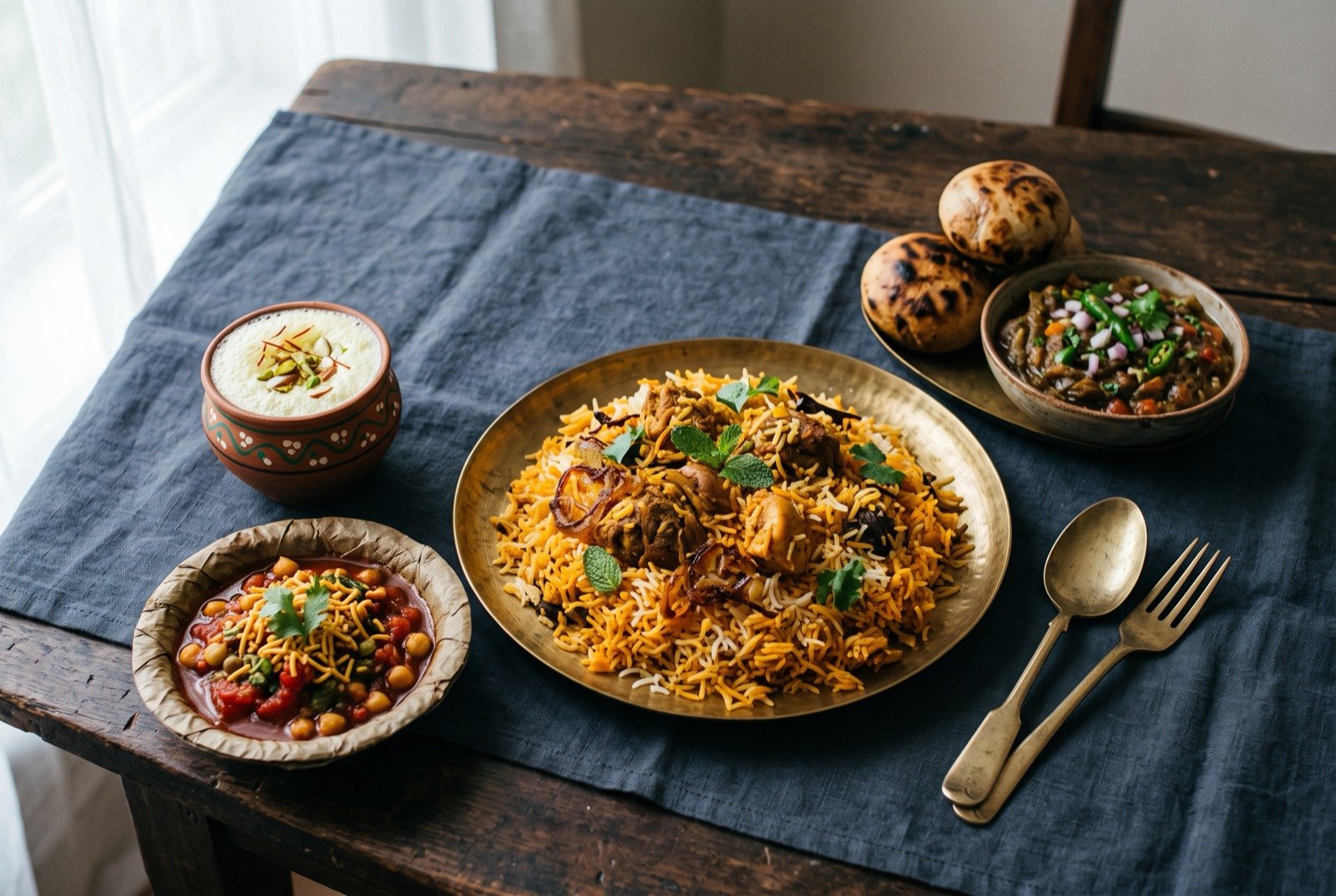
Three food worlds sit inside one river valley: a Persianate Shia court in Lucknow that sealed a pot with a rope of dough and called the sealed steam inside it a technology worth naming; Varanasi's own, differently syncretic table, a Hindu royal house employing Shia administrators; and, further east and south, Bihar's frugal, portable, roasted-flour cooking and Jharkhand's Adivasi forest cooking of forage and ferment, a plain and a plateau that never had a court at all. Every dish as tradition built it, then what a modern chef would change.
Sources and review · What this chapter does not assert · How we research · Spotted something wrong?
A Sense of Place
The Ganges does not carry one cuisine downstream. It carries a gradient. At Lucknow, roughly on the river's northern tributary the Gomti, the staple is wheat and the aesthetic is Persian court restraint. At Varanasi, further down the Ganges proper, the staple is still wheat but the frame is Shaivite pilgrimage and a fiercely vegetarian home kitchen sitting directly alongside a Muslim commercial quarter. By the time the plain reaches Bihar, rice has entered the rotation properly and the whole register of the cooking drops: this is not court food and does not pretend to be, it is the food of people who have had to make protein and calories go a very long way. And south of Bihar, where the plain finally gives out into the forested, mineral-rich Chota Nagpur plateau, the cooking stops being Gangetic-plain cooking altogether: it is Adivasi forest cooking, built on foraged mushrooms, fermented rice beer and roughly two hundred distinct indigenous foods that Jharkhand's own tribal communities can still name, even where fewer than half of them are still regularly eaten.
Awadh and Lucknow: a court that outlived its own kingdom
Awadh was founded in 1722 by Saadat Khan, a Khurasani merchant's son from Nishapur in Safavid Iran, who became the Mughal empire's semi-autonomous governor of a wheat-rich province and whose descendants ruled it as practising Shia Muslims over a population that was overwhelmingly Sunni Muslim and Hindu. When Nawab Asaf-ud-Daula moved the capital from Faizabad to Lucknow in 1775, he brought with him, and drew to him, the poets, musicians and cooks of a Mughal Delhi that was by then visibly collapsing. What resulted is usually called Mughlai food in English-language writing, and that is not quite right: Awadhi cooking is consistently described, by its own historians, as lighter, more restrained and more deliberately Persian in flavour architecture than the court cuisine it grew out of. Korma uses fried onion paste and yoghurt and no turmeric; kaliya, its close cousin, uses turmeric and raw onion paste and was refined in Lucknow's kitchens into a version finished with real gold leaf. The whole vocabulary, nazakat, nafasat, tehzeeb, delicacy, refinement, culture, describes food, manners and dress in the same breath, because in Lucknow they were never treated as separate subjects.
Varanasi: the same river, a different arrangement
Varanasi, Kashi, Banaras, is a Shaivite pilgrimage centre whose home cooking has been sattvic, strictly vegetarian, for as long as anyone can document, and whose devotional life shapes the calendar of what is eaten and when as completely as Awadh's Muharram calendar shapes Lucknow's. It is also, and at the same time, a genuinely syncretic food city, using the same "Ganga-Jamuni tehzeeb" language Lucknow uses for itself, but built by a different historical mechanism entirely: a Hindu royal house, the Kashi Naresh line, employing a Shia Muslim family, descended from Maulana Syed Gulshan Ali of Najaf, as its chief administrators for four generations. Varanasi's own Muslim quarter, Dalmandi, named for its lentil traders, sits alongside the ghats and the temples as the city's other kitchen, not a separate city.
Bihar: the food of little fuel and less land
Bihar has the lowest per-capita income of any Indian state, a position that has worsened steadily since independence, and its defining ingredient, sattu, roasted and ground Bengal gram flour, exists specifically because it needs no fuel to prepare: mixed with water alone, it is a complete, portable, high-protein food, which is precisely why it has always been the food of farmers, labourers and the rural poor rather than a delicacy. Litti chokha, the state's own signature dish today, a sattu-stuffed wheat ball roasted directly in the embers of a wood or cow-dung fire, is Bihar's answer to the same fuel scarcity in a different form: a technique built around not needing an oven at all. Bihar's long history of labour out-migration, first under colonial-era indenture to the Caribbean, Fiji and Mauritius, now into Delhi and Mumbai, is the documented mechanism by which both dishes have travelled with people rather than staying at home.
Jharkhand: a plateau that is not Bihar wearing a different name
Jharkhand was carved out of southern Bihar on 15 November 2000, deliberately on Birsa Munda's birth anniversary, the tribal leader who led the Ulgulan revolt against British-era land seizure. That date was a statement: this state's identity is Adivasi identity, not administrative housekeeping. Roughly a quarter of Jharkhand's population is Adivasi against roughly a tenth of the Bihar left behind, the two states speak substantially different languages (Bihar's Bhojpuri, Magahi and Maithili against Jharkhand's Santali, Mundari and Kurukh), and the ecology could not be more different: Bihar's flat, ploughed Gangetic plain against Jharkhand's forested, mineral-rich Chota Nagpur plateau. Jharkhand's own food, foraged mushrooms, fermented rice beer, wild greens named in Mundari and Santali rather than Hindi, belongs to this chapter on its own terms, not folded into a generic Bihari voice.
A table of peoples, logic and dishes
| Region | Defining logic | The dishes that carry it |
|---|---|---|
| Awadh and Lucknow | Persian court restraint, dum pukht's sealed steam | galouti kebab, dum biryani, sheermal |
| Varanasi | Shaivite vegetarian home cooking beside a Muslim commercial quarter | tamatar chaat, malaiyo, kachori sabzi |
| Bihar | Frugal, fortifying, fuel-light cooking for farmers and migrant labour | sattu paratha, litti chokha, thekua |
| Jharkhand's Adivasi communities | Forest forage, fermentation and a distinct tribal ecology | dhuska, rugra, handia |
The History in Layers
Indigenous core. The single oldest textual anchor this chapter's research found for anything on this plain is Buddhist, not Mughal. The Pali Vinaya Pitaka's account of the Buddha's first meal after his enlightenment at Bodh Gaya, in the historical heart of Magadh, describes two merchants, Tapussa and Bhallika, offering him manthu, rice or barley flour worked into a ball with honey, which Buddhist reference sources describe as made from parched, ground grain, the same basic preparation as modern sattu. The fullest telling of that story is a later compilation, several centuries after the events it narrates, so this is fair to call the oldest surviving description of something functionally identical to sattu, located exactly in the region this chapter covers; it is not fair to call it proof of five centuries or more of unbroken practice since. Sattu's own popular association with the historical Magadh region, roughly the modern Patna-Gaya belt, is a real and widely held piece of regional identity, but this chapter treats it as exactly that, identity, not settled archaeology.
Trade and religious layers. Awadh's own defining trade layer is not goods but people: Persian and Central Asian cooks, poets and administrators, carried into Lucknow's court by the Nawabs' own Shia identity and by Mughal Delhi's collapse. The same broad Persianate current reached two other courts on this atlas's map by entirely separate routes and at entirely separate times, and it is worth being precise about the difference, because it is easy to flatten into one story that isn't true. Kashmir's Wazwan tradition has its own, much earlier point of contact: the fourteenth-century Persian Sufi saint Mir Sayyid Ali Hamadani is credited with bringing Persian and Central Asian cooks to Kashmir some six hundred years ago, well before the Mughal empire existed at all, let alone Awadh's eighteenth-century dynasty, and Kashmir's own Silk Route position kept that influence arriving independently for centuries afterward. Hyderabad's Nizami cuisine developed under a different, roughly contemporary successor dynasty that deliberately recruited its own cooks from across the Arab and Persianate world for its own court. All three courts, Awadh, Kashmir and Hyderabad, ended up with a recognisably shared vocabulary, dum-style sealed cooking, a specialist-cook hierarchy, the same reservoir of Persian loanwords, saffron and rosewater and dried fruit, because each independently drew on the same deep well, not because any one of the three learned it from the other. No source this chapter's research found claims or even suggests direct contact between the three; this chapter makes none either.
Varanasi's own religious layer runs on a different axis entirely: a Hindu royal house's employment of Shia administrators, rather than a Muslim court's patronage of everyone else, which is precisely why its own version of Ganga-Jamuni syncretism reads as the mirror image of Lucknow's rather than a copy of it. Bihar and Jharkhand's religious layer is quieter in this chapter's sourcing but no less real: Chhath Puja's sun-worship, four days of fasting and offering built around thekua and seasonal fruit, and, across Jharkhand's Santal, Munda, Ho and Oraon communities, a living Sarna and animist ritual calendar in which handia, the fermented rice drink, is not incidental refreshment but is bound, in the strongest sourcing this chapter found, into the Santal community's own creation story.
The colonial economy, and its two very different footprints on this one plain. Awadh's colonial history is a single sharp break: the British East India Company annexed the kingdom outright on 11 February 1856, on the stated grounds of misgovernance, though the more consistently cited real motive was Awadh's value as fertile land and as a market for British manufactured goods. Nawab Wajid Ali Shah was exiled to Calcutta, where he built a deliberate miniature Lucknow at Metiabruz on the Hooghly, taking his musicians, poets and, crucially, his dum pukht-trained royal cooks with him; because meat was too expensive to feed at Metiabruz's own reduced scale, those transplanted cooks padded their biryani out with large chunks of potato, which is the well-documented origin of Kolkata biryani's own defining feature. Bihar's colonial economy left a different, slower-burning wound: the Permanent Settlement of 1793, applied first and most completely to Bengal and Bihar, fixed zamindars as hereditary landlords owing a permanently fixed rent while stripping peasants of customary rights, a system widely credited by historians as one of the deep structural causes of Bihar's long-run poverty, a poverty that persists today in hard economic figures and that has driven well over a century of labour migration, carrying sattu and litti chokha with it.
The modern moment, stated plainly. In October 2025 Lucknow was named a UNESCO Creative City of Gastronomy, the second Indian city after Hyderabad, recognition that coverage consistently frames as honouring a living culinary culture still cooked in Chowk and Aminabad rather than a museum piece. Bihar, in the same period, remains India's poorest state by per-capita income, and Jharkhand's tribal communities are documented losing more than half of their own catalogued indigenous foods to market pressure and hybrid-seed promotion even as academic fieldwork works to record what remains. Handia itself sits at a genuinely live legal fault line: Jharkhand's excise law, inherited from a 1915 colonial statute, sets tight legal-sale limits on the same drink that sustains a documented, historically women-led household economy, and prohibition enforcement is applied, by several accounts, more strictly in areas with larger tribal populations than elsewhere. This chapter has tried to hold three genuinely different modern stories together rather than letting Lucknow's UNESCO recognition stand in for the whole plain.
The Flavour Arsenal
Seeds and pods. Mace, nutmeg and green cardamom, all three bought whole rather than ground, carry a disproportionate share of galouti kebab's identity, and this is a spice bench that rewards precision more than heat: this is Persian-influenced court cooking, not a chilli cuisine. Ajwain and kalonji season Bihar's savoury doughs, litti's casing and sattu paratha alike. Sesame and jaggery together, in tilkut and til ke laddu, mark the Makar Sankranti sesame-and-jaggery custom shared across North India, "eat sesame and jaggery, speak sweetly."
Leaves. Fresh coriander runs through nearly everything on this plain as a finishing herb rather than a cooked base. Sal leaves, stitched into a dona bowl, are Varanasi's own traditional serving vessel for tamatar chaat, a functional use of a forest leaf that also happens to be the same tree, Shorea robusta, whose roots host Jharkhand's rugra mushroom in a genuine ecological link this chapter did not expect to find between two of its four sub-regions.
Ferments and preserved staples. Sattu itself, roasted rather than fermented, is this chapter's central preserved staple, a no-cook, shelf-stable protein source built specifically for people with little fuel to spare. Jaggery, not refined sugar, sweetens Bihar's festival food and needs the same adulteration vigilance this atlas has already flagged for other volumes' unrefined sugars. Handia and mahua, Jharkhand's two indigenous ferments, get their own full treatment in the Ferment and Preserve Bench below.
Chillies. This is, deliberately, the least chilli-forward volume this atlas has yet written. Awadhi cooking is repeatedly and specifically described by the people who cook it as restrained rather than heavy or fiery, its heat carried by fresh green chilli in modest amounts rather than dried red chilli in quantity; even Bihar's more assertively flavoured dishes, chana ghugni and the various chokhas, lean on raw mustard oil's own sharp pungency for their bite rather than on chilli heat as such.
Starches and staples. Wheat, not rice, is the plain's dominant grain at its Awadh and Bihar ends, ground for sheermal, litti's casing, thekua and sattu paratha alike; basmati rice, grown further north and west, carries dum biryani specifically. Sattu is this chapter's own named staple, discussed at length above. Rugra, Jharkhand's foraged forest mushroom, functions as a genuine seasonal protein source rather than a curiosity, high in carbohydrate and protein, low in fat, and, remarkably, the subject of real pharmacological research into its immune and cardioprotective properties, entirely separate from its kitchen use.
The Technique Ladder
Rung 1. Seal the pot, and trust the steam you cannot see
Dum pukht names both a technique and, by extension, this volume's whole Awadhi half: partially cooked ingredients go into a heavy vessel, ideally thick clay or copper, sealed at the rim with a rope of wheat-flour dough pressed around the join before the lid goes on, so that nothing, not moisture, not rendered fat, not the spices' own volatile aromatics, escapes into the kitchen. Condensation on the sealed lid drips back onto the food throughout the cook, a genuine self-basting mechanism, and the pot then sits over very low charcoal with further hot coals placed on the lid itself, heat arriving from above and below at once. The often-repeated internal-temperature figure for this process, commonly given as 120 to 150°C, is an unverified figure recycled across hospitality blogs rather than anything measured and published, and this chapter does not repeat it as settled fact; what can be stated with confidence is the qualitative mechanism, trapped steam, self-basting condensation and concentrated aromatics, and the practical consequence, that a diner genuinely cannot tell from the plate whether the sealed step actually happened for the hours it needed to, which is precisely the complaint several of this chapter's own contemporary Lucknow sources make about the dish's own commercial imitators.
What a cook does with this rung. A domestic kitchen has no clay handi, but a genuinely heavy, tight-lidded cast-iron or enamelled Dutch oven, its own lid weight approximating the dough seal's function, gets close; where the lid does not seal perfectly, doubled heavy-duty foil pressed onto the rim before the lid goes on is the standard modern shortcut used even inside many Indian restaurant kitchens, not only as a home compromise. No Awadhi source recommends a Big Green Egg specifically for dum cooking; this chapter's own extrapolation, offered honestly as a plausible high-end adaptation rather than sourced tradition, is that a kamado run indirect, its ceramic body genuinely built for sustained, sealed, low heat, can substitute for the vessel's function if not its shape.
Rung 2. Tenderise with a live enzyme, then mince it fine enough to emulsify
Galouti kebab's whole technical achievement is textural: a minced kebab soft enough to eat without chewing, built from two things a written ingredient list underplays. Raw, unripe papaya contributes papain, a genuine, well-documented protease that breaks peptide bonds in muscle protein, and it must be unripe, since papain content drops sharply as the fruit ripens, which is real food science rather than folklore. Kachri, a dried, ground wild melon native to Rajasthan's arid tracts, is used the same way and contributes its own tart flavour besides, though no source this chapter's research reached could confirm kachri's specific enzymatic action with the same scientific citation papain enjoys; treat it as trade-tested rather than laboratory-verified. The second half of the technique is mechanical, not chemical: the meat is minced three times over, worked into something closer to an emulsion than a conventional kebab mix, which is what actually lets it hold together as a soft patty on a flat griddle rather than a grilled skewer.
What a cook does with this rung. A food processor's blade, run in short pulses rather than one long blitz, gets closer to a true emulsion than a butcher's mincer run once; work the tenderiser and spice paste in at least four hours ahead, not immediately before cooking, so the papain or kachri has real time to work before the heat denatures it. Fresh-ground, not pre-mixed, whole spice is the single biggest lever a home cook has that a hotel kitchen under time pressure routinely skips.
Rung 3. Cook the rice and the meat separately, and know which biryani you are making
Lucknow's biryani is pakki, cooked: both meat and rice are separately part-cooked before they are ever layered and sealed together, unlike Hyderabad's kacchi, raw, method, where raw marinated meat and raw soaked rice are layered together and the whole dish cooks for the first time under dum. This is the single clearest, most consistently corroborated technical distinction this chapter's research found between the two cities' biryanis, and it is worth being precise about, since the two methods demand genuinely different timing: rice parboiled to roughly seventy to ninety per cent doneness, meat separately browned and part-cooked in its own gravy, twenty minutes for chicken, up to forty for mutton, before the two are ever layered and sealed for a comparatively short final dum of twenty five to forty five minutes, far shorter than a meat-only dum pukht dish, precisely because both components arrive at the seal already substantially cooked.
What a cook does with this rung. Genuinely aged basmati, not merely "basmati," elongates on cooking without going sticky in a way fresher rice does not, and this is the single ingredient decision that most affects whether a home pakki biryani holds distinct, separate grains after its own dum or collapses into a rice pudding.
Rung 4. Roast in the ember, not the oven, and let the crust smoke
Litti is traditionally cooked directly on the embers of a wood or dried cow-dung fire, once the flame has died to ash-covered coal, turned repeatedly on all sides for seven to ten minutes until evenly browned and cooked through. It is this direct contact with a live coal, not baking, that produces the thick, deliberately smoky crust that defines the dish; where a cook is uncomfortable placing dough straight onto coals, a wire rack set just above them, still turned repeatedly, is the attested, slightly less direct alternative. A conventional oven, the standard modern adaptation everywhere this dish now travels, produces a real and edible litti; it does not produce this specific crust.
What a cook does with this rung. This is one of the rare places in this atlas where the reader's own high-end kit is genuinely closer to tradition than a domestic oven is, rather than an extrapolation from it: a Big Green Egg run at high, direct heat, fuelled with real lump charcoal, is producing actual wood-and-coal combustion, char and smoke, in a way no electric or gas oven can, and littis set directly on the grate near the coals, turned as the tradition itself specifies, come closer to the genuine ember-roast than any baking method this chapter's research found recommended.
Rung 5. Dress the mash raw, and let the roasting vegetable carry the whole dish
Chokha's entire technique is a discipline of restraint after one deliberate act of fire: the vegetable itself, aubergine, potato or tomato, is fire-roasted or boiled and then mashed, but everything added to it afterwards, onion, garlic, green chilli, coriander, a generous pour of raw mustard oil, goes in raw and unsautéed. The dish's whole flavour argument rests on the contrast between one cooked, smoky element and several sharp, uncooked ones, and cooking any of the raw components further, a common instinct in a Western kitchen trained to sauté aromatics before combining them, actively destroys what chokha is.
What a cook does with this rung. Resist the instinct to soften the onion or garlic first. Char the aubergine hard enough that it genuinely collapses, directly over a naked flame or a live coal bed rather than under a grill, since the smoke the skin picks up during that direct exposure is doing real flavour work the interior flesh alone cannot replicate.
Rung 6. Whip cold milk into a true foam, and judge it by the eye, not the almanac
Malaiyo's traditional method holds that saffron- and cardamom-scented milk, left outdoors overnight in winter, is transformed by the cold night dew into something that froths and aerates on hand-churning the following morning in a way it otherwise would not. No source this chapter's research reached actually tested or explained this mechanism against the far more mundane alternative, that any milk chilled overnight, dew or no dew, would froth more readily on vigorous churning than milk at room temperature; this chapter states the traditional practice as the traditional practice, and declines to assert a food-science claim about dew specifically that nobody has actually verified.
What a cook does with this rung. Whatever the dew is or is not doing, the aeration itself is a genuine, replicable mechanical process, exactly the emulsion-by-mechanical-aeration problem this atlas has already documented for Yemen's whipped hilbeh in AS-09: a stand mixer's whisk attachment, or a high-power blender's whisk function, run on chilled, saffron-and-cardamom-infused milk for several minutes, will produce real, lasting foam far more reliably than hand-churning alone, and a home cook judging success by the same standard malaiyo's own tradition already uses, has the foam genuinely lightened and turned pale, rather than merely looking stirred, arrives at a properly made dessert whether or not any dew was ever involved.
The Ferment and Preserve Bench
1. Handia
Jharkhand's fermented rice beer, made by fermenting de-husked, boiled rice with ranu, a starter tablet combining roughly twenty to twenty five different plant and herb ingredients, in earthen pots over roughly a week, reaching around 11 per cent alcohol in a documented finished batch, with measurable protein and carbohydrate content besides, so that it genuinely functions as food as well as drink. It is described in the strongest sourcing this chapter's research found as bound into the Santal community's own creation story, and is central to marriage, funeral and harvest ritual across the Santal, Munda, Ho and Oraon communities, historically a women-led household craft now sitting at a genuinely contested intersection of tradition, livelihood and colonial-inherited excise law.
2. Mahua
Fermented mahua flower, from the tree Madhuca longifolia, produces a distinct indigenous spirit, mahua liquor, used in the same communities' festivals and ceremonies, suppressed for most of the past century under British-era and post-independence excise policy that framed it as a dangerous tribal intoxicant. Mahua's own seed oil, separately, is a real cooking and skin-care ingredient across Jharkhand's tribal households, and its dried flower is ground into flour for festive fried breads, a plant whose whole economy runs through food, drink and ritual together rather than any one of the three alone.
3. Sheermal's yeasted dough
A genuine leavened ferment rather than a chemical rise, sheermal's milk-and-flour dough is given real proving time before baking, the yeast working against the dough's own richness of ghee, khoya and sugar rather than a plain lean dough, which is what gives the finished bread its soft, faintly sweet crumb rather than a dense, unleavened one. Covered in full at Dish 3 above.
Sourcing in Britain
Verified this research pass. Uttar Pradesh, Bihar and Jharkhand do not have the distinct, geographically legible UK retail footprint some other regions of this atlas enjoy: there is no "Little Bihar" the way Southall is Little Punjab or Wembley is a Gujarati stronghold, and this chapter states that absence plainly rather than inventing a shop cluster that does not exist.
The ranked list: what decides great from grim
- Mustard oil, a genuine legal grey zone, not guessed at. Pure mustard oil cannot legally be sold as a food in the UK: EU-inherited regulation caps erucic acid in foodstuffs at 5 per cent, and pure mustard oil naturally contains 22 to 50 per cent, which is why every bottle of "100 per cent pure mustard oil," TRS, Rajah and equivalents, is labelled "for external use only." UK South Asian food writers themselves, Hari Ghotra among them, document that the diaspora simply cooks with the external-use product regardless of the label. A genuine legal alternative exists: KTC's "Edible Mustard Oil Blend," 51 per cent mustard seed oil to 49 per cent rapeseed with an antifoaming agent, cleared by UK Trading Standards and currently sold at Morrisons, ASDA, Amazon UK and Veena's. For full pungency, the diaspora's own choice, TRS or Rajah's external-use oil; for a legally food-labelled product, KTC's blend, milder for the dilution.
- Sattu, correctly sourced from chana, not barley, and checked for rancidity. Bihar Khadi and Mithila Foods both sell explicitly Bihar-labelled chana sattu online; a declared protein content around 20 to 22g per 100g signals the genuine article, anything markedly lower suggesting dilution. No single Wembley, Southall or Tooting grocer could be confirmed stocking sattu by name in this research, though it sits within the general pulses range these stores routinely carry, a real gap named rather than papered over.
- Aged basmati specifically, for dum biryani. Daawat Traditional and Kohinoor are both reported to age their premium lines one to two years, stocked in UK Tesco and ethnic grocers; Tilda, the UK's best-selling brand, is positioned as the reliable everyday choice rather than the aged premium tier.
- Kachri, or an honest substitute, for galouti's tenderising step. QURA Organically Grown Kaachri Powder is genuinely buyable on Amazon UK, and several UK-facing listings state it substitutes for fresh green papaya paste in the same ratio, the more reliable UK route than sourcing genuinely unripe green papaya.
- Whole mace, nutmeg and cardamom, ground fresh, for the galouti bench specifically. Steenbergs and Real Foods both sell whole mace blades, carrying a markedly more intense aroma than the pre-ground form.
- Real jaggery, checked against adulteration, no sulphur dioxide, lime, phosphoric acid or bleaching agent. Niru, Fudco, Top Op's "Deshi Jaggery" line and Jay Brand are all named trustworthy on this basis, stocked through Veena's, Sattvic Foods, Indian Basket and Pandit UK.
- Handia and mahua, honestly named as two different UK stories. Handia cannot currently be bought in Britain and structurally cannot be, since its whole character depends on a live ferment drunk within days of brewing; no substitute preserves what actually makes it interesting, and this chapter does not offer a fake one. Mahua spirit, surprisingly, now can be bought: DesmondJi, imported via Maharaja Drinks; Six Brothers ("Mahura"), launching in the UK from 2025 via trade-press reporting not yet independently confirmed at retail; and Ma'hooah, mahua flowers imported but distilled at UK craft distilleries, a UK-made product on an imported raw ingredient rather than an imported finished spirit. Treat the mahua landscape as accurate for September 2026 and likely to date within a year.
Kit note
Sealing a dum pot at home is best done with a genuinely heavy, tight-lidded cast-iron or enamelled Dutch oven, doubled heavy-duty foil pressed under the lid where the fit is imperfect, the same shortcut used inside many Indian restaurant kitchens, not only as a home compromise. No Bihari, Awadhi or UP source recommends a Big Green Egg specifically for either dum biryani or litti; where this chapter suggests one, for litti's ember roast specifically, it is because a kamado's real lump-charcoal combustion is, unusually, closer to the genuine traditional method than a domestic oven is, not an atlas extrapolation dressed up as tradition, and this chapter has tried to be clear throughout about which is which.
What could not be verified
No UK physical Indian grocer in Wembley, Southall or Tooting could be confirmed by name stocking sattu, though it plausibly sits within their general stock; no UK bakery or grocer could be confirmed selling ready-made sheermal or thekua, both genuinely a from-scratch bake for a British kitchen; and no search in Hindi, Bhojpuri or Maithili was run for this sourcing thread specifically, which likely explains why no dedicated Bihari or Purvanchali UK grocer could be found by an English-language search alone, exactly the same honest limitation this atlas has already named for Yemeni grocers in Birmingham and South Shields in AS-09.
Voices and Sources
From inside the tradition, historians and named practitioners
- Abdul Halim Sharar, whose Guzashta Lucknow (1926) remains the closest thing to an in-tradition primary ethnographic source on the Nawabi kitchen this chapter's research could find, writing from inside Lucknow as a critique of its own post-1857 decline: "As any community or nation progresses, its diet is the most salient guide to its refinement."
- Rana Safvi, historian, whose essays on korma, kaliya and kebab history gave this chapter its clearest sourced technical distinctions, and whose conspicuous silence on the galouti origin legend, having discussed very similar toothless-Nawab stories elsewhere as legend, is the strongest single piece of scholarly scepticism this chapter's research found on that story.
- Ira Mukhoty, whose The Lion and the Lily (2024), worked from French rather than British colonial archives, argues against the caricature of the Nawabs as merely decorative gourmands.
- Sangeeta Bhatnagar and R.K. Saxena, authors of Dastarkhwan-e-Awadh, gathering "anecdotes and secrets long held by the descendants of the nawabs, talukdars, bawarchis and rakabdars" of Lucknow.
- Imtiaz Qureshi (1931 to 2024), the chef most responsible for dum pukht's twentieth-century commercial revival at ITC's Bukhara and Dum Pukht restaurants, who described his own working method plainly: "I have an andaz. I measure the ingredients in my palm, I know by instinct, by experience, whether what I am holding is enough, or if it is more or less."
Lucknow today
- Askari Naqvi, of Naimatkhana, on the failure mode of commercial dum pukht: "When you have a slow-cooked, dum pukht biryani in a restaurant, how do you know it's really slow-cooked? There are no guarantees."
- Sheeba Iqbal, of Aab-o-Daana: "After you have an Awadhi meal, you don't feel bloated because it's rich, not heavy."
- Rohit Joshi, executive chef at Oudhyana, the Taj Mahal Lucknow: "Heritage without evolution becomes static; evolution without technique becomes dilution."
- Sufiya Kidwai, a 72-year-old Lucknow home cook who keeps specific family recipes deliberately out of commercial circulation entirely.
- Atul Kesari, of Varanasi's tamatar chaat lineage: "Right from the recipe to the preparation, we religiously follow our Dadaji's way."
The academic backbone, Jharkhand
- Ghosh-Jerath and colleagues, whose 2020 Frontiers in Nutrition fieldwork among Khunti district's Munda community documented 194 distinct indigenous foods and gave this chapter its Mundari-language plant and food terms directly from the community itself.
- Roger Begrich, whose 2020 Cambridge University Press chapter on handia's political economy is genuinely first-rate scholarship on a subject this chapter could otherwise have treated as a curiosity rather than the contested, load-bearing livelihood question it actually is.
In Britain
- Aktar Islam, the two-Michelin-starred chef behind Oudh 1722 in Borough, London, the UK's clearest current statement of serious, technique-led Awadhi fine dining, though himself of Bangladeshi rather than Lucknowi heritage, a technical rather than an ancestral claim to this cuisine.
- Hari Ghotra, British-Punjabi food writer, on the honest reality of UK mustard oil labelling: naming plainly that the diaspora cooks with the "external use" product regardless of what the bottle says.
Things this chapter has deliberately not asserted
- That Nawab Wajid Ali Shah, or Nawab Asaf-ud-Daula, is definitely the toothless Nawab of the galouti kebab legend, or that the legend is historically accurate at all. The dates do not reconcile with Tunday Kababi's own 1905 founding, and no source consulted resolves this.
- The figure of "160 spices" for galouti kebab as verified fact. Repeated everywhere, enumerated nowhere.
- That dum pukht's Bara Imambara famine-relief origin story is a single, independently verified historical event, as opposed to a popular legend structurally echoed by a similarly attributed origin story for khichra.
- That Awadh is nihari's home. The strongest sourcing, English academic and directly searched Urdu alike, places its origin in Old Delhi; Lucknow's own century-old nihari tradition is real but a regional variant, not an origin claim.
- That thekua is a Varanasi dish. Every substantive source anchors it to Bihar and Chhath Puja; Varanasi eats it through the same shared eastern-Gangetic Bhojpuri festival culture that reaches into Bihar, not through a distinct local origin.
- Any direct historical contact or borrowing between the Awadh, Kashmir Wazwan and Hyderabad Nizami court kitchens. The sourcing found supports independent parallel development from a shared Persianate source, not mutual influence.
- The precise internal temperature of a sealed dum pukht vessel. The commonly quoted 120 to 150°C figure is unmeasured and repeated across secondary sites rather than published research.
- The actual food-science mechanism by which outdoor dew exposure, as against simple overnight chilling, produces malaiyo's foam. No source tested this; the traditional practice is stated as tradition, not as verified science.
- That sattu provably originated in the historical Magadh region as settled archaeological fact. What is real is the Vinaya Pitaka's account of a functionally identical food offered in the right place; that is not proof of unbroken practice across the intervening centuries.
- Precise taxonomic reconciliation between the species-level (Astraeus hygrometricus) and genus-level (Geastrum) identifications of rugra found across different sources.
- What, specifically, distinguishes Santal, Munda, Ho and Oraon handia recipes from one another. The available sourcing treats these communities' practices as closely related and largely describes them collectively; real community-specific distinctions may exist but were not found and are not invented here.
- That any UK Bihari or Purvanchali-specific grocer or bakery exists, or does not. Actively searched for in English, not found; a real limitation of English-language research into a community whose retail footprint, if it exists, may simply not have a significant English-language web presence.
Volume Four of the Indian subcontinent, Not Just Stew. Research briefs: AS-17-tradition.md and AS-17-modernist-sourcing.md. Sourcing verified September 2026.
Seal the pot, and trust the steam you cannot see
Dum pukht names both a technique and, by extension, this volume's whole Awadhi half: partially cooked ingredients go into a heavy vessel, ideally thick clay or...
Tenderise with a live enzyme, then mince it fine enough to emulsify
Galouti kebab's whole technical achievement is textural: a minced kebab soft enough to eat without chewing, built from two things a written ingredient list...
Cook the rice and the meat separately, and know which biryani you are making
Lucknow's biryani is pakki, cooked: both meat and rice are separately part-cooked before they are ever layered and sealed together, unlike Hyderabad's kacchi...
Roast in the ember, not the oven, and let the crust smoke
Litti is traditionally cooked directly on the embers of a wood or dried cow-dung fire, once the flame has died to ash-covered coal, turned repeatedly on all...
Dress the mash raw, and let the roasting vegetable carry the whole dish
Chokha's entire technique is a discipline of restraint after one deliberate act of fire: the vegetable itself, aubergine, potato or tomato, is fire-roasted or...
Whip cold milk into a true foam, and judge it by the eye, not the almanac
Malaiyo's traditional method holds that saffron- and cardamom-scented milk, left outdoors overnight in winter, is transformed by the cold night dew into...
The dishes
- Galouti kebab Lucknow, Chowk
- Awadhi dum biryani Lucknow
- Sheermal Lucknow
- Tamatar chaat Varanasi, Luxa Bazaar and Chowk
- Malaiyo Varanasi, winter only
- Litti chokha Bihar
- Sattu paratha Bihar
- Thekua Bihar
- Dhuska Jharkhand, associated with the Munda community
- Rugra curry Jharkhand's sal forests, foraged at the start of the monsoon
Sources and review
- Reviewed
- Not yet reviewed from inside the tradition
- Cooked
- Not yet cooked and reported
Where this volume comes from
3 research briefs on file for this volume, researched to the rules on How we research. Published 4 September 2026. Last changed 8 September 2026.
The brief's own account of its sources
Overall balance. Across both threads, roughly 125 to 130 distinct sources were consulted. The clear majority are Indian: national and regional Hindi-language press (Prabhat Khabar, ETV Bharat Hindi, Amar Ujala, AajTak, Newsgram), Urdu-language sources searched and used directly (Urdu Wikipedia across a dozen relevant articles, Jang Urdu, Dawn Urdu, Itihaas.ai's Urdu pages), Hindi and English Wikipedia (cross-checked rather than trusted alone), serious Indian heritage/journalism platforms (Sahapedia, three separate pieces citing named academic bibliographies; ThePrint; Scroll.