Asia · Volume 20
Gujarat and Maharashtra
The Merchant’s Thali, the Konkan Tide and a Kitchen from Persia
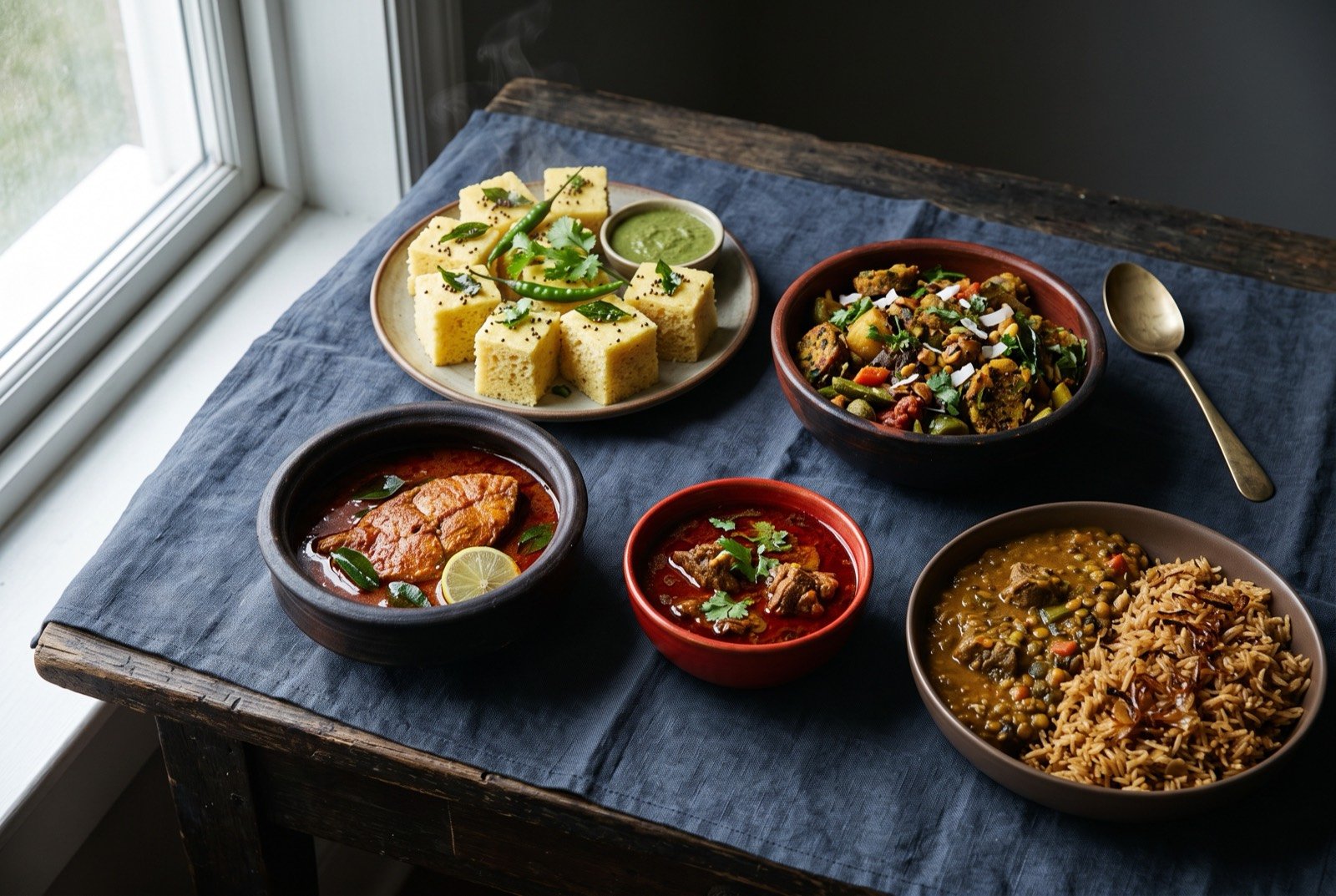
Four food worlds share two state borders here, and this chapter refuses to flatten any of them into the others. Gujarat's Jain and Vaishnav merchant table runs on besan, jaggery and a discipline of what may not be pulled from the ground. Maharashtra is not one cuisine but two: the Konkan coast grinds wet coconut and kokum against the tide, while the Deccan plateau inland roasts dry chilli and onion against the sun. And Bombay carries a fourth thread entirely, Parsi cooking, Zoroastrian Persia's own food, carried east by refugees more than a thousand years ago and reshaped twice, once in Gujarat and once again in the city that grew up around the community that kept it. Every dish as tradition built it, then what a modern chef would change.
Sources and review · What this chapter does not assert · How we research · Spotted something wrong?
A Sense of Place
Gujarat: four ecologies behind one merchant table
Gujarat is not one landscape. Gujarati sources themselves divide the state into four working regions: Kutch, isolated enough by desert and sea to have developed its own distinct food entirely, bajri rotla, mung khichdi, garlic chutney and buttermilk; Kathiawar, the Saurashtra peninsula, whose rural winter table of thick bhakri, garlic chutney and buttermilk is explicitly built as energy-dense sustenance for agricultural labour, and whose own undhiyu is deep red and far spicier than the coastal version; Charotar, the fertile central plain around Anand and Kheda, historically the state's richest agricultural belt; and South Gujarat, the coastal, trade-facing strip running Surat to Valsad, home to undhiyu's winter vegetable culture in its fullest form. Gujarat leads India in groundnut cultivation, roughly a quarter of the country's entire groundnut acreage, concentrated in Saurashtra and Kutch's dry-farmed interior, and that single agricultural fact is the whole reason groundnut oil, not mustard or sesame, is Gujarat's everyday cooking fat. The crop only became central after a farmer named Padambhai Patel began sowing it at Moti Marad village in 1905; before that, wheat and bajra held the ground.
Behind all four regions sits one social fact that shapes the cuisine more than any of them: a wealthy, historically dominant merchant caste, Bania or Vaniya, trading and moneylending its way to genuine civic power across centuries, generally Vaishnava or Jain, strict vegetarian, teetotal and orthodox in observing ceremonial purity, a community with a documented historic avoidance even of killing insects while cooking. Gujarat's unusually elaborate farsan (snack) and mishthan (sweet) culture is not decorative. It is what an urban, prosperous, food-conscious trading population sustains commercially over centuries when its religion gives it real reason to think hard about what and how it eats.
Jain and Vaishnav vegetarianism are not the same vegetarianism, and this chapter treats them as two distinct structuring logics rather than one shared rule with local colour. Jain practice runs on ahimsa, non-violence, taken all the way down: Jain cosmology holds that souls inhabit not only animals but plants, and microscopic organisms living in soil and water. Root and tuber vegetables, potato, onion, garlic, carrot, are avoided specifically because pulling one up kills the whole plant and the countless organisms in the surrounding earth, a genuinely different harm from picking a fruit or leaf, which the plant survives. A Gujarati source puts it in exactly these terms: this is the real reason Jains do not eat potato and yam. Eating after sunset is avoided too, since insects drawn to lamplight and cooking fire after dark are more easily killed by accident. A further rule, dvidal, holds that raw pulses should not be combined with fresh dairy, a fermentation and spoilage logic rather than an ahimsa one, and it sits in genuine, unresolved tension with a cuisine that pairs besan with fresh curd constantly, in kadhi, in khandvi, in dhokla batter. This chapter names that tension rather than pretending it away. Dairy itself is permitted in Jain practice, since milking does not kill the animal.
Vaishnav vegetarianism is devotional, not ahimsa-first. Food is prepared as an offering, bhog, to Krishna, then eaten as consecrated prasad. Gujarat's dominant form is Pushtimarg, the Path of Grace, founded by Vallabhacharya in the late fifteenth century; his successor Vitthalnatha toured Gujarat converting "many merchants, agriculturalists, and artisans," and the sect's Gujarati following concentrated specifically among the Bhatia, Lohana, Bania and Marwari trading castes, almost all of them urban. That wealthy devotee base funded Pushtimarg's temples, and the same mercantile diaspora later carried the sect first to East Africa, then to Britain.
| Jain | Vaishnav (Pushtimarg) | |
|---|---|---|
| Root logic | Ahimsa: minimise harm to all life, plant and microbial included | Bhakti: food as offering to Krishna, eaten as prasad |
| Root vegetables | Avoided | Generally eaten |
| Night eating | Avoided | Not restricted on the same grounds |
| Dairy | Permitted | Central, devotionally significant |
| Occasion | Personal, daily discipline | Communal temple offering, festival calendar |
A fourth Gujarati food world sits alongside these two, meat-forward where they are strictly vegetarian, and this chapter names it plainly rather than folding it silently into "Gujarati vegetarian food": the Dawoodi Bohra, or Bohri, community, a Gujarati trading population historically centred on Surat, whose own name comes from the Gujarati vohorvu, to trade. Bohri cooking fuses Gujarati technique with West Asian influence carried home along Gulf trade routes, kheema samosas, a dum-cooked biryani built on fried-onion yoghurt and shahzeera, eaten communally off a shared thaal platter with a strict no-waste ethic and opened, always, with something sweet.
Maharashtra: two ecologies, not one
Maharashtra reads as a single state and cooks as two genuinely different food worlds. The Konkan coast, the narrow strip running south from Mumbai through Raigad, Ratnagiri and Sindhudurg towards Goa, is pinned between the Arabian Sea and the Western Ghats: coconut palms and rice paddy on the flat land between hill and sea, a fishing economy worked from small ports, and a monsoon that dictates the whole cooking calendar, since fishing itself pauses in the roughest weeks and dried, salted fish carries the kitchen through. "Malvani" names the specific southern style around Malvan town, a cuisine and a community identity both. There is a real internal distinction worth carrying forward here too: Chitpavan, or Kokanastha, Brahmins are native to the coast itself, a genuinely different community from the Deshastha Brahmins of the inland Deccan.
The Deccan plateau, running from the Pune hinterland through Satara, Sangli and Kolhapur to drier Solapur and further east to Vidarbha around Nagpur, is dryland country: jowar and bajra millets rather than rice as the everyday grain, and a fiercer, more chilli-forward cooking than the coast ever needs to be. Kolhapur in particular holds its own named masala tradition and its own chilli cultivar, a food identity distinct enough to have its own reputation across India.
| Community/zone | Ecology | Fat | Starch | Souring | Aromatic base |
|---|---|---|---|---|---|
| Konkan coast | Coastal, monsoon-fed | Coconut oil, ghee | Rice | Kokum | Fresh wet coconut-garlic-coriander masala |
| Kolhapur, Deccan | Dryland plateau | Groundnut oil, ghee | Rice, jowar | Tamarind, kokum | Kanda-lasun (onion-garlic) masala, lavangi chilli |
| Wider Deccan (Pune, Vidarbha) | Dryland plateau | Groundnut oil | Jowar, bajra bhakri, rice | Tamarind, kokum, raw mango | Goda/kala masala (dagad phool, coconut, sesame) |
| Bombay Parsi | Urban port city | Ghee, oil | Rice, bread | Vinegar, dried fruit, jaggery | Dhansak masala, saffron, rosewater |
Bombay's fourth thread: Persia, by way of Gujarat
Parsi cuisine's actual origin sits outside the subcontinent's usual reference points entirely, and this chapter says so early rather than treating it as a Bombay footnote. It is Zoroastrian Persian cooking, carried east by refugees fleeing the Arab conquest of Persia, reshaped first across generations in Gujarat, and only much later again in the port city its community eventually made its own. It gets its own full treatment throughout this chapter, not a paragraph borrowed from someone else's history.
The History in Layers
Gujarat's deep roots go back further than most of this cuisine's English-language reputation suggests. The earliest documented ancestor of a dish in this chapter is dukkia, a pulse precursor of dhokla named in a Jain text dated to 1066 CE; the word "dhokla" itself first appears in the Gujarati text Varanaka Samuchaya, 1520 CE. A Gujarati history piece frames the dish's steaming technique as having made it "light, nutritious and easy to digest," which is exactly why it caught on "in Jain and Gujarati society" specifically: a steamed, oil-light preparation suited a community bound by strict purity codes. And a correction worth making plainly, since English-language writing gets it wrong constantly: khaman and dhokla are genuinely different dishes in Gujarati usage, not a Western conflation. Traditional dhokla is a rice-and-lentil batter; khaman is besan alone, lighter and softer. Gujaratis themselves distinguish the two; it is chiefly outsiders who collapse them into one word.
Gujarat's coast has traded since antiquity, Bharuch developing as a port under the Nanda, Maurya, Satavahana and Gupta periods, its textiles praised by Greek and Roman observers. Surat is the case that carries this chapter's cosmopolitan-trading-town argument. By the seventeenth and eighteenth centuries it was, by contemporary account, perhaps the single most important port city of the Mughal empire, trading with the Persian Gulf and the Red Sea, hosting English and Dutch trading factories and Armenian merchants, its population genuinely mixed, Hindu, Muslim and Parsi. The Jain merchant Virji Vora controlled the pepper trade there through the mid seventeenth century and financed European trading companies directly. And Gujarat's Jain merchant elite operated inside Mughal court culture, not outside it: Shantidas Jhaveri, a Jain jeweller and bullion trader, was Ahmedabad's wealthiest seventeenth-century merchant, court jeweller to Jahangir and Shah Jahan both, and became Nagarsheth, city chief, a title formalising the merchant class's role as intermediary between Mughal administration and the city, a position his family held hereditarily from 1732. No source traces a direct Mughal influence on Jain or Vaishnav vegetarian technique specifically; this chapter leaves that unresolved rather than inventing a lineage undhiyu's own pit-cooking method, most likely rooted in local South Gujarat earthenware tradition, does not obviously need.
Maharashtra's two histories run differently. No academic food history was found for Malvani cuisine's own development, a real gap this chapter states rather than smoothing over. What is well documented is the Deccan's commercial food history and the honest limits of its more romantic claims. Kolhapuri cuisine is commonly linked in tourism writing to royal patronage under the Kolhapur princely state, Chhatrapati Shahu Maharaj, who ruled 1894 to 1922, but no source gives a specific, sourced account of what was actually served in that kitchen, and this chapter presents the royal association as commonly asserted rather than documented. Vada pav and pav bhaji are genuine Bombay street-food inventions tied to the city's mill-worker economy, not Deccan home cooking, and this chapter keeps them there rather than presenting them as inland Maharashtra's domestic table. Vada pav is commonly credited to Ashok Vaidya, said to have started selling batata vada and poha outside Dadar station in 1966, a dish that later took on real political symbolism through its association with Shiv Sena and Marathi identity politics in Mumbai; this origin story circulates widely in Hindi and Marathi popular press but was not corroborated by any independent academic or archival source in this chapter's research, and is repeated here as the commonly told account, not verified history. Pav bhaji's invention is popularly tied to a cotton-supply disruption during the American Civil War of the 1860s, an oddly specific claim that likewise could not be corroborated and is flagged the same way.
A genuine correction belongs here, and it matters: sabudana khichdi is not ancient. Despite anchoring "traditional" Hindu fasting food today, sabudana, sago pearl, is not an old Indian ingredient. Tapioca arrived in India by Portuguese introduction to Kerala's Malabar coast in the seventeenth century; sago pearl processing as an actual industry is dated much later still, cottage manufacture in India specifically beginning around 1943 to 1944 in Salem, Tamil Nadu. Sabudana khichdi is therefore a nineteenth to twentieth century dish, adopted into fasting cookery only after tapioca's arrival, not an ancient observance. It joins this atlas's other quietly debunked "ancient" claims, and belongs squarely in this chapter's deliberately-not-asserted list rather than being written as old because it feels old.
Puran poli, by contrast, genuinely is old, and genuinely is shared, and this chapter treats it that way rather than picking a side. A reference appears in the twelfth-century Sanskrit encyclopaedia Manasollasa, written by the Karnataka king Someshvara, and a recipe under the name bakshyam appears in the fourteenth-century Telugu encyclopaedia Manuchariya; current practice spans Maharashtra, Gujarat, Goa, Madhya Pradesh, Karnataka and Telangana. Neither Maharashtra nor Gujarat has the older claim, since the dish predates either state as a modern political unit by centuries, and this chapter names both traditions in full rather than adjudicating a winner.
Parsi Bombay's history runs on a single chronicle, and this chapter is precise about what that chronicle can and cannot support. The primary source for the migration narrative is the Qissa-i Sanjan, a Persian-language verse chronicle composed in 1599 CE by the priest Bahman Kaikobad, several centuries after the events it describes. It is, per the historiography, the only surviving literary record of the migration, and the Parsi community generally treats it as broadly accurate, while professional historians flag real limits: composed centuries after the fact from oral transmission, three different migration dates proposed (716, 785 and 936 CE) because the chronicle's own internal chronology is vague, genuine scholarly debate over whether Sanjan or the island of Diu was the actual first landing, and evidence Zoroastrians may have had earlier contact with Gujarat than the narrative allows. This chapter follows the careful, deliberately wide framing, traditionally dated to around the eighth to tenth century CE, rather than asserting a single precise date the sources do not actually support. The chronicle's own most famous story, the migrants' leader responding to a local king's warning, a full bowl of milk, there is no room for you, by stirring in sugar without spilling a drop, we will sweeten your kingdom without displacing anyone, functions as the community's foundational self-image of assimilation without disruption, and is presented here as exactly that: the tradition's own story about itself, not documented history. A peer-reviewed genetics paper does independently corroborate the general outline, an Iranian-origin population settling in Gujarat with limited subsequent genetic mixing, biological rather than culinary evidence, but real, even where the chronicle's specific details are legend.
The development happened in two stages, and this matters directly for how the food actually tastes. Settling first in Gujarat, Parsis absorbed real Gujarati technique and ingredient logic over generations, Persian dried fruit, nuts, saffron and rice meeting Gujarati coconut, fish, meat and heavier spicing. Only later, as the East India Company grew Bombay into a major port, did significant numbers move to the city, where British and Portuguese contact added a further layer again, custard being the clearest surviving example. What survived the whole journey intact, and reads as genuinely Persian rather than absorbed en route, is the pairing of dried fruit and meat, apricot with mutton above all, alongside saffron and a vinegar-and-rosewater-forward souring quite unlike tamarind or kokum, and the khoresh, Persia's own slow-cooked stew of meat, fruit and a sour element over rice, standing as dhansak's direct structural ancestor.
The Flavour Arsenal
Gujarat
Besan, gram flour, is the backbone of this cuisine's savoury register, doing two entirely different jobs across the same ingredient: fermented and steamed, the dhokla family, or cooked to a paste and set, khandvi and kadhi. Sweet-sour-spicy balance is real, locally named and genuinely structural, not an outsider's cliché: Gujarati dal is literally called khatti meethi dal, sour-sweet dal, jaggery balanced against kokum or tamarind so that, in the phrase itself, none of the flavours dominate. A Gujarati source frames the sweetness as more than seasoning: in Gujarati life, sweetness is not confined to dessert, it is a symbol of emotion, celebration and hospitality, and many households do not consider a meal complete without something sweet at its end. This chapter does not, however, assert a specific historical reason sweetness entered the savoury register in the first place, merchant wealth, sugarcane abundance, a Mughal-era sugar trade moment are all plausible and none is sourced; the pattern is well corroborated, its origin story is not. Souring runs on kokum, tamarind, lemon and soured buttermilk depending on dish and season. Groundnut oil is the dominant fat, for agricultural reasons rather than preference alone. Vaghar, tempering, mustard seed, cumin, asafoetida, curry leaf and whole dried chilli bloomed in hot oil or ghee, is the connective technique running through nearly every savoury dish in this chapter.
Maharashtra
Kokum versus tamarind. Kokum, the dried rind of Garcinia indica, native to the Western Ghats, is the Konkan coast's default souring agent, used dried, as amsul or aagal, or as a soaked liquid or concentrate. Sindhudurg and Ratnagiri Kokum received India's Geographical Indication tag in March 2016. It is repeated everywhere that kokum suits coconut-based curries better than tamarind, though no scientific comparison of the two agents' chemistry was found anywhere in this chapter's research, and that claim is presented as received cooking wisdom rather than verified science. Wet masala versus dry spice is the Konkan's real structural distinction: a stored dry Malvani masala of fifteen or sixteen spices sits as background seasoning, while a fresh wet masala, grated coconut, garlic, coriander and green chilli, is ground to order and fried until the oil visibly separates from the paste, the step that actually gives a Malvani curry its body. Goda masala, the Deccan's sweet spice blend, is distinguished from generic garam masala by one specific inclusion, dagad phool, stone flower, a lichen, alongside cumin, coriander seed, clove, cinnamon, coconut, sesame and dried chilli, roasted until dark. Kanda-lasun masala, onion-garlic masala, is Kolhapur's own separate dry blend, built on browned onion and garlic rather than goda masala's sweeter, coconut-forward profile. Lavangi mirchi, the Kolhapuri chilli, is a small, fierce variety named in current Maharashtra produce-market reporting alongside Sankeshwari and Bedgi as one of the region's distinct commercial chilli cultivars, real evidence of a genuinely fiercer inland chilli economy than the coast's.
Parsi
The trinity tikhu-khatu-mithu, spicy-sour-sweet, built on brewed Parsi cane vinegar and jaggery as the two ingredients that finish and define Parsi savoury cooking, alongside the dhansak masala itself, cumin, coriander, fenugreek, cinnamon, cardamom, black pepper and dried chilli, roasted, plus saffron, rosewater, and dried apricot as the clearest surviving marker of direct Persian technique.
The Technique Ladder
Rung 1. Ferment the batter, and read it by its rise and its sour, not the clock
Dhokla's traditional batter, chana dal and rice soaked overnight and ground to a paste, is left to ferment a genuine minimum of four hours, traditionally six to eight or overnight depending on season, a wild lactic-acid and yeast fermentation exactly comparable in principle to idli or dosa batter, and it does two jobs at once: it leavens the batter, and it builds the characteristic sourness that gives khatta dhokla its name. By the 1980s, instant besan mixes and the chemical raising agent Eno fruit salt had replaced overnight soaking and fermentation for khaman entirely, no grinding, no waiting, just whisk, steam and temper, and khaman dhokla is now genuinely what most people eat, an estimated 10,000kg of it in Ahmedabad alone, daily.
What a cook does with this rung. Judge readiness by smell and rise, not by a fixed hour count: a batter that has genuinely doubled and carries a faint, distinct sourness has fermented properly, whatever the clock says, since real fermentation runs faster in a warm kitchen than a cool one. Eno is the honest modern shortcut, used by most households, including in Gujarat itself, and this chapter does not pretend fermentation is the only legitimate route, only the slower, more traditionally correct one.
Rung 2. Seal the pit, and judge it by the leaf, not the clock
Undhiyu's vegetables, small aubergine, surti papdi, fresh pigeon pea, potato, sweet potato and unripe banana, are coated in a fresh coriander-garlic-ginger-green chilli paste along with spiced muthia dumplings, packed into an inverted earthenware pot, a matla, and set into a dug pit with fire and coals built around and over it, cooking entirely on trapped heat and its own steam, no added water, minimal oil. In the Valsad tradition specifically, the pot's mouth is sealed with the leaves of a seasonal plant called kalhar, available only until February, whose fragrance is described in Gujarati reporting as so distinctive it transforms the flavour of every vegetable inside, a genuinely local detail this chapter found nowhere in English-language sourcing. No source anywhere gives a reliable clock time for the buried-pot method, only the mechanism, and this chapter states that honestly rather than inventing a figure.
What a cook does with this rung. A heavy, well-sealed lidded pot or a Dutch oven, lid weighted or wrapped, replicates the sealed, self-basting logic without a garden pit; judge doneness the way the tradition itself does, by aroma and by the vegetables' own give, not by a borrowed timer.
Rung 3. Grind the wet masala to order, and fry it until the oil breaks free
Malvani and wider Konkan cooking runs a fresh wet masala, grated coconut, garlic, coriander leaves and green chilli, ground to order for each curry and fried in oil specifically until the oil visibly separates from the paste, before the rest of the curry base goes in. This step, not the background dry Malvani masala, is what gives a properly made Konkan curry its body, and it is the clearest marker separating a curry cooked properly from one taking a shortcut.
What a cook does with this rung. A high-power blender closes most of the gap a stone grinder once filled; the fry, not the grind, is the part worth genuine patience, since an under-fried paste tastes raw and thin no matter how fine the grind behind it.
Rung 4. Roast the dry masala for colour, not just aroma
Goda masala's name, kala masala, black masala in Marathi, refers directly to the dark roast its component spices are taken to, cumin, coriander seed, clove, cinnamon, coconut, sesame and dagad phool, roasted until genuinely dark rather than lightly toasted. Kolhapur's own kanda-lasun masala runs the same logic with onion and garlic browned down alongside the dry spice roast.
What a cook does with this rung. A dedicated spice grinder is the right tool for both blends, built fresh from whole spice rather than bought pre-ground; roast in a dry pan over a moderate flame, watching colour rather than a stopwatch, since the difference between a properly dark goda masala and a merely toasted one is the whole difference between Maharashtrian dal tasting of Maharashtra and tasting of generic curry spicing.
Rung 5. Let dried fruit and vinegar do a khoresh's work
Parsi cooking's clearest surviving marker of direct Persian technique, rather than technique absorbed from Gujarat or coastal India along the way, is the pairing of dried fruit with meat, apricot with mutton above all in jardaloo sali boti, alongside a vinegar-and-jaggery-forward sweet-sour-spicy finish, tikhu-khatu-mithu, standing in for the tamarind or kokum souring this chapter's other three worlds all reach for instead. This is the khoresh logic, Persia's own slow braise of meat, fruit and a sour element, surviving essentially intact more than a thousand years and one migration later.
What a cook does with this rung. Treat the dried apricot as a structural ingredient, simmered into the braise long enough to soften and release its own sweetness into the sauce, not scattered on as garnish at the end; and finish savoury Parsi dishes with vinegar and jaggery stirred in specifically at the close, tasting for the three-way balance rather than any single flavour dominating, exactly the discipline the phrase tikhu-khatu-mithu names.
The Ferment and Preserve Bench
1. Dhokla and khaman's live batter
Covered in full at Dish 1 and Rung 1 above: a genuine, wild lactic-acid and yeast fermentation, judged by rise and sourness rather than the clock, standing behind the whole dhokla, khaman and handvo family. Handvo itself, rice and a lentil mix ground with curd and left to ferment overnight or a minimum of eight hours at roughly 25°C until visibly doubled, runs on exactly the same logic, and carries the same modern shortcut history: a besan-only "blind" (andhariyo) version, no soaking or fermentation, ready in about thirty minutes, mirrors khaman's own displacement of traditional dhokla.
2. Kokum, dried and as agal
Kokum, the dried rind of Garcinia indica, is preserved two ways across the Konkan kitchen: salted and sun-dried whole, amsul, for direct use in curries and dal, or reduced further to a concentrate, agal, the closer match for sol kadhi's own traditional flavour. Both are genuinely available in the UK (see Sourcing in Britain), and neither should be replaced with tamarind without saying so plainly, since tamarind gives sourness without kokum's faint purple colour and mild bitterness, a different flavour standing in for the real one.
3. Dhansak's caramelised rice
Not a preserve in the strict sense, but a genuine, deliberate technique worth its own note: dhansak's rice accompaniment is caramelised by browning sugar and onion together before the rice itself goes in, a controlled Maillard step rather than a simple pilaf, and it is this caramelisation, not the rice's spicing, that makes it dhansak's rice specifically rather than any other brown rice.
Sourcing in Britain
Verified this research pass, 4 September 2026.
The ranked list: what decides great from grim
- Kokum, dried and/or as agal. Nothing else gives sol kadhi and Malvani fish curry their specific sour-fruity, faintly bitter, pale-purple character; tamarind is a different flavour wearing the same job title. Genuinely available: Spice Mountain, The Asian Cookshop and Indian Basket all stock dried kokum, and Urban Platter's Kokum Agal (700ml, unsweetened) and Pandit UK's own agal are both real, current UK products.
- Fresh curry leaf, or failing that frozen, never dried. Mainstream UK retail is genuinely patchy here, Sainsbury's and Tesco both list small packs but stock is inconsistent by branch. The reliable route is a specialist South Asian grocer, particularly in Southall or Wembley, where curry leaves are typically sold fresh on the twig; this chapter cannot responsibly name one specific shop and vouch for its stock on any given day, and says plainly that a reader should go and look. Frozen keeps far more of the volatile aromatic character dried leaf loses within weeks, and dried should be treated as a last resort for the tarka technique this cuisine runs on, not an equivalent.
- Goda masala, genuinely bought or genuinely home-ground, never swapped for garam masala. Bedekar, a well-known Maharashtrian household brand, is stocked by The Indian Shop; Sara's Fresh Masale sells a UK-made version at £3.00; MH12 Foods grinds one to order. The toasted coconut and dagad phool at its core are what make Maharashtrian dal taste of Maharashtra rather than of generic curry-house spicing.
- Groundnut oil as the cooking medium, not a neutral vegetable oil. Well stocked under its "groundnut" or "peanut oil" naming (KTC, The Asian Cookshop's own line, Veena's collection); its faint nuttiness is part of the flavour base of Gujarati cooking specifically, and it is one of the cheapest, easiest authentic swaps available.
- Alphonso mango pulp (tinned) as a genuinely good year-round substitute for fresh. KTC, East End (via Ocado), Laila (Tesco), Natco and Heera all sell it, and Sous Chef, a specialist retailer well matched to this book's reader, stocks it too. For a cooked application, tinned pulp at peak-ripeness processing performs close to fresh; the real fruit, imported fresh roughly April to June by specialists such as alphonsomango.co.uk, is still worth chasing every year regardless.
- Jaggery, block rather than granulated "jaggery sugar." Its mineral, faintly smoky depth is doing real work in Gujarati kadhi and Maharashtrian dal, not just sweetness, work the more processed granulated form loses. Natco Kolhapuri jaggery, specifically marketed under the Kolhapur name, is a small but genuinely relevant provenance marker for this volume.
Kolhapuri chilli, and an honest approximation
Kolhapur's food culture runs on two named local chillies, lavangi (hot) and the milder, colour-giving byadagi, ground together into the region's dark red masala. Neither is separately sold whole under those names by mainstream UK grocers, and a reader wanting the authentic profile should either buy a ready-made Kolhapuri masala ('Ome Made Store and Kpra Foods both sell one) or approximate at home with Kashmiri chilli powder for colour cut with a smaller quantity of a genuinely hot chilli powder, bird's eye or cayenne, for heat, stated here as an approximation, not a claim that lavangi or byadagi themselves are obtainable.
Bombay duck, and the import history worth telling in full
Dried Bombay duck (bombil, dried lizardfish) is the genuinely Konkan ingredient, distinct from Sri Lankan Maldive fish, and carries a real, documented import history worth telling on the same footing as this atlas's katsuobushi note for Japan. Following a 1996 discovery of Salmonella-contaminated seafood exports from India, the European Commission prohibited fish imports from India except from EC-approved factories; because bombil is traditionally sun-dried in the open air rather than factory-processed, it was effectively banned. The ban eased after a UK campaign, a Birmingham merchant securing a Mumbai packing facility meeting the EC-approved standard, and dried Bombay duck returned to UK shelves by December 2000. The precise current, post-Brexit UK border-control regime for this product could not be independently confirmed; what can be confirmed is that it is currently sold, openly, by multiple UK retailers, The Asian Cookshop, Amazon UK, The Fish Society and Ceylon Foods Limited among them.
Parsi-specific sourcing, and a genuine, only partly resolved gap
Hunza apricots, from the Hunza Valley in Pakistan, are the closest UK-available match to the small, intensely flavoured dried apricot Parsi cooking depends on, genuinely widely sold, one Amazon UK listing specifically labelled "Jardaloo," the Gujarati and Parsi word for dried apricot. Vinegar is the real, unresolved gap. Dhansak traditionally uses a specific vinegar historically associated with Navsari, Gujarat, described in Parsi community writing as a closely guarded household secret without a precise commercial name reachable from the UK. Goan Coconut Toddy Vinegar, with the mother, organic and unpasteurised, is a genuinely close relative, the same fermented-palm-sap tradition, coconut rather than palmyra sap, and should be presented honestly as an approximation, not the real Navsari product, with a mild cane or malt vinegar as the fallback of last resort.
Kit mapping
The dedicated spice grinder is the right tool for goda masala and Kolhapuri masala both, whole-spice blends meant to be roasted and ground fresh. The high power blender is right for the wet coconut-and-chilli masalas underpinning Konkan curries, and for coconut milk extraction. The chinois earns its place straining sol kadhi and other coconut-milk preparations to a genuinely fine texture, and straining kokum pulp free of fibre. The dehydrator is a less direct fit than for a chilli- or fish-drying cuisine, but useful for drying fresh curry leaf or coriander at home for a longer-lasting, better-flavoured product than shop-bought dried leaf. Sous vide is not a natural fit for this volume's core stovetop dal, curry and steamed-batter techniques; its most plausible use, precise low-temperature cooking of dhansak's meat component or of patra ni machhi's fish before finishing, both offered above, is this atlas's own proposed elevation, not a documented traditional or restaurant technique. The Big Green Egg is the weakest fit of the reader's kit for this volume: none of this chapter's core dishes come from an open-flame or tandoor tradition, and this chapter does not manufacture a use for it that the research does not support.
Voices and Sources
From inside the tradition, in India
- Meera Sodha, born in Lincolnshire to Ugandan Asian parents of Gujarati and Parsi heritage, whose debut cookbook Made in India, Cooked in Britain (2014) is explicitly Gujarati- and Parsi-emphasis, and who has written The Guardian's weekly vegan column since 2017. The single clearest diaspora writer of this chapter's tradition, used directly rather than as a footnote.
- Anahita Dhondy, SodaBottleOpenerWala and author of The Parsi Kitchen (HarperCollins India, 2021), on dhansak, in her own words: "It's rich, nostalgic and full of zest, very much like my unshakeable community."
- Perzen Patel, "Bawi Bride," Mumbai, named India's Best Regional Food Blogger 2014 and 2015, the sharpest sourced voice this chapter found on why misrepresented versions of this food fail: on discovering Nigella Lawson's dhansak recipe contained tamarind and pomegranate seeds, absent from any traditional version, "Ask any one of the 120,000 Parsis alive and they will tell you that there's no way Dhansak looks like this!" It is her own correction, that lagan nu custard is traditionally served mid-meal, between the fish and rice courses, not as a closing dessert, that this chapter's Dish 9 draws on directly.
- Minal Patel, Prashad, Drighlington, near Bradford, Michelin Bib Gourmand since 2014, whose stated daily practice, grinding a fresh chilli-garlic-ginger paste per dish rather than holding a batch, and stirring garam masala in only near the very end so it infuses rather than cooks further, this chapter treats as the clearest concrete example anywhere of what actually separates a serious kitchen from a curry-house shortcut.
- Cyrus Todiwala OBE, Café Spice Namasté, London, born and raised in a Parsi family in Mumbai, in his own words on technique: "layer, experiment and have fun," and on tradition and innovation, choose a key ingredient, decide the dish, "then you look at how best to bring it closest to a traditional form of cooking and then the idea of giving it a twist."
- Munaf and Nafisa Kapadia, The Bohri Kitchen, Mumbai, Nafisa cooking entirely from family and community knowledge with no professional training. This chapter names honestly that most press coverage centres Munaf as entrepreneur-narrator rather than Nafisa as the cook actually holding the technique, a pattern worth naming rather than reproducing.
The gap, named plainly
No modernist or elevated restaurant anywhere in India was found dedicated to Gujarati vegetarian cuisine specifically, as its organising identity, comparable to what Masque or Ekaa do for pan-Indian ingredient cuisine. Repeated, direct searching found only excellent, unreconstructed heritage thali houses, Agashiye in Ahmedabad and Shree Thaker Bhojanalay in Mumbai, and isolated borrowed elements (khaman-dhokla, mango chunda) within otherwise pan-Indian tasting menus. This chapter states that gap plainly rather than papering over it with the nearest adjacent restaurant, while flagging honestly that this research pass ran entirely in English; a Gujarati-language search specifically for modern Gujarati vegetarian cooking was not run, and might overturn this finding if such a scene exists but is documented only in Gujarati press.
Things this chapter has deliberately not asserted
- A specific historical reason sweetness entered Gujarati savoury cooking. The pattern, jaggery and sugar balanced against sour and spice, is well corroborated; no source adjudicates between the plausible candidates for why.
- Precise, verified quantities and cook times for undhiyu's traditional buried-pot method. Every source describes the mechanism; none gives a reliable clock time, and this chapter's own recipe adapts the logic to a sealed pot rather than inventing a pit timing.
- Whether Gujarat's vedmi fills with chana dal or toor dal. Two sources gathered for this chapter directly contradict each other, and it remains unresolved.
- Which state, Gujarat or Maharashtra, holds the deeper claim on puran poli or on shrikhand. No source adjudicates either, and this chapter names both traditions without ranking them.
- A named, codified Gujarati spice blend equivalent to a regional garam masala, distinct from general tempering vocabulary. None was found.
- That vada pav was invented by Ashok Vaidya at Dadar station in 1966, or that pav bhaji followed directly from an American Civil War cotton-supply disruption. Both circulate widely in Hindi and Marathi popular press and rest on popular retelling rather than independent academic or archival corroboration.
- That misal pav originated in Kolhapur. No source found makes this claim with evidence; Kolhapur is named for the dish's intensity there, not for its invention.
- Sabudana khichdi as an ancient fasting food. It is a nineteenth to twentieth century dish, adopted into vrat cooking only after tapioca's Portuguese-era introduction to Kerala and the much later industrialisation of sago processing in India, from around 1943 to 1944.
- The Kolhapur royal kitchen's documented, specific historical role in shaping Kolhapuri cuisine, as opposed to a retrospective prestige association repeated in tourism writing.
- How the Jain dvidal (pulse-plus-dairy) rule practically reconciles with dishes that combine besan and fresh curd, kadhi, khandvi, dhokla batter among them. Sources describe the rule and describe the dishes; none reconciles the two, and this chapter has not resolved it by inference.
- The precise, dish-by-dish historical mechanism by which Parsi cooking absorbed Gujarati technique. Asserted at a high level across several sources, not documented at the level of specific dishes or periods.
- The traditional method for brewing Parsi cane vinegar. Its role and character are documented; the technique itself was not found in any source reached for this chapter.
- Any direct lineage between Parsi patra ni machhi and the Konkan coast's turmeric-leaf patoleo. They share a technique family and a coastal ecology, not a documented common ancestor.
- That any UK restaurant is currently organised around Konkan or Malvani cuisine as its stated identity. Actively searched for, not found, and named here as a real, current gap.
Not Just Stew, a volume of the Indian subcontinent. Research briefs: AS-20-tradition.md and AS-20-modernist-sourcing.md. Sourcing verified September 2026.
Ferment the batter, and read it by its rise and its sour, not the clock
Dhokla's traditional batter, chana dal and rice soaked overnight and ground to a paste, is left to ferment a genuine minimum of four hours, traditionally six...
Seal the pit, and judge it by the leaf, not the clock
Undhiyu's vegetables, small aubergine, surti papdi, fresh pigeon pea, potato, sweet potato and unripe banana, are coated in a fresh...
Grind the wet masala to order, and fry it until the oil breaks free
Malvani and wider Konkan cooking runs a fresh wet masala, grated coconut, garlic, coriander leaves and green chilli, ground to order for each curry and fried...
Roast the dry masala for colour, not just aroma
Goda masala's name, kala masala, black masala in Marathi, refers directly to the dark roast its component spices are taken to, cumin, coriander seed, clove...
Let dried fruit and vinegar do a khoresh's work
Parsi cooking's clearest surviving marker of direct Persian technique, rather than technique absorbed from Gujarat or coastal India along the way, is the...
The dishes
- Dhokla Gujarat
- Undhiyu Gujarat, South Gujarat especially
- Puran Poli / Vedmi Gujarat and Maharashtra
- Malvani Fish Curry (Mase Kalvan) Maharashtra, the Konkan coast
- Sol Kadhi Maharashtra, the Konkan coast
- Kolhapuri Mutton: Tambda Rassa Maharashtra, the Deccan, Kolhapur
- Misal Pav Maharashtra, the Deccan and Mumbai
- Dhansak Bombay, Parsi
- Patra Ni Machhi Bombay, Parsi
Sources and review
- Researched
- No outside sources linked
- Reviewed
- Not yet reviewed from inside the tradition
- Cooked
- Not yet cooked and reported
Where this volume comes from
3 research briefs on file for this volume, researched to the rules on How we research. Published 4 September 2026. Last changed 8 September 2026.
The brief's own account of its sources
Gujarat pass: roughly 40 web searches, close to half run directly in Gujarati script. Sourcing breakdown by claim-weight: roughly 40 to 45 percent local Gujarati-language and India-published, genuinely in-tradition (Gujarati Vishwakosh, Gujarati Wikipedia, TV9 Gujarati, ETV Bharat Gujarati, VTV Gujarati, Zee News Gujarati, Webdunia Gujarati, abtakmedia.com, and the IIM Ahmedabad Nagarsheth publication); roughly 25 to 30 percent credible English-language academic or serious press (Jainworld, cross-checked against Wikipedia; K.T.