Asia · Volume 21
Goa
The Convent Kitchen, the Temple Kitchen and the Toddy Tapper’s Coast
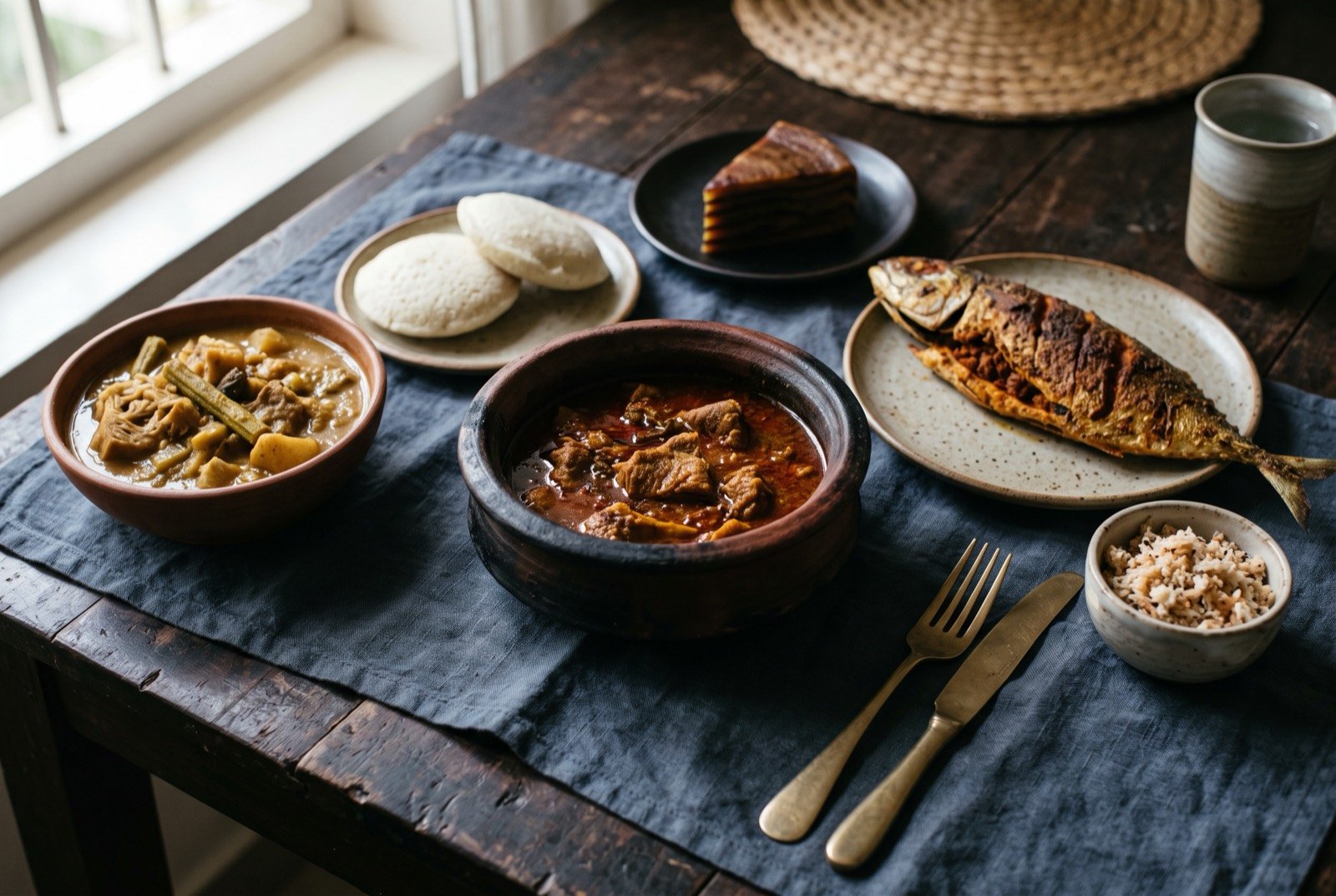
Goa taken seriously, not as one vindaloo-shaped idea of a place but two food worlds sharing one small strip of coast: a Catholic table built by four and a half centuries of Portuguese rule, souring with vinegar and leavening with palm toddy, and a Hindu Saraswat table that predates that rule and never stopped cooking through it, souring with kokum and tamarind and leavening with urad dal. English-language food writing collapses Goa into vindaloo; Goan food writing itself has been credibly accused, from inside the tradition, of collapsing Goan Hindu food into Saraswat Brahmin food alone. This chapter tries to do neither, and every dish as tradition built it, then what a modern chef would change.
Sources and review · What this chapter does not assert · How we research · Spotted something wrong?
A Sense of Place
Old Conquests, New Conquests, and why that line still matters
Goa's Portuguese-era administrative geography is not trivia, it is the reason the Catholic layer sits unevenly across the territory. The Old Conquests, Tiswadi, Bardez and Salcete, were taken first, around 1510, and carried the deepest and longest Portuguese cultural and religious imprint: this is where the Inquisition bit hardest, where conversion was most complete, and where pork, vinegar and the full kuswar sweet roster are most at home. The New Conquests, territories annexed later, in the eighteenth century, under a more relaxed religious policy, kept a stronger Hindu demographic and a shallower Catholic imprint. A chapter that treats "Goan Catholic food" as evenly spread across the state is already flattening something real; a North Goa Christmas kuswar platter and a South Goa one differ by more than seasoning, a point named source Geraldine Menezes makes directly below.
Two tables, one ecology
Both traditions cook on the same base: rice paddy on the coastal flats, coconut palms everywhere, kokum trees in the hill country, a monsoon that drenches the state from June to September and a fishing economy the whole coast depends on. What diverges is what each community does with that base. Catholic Goan cooking sours predominantly with vinegar, brought by the Portuguese and adapted using palm toddy vinegar in place of European wine vinegar; Hindu Goan cooking sours with kokum and tamarind, the older Konkan coast's own souring agents. Catholic cooking centres pork; Gaud Saraswat Brahmin cooking is pesco-vegetarian, eating fish routinely, a genuine anomaly among Brahmin communities that the tradition itself explains through a story about the sage Saraswat, fed fish by the Saraswati river during a drought so he could keep teaching the Vedas. Catholic households leaven with toddy; Hindu households, for the one dish both traditions share by name, sanna, leaven with urad dal instead, a divergence covered in full below because it is the single cleanest technical fact this chapter found for stating the whole argument in one dish.
The Gaud Saraswat Brahmins, and the trap of treating them as all of Goan Hindu food
Community tradition holds that Saraswats once lived along the banks of the vanished Saraswati river in north India and dispersed south in stages, one branch settling in Goa's Salcete, Tiswadi and Bardez talukas as Gaud Saraswat Brahmins, organised internally into Bardeskars, Pednekars and Sastikars by which taluka their families held. This is community-transmitted history rather than independently verified fact, and this chapter treats it as such. What is better documented is what the Portuguese Goa Inquisition did to that community from the mid sixteenth century: a 1546 order from King John III to destroy Hindu temples and suppress Hindu worship led to the destruction of over 350 temples by 1559 and a ban on private idol worship. GSB families crossed the Zuari river on a moonless night, carrying their deities, to resettle inland at Ponda under the protection of the Adilshahi, a Muslim kingdom, precisely because it sat outside Portuguese reach. The relocated temples, Shree Shantadurga at Kavlem and Shree Mangesh at Mangeshi chief among them, replicated the agricultural field system the community had managed on the coast, minus the khazan, reclaimed saltwater paddy, typology that no longer applied inland, and absorbed arches and domes from the Portuguese church architecture around them while keeping Hindu ritual spatial planning, a real, documented case of colonial-era architectural syncretism running in the opposite direction from the one usually told.
But "Goan Hindu food" is not a synonym for "Gaud Saraswat Brahmin food," and treating it as one is, per the Goan writer Malavika Neurekar, an active and specifically caste-inflected error rather than a neutral simplification. Neurekar, writing in the Joao-Roque Literary Journal, argues that Saraswat cookbooks such as Rasachandrika (1943) functioned partly to consolidate caste identity and endogamy against pan-Indian nationalist homogenisation in the run-up to independence, that Goan Hindu cooking is "systematically presented as synonymous with Saraswat Brahmin cooking," and names a specific "Saraswat Food Festival" where cultural categories were "open only to Saraswat Brahmins," an instance of what she calls the "culturalisation of caste." This chapter has to be honest about its own limits here: it can name the Bhandari community, traditionally toddy tappers and, per some sources, over 30 percent of Goa's Hindu population, who historically ran the cheap eating-houses that fed labourers "hot, spicy and meagre" food; it can name the Kunbi, among Goa's earliest settled agricultural communities, many of whom converted to Catholicism under Portuguese rule while others retained Hindu practice; it can name the Gomantak Maratha Samaj and the Daivadnya. What this chapter could not do, despite trying, is find a single specific Bhandari, Kunbi or Daivadnya dish name, technique or recipe documented in English by a source meeting this atlas's own standard. That absence is real, not a gap in this chapter's search effort alone, and it reproduces, in miniature, exactly the erasure Neurekar is naming. This chapter would rather state that plainly than quietly repeat the pattern under the cover of a token mention.
A table of communities, ecology and food logic
| Community | Souring | Fat | Centre of the festive table | Leavening | Ritual frame |
|---|---|---|---|---|---|
| Goan Catholic | Vinegar (toddy vinegar), tamarind alongside it | Coconut oil, some ghee | Pork: sorpotel, vindalho, chourico | Palm toddy (sura) | Feast/fast calendar: Lent, Christmas kuswar, Feast of St Francis Xavier |
| Gaud Saraswat Brahmin | Kokum, tamarind | Peanut oil in Goa, coconut oil among Karnataka Saraswats | Fish, rarely meat; strict vegetarian for priests and festival naivedya | Urad dal | Naivedya/prasada at Shantadurga and Mangeshi; Ganesh Chaturthi, Hartalika, Shravan |
| Bhandari, Kunbi and other Goan Hindu communities | Presumed kokum/tamarind, consistent with the wider coastal ecology | Not documented in English sourcing reached for this chapter | Not documented | Not documented | Not documented |
The History in Layers
1510 and the Old Conquests: what actually changed at the table
Afonso de Albuquerque took Goa in 1510, and the Portuguese held it, with two short British interruptions during the Napoleonic period, until India's 1961 annexation, 451 years, the longest single European colonial presence anywhere in South Asia. The Goan historian Fatima da Silva Gracias, of Dhempe College, is the strongest named source this chapter's research reached on what that rule actually did to the plate, and her account is precise rather than impressionistic: in 1736 "the Holy Inquisition issued a decree banning Christians from cooking rice without salt," because plain unsalted rice was "considered as habits of the gentios," non-Christians. Pork's non-consumption was, in her words, "at one time an offence punishable by the Inquisition." The Portuguese introduced potato, tomato, pumpkin, aubergine, cashew, chilli, papaya, passion fruit, pineapple, guava and oven-baked bread, and, critically, "sura (palm toddy) instead of the yeast in the process of fermentation," the documented root of the toddy-leavened bread and sannas tradition this chapter returns to repeatedly. Nuns of the Convento da Santa Monica are credited with introducing Portuguese recipes and creating the Indo-Portuguese fusion dishes directly, including sweets still served in some Goan Christian homes on festive occasions. And Gracias draws the line this whole chapter is built on: the Portuguese introduced vinegar "for adding flavour, provide a sour taste and as a preservative," and "Hindus and Muslims in Goa do not use vinegar in their cuisine." Vinegar is not a stylistic choice here. It is presented by a Goan historian as the marker that separates one Goan table from the other.
Vinha d'alhos to vindalho: the marinade that crossed an ocean
This atlas has already told half this story, in Volume EU-10, Portugal. Carne de vinha d'alhos, meat marinated in wine or vinegar with garlic, salt and paprika or chilli paste, is a Minho dish, still eaten at Christmas in Madeira, developed originally to preserve meat on long sea voyages, the wine's slow conversion to vinegar over weeks at sea doing the preserving work sailors needed. Portuguese traders reached Goa from 1510, and Goan cooks adapted the marinade using palm toddy vinegar in place of wine that could not be reliably shipped, folding in tamarind and Goan chilli. Gracias names vinha d'alhos alongside sarrabulho, cabidela and pork feijoada as Portuguese dishes genuinely adapted rather than exported wholesale, and the name itself corrupted cleanly through Konkani and English mouths across three centuries: vinha d'alhos to vindalho to English "vindaloo." No source found anywhere in either research pass disputes this etymology, unusually clean for a colonial food history claim, and this volume gives vindalho its full, twice-given treatment below; Volume EU-10 stays the Portuguese side of the story and is not re-treated here.
The Goa Inquisition, from the other side of the same event
The same institution that regulated Christian rice and made pork mandatory on the feast table destroyed, per standard historical accounts, over 350 Hindu temples by 1559 following a 1546 royal order, and banned private idol worship outright. The Goan GSB community's own math, monastic network preserves an internal migration record of what that meant in practice: Kavale Math, the oldest math of the Smartha GSB community, was destroyed under Portuguese rule in 1564, its swamis relocating to Varanasi, and the math itself was not revived in Goa, at Kavale, until 1630. Kashi Math and Gokarn-Partagali Math, the community's other two principal maths, both trace comparable displacement. This is not a footnote to the Catholic story, it is the same event, told from the side of the community it was designed to convert or displace, and this chapter treats the two histories as one history rather than as a main narrative with a Hindu appendix.
Vindalho reaches Britain
A secondhand digest of Gracias's Cozinha de Goa (2011), the single most important source this chapter's research could not access in full, states that the British first encountered vindalho during their 1797 to 1813 occupation of Goa and that Anglo-Indian communities in British India called it "Portuguese curry." This chapter could not independently cross-confirm that specific date in a second source and flags it as plausible rather than settled. What Gracias does state plainly, and what this chapter takes seriously, is that the Western and anglicised version of vindaloo familiar in Britain "often substitute[s] tomato ketchup, altering authenticity": the dish that gave a generation of British curry houses their hottest option on the menu is, by a Goan historian's own account, already a drift from what Goan Catholic kitchens actually cook.
Three contested attributions, named rather than settled
Xacuti's origin is genuinely disputed rather than merely under-researched. Portuguese-language sourcing (Portuguese Wikipedia's "Culinária de Goa," citing Cherie Y. Hamilton's Os sabores da lusofonia) labels it Hindu-influenced; sourcing from the Hindu side of this research describes xacuti as possibly pre-Portuguese and indigenous to the Konkan, eaten at festive occasions in "both Christian and Hindu" households alike. A widely repeated claim that it originated specifically in Harmal village, Pernem taluka, to warm paddy-field workers against monsoon colds, recurs across tourism-content sites with no named historian behind it and should be read as folklore. This chapter presents xacuti as shared or disputed, not as belonging to either community alone, reversing the assumption this volume started with.
Cafreal's origin in Portuguese Mozambique, "à Cafreal," Portuguese-era cafre referring to inhabitants of "Kaffraria" in southern Africa, brought to Goa by African soldiers under Portuguese service, rests on non-academic sourcing (a single Goa content site citing only its own affiliated domain) and could not be verified against a named historian in either research pass. Plausible, given the wider Portuguese Africa-Goa colonial network; not confirmed.
Prawn balchão's origin in Macau, also once Portuguese, carried to Goa via colonial trade, recurs across generalist food sites with no named historian behind it either. Flag as plausible, not confirmed.
The Flavour Arsenal
The souring line: vinegar against kokum and tamarind
This is the single technical fact that divides Goa's two tables, and it is worth stating as plainly as Gracias herself states it. Toddy vinegar, fermented from palm sap, souring and preserving vindalho, sorpotel, balchão, fish recheado and chourico, is Catholic Goa's structuring souring agent, a direct Portuguese introduction adapted to local materials. Kokum, dried Garcinia indica rind, and tamarind, sour Hindu Goa's fish curries, dal and solkadhi, the older Konkan coast's own agents, predating the Portuguese by however long the coast has been cooking fish in coconut milk. Both agents are genuinely well stocked in Britain, which matters, because a reader reaching for tamarind alone in a Catholic dish, or vinegar in a Hindu one, is not making a minor substitution, they are cooking the other tradition's food by accident.
Chilli, and the honest labelling problem
Chilli itself is a Portuguese-mediated New World import, per Gracias's own ingredient list, arriving in Goa through the same trade network that carried potato, tomato and cashew. The specific dried red chilli used across both tables for colour without excessive heat is sold in Britain as "Kashmiri chilli," and a specialist UK retailer's own educational copy admits plainly that "not all Kashmiri chillies are grown in Kashmir, some are also grown in Himachal Pradesh," with growers "in the Punjabi Region of India producing a harsher flavour and hotter heat." Treat "Kashmiri chilli" as a trade name describing a colour and heat profile, not a guarantee of where it grew, and check the ingredients list on a pre-ground product for cumin, coriander or salt cut into it.
Coconut, toddy and feni: one palm, three products
The coconut palm supplies this whole coast's cooking fat and its liquid medium, milk pressed fresh or bought as a creamed block, and, tapped rather than harvested, its sap gives Goa two more products entirely. Toddy (sura), the fresh fermenting sap, is Catholic Goa's leavening agent for bread and sannas, documented by Gracias as a direct Portuguese substitution for European yeast; it does not survive export and has no UK equivalent. Feni, cashew or coconut spirit, is its distilled cousin: cashew apple juice ferments roughly 72 hours, a first distillation in wood-fired clay-pot stills (bhattis) yields the milder urak, and a second distillation of urak with fresh juice yields feni proper, typically 40 to 43 percent ABV, bottled undiluted. Cashew feni received India's Geographical Indication tag in 2009, reported as the first Indian liquor ever to receive one, and the Goa state government separately named it the state's "Heritage Spirit" in 2016. Feni is explicitly Catholic-associated, used in sorpotel and chourico and drunk at Catholic weddings, but is not exclusively Catholic; cashew and coconut feni are drunk across Goan communities.
Tirphal and asafoetida: the two spices that mark a kitchen's tradition
Tirphal (Zanthoxylum rhetsa), a Sichuan-type pepper "commonly used in Konkani and Mangalorean dishes," gives khatkhate its distinctive tingling top note and is a genuine marker of Hindu Konkani cooking rather than the Catholic table. Asafoetida (hing) is repeatedly named as a signature Brahmin-kitchen staple, substituting for the flavour base onion and garlic would otherwise provide in dishes cooked without them for ritual purity, another clean marker separating the two traditions' everyday seasoning logic.
Fat: a real, unresolved discrepancy
Rachnakar's Parul Jauhari, a named Goan Saraswat food writer, states peanut oil is the more common cooking fat in Goan Saraswat kitchens specifically, with coconut oil preferred by Karnataka Saraswats, a genuine regional distinction within the wider Konkani Saraswat diaspora. A weaker, commercial comparative source claims Hindu Goan cooking generally favours coconut oil for "a lighter, more floral" result. This chapter does not resolve that discrepancy and states it as unresolved rather than picking a side.
The Technique Ladder
The argument, from inside
The clearest living statement of this chapter's whole argument, that Goan technique needs no imported method to reach a serious table, comes from Avinash Martins, of Cavatina and Table in the Hills in Velim, South Goa, ranked in India's Top 50 Restaurants (Condé Nast Traveller/Zomato). He has enrolled a cooperative of toddy tappers as suppliers: "Our food is linked to the toddy. I make my bread and cakes too using the toddy." He favours the imam dasta, mortar and pestle, "in the kitchen over the blender." He cooks Catholic, Saraswat and the food of Goa's Velip, Gawd and Kumbi tribal communities under one roof, a genuinely unusual scope: "Goan cuisine is a kaleidoscope of different flavours, textures, colours and cultures." Set against this, Gaggan Anand, not a Goan chef, has published a pork vindaloo that brines the belly twelve hours, vacuum-seals and cooks it sous vide at 73°C for twelve hours, presses it, re-vacuums it, reheats it sous vide at 60°C, then blowtorches and plates it with "goa cress." That is the imported-technique version this atlas argues against, named here as a contrast rather than a model: everything Martins does with toddy and a mortar, sous vide and a vacuum bag can also do, more slowly, less specifically, without ever touching the coast it claims to represent.
Rung 1. Roast, then grind: the technique that makes a curry taste of Goa rather than of generic India
Xacuti's whole technical identity rests on one move: coriander seed, cumin, cloves, cinnamon, fennel, nutmeg, poppy seed and dried red chilli dry-roasted in a heavy pan until each is individually coloured, then ground with roasted grated coconut into a paste, rather than ground raw as a wet masala.
What a cook does with this rung. Roast each spice separately over low heat, shaking constantly, judging by colour and smell rather than a clock, since no source consulted in either research pass gave a numeric roasting temperature or endpoint for any Goan spice roast; grind while still faintly warm in a dedicated spice grinder and use within a few weeks. This is the same principle that makes khatkhate's tirphal and the wider Konkani spice tradition specific rather than generic: roasting before grinding, not after.
Rung 2. Marinate in vinegar, and let time do what heat cannot
Vindalho's marinade is built to sit, not to flash-cook: garlic, chilli, vinegar and warm spices ground into a paste, worked into the meat, and left. No credible in-tradition source gives a fixed ratio or marination time for this, a genuine gap this chapter states rather than papers over with an invented number; what is consistent is that longer resting deepens both the acid penetration and the chilli's colour bleed into the meat.
What a cook does with this rung. Marinate overnight at minimum, in a non-reactive container, and cook the marinade itself into the dish rather than discarding it, since the vinegar's job is preservation and flavour both, not just tenderising.
Rung 3. Leaven with what the coast actually ferments: toddy against urad dal
Sannas is the cleanest single dish in this whole chapter for showing the technique divergence between the two tables, and it belongs here as much as in the dish list below because the ladder itself is built on it. Catholic households leaven with toddy (sur), fresh coconut-palm sap, producing an open, faintly sour crumb, and toddy-leavened sanna is specifically served at "marriages, birthdays, feasts, Holy Communions and other celebrations." Hindu households leaven with urad dal (black gram) instead, plus coconut water and coconut milk, a denser, coarser result closer to idli.
Modern practice on both sides has largely shifted from red (ukde) rice to white rice for speed, and toddy substitutes now include commercial yeast, homemade fermented coconut water, and, per one Goan source, even Sprite.
What a cook does with this rung. Where toddy is unavailable, a small quantity of fresh yeast plus a longer, cooler overnight ferment gets closer to toddy's real tang than a fast rise does; where urad dal is the leaven, soak it separately from the rice and grind the two together only once both have softened, for an even crumb.
Rung 4. Grind raw, never cook the paste before it goes in
Fish recheado's stuffing paste, Byadgi chilli for colour, a hotter chilli for heat, toddy vinegar, tamarind and warm spices, is ground raw and never cooked directly before it goes into the fish; it cooks exactly once, sealed inside the flesh as the fish fries.
What a cook does with this rung. Grind the paste to a smooth, thick consistency that will hold inside a slit rather than weep out, and fry gently enough that the fish cooks through before the exterior scorches, since a raw paste inside an overcooked fish is the single easiest way to ruin this dish.
Rung 5. Reduce until the dish behaves like a pickle, not a curry
Prawn balchão sits at the far end of the same souring logic as vindalho: whole spices soaked in vinegar and ground to a thick paste, cooked down until the dish functions like a pickle rather than a hot curry, made well ahead and served cold or at room temperature.
What a cook does with this rung. Cook the paste and prawns down until visibly thick and glossy rather than saucy, and let the dish rest at least a day before serving, since balchão, like sorpotel above, is repeatedly and consistently described as improving with time rather than eaten fresh.
The Ferment and Preserve Bench
1. Toddy vinegar
Fermented palm sap, the Catholic table's structuring souring and preserving agent, behind vindalho, sorpotel, recheado, balchão and chourico alike. Genuinely fragile in UK supply, see Sourcing in Britain.
2. Feni
Cashew or coconut spirit, double distilled in wood-fired clay pot stills, covered in full in the Flavour Arsenal above. GI-protected since 2009, and, as of the July 2025 UK-India trade agreement, carrying UK Geographical Indication protection too.
3. Chourico
Pork cured with toddy vinegar and chilli-spice masala, sun-dried and smoked, distinct from Portuguese chouriço and Spanish chorizo because Goa's humidity defeated European-style sausage curing and forced a different method. Named producer Antonio de Silva, third-generation maker under the brand Vailankainn, South Goa: "It's the most important element in choris," toddy vinegar is "the best preservative and adds flavor." No ready-made version exists in the UK; see Sourcing in Britain for a home-curing method.
4. Kokum
Dried Garcinia indica rind, the Hindu table's own souring and preserving agent, soaked for solkadhi (the kokum-coconut digestive drink shared across the wider Konkan coast, cross-linked to Volume AS-20 rather than re-treated here) and stirred into fish curries and dal. Well stocked in Britain; see Sourcing in Britain.
Sourcing in Britain
Verified September 2026. Where a supplier could not be fully confirmed, that is said rather than smoothed over.
The headline finding here is a genuinely good one, worth stating plainly. Kokum, the ingredient most load-bearing for the Hindu Saraswat half of this volume, is well stocked and inexpensive in the UK. Feni, long assumed impossible to buy in Britain, is now genuinely obtainable. The weak link is narrower than a reader might expect: one single-brand, intermittently stocked toddy vinegar, and no ready-made Goan chourico anywhere in the country.
The ranked list: what decides great from grim
- Kokum. Verified, readily available, dried. Named UK stockists: The Asian Cook Shop (Topop brand, 375g, £3.99), Jalpur via Amazon UK (marketed explicitly as a "tamarind alternative" for dals, fish curry and sol kadhi), Silkrute UK, Indian Basket (London), Cestaa Retail.
- Toddy vinegar, the most fragile item in this whole dossier. Both UK stockists found, The Asian Cookshop and Currytree, sell the same single brand, Olde Goa, and the Asian Cookshop's own listing was out of stock at time of checking. No credible in-tradition substitute recommendation could be found; generalist recipe sites suggest malt vinegar, apple cider vinegar or coconut vinegar, but none of this is attributable to a named Goan cook or writer, and this chapter states that gap rather than presenting a guessed substitute as settled practice.
- Feni, genuinely obtainable now. A.G. Caravela, a Goan-Portuguese family business based in Reading, sells Gianna's Classic Cashew Apple Feni, 75cl, 42.8% ABV, £27.02, UK-wide delivery. The July 2025 UK-India trade agreement additionally grants feni UK Geographical Indication protection, reportedly opening wider retail and hospitality stocking, though that broader effect had not yet materialised at time of writing.
- Kashmiri chilli, widely available, honest labelling caveat needed. Spice Mountain, Green Saffron, Heera and The Spice Shop all stock it; treat the name as a trade descriptor for colour and heat profile, not a growing-origin guarantee, per Green Saffron's own educational copy.
- Genuine Goan chourico, the clearest gap. No UK butcher, Goan diaspora supplier or specialist importer sells it ready-made. meatsandsausages.com's "Goan Sausage" gives a technically sound general charcuterie ratio (per 1000g meat: 700g lean pork to 300g back fat, 30g salt, 2.5g Cure #1, 2g pepper, 2g ground red chillies, 2g cumin, 1g turmeric, 1g cinnamon, 0.5g cloves, 0.5g ginger, 7g garlic, 90ml vinegar; stuffed into 32 to 36mm hog casings, dried two months at 15 down to 12°C, 85 to 75% humidity), workable given a dehydrator, though it uses generic rather than toddy vinegar and is not itself a Goan source. ItsGoa's home method, a salt-and-lemon two-stage cure under weight, sun-dried then wood-smoke finished, reads closer to in-tradition practice but was not independently verified.
- Goa-specific cashews, a nice-to-have. Fatima Export & Import ("Fatima Cashews UK") and TheRefillery.co.uk both sell Goa-grown cashews specifically; generic UK cashews will cook fine, but these reward the reader going further.
Ingredients, shop by shop
Coconut, tamarind, curry leaf, asafoetida are all standard UK South Asian grocery stock and present no genuine sourcing challenge. Vandevi is the dominant UK asafoetida brand. Solkadhi's method is confirmed consistently across several Indian-published recipe sources: kokum soaked in warm water 30 to 45 minutes and squeezed for its extract, combined with fresh or tinned coconut milk and a pounded masala of green chilli, cumin, garlic and coriander leaf.
Physical shops. No dedicated bricks-and-mortar Goan grocer was found in the UK; Wembley and Southall are general South Asian grocery hubs (Wembley leaning Gujarati, Southall Punjabi) rather than Goan-specific, and the chapter should not overstate their Goan character. What exists instead is Goan-run restaurants and the online specialists named above.
Restaurants, the "eat it properly first" companion. Olde Goa (Norbury, London), owner Savio Azaredo, is the strongest-verified authenticity signal: he makes sorpotel to order with imported toddy vinegar, feni and jaggery, and will include liver on request "for diaspora members who miss it." "This is soul food. You can't cheat on ingredients." Also confirmed: Palms of Goa (Fitzrovia, 26-plus years, praised for its Lamb Xacuti), Goan Spice (Wembley), Casa de Goa and Vailankanni Imperial Lounge (both Hounslow), Bardez (Manchester), Estado da India (Birmingham, modern fusion register). No dedicated Goan Hindu or Saraswat restaurant was found anywhere in Britain, a real and striking gap this chapter states directly rather than around.
Voices and Sources
The Catholic table
- Fatima da Silva Gracias, Dhempe College of Arts and Science, Goa, historian of Indo-Portuguese history, women's studies and food, author of Cozinha de Goa: History and Tradition of Goan Food (2011) and the essay "The Journey of Goan Food" (India Seminar, 2004). The strongest single source behind this chapter's account of the Inquisition's dietary regulation, sorpotel's formation and the vinegar-versus-kokum divide.
- Avinash Martins, Cavatina and Table in the Hills, Velim, South Goa: the chapter's clearest living statement of indigenous technique as already restaurant grade, toddy leavening, mortar and pestle, tribal and cross-community cooking under one roof.
- Antonio de Silva, Vailankainn, South Goa, third-generation chourico maker, on toddy vinegar as "the most important element" and "the best preservative."
- Geraldine Menezes, Claudio Joseph Faria and Melissa Martins, named living sources on North versus South Goa's differing kuswar traditions, via Gomantak Times.
- Floyd Cardoz, Bombay-born, Goa-raised, credited as a pioneering figure in modern Indian cuisine in the United States, chef at Tabla, New York, and later Paowalla, where his Pork Ribs Vindaloo is probably the single most citable "Goan dish elevated in the West" data point this research found. Died April 2020.
The Hindu Saraswat table
- Malavika Neurekar, writer, formerly of the Goa Chitra Ethnographical Museum, author of "Caste in the Kitchen" (Joao-Roque Literary Journal): the single most reflexive and structurally important source across both research passes for this volume, naming the collapse of "Goan Hindu food" into "Saraswat food" as an active bias rather than a neutral gap.
- Shubhra Shankhwalker, Camurlim, North Goa, home chef and caterer, preserving over 200 family GSB recipes learned from her mother-in-law Saroj Shankhwalker: "One of the biggest misconceptions about Goan Hindu food is that it's vegetarian. But we eat chicken, mutton and fish."
- Parul Jauhari, writing for Rachnakar, on the everyday Saraswat table: dalitoy, kismur, phodi, surnali, and the peanut-oil-versus-coconut-oil distinction within the wider Konkani Saraswat world.
- Uma, of Uma's Culinary World, a named Konkani community food blogger whose recipes are thanked by readers, in Konkani, for preserving "our old-style recipes."
- Padma Mahale, author of ISHTANN: The Best of Goan Saraswat Cuisine, written originally in Konkani and now in its seventh English edition, the single most concretely Goa-specific Saraswat cookbook this research found.
- Odette Mascarenhas, food historian and former Times of India food critic, author of The Culinary Heritage of Goa (2015, Gourmand World Cookbook Award) and The Culinary Odyssey of Goa (2023). Used here as a source, with Neurekar's direct critique of her treatment of non-Saraswat Hindu cooking carried alongside it rather than silently dropped.
The gap, named
This chapter found no equivalent English-language documentation for Goa's Bhandari, Kunbi, Gomantak Maratha or Daivadnya communities' food to what exists for the Catholic and Gaud Saraswat Brahmin tables. This is not a neutral absence. Neurekar's own essay names the mechanism directly, and this chapter's research reproduced it rather than escaping it, despite trying. No UK-based Goan Hindu or Saraswat chef, restaurant, pop-up or supper club was found anywhere, against a well-documented Catholic diaspora restaurant scene running from Norbury to Manchester. Both gaps are stated here rather than smoothed over.
Things this chapter has deliberately not asserted
- A fixed vinegar-to-chilli-to-garlic ratio, or a specific marination time, for vindalho. No credible in-tradition source gave one; the recipe above sits within a consistently observed range, not an attributed traditional formula.
- Xacuti as an exclusively Catholic dish. Sourcing is genuinely mixed and contested between the two traditions; this chapter presents it as shared or disputed rather than settling the question either way.
- Cafreal's specific origin among African soldiers serving the Portuguese in Mozambique. Plausible, given the wider colonial network, but resting on non-academic sourcing that could not be independently confirmed.
- Prawn balchão's specific origin in Macau. Recurs across generalist food sites with no named historian behind it; plausible, not confirmed.
- Xacuti's claimed origin in Harmal village, Pernem taluka, invented to warm paddy-field workers against monsoon colds. Repeated across tourism content with no historian or documentary source behind it; treated here as folklore.
- The precise date the British "discovered" vindalho during the 1797 to 1813 occupation of Goa. Sourced only via a secondhand digest of Fatima da Silva Gracias's Cozinha de Goa, and could not be independently cross-confirmed in a second source.
- A specifically Goan Catholic version of caldeirada. This chapter's research found only mainland Portuguese fisherman's-stew recipes; no Goan-specific version, with a named cook, historian or Goan-published recipe, could be sourced, and no dish for it appears in this chapter as a result, a real gap rather than a minor one, given it is named in this volume's own original spine.
- "Matsya Gotra" as a GSB community self-identification, and the euphemism "jhalke" ("sea vegetable") for fish. Both are reported only in general aggregation, with no primary or academic source found confirming either.
- The Shantadurga temple's Magha Shukla Shashthi "Harijan honour" custom, as continuing "for the last four centuries." Found only in aggregator sourcing, not confirmed against the temple's own primary material or an academic source.
- Whether peanut oil or coconut oil is the more traditional fat in Hindu Saraswat cooking specifically. A named Saraswat food writer states peanut oil; a weaker comparative source claims coconut oil. This chapter states the discrepancy rather than resolving it.
- Full recipes, or firm claims of exclusive Saraswat ownership, for tondak, a complete ambe upkari, moong ghashi or Kuvala Channe Ghashi. All are named across sources but none was sourced richly enough, from a named in-tradition author, to give a real recipe with confidence; they are omitted from the dish list rather than invented.
- Any dish, technique or named recipe for Goa's Bhandari, Kunbi, Gomantak Maratha or Daivadnya Hindu communities. Despite specific effort, this chapter's research found none meeting house sourcing standard. Their absence from this chapter is a real gap, named directly rather than filled with borrowed or generic content.
- Konkani-language primary sourcing, as house style specifically instructs. Both tradition research passes for this volume attempted Konkani-language search and both report the same result: Devanagari and Romanised Konkani queries routed back into the same English-language secondary ecosystem already found via English search, rather than surfacing new primary material from temple trusts, math publications or the Konkani Bhasha Mandal. This chapter states that shortfall plainly rather than claiming a search that did not, in practice, succeed.
Roast, then grind: the technique that makes a curry taste of Goa rather than of generic India
Xacuti's whole technical identity rests on one move: coriander seed, cumin, cloves, cinnamon, fennel, nutmeg, poppy seed and dried red chilli dry-roasted in a...
Marinate in vinegar, and let time do what heat cannot
Vindalho's marinade is built to sit, not to flash-cook: garlic, chilli, vinegar and warm spices ground into a paste, worked into the meat, and left.
Leaven with what the coast actually ferments: toddy against urad dal
Sannas is the cleanest single dish in this whole chapter for showing the technique divergence between the two tables, and it belongs here as much as in the...
Grind raw, never cook the paste before it goes in
Fish recheado's stuffing paste, Byadgi chilli for colour, a hotter chilli for heat, toddy vinegar, tamarind and warm spices, is ground raw and never cooked...
Reduce until the dish behaves like a pickle, not a curry
Prawn balchão sits at the far end of the same souring logic as vindalho: whole spices soaked in vinegar and ground to a thick paste, cooked down until the dish...
The dishes
- Vindalho Catholic Goa
- Sorpotel Catholic Goa
- Cafreal Catholic Goa, plausibly via Portuguese Mozambique
- Fish recheado Catholic Goa
- Xacuti Goa, shared and disputed between the Catholic and Hindu tables
- Sannas Goa, cooked distinctly by both the Catholic and Hindu Saraswat tables
- Khatkhate Goa, Hindu Saraswat table
- Kismur (kismoor) Goa, Hindu Saraswat table
- Prawn balchão Catholic Goa, plausibly via Portuguese Macau
- Bebinca Catholic Goan convent kitchen
Sources and review
- Reviewed
- Not yet reviewed from inside the tradition
- Cooked
- Not yet cooked and reported
Where this volume comes from
3 research briefs on file for this volume, researched to the rules on How we research. Published 4 September 2026. Last changed 8 September 2026.
The brief's own account of its sources
Catholic tradition (Part One). Genuinely Goan-rooted source-threads: roughly five to six, of which Fatima da Silva Gracias (India Seminar essay directly fetched; *Cozinha de Goa* only via a secondhand Goanet digest) does most of the historical load-bearing work. Gomantak Times (two articles) and Herald Goa (one article) are genuine Goan dailies. Délio de Mendonça and Teotónio de Souza are named, credentialled academics but reached only bibliographically, not in full text. Portuguese sources: Portuguese Wikipedia's "Culinária de Goa" (citing Cherie Y.