Asia · Volume 15
Kashmir, Jammu and Himachal Pradesh
The Trami, the Boti and a Kitchen Split Three Ways
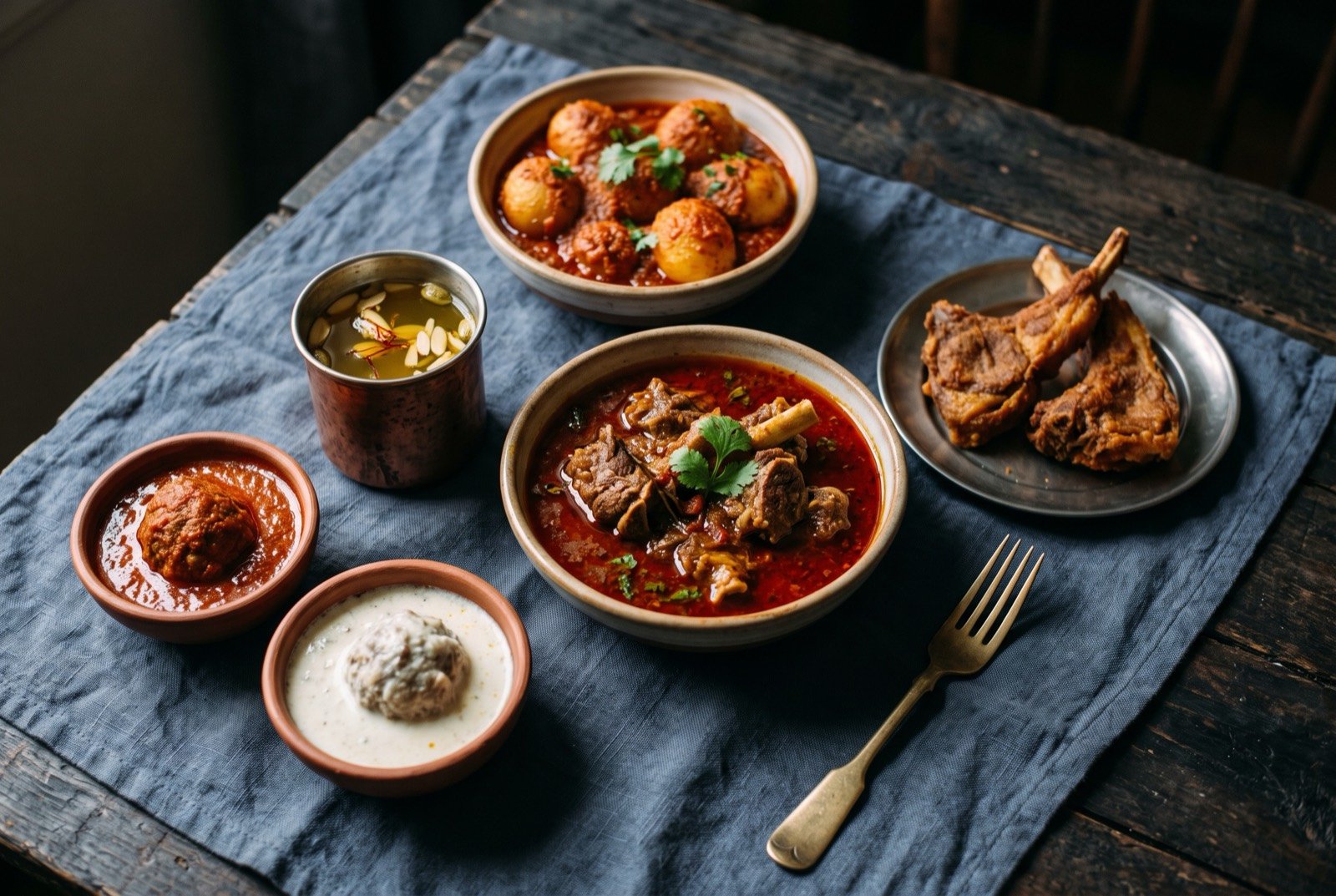
A single Indian state, until its 2019 reorganisation, holds three food worlds that share a border more than they share a table: the Kashmir Valley's Persian and Central Asian inflected Wazwan feast, itself split between Kashmiri Muslim and Kashmiri Pandit kitchens that share nothing but the table it is served on; Jammu's drier, largely vegetarian Dogra cooking, soured with dried pomegranate seed and finished under a charcoal smoke Kashmir does not use; and Himachal Pradesh's hereditary boti-cooked communal feast, dham. Ecology and a shared history of Mughal, Sikh and Dogra rule argue for one volume; the dishes themselves never let the reader forget they are three different cuisines, and each one is given as tradition built it, then with what a modern chef would change.
Sources and review · What this chapter does not assert · How we research · Spotted something wrong?
A Sense of Place
The Kashmir Valley is a bowl of paddy fields and saffron terraces at roughly 1,600 metres, ringed by mountains high enough to close the valley to the rest of India for months of winter, watered by the Jhelum and by Dal Lake's wetlands, which grow the lotus stem, nadru, that Kashmiri Pandit cooking treats as a defining vegetable. Rice is the staple starch, saffron the valley's signature export crop, walnut its defining nut, and both the Muslim majority and the Hindu Pandit minority who once lived alongside them share this ecology completely while cooking two different cuisines on top of it. Jammu, south and lower, is warmer, drier and closer in feel to Punjab, its Dogra Hindu majority eating a largely vegetarian, legume and dairy forward diet with meat as an occasional rather than a central food, its own hill districts, Bhaderwah and Doda chief among them, growing a prized, small, creamy rajma bean that the plains do not. Himachal Pradesh is not one ecology at all: its Hindu lowland districts, Kangra's tea gardens, Mandi's river valley, Kullu's apple orchards, Chamba's old Rajput hill capital, grow wheat and rice and keep dairy cattle, while Lahaul, Spiti and the Pangi valley's Bhot villages, higher, colder and Tibetan Buddhist, grow barley for sattu and keep yak, sheep and goat, exactly the ecology this atlas has already given its own volume in the wider High Himalaya (Volume AS-24). This chapter's Himachal material belongs to the Hindu lowland belt; its highland Buddhist villages are named here for honesty, not treated again.
| People or place | Defining ecological or social logic | Dishes that carry it |
|---|---|---|
| Kashmiri Muslim majority, the Kashmir Valley | Persian and Central Asian court cooking carried by hereditary waza cooks; onion, garlic and shallot as the gravy base | Tabak maaz, gushtaba, rista, rogan josh, aab gosh |
| Kashmiri Pandit minority, displaced from the valley since 1990 | A single, specific religious exclusion, no onion, garlic or tomato, met not with general asceticism but with genuine enthusiasm for meat, built on asafoetida and dried ginger instead | Nadru yakhni, dum aloo, monj haakh |
| Dogra Hindu majority, Jammu | A largely vegetarian, dairy and legume economy; storable souring agents, dried pomegranate seed and dried mango powder, over fresh acid; a distinctive charcoal smoking finish, dhuni | Khatta meat, ambal, rajma chawal, the Dogra Taam wedding feast |
| Hill Hindu communities of Kangra, Mandi, Kullu, Chamba, Bilaspur and Sirmaur | A hereditary Brahmin caste of cooks, the botis, cooking an entirely onion and garlic free communal feast, dham, on yoghurt, khoya and whole spices | Chana madra, sepu badi, siddu, babru |
| Bhot villages of Lahaul, Spiti and Pangi valley | Tibetan Buddhist, barley and yak-dairy highland ecology, ecologically and religiously continuous with the wider High Himalaya rather than with the rest of Himachal Pradesh | Momo, thukpa, churpe, butter tea, all treated in Volume AS-24 |
The History in Layers
Wazwan's own origin is genuinely contested, and the sources that disagree with each other are not Western guesswork but Kashmir's own press. Kashmir Observer dates the tradition to the fourteenth century, when Sultan Zain-ul-Abidin is said to have invited master cooks from Central Asia into his court, becoming the first wazas; Kashmir Life ties the same moment more cautiously to the wider Shah Mir Sultanate and the arrival of Persian Sufis and artisans, and offers the single strongest textual anchor either agent researching this chapter could find: Mulla Muhammad Ali Kashmiri's Tuhfat-ul-Ahbab, a chronicle completed in the early seventeenth century, which already names kabab, pulao, zard pulao, tursh pulao and yakhni as dishes of the sixteenth century Kashmiri court, and speculates, without claiming certainty, that the professional cooks it mentions at royal weddings may be the ancestors of today's waza. The Wire's Urdu edition gives a third account again, that wazwan arrived with migrants fleeing Timur's conquests out of Central Asia. This chapter does not pick one. What every source agrees on is the mechanism, Persian and Central Asian cooking arriving with the Sultanate and settling into a hereditary Kashmiri Muslim profession, the waza, paid not by the number of dishes served but by the weight of meat cooked, passing skill from father to son, and increasingly worried, in its own words, that it is dying: Haji Asadullah Khan, fifth generation head of Srinagar's Shaitan Waz'e family, whose ancestor earned the nickname producing an improbable range of dishes from a small quantity of meat under Prime Minister Ghulam Mohammad Bakshi in the 1950s, told The Kashmir Walla plainly that fewer, smaller weddings and years of unpaid apprenticeship are pushing his own children away from the trade.
Kashmiri Pandit cooking sits inside the same valley and the same feast structure, Pandits use the word saal for their own version of the communal feast, but runs on a different rule entirely: no onion, garlic or tomato, ever, replaced by asafoetida, dried ginger and fennel, with colour and body built from yoghurt and Kashmiri red chilli rather than a fried aromatic base. Greater Kashmir and Kashmir Observer, both local outlets, state the contrast evenhandedly, the absence of onion, tomato and garlic on the Hindu side against the absence of asafoetida on the Muslim side, rather than treating either cuisine as the other's plain variant, and this chapter follows that framing rather than a lazier one. It is worth being direct about a real trap here: several diaspora and commercial sources reach for a sattvic or Shaivite explanation, as if the no-onion rule reflected a broader ascetic, vegetarian leaning philosophy. A named Kashmiri Pandit writer, Amit Bamzai, argues the opposite in Outlook India, citing the Nilmat Purana, a text he dates to the sixth to eighth centuries CE, as early documentation of routine Pandit meat eating, justified through Kashmiri Shaivism specifically, and naming a real ritual example, the offering of goat's liver at the Sharika Mata festival, and Pandit families historically continuing to eat meat well into the days most Hindu communities elsewhere in India keep strictly vegetarian. He frames the more recent turn toward stricter vegetarianism among some Pandits as a modern development tied to wider Hindu nationalist sympathy after displacement, not a return to an older purity. This chapter takes his word over the tourist-facing gloss: Kashmiri Pandits are historically enthusiastic meat eaters with one specific, narrow dietary exclusion, not ascetics.
That displacement is the valley's other defining modern fact. Over several weeks between January and March 1990, the great majority of Kashmiri Pandits left the valley, estimates of the numbers range widely, and most resettled in Jammu, Delhi and further abroad. A 2025 academic study in the journal Social Identities, reachable in this chapter's research only at abstract level, frames food as a powerful locus of memory for displaced Pandits specifically, and other sources suggest the cuisine has taken a slightly different shape in each place families landed rather than being preserved as one uniform diaspora tradition. What is not in doubt is that the cuisine is being actively kept, not just mourned: a Delhi festival curating traditional Kashmiri Pandit dishes was reported as recently as August 2026, and a real cookbook literature exists specifically to recover it, discussed under Voices below.
Jammu's history runs on a different track. Its Dogra rulers served as Mughal mansabdars under Shah Jahan and Aurangzeb before Gulab Singh, a noble at the court of Sikh emperor Ranjit Singh, became Raja of Jammu in 1822 and founded the Dogra dynasty proper in 1846, ruling under British paramountcy until 1947, a layering academic sourcing describes as blending Dogra, Kashmiri and Mughal habits directly. One specific and striking crossover connects Jammu's rule to Kashmir's own kitchen history: Kashmir Times reports that Srinagar's professional wazas fled forced labour, begaar, imposed under Dogra rule around 1886, relocating to the remote Gurez valley and, by this account, helping preserve the grand Wazwan tradition there. It is a real, sourced connection between the two halves of this volume, but a political and economic one, not a shared cooking technique; no source found describes Wazwan's hand-pounded meat tradition extending into Dogra Jammu cooking itself, which develops instead along its own, largely vegetarian and legume-forward line.
Himachal Pradesh's own history splits the same way its ecology does. Chamba, its oldest Rajput hill capital, has a real, independently verifiable founding around 920 CE under Raja Sahil Varman, and a persistent local legend, repeated only in travel writing rather than academic history, that a later king recreated Kashmiri court dishes without meat for his own Brahmin court, giving rise to madra and, through it, to dham itself. This chapter names the legend as a legend. What is better attested is dham's link to temple and festival life more broadly, the Mandi Shivratri fair, tied to a sixteenth century Rajput founding and a later king's invitation of the region's hill deities to a shared feast, being the clearest documented case of dham as a genuinely temple-community institution rather than a private one. Lahaul, Spiti and Pangi's Bhot villages carry an entirely separate history again, Tibetan Buddhist, tied to trans-Himalayan trade and monastic culture rather than to any Rajput court, and a rigorous 2025 academic survey of Spiti's own traditional foods, read in full for this chapter, gives that separate history a firm evidential floor: barley, yak, sheep and goat, a fermented cottage cheese called churpe, and a diet built for a cold desert above 3,000 metres, sharing essentially nothing with the dham culture two valleys away.
The Flavour Arsenal
The two Kashmiri gravy bases, side by side
| Base | Built from | Used by |
|---|---|---|
| The Muslim base | Garlic, ginger, shallot (pran), red chilli powder or ratanjot for colour, whole warming spices | Rogan josh, gushtaba, rista, tabak maaz |
| The Pandit base | Asafoetida (hing), dried ginger powder (sonth), fennel (saunf), yoghurt, red chilli powder or ratanjot for colour, no onion, garlic or tomato | Nadru yakhni, dum aloo, monj haakh |
Aromatics and colourants
| Ingredient | What it does |
|---|---|
| Hing (asafoetida) | Raw, its sulphur compounds smell sulphurous; bloomed in hot fat they break down into the same savoury compounds cooked onion and garlic produce, making it a genuine mechanistic substitute in Pandit cooking, not a symbolic one |
| Sonth (dried ginger powder) | Pandit cooking's standing aromatic where Muslim cooking would use fresh ginger and garlic together |
| Saunf (fennel) | Ground into both Pandit and Muslim gravies for a sweet, anise-adjacent backbone |
| Pran (Kashmiri shallot) | The Muslim base's third aromatic alongside garlic and ginger, absent entirely from Pandit cooking |
| Ratanjot (alkanet root) | A pure dye, not a flavour, used by both communities to redden a gravy without adding heat; genuinely unregulated for food use in Britain (see Sourcing) |
| Kashmiri red chilli | Low heat, very high colour extraction; functionally interchangeable with ratanjot as a colourant in several dishes, which matters for anyone trying to control a dish's heat and colour separately |
| Ver | A small dried cake of ground fennel, black cardamom, garlic, ginger, clove, cumin, pepper, chilli and shallot, crumbled into a finished dish as a last-minute aromatic lift, not a base; dried, not fermented, and not sold ready-made anywhere in Britain |
Souring agents
| Ingredient | What it does |
|---|---|
| Anardana (dried pomegranate seed) | Jammu's preferred souring agent for meat, chosen historically because it stores through a season fresh acid cannot |
| Amchur (dried mango powder) | Jammu's second storable sour agent, often used alongside anardana in khatta meat |
| Tamarind and jaggery | Ambal's sweet and sour base, soured with tamarind rather than the vinegar or lime a Western recipe might reach for |
Dairy and thickeners
| Ingredient | What it does |
|---|---|
| Yoghurt | The base of Kashmiri yakhni and Himachali madra gravies alike; the single technique both traditions must solve is stopping it from splitting against heat |
| Khoya | Reduced milk solids, the richness behind Himachali madra, alongside yoghurt |
| Besan (gram flour) | A stabilising and thickening agent in some Himachali dham gravies; not confirmed for Kashmiri yakhni despite the resemblance, where the sourced technique instead points to rice flour |
Starches and staples
| Ingredient | What it does |
|---|---|
| Rice | The Kashmir Valley and Jammu staple; modur pulao's sweet saffron rice and the plain rice of a Wazwan trami both depend on it |
| Wheat | Jammu's toda flatbread and Himachal's siddu and babru breads |
| Bhaderwah rajma | A smaller, creamier kidney bean grown at altitude in Doda district, prized above commodity kidney beans for Jammu's rajma chawal |
| Nadru (lotus stem) | Harvested from Dal Lake and its wetlands, the defining vegetable of several Kashmiri Pandit dishes |
| Haak | A collective Kashmiri term for a range of quick-cooking mustard family greens, eaten by both communities, more centrally by Pandits |
The Technique Ladder
Rung 1. Pound gushtaba and rista into a paste, do not mince them.
Raw, still-warm mutton is worked by hand on a stone with a wooden mallet, the goshpare, until the muscle fibre is not just cut but physically sheared and its connective tissue and sinew torn out entirely, producing something closer to a mousseline forcemeat than a burger mix. A rotary mincer chops fibres short but leaves sinew intact as fine threads running through the meat, which shows up as a grainy, stringy bite a Kashmiri diner is said to notice immediately. A home cook can approximate the effect, not replace it, by pulsing chilled meat and fat in short bursts in a high-power blender, keeping the mixture cold to stop the fat rendering early, then pushing the paste through a chinois to strip out whatever sinew the blender's blade did not.
Rung 2. Temper yoghurt into heat, never the reverse.
Yoghurt's casein proteins denature and clump when they meet sudden or excessive heat, which is why a yakhni or a madra gravy is built by bringing the yoghurt to room temperature, whisking it thoroughly, and adding it gradually to the hot base while whisking continuously, so the temperature shock at any one moment stays small. Where a stabiliser is used at all, the sourced Kashmiri technique points to rice flour rather than the gram flour a reader might expect from elsewhere in North Indian cooking, worked into the whisked yoghurt before it goes anywhere near the pot; Himachali madra instead uses gram flour directly, a genuine, sourced difference between the two traditions rather than a regional variant of the same trick. A sous vide bath or a very low induction setting gives a home cook more reliable control over this than an open flame ever will.
Rung 3. Cook tabak maaz twice, for two different reasons.
Lamb ribs are simmered gently in milk and water with whole spice until the connective tissue has fully broken down into gelatine, then removed, dried, and shallow fried hard in ghee until the surface fat and skin caramelise and crisp in a couple of minutes a side. The first stage is slow collagen hydrolysis kept below boiling; the second is fast Maillard browning that would simply steam the meat if the ribs were not properly dried first. A sous vide bath gives the first stage more consistency than a stovetop braise, and a very hot Big Green Egg gives the second stage more smoke and colour than a domestic pan.
Rung 4. Dry vegetables in the sun to survive a Kashmir winter, hokh syun.
Sliced aubergine, bottle gourd, turnip, spinach, tomato and fenugreek are threaded or laid on wicker trays, kani-chari, dried in the sun and brought indoors each night to avoid the dew that would otherwise rot them, a genuine and still practised, if declining, technique documented directly by Kashmir's own press. The physics is exactly what a dehydrator does at controlled low temperature, removing enough water activity to stop microbial growth, with the real advantage over full summer sun that a dehydrator can hold a temperature too low to case-harden the surface, sealing moisture inside where sun-drying would not.
Rung 5. Smoke a finished dish with charcoal and mustard oil, dhuni.
A piece of burning charcoal is set in a small container inside the cooked dish itself, hot mustard oil poured over it to raise smoke, and the vessel sealed so the smoke has nowhere to go but into the food, a technique named specifically and repeatedly for Dogra cooking, applied to khatta meat, rajma and ambal alike. The mechanism is standard smoke chemistry, phenolic and carbonyl compounds carried on the fat and absorbed into the dish's surface, but the trapped-vessel method concentrates it far more than an open grill would. A small stainless cup of hardwood charcoal doused with hot mustard oil under an upturned bowl is a close, controllable modern version of the same idea.
Rung 6. Cook a dham gravy in a narrow-necked vessel you cannot see into.
Himachal's hereditary boti cooks work in brass or copper vessels, batloi or charoti, deliberately built with a broad base and a narrow neck that retains heat but hides the gravy from view, managing a yoghurt-based madra without curdling by feel and years of practice rather than by watching it. It is worth naming honestly as a technique a home cook should not try to replicate blind: a wide, uncovered pan and a thermometer will manage the same gravy far more reliably than an opaque vessel ever could, and the boti's skill is in the years of practice the narrow neck demands, not in the vessel's shape itself.
The Ferment and Preserve Bench
1. Hokh syun.
Slice aubergine, bottle gourd, turnip or fenugreek and lay or thread them on wicker trays, dry them in direct sun through the day, and bring them indoors each night to avoid dew and the fungal spoilage it invites, repeating for several days until fully dry. A dehydrator run at a low, controlled temperature does the same job more reliably and without the case-hardening risk of strong summer sun, and is directly and honestly the modern equivalent of a genuine Kashmiri winter-survival technique, not an approximation of it.
2. Ver.
Grind fennel, black cardamom, garlic, ginger, clove, cumin, black pepper, dried chilli and shallot into a rough paste, bind it into small flattened cakes, and dry them hard in the sun or a low oven over several days, to be crumbled into a finished dish as a last aromatic lift. It is dried, not fermented, despite occasional loose description, and it is not sold ready-made anywhere in Britain, making it, unusually for this atlas, an ingredient where a dehydrator is not a convenience but close to the only realistic route to the real thing.
3. Auriya.
Whisk a tablespoon of ground brown mustard seed into a cup of yoghurt and leave it somewhere warm for 6 to 7 hours to ferment before folding through boiled, crushed potato, a genuine Dogra summer dish valued for its cooling, probiotic qualities as much as its flavour.
4. Kalari.
A semi-hard, curdled cheese, pan-fried to a golden crust while staying soft inside, whose origin is genuinely disputed: most sources tie it to the nomadic Gujjar-Bakarwal pastoralist communities of Jammu and Kashmir, who developed it to preserve milk on the move, while one named Dogra-culture scholar argues it was invented locally rather than imported. This chapter names both claims rather than settling between them.
Sourcing in Britain
Kashmiri saffron is the ingredient this chapter asks the reader to spend the most care on, because it is also the one most likely to disappoint him. Genuine Pampore saffron carries a real Geographical Indication tag since 2020, backed by ISO 17025 accredited lab testing and, increasingly, isotope fingerprinting against the exact soil and water of the growing region, precisely because fraud is common enough to need forensic defences. It is not a hypothetical risk for a British buyer: West Sussex Trading Standards tested ten saffron samples on sale in the county and found seven adulterated, an investigation that escalated to a near-£750,000 seizure of adulterated stock from a factory in Spain, and cheap Iranian saffron has been documented being relabelled and sold as Kashmiri in Britain since at least 2005. Genuine saffron should cost roughly £6 to £8 a gram at UK retail; anything markedly cheaper with no specific Pampore or GI claim attached is very likely honest, perfectly good Iranian or Spanish saffron trading under a more valuable name, not a scandal exactly, but a mislabelling worth recognising and pricing accordingly. Of the retailers this chapter's research could check, Kashmiril is the most convincing on the strength of its stated GI certification, lab testing and named-farmer sourcing; Luxurients is a credible UK-based alternative with independently judged Great Taste Award recognition, though it makes no GI claim of its own.
Kashmiri chilli powder is, by contrast, one of the easiest ingredients in this whole chapter to get right, and cheaply: Steenbergs, Spice Kitchen and Sous Chef all sell a credible version for a few pounds. The honesty worth passing on is that most commercial Kashmiri chilli, in India as much as in Britain, is not actually grown in Kashmir at all but is Byadagi chilli from Karnataka, bred and sold for the same low-heat, high-colour profile; this is a lower-stakes mislabelling than saffron's, since the two chillies are close functional cousins rather than an unrelated product wearing a false name, but the reader should know the word on the jar is describing a chilli type more than a place. Deggi mirch is a related but genuinely distinct blend, Kashmiri-type chilli cut with dried red bell pepper, and the two should not be swapped without noticing a real difference in the finished dish's colour to heat balance.
Ratanjot sits in a genuine regulatory dead end. Its colouring compound, alkannin, once carried the EU additive code E103, and that approval has since been withdrawn; it does not appear on the UK's own regulated food-additive list. Every UK retailer this chapter's research found selling it markets it for soap making, dyeing or cosmetic use, not food, which means using it as a cooking colourant, as some Kashmiri Muslim rogan josh recipes traditionally do, sits outside UK food-additive regulation entirely. This chapter's elevations use a small amount of beetroot powder or lean more heavily on Kashmiri chilli itself for colour instead, offered plainly as a substitute rather than a hidden equivalent.
Hing and sonth are both cheap and widely available through general South Asian grocers and specialist spice retailers, but one distinction is worth a specific note for this reader: most retail hing is compounded, pure asafoetida resin cut with rice flour, corn flour or wheat flour to make it usable, and most of that compounding uses wheat flour, which matters if gluten needs to be avoided; a small number of gluten-free compounded brands and pure resin lumps exist from specialist retailers for exactly that reason.
Haak, honestly, is not available in Britain in any form. Cavolo nero is the least dishonest widely available substitute for leaf texture and cooking behaviour, though it is more robust and more bitter than haak's mellower character, and this chapter says so rather than pretending the two are equivalent. Nadru is a genuinely better story: fresh lotus stem is stocked by UK Southeast Asian grocers, and frozen sliced lotus root travels well through Korean and pan-Asian frozen suppliers, both a more reliable route than any South Asian grocer, which do not routinely stock it despite its central place in Kashmiri Pandit cooking. Kashmiri walnuts and Bhaderwah rajma, by contrast, are not marketed with any specific provenance claim a British buyer can check at all; a reader is realistically buying ordinary walnuts and ordinary kidney beans, which this chapter treats as a non-issue rather than a compromise to apologise for.
For eating rather than cooking, Kashmir, A Culinary Paradise in Putney, opened by Kashmiri chefs Rohit and Shweta Razdan and still trading, is the one restaurant this chapter's research can confidently point a reader toward as a genuine, currently open Kashmir Valley kitchen. It is worth being direct about the largest single source of confusion a British reader is likely to bring to this chapter: most of what Britain calls Kashmiri food, including a well-reviewed restaurant that traded under the name Wazwan in Sheffield before closing in 2022, descends from the Mirpuri diaspora of Pakistan-administered Azad Kashmir, whose food culture is closer to Punjab than to the Kashmir Valley's Wazwan tradition. This is not a minor caveat. Bradford's large Kashmiri-identifying community is overwhelmingly Mirpuri, and its grocers, restaurants and butchers, real and excellent as they are, are not the right address for haak, nadru or Wazwan-style whole spices, which a reader will realistically source through general South Asian grocers and the specialist online retailers named above instead. No restaurant or grocer specifically serving Dogra or Himachali food was found trading anywhere in Britain, a genuine and clean gap this chapter states rather than pads over.
On kit: a Big Green Egg is a genuinely useful, reasonably honest stand-in for Wazwan's skewered and direct-heat cooking, the seekh kebab side of the meal and the final fry stage of tabak maaz, but a poor and slightly misleading one for the long-simmered degchi dishes that make up most of a Wazwan, which are better served by a heavy pot on a normal hob. A dehydrator earns its place twice over in this chapter, once for hokh syun, a genuine, traditional dehydration technique it simply does more reliably than the sun, and once for ver, an ingredient with no UK retail existence at all, where making it at home is not a workaround but the only real option available.
Ranked: the ingredients that decide great from grim
First, Kashmiri saffron, and specifically whether it is real, because this decides both the cost and the reader's trust; buy from a retailer that names Pampore and shows its lab numbers, not one that simply prints the word Kashmiri on the jar. Second, haak versus a substitute green, because this decides whether the tradition-first version of a Pandit dish reads as the real thing or a polite fiction, and no cook in Britain should pretend otherwise. Third, ver, the one ingredient that cannot be bought at all and must be made, which happens to be the one place in this whole chapter where this reader's own kit gives him a genuine advantage over most people attempting this food.
Voices and Sources
Chandramukhi Ganju's Koshur Saal, now in its fifth edition, is the clearest single act of Kashmiri Pandit cookbook preservation this chapter found, over two decades of research condensed into 184 recipes with their cultural and religious context intact, explicitly framed by its author as a way for the global Kashmiri diaspora to reconnect with a kitchen many left behind. Krishna Prasad Dar's earlier Kashmiri Cooking sits alongside it as a genuine classic, unusually and usefully covering both the Pandit hing-curd tradition and the Muslim onion-garlic one side by side rather than treating either as the whole of Kashmiri food. Wazwaan, Traditional Kashmiri Cuisine, written by the Waza brothers, Sharief, Shafi and Rafiq, with Rocky Mohan, is a rare case of a hereditary waza family publishing its own book rather than being written about, and deserves a physical copy rather than secondhand reliance on this chapter. Amit Bamzai's Outlook India essay on Kashmiri Pandit meat eating did real work in this chapter specifically by correcting a sattvic framing that several less careful sources repeat uncritically.
The waza guild is documented with real specificity by The Kashmir Walla, a Kashmir-based outlet, through named cooks Haji Asadullah Khan of Srinagar's Shaitan Waz'e family and Mohammad Shafi Khan of the Ahad family, both speaking directly about a trade they worry is dying. Chef Prateek Sadhu, genuinely Kashmiri by birth and trained at Alinea, Noma and The French Laundry before returning to India, deserves particular weight in this chapter: his restaurant NAAR, physically inside Himachal Pradesh near Kasauli, builds a contemporary Himalayan tasting menu on fermenting, drying, salting, smoking and curing, techniques this chapter treats as continuous with, not a replacement for, the older preservation logic of hokh syun and ver, and reworks Kashmir's own sun-dried fish, hokhegad, as a dish he calls Dirty Toast. Sanjay Mishra, a named boti of Pathiar village in Kangra district profiled by The Better India, gave this chapter's dham material its one properly human, individually verifiable voice, describing a hereditary trade he left and then returned to revive. Academically, a 2025 paper by Sharma, Bharti and colleagues in the Indian Journal of Traditional Knowledge, read in full for this chapter, gives Lahaul-Spiti's food culture an unusually rigorous evidential floor, and a companion paper on Himachali dham in the Journal of Ethnic Foods anchors this chapter's account of the boti tradition, though it could only be read at summary level. Kashmir's own local press, Greater Kashmir, Kashmir Life, Kashmir Observer and The Kashmir Walla, and Jammu's Daily Excelsior, did the great majority of the load-bearing work behind this chapter's account of Wazwan, the Pandit and Muslim distinction, and Dogra cuisine specifically, and are named here because that is exactly the standard this atlas asks of itself.
Things this chapter has deliberately not asserted
- That Wazwan began in a single, settled century. Kashmir's own local press disagrees on whether it was the fourteenth or fifteenth century, and on whether the cooks arrived invited or as refugees from Timur's conquests, and this chapter has not picked a side.
- That thirty six dishes is the normal size of a Wazwan. It is the ceiling of a formal, royal-style feast repeated across English-language sources, while a Kashmir-based Urdu outlet describes something closer to seven to a dozen dishes as the lived reality, and only seven recur everywhere as truly indispensable.
- That a 1974 government order capped formal Wazwan service at five dishes. This appears in a single Urdu source and could not be corroborated elsewhere.
- That wost is a distinct role from waza or vasta waza. No source could confirm this as a separate term rather than a transliteration variant.
- That besan, gram flour, stabilises a Kashmiri yakhni gravy. The sourced technique this chapter could find points to rice flour instead, and even that comes from a diaspora recipe writer rather than an in-tradition source.
- That Kashmiri Pandit cooking reflects a broadly sattvic or ascetic philosophy. A named Kashmiri Pandit author directly contradicts this, documenting the community as historically enthusiastic meat eaters with one specific dietary exclusion, not a general one.
- That monj haakh has a documented recipe. This chapter could find only passing mentions of the dish, with no real technique or quantity attached to it anywhere reachable.
- That Kashmiri Pandits and Kashmiri Muslims prepare kahwa differently. Every source treats it as a shared, non-contested practice, and this chapter has not invented a distinction to match its Wazwan material.
- That the Chamba dham origin story, a specific king recreating Kashmiri court dishes for his Brahmin subjects, is documented history rather than local legend. It appears only in travel writing, not in the one academic source on dham this chapter could locate, even in summary.
- That bhandari is the correct term for a Himachali dham cook. Every source this chapter found uses boti instead.
- That khoru is a real, distinct Dogra dish. Targeted search in both English and Hindi found nothing to corroborate it.
- That a chef with Michelin recognition in Britain cooks Kashmiri or Himachali food specifically. The closest case, a dish called Wazwan on Aktar Islam's menu at the two-starred Opheem, is one course by a British Bangladeshi chef referencing the idea of the feast, not the work of a Kashmiri kitchen, and this chapter has been careful not to let the name imply otherwise.
- That the Sheffield restaurant Wazwan represents Kashmir Valley cuisine, or is still open. Its ownership traces to the Mirpuri Aagrah tradition rather than Srinagar's waza guild, and it appears to have closed in 2022.
Pound gushtaba and rista into a paste, do not mince them.
Raw, still-warm mutton is worked by hand on a stone with a wooden mallet, the goshpare, until the muscle fibre is not just cut but physically sheared and its...
Temper yoghurt into heat, never the reverse.
Yoghurt's casein proteins denature and clump when they meet sudden or excessive heat, which is why a yakhni or a madra gravy is built by bringing the yoghurt...
Cook tabak maaz twice, for two different reasons.
Lamb ribs are simmered gently in milk and water with whole spice until the connective tissue has fully broken down into gelatine, then removed, dried, and...
Dry vegetables in the sun to survive a Kashmir winter, hokh syun.
Sliced aubergine, bottle gourd, turnip, spinach, tomato and fenugreek are threaded or laid on wicker trays, kani-chari, dried in the sun and brought indoors...
Smoke a finished dish with charcoal and mustard oil, dhuni.
A piece of burning charcoal is set in a small container inside the cooked dish itself, hot mustard oil poured over it to raise smoke, and the vessel sealed so...
Cook a dham gravy in a narrow-necked vessel you cannot see into.
Himachal's hereditary boti cooks work in brass or copper vessels, batloi or charoti, deliberately built with a broad base and a narrow neck that retains heat...
The dishes
- Tabak maaz Kashmir Valley, Muslim tradition
- Gushtaba, and its red sibling rista Kashmir Valley, Muslim tradition
- Rogan josh Kashmir Valley, Muslim tradition
- Nadru yakhni Kashmir Valley, Kashmiri Pandit tradition
- Dum aloo, Kashmiri Pandit style Kashmir Valley, Kashmiri Pandit tradition
- Khatta meat Jammu, Dogra tradition
- Ambal Jammu, Dogra tradition
- Chana madra Himachal Pradesh, Hindu lowland belt, dham tradition
- Siddu Himachal Pradesh, higher districts
- Kahwa Kashmir Valley, shared by both communities
Sources and review
- Reviewed
- Not yet reviewed from inside the tradition
- Cooked
- Not yet cooked and reported
Where this volume comes from
3 research briefs on file for this volume, researched to the rules on How we research. Published 4 September 2026. Last changed 8 September 2026.
The brief's own account of its sources
Proportion of sources, roughly: Of the sources actually used as citations in this brief, I would estimate about a quarter are Kashmir-published or India-published local press or local-adjacent outlets in English or Urdu (Greater Kashmir, Kashmir Life, Kashmir Observer, ETV Bharat Urdu's J&K service, Kashmir Images, The Wire and The Wire Urdu, Outlook India), a small handful are genuine academic or reference-grade sources (the *Social Identities* paper, abstract only; the ScienceDirect wazwan review, summary only; Urdu and English Wikipedia used cautiously and flagged wherever relied on), one