The Indian subcontinent · Volume 15, The Trami, the Boti and a Kitchen Split Three Ways
Rogan josh
Kashmir Valley, Muslim tradition
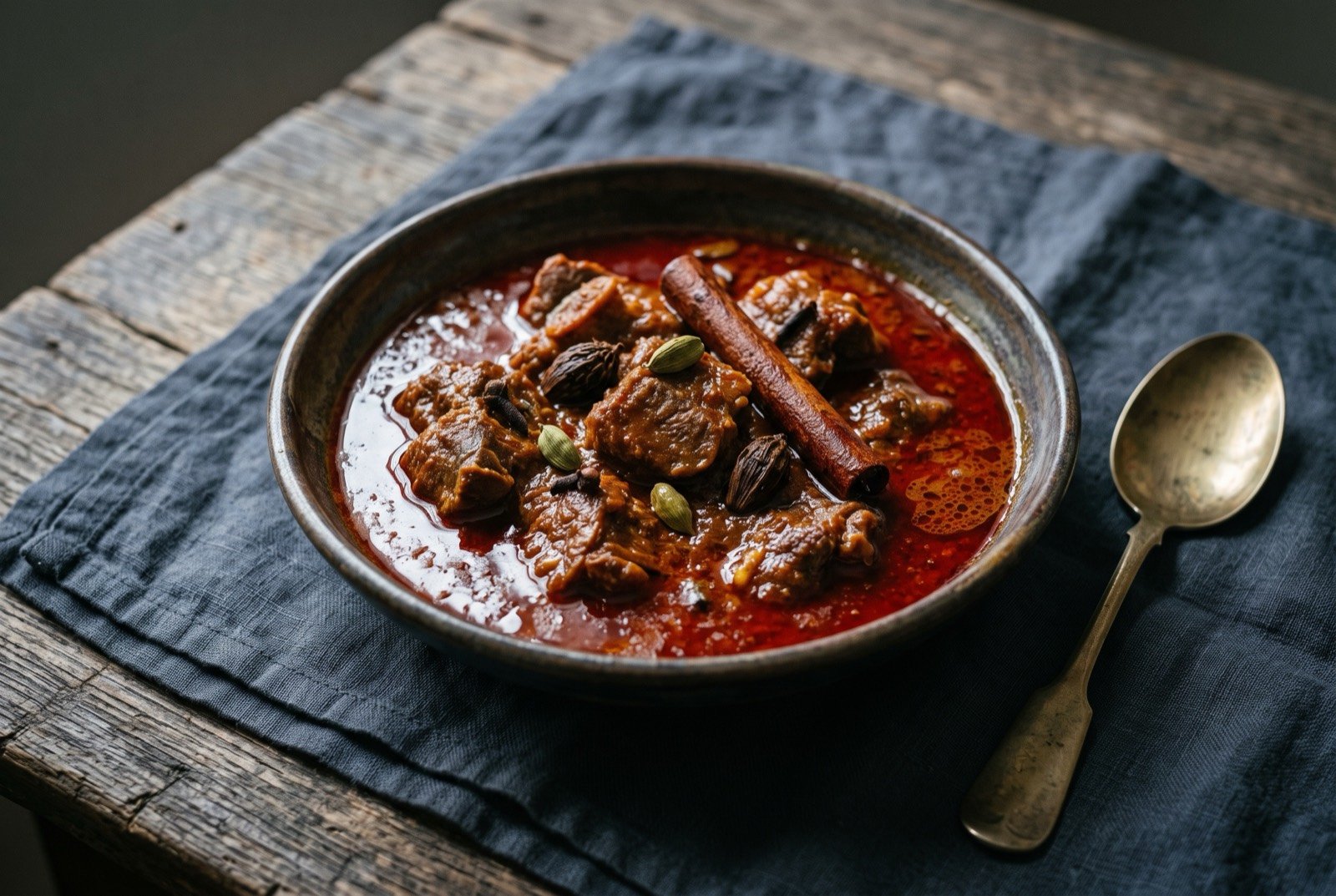
Illustration
- Time
- 2 hours
- Researched
- Researched from 145 sources in the brief
Named cuts, lower ribs, the lower back cut called bukhtor, chest and neck, cut into pieces of roughly 70 to 80 grams, recur across several sources describing the Muslim version of this dish; the Pandit equivalent uses the same colourants without the onion, garlic and pran base, built instead on hing and sonth, though no dedicated Pandit-quantity recipe could be found in this chapter's research.
As tradition built it
Serves 4. About 2 hours.
Ingredients
- 1 kg mutton, cut into 70 to 80g pieces
- for browning ghee, for browning
- 6 garlic cloves, crushed
- 1 tbsp grated ginger
- 2 pran or ordinary shallots, finely chopped
- 2 tbsp Kashmiri red chilli powder
- 4 green cardamom pods
- 4 cloves
- 1 cinnamon stick
- 300 ml water
- a small amount, optional ratanjot, optional, for colour
Method
- Brown the mutton in ghee, then remove and set aside.
- In the same pan, cook a paste of the garlic, ginger and pran or shallots until soft.
- Return the meat to the pan with the Kashmiri red chilli powder, cardamom, cloves and cinnamon stick.
- Add the water, cover and simmer for around an hour and a half until the meat is tender and the gravy has reduced and reddened.
- Where a deeper colour without more heat is wanted, add a small amount of ratanjot instead of or alongside the chilli, since both are used as dyes rather than flavourings in this dish.
Notes
The Kashmiri Pandit version of this dish uses the same colourants without the onion, garlic and pran base, built instead on hing and sonth; no dedicated Pandit-quantity recipe could be found in this chapter's research.
What a modern chef changes
Fresh-ground chilli, a beetroot substitute for ratanjot, and meat cooked apart from its gravy
Applies rung 1's discipline to colour and doneness
Method
- Dry and grind the chilli fresh. Dry whole Kashmiri chillies in a dehydrator before grinding them in a dedicated spice grinder immediately before use, for a brighter colour and a fresher flavour than a jar of pre-ground powder gives.
- Substitute beetroot powder for ratanjot. Ratanjot sits outside UK food-additive regulation, see Sourcing, so use a small amount of beetroot powder alongside the chilli for colour instead, offered honestly as a substitute rather than a hidden equivalent.
- Cook the meat sous vide, separately. Bring the meat to a controlled, even doneness by sous vide, then finish it in the reduced gravy only at the end, rather than braising meat and gravy together for the full cooking time.
- Strain the gravy. Pass the finished gravy through a chinois for a silkier sauce before returning the meat to it.