The Indian subcontinent · Volume 15, The Trami, the Boti and a Kitchen Split Three Ways
Gushtaba, and its red sibling rista
Kashmir Valley, Muslim tradition
Illustration
- Time
- 2 hours
- Researched
- Researched from 145 sources in the brief
Gushtaba is always the last savoury dish of a Wazwan, its refusal treated in more than one source as a real breach of hospitality, and it is built by the same hand-pounding technique as its structural twin, rista: the same meat paste, finished in a red gravy coloured with ratanjot or Kashmiri chilli rather than gushtaba's white yoghurt one. No dedicated Pandit version of either dish with real quantities could be found in this chapter's research, a genuine gap; a Pandit cook would substitute hing and sonth for the garlic below. The quantities that follow come from a professionally tested and published recipe by chef Romy Gill, whose own cooking covers the wider Himalayan region rather than Kashmir specifically, and should be read as a serious, cookable source rather than an in-tradition Kashmiri one.
As tradition built it
Serves 6. About 2 hours.
Ingredients
The method as the tradition gives it, with the ingredients named. Quantities follow as we verify them, lead dishes first.
For the meatballs
- 600 g goat, mutton or lamb leg
- 1 litre water
- 6 green cardamom pods
- 4 black cardamom pods
- 4 cloves
- 1 (5cm) cinnamon stick
- 1 tsp salt
For the base paste
- 1 kg shallots, finely chopped
- 125 g ghee
For the yoghurt gravy, gushtaba
- 600 g yoghurt
- 300 ml water
- 6 garlic cloves, crushed
- 2 tsp ground ginger
- 2 tsp ground fennel
- 1/2 tsp dried mint
- 2 tbsp ghee or rapeseed oil
For the red gravy, rista
- ratanjot or Kashmiri chilli
- garlic, crushed
- ginger, ground
Method
- Pound the goat, mutton or lamb leg with a wooden mallet on a board until it resembles a smooth pâté; a food processor pulsed in short bursts works, though the texture will differ from hand pounding.
- Shape the pounded meat into balls and simmer in the stock of water, cardamom, cloves, cinnamon and salt.
- Separately, fry the shallots in the ghee until soft and golden, for the base paste.
- For the gushtaba gravy, whisk the yoghurt with the water until smooth, then combine with the garlic, ginger, fennel and mint, and cook gently in the ghee or rapeseed oil, whisking continuously so the yoghurt does not curdle.
- Add the meatballs and their stock to the gravy, simmer around 15 minutes until it thickens, then rest for 30 minutes so the gravy seeps back into the meatballs before serving.
- For rista, make the same meat paste into balls and simmer instead in a gravy built from ratanjot or Kashmiri chilli, garlic and ginger, without the yoghurt.
Notes
No dedicated Kashmiri Pandit version of either dish with real quantities could be found in this chapter's research; a Pandit cook would substitute hing and sonth for the garlic here.
These quantities come from a professionally tested and published recipe by chef Romy Gill, whose own cooking covers the wider Himalayan region rather than Kashmir specifically, and should be read as a serious, cookable source rather than an in-tradition Kashmiri one.
What a modern chef changes
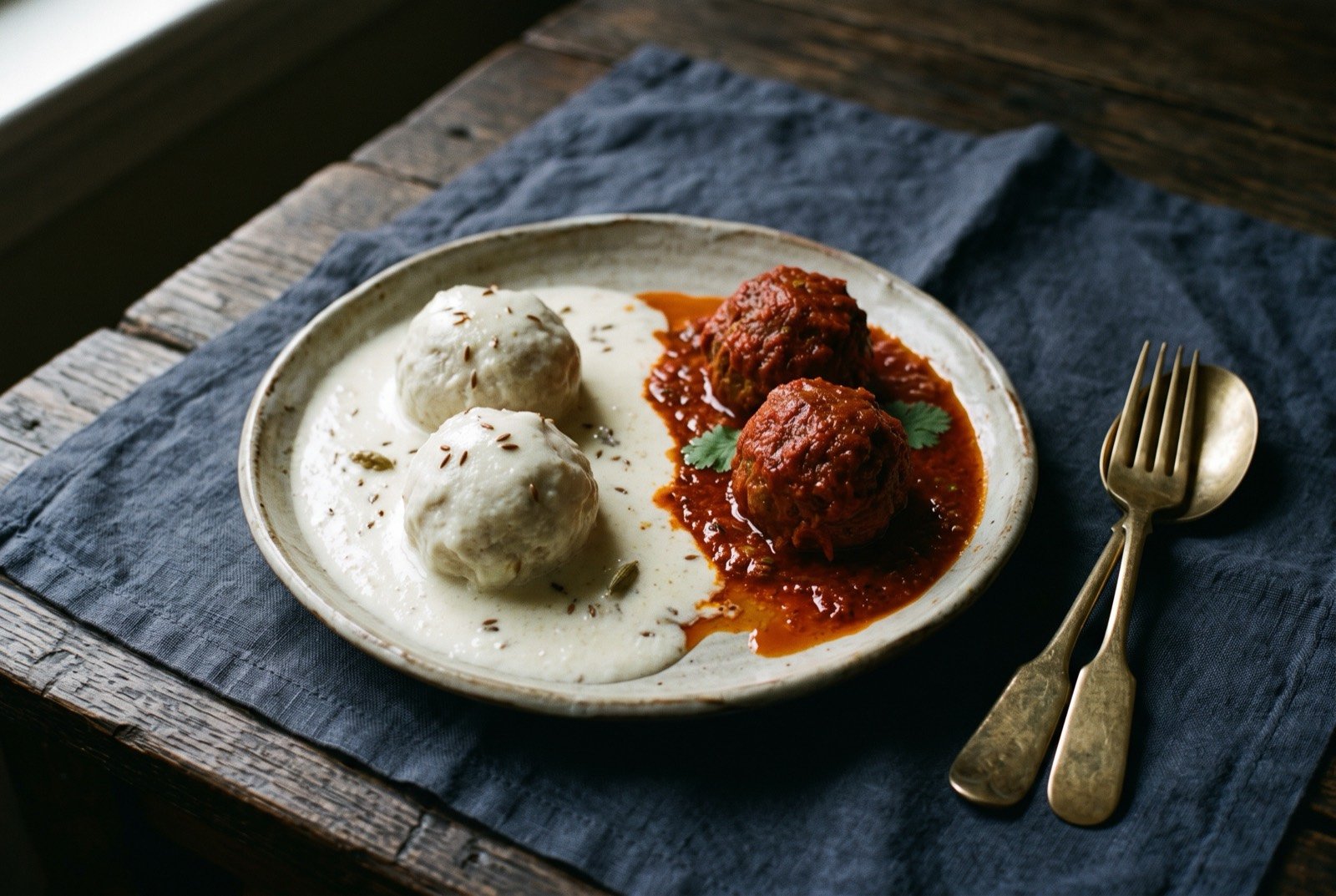
One paste, two gravies, plated to show the logic
Builds on rung 1
Method
- Pound by blender. Pulse the meat cold in a high-power blender in short bursts, then push the resulting paste through a chinois to strip out any remaining sinew, an approximation of hand pounding rather than a replacement for it.
- Hold the gravy sous vide. Keep the yoghurt gravy in a sous vide bath at a fixed sub-simmer temperature while whisking the yoghurt in gradually, removing the risk of a stovetop's uneven heat splitting it.
- Dehydrate the shallot. Dry a portion of the fried shallot until crisp and shatter it over the finished dish for a textural echo of the base paste.
- Plate the two together. Serve gushtaba and rista side by side on the same plate, one white, one red, from visibly the same meat, making the dish's own internal logic, one technique, two gravies, the point of the plate rather than something the diner has to be told.