Asia · Volume 18
Bengal and Bangladesh
The Ilish, the Chhena and a Border the Kitchen Never Kept
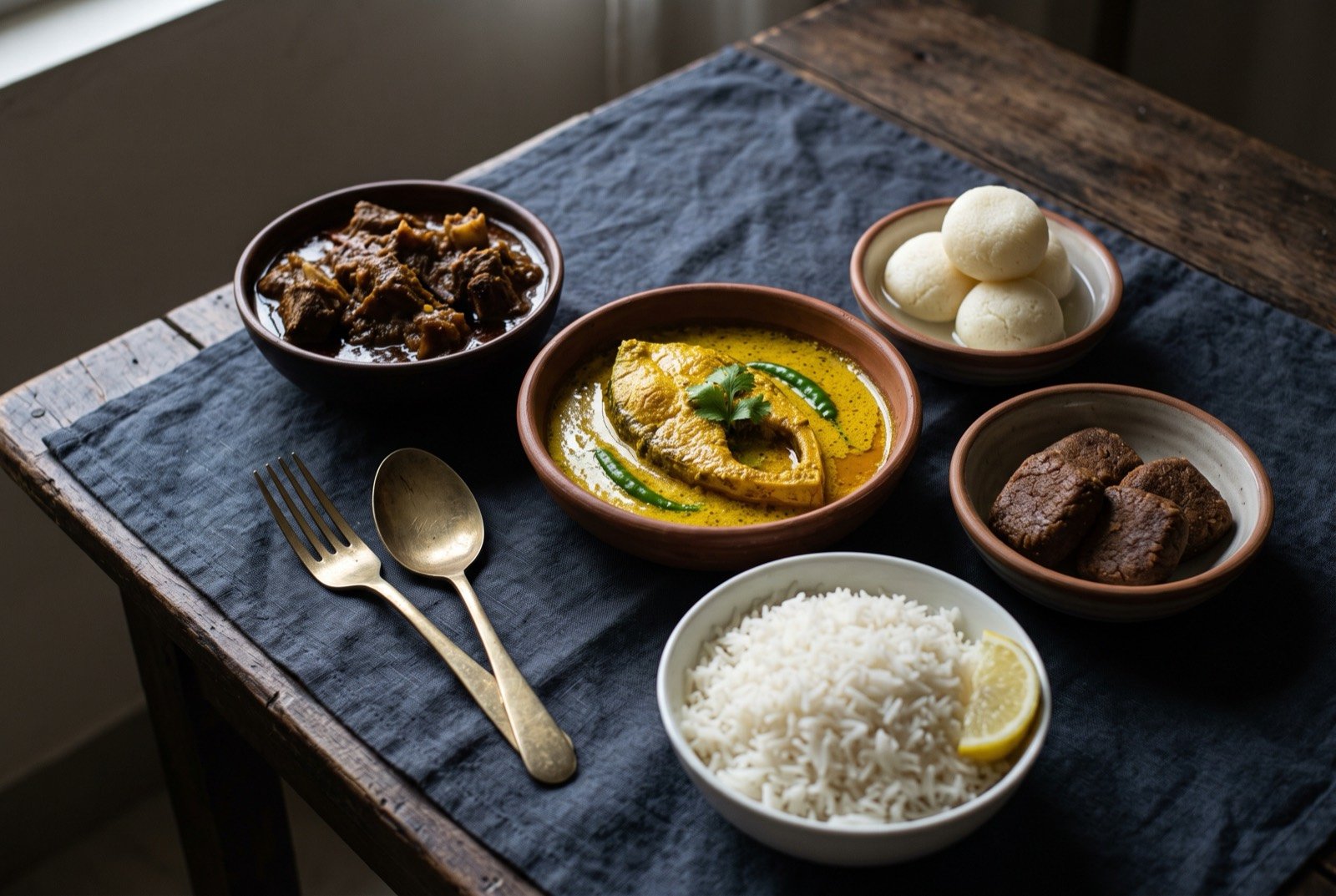
One food world, cut in half twice: once in 1947, when Partition drew a border straight through the Ganges delta on religious lines, and again in 1971, when Bangladesh fought its way out from under Pakistan to become its own country. West Bengal, Indian and Hindu-majority, and Bangladesh, independent and Muslim-majority, now sit either side of that line, and this chapter treats them as what a Kolkata chef put more precisely than any historian consulted for it: "Bengalis are a linguistic group rather than a single ethnic group." The rice, the river fish, the mustard oil and the panch phoron do not know where the border runs. The politics, the religion and the two countries' very different twentieth centuries do, and a chapter that pretended otherwise would be lying by omission. Every dish as tradition built it, then what a modern chef would change.
Sources and review · What this chapter does not assert · How we research · Spotted something wrong?
A Sense of Place
Bengal and Bangladesh together occupy the lower reaches of the Ganges-Brahmaputra-Meghna system, the largest river delta on earth. Near Dhulian the Ganges splits: the Padma continues east into Bangladesh, while the Bhagirathi runs south through West Bengal and, from Nabadwip downstream, takes the name the colonial world knew it by, the Hooghly. Kolkata was built on the Hooghly's eastern bank for a purely practical reason: navigable water to the sea, and behind it the same rice paddy, freshwater fish and mustard field that the rest of the delta shares. Everything in this chapter grows out of that one ecological fact, a floodplain wet enough, silted enough and warm enough to grow rice and mustard in the same fields and to fill its rivers, ponds and estuaries with fish that a household eats far more often than it eats meat.
One delta, two food-political histories
At Partition in 1947, the delta's Muslim-majority east became East Bengal, then East Pakistan, a Bengali-speaking province governed from a capital a thousand miles away by an Urdu-speaking and Punjabi elite who tried, and failed, to impose Urdu as Pakistan's sole national language on a population that was, by its own numbers, the majority language group in the country. That attempt provoked the 1952 Language Movement, which hardened a distinct Bengali Muslim identity, separate from both West Pakistan's Urdu culture and West Bengal's Hindu Bengali culture next door. This chapter has looked directly for a source tying specific food practices to the Language Movement itself and found none: what the movement demonstrably did was cultural and political, and the food-history link some later writing implies is inference dressed as fact. It is not asserted here.
Independence came in 1971, after a war whose declaration is dated to Chittagong, and whose aftermath fed directly into the 1974 famine, a catastrophe that sits in Bangladeshi national memory roughly the way the 1943 Bengal famine sits in Kolkata's, though it is a distinct, later and definitionally Bangladeshi event, not a colonial-era one. The government's own figure was 40,000 deaths from starvation; non-government estimates run from 100,000 to 1.5 million, including post-famine mortality. Bangladeshi scholarship treats it as a distribution failure rather than a food-availability failure: floods, mismanaged grain stocks, corruption, restrictions on moving grain between districts, smuggling to neighbouring countries, and American aid withheld over Bangladesh's trade ties with Cuba, all layered onto a newly independent state's fragile administration. Mortality among landless families ran three times higher than among households with three acres or more. That is a hard fact to put at the front of a food chapter, and this one has not softened it.
West Bengal's own twentieth century was different again: a colonial capital's decline after the capital itself moved to Delhi in 1911, then, from 1947, the sudden arrival of millions of Hindu refugees from the newly separated east. Their arrival is the direct cause of a distinction that still organises how Kolkata eats and talks about eating: Ghoti and Bangal. Ghoti identifies Bengali Hindus whose families lived west of the old Bengal-Padma line, broadly West Bengal as it now stands. Bangal identifies the refugee and migrant population who arrived from the east, above all after 1947. The term is older than Partition by two centuries, but it sharpened into today's food-coded shorthand only after the mass displacement gave it a population to describe. What is said to differ at the table is specific enough to be worth stating rather than gesturing at: Ghoti cooking runs toward sweetness (rasgulla, mishti doi and langcha are named as characteristically Ghoti confections), leans on posto, poppy seed paste, in savoury cooking in a way Bangal cooking largely does not, and favours chingri, prawn, above all chingri malai curry, over the hilsa that defines Bangal and Bangladeshi cooking. Kolkata's own food writers are careful to add that the sharp spicy-versus-sweet opposition sometimes claimed for the two groups has softened in the modern, intermarried, urban household, and this chapter repeats that caveat rather than presenting Ghoti and Bangal cooking as two hermetically sealed traditions. Most Kolkata kitchens today cook from both.
Sylhet, on its own ground
Sylhet division, in Bangladesh's northeast, sits apart from the rest of the country geographically, in hills and haor wetlands bordering the Indian states of Meghalaya and Assam, and culturally, with its own Sylheti dialect, historically written in a separate script, Sylheti Nagari. Its cuisine is distinguished from mainstream Bengali cooking by two things above all: a preference for sour, "teng", flavoured curries, and a preference for sticky rice, biroin, grown specifically in Sylhet and the Chittagong hill tracts, the base for chunga pitha, rice cooked inside bamboo. Its defining souring agent is shatkora, a round, tart citrus native to the greater Sylhet hill country, inedible raw and used to sour beef, goat, boal fish or lentils, treated in full below. Sylhet also hosts the subcontinent's first commercial tea garden, Malnicherra, established in 1854, though this chapter could not source what the tea garden workforce itself actually ate, historically or now, a real and named gap rather than an inferred one.
Sylhet's own seafaring and lascar history, the deckhands who worked East India Company and later British merchant vessels from at least the seventeenth century and who built, from the 1920s onward, the trade that became the British Indian restaurant, is this atlas's territory already: EU-37, The New British Table, covers that migration, the Bangladesh Caterers Association, the invention of the balti and the chicken tikka masala dispute, and the visa-driven crisis now closing that trade at real scale. This chapter does not re-derive that history. What it owes EU-37's reader instead is the other half of the story: what Sylhet and the wider delta actually eat, on their own ground, the food that curry house menus were built to not serve.
A table of peoples, logic and dishes
| Region | Defining logic | The dishes that carry it |
|---|---|---|
| Kolkata and the Ghoti districts | mustard, posto and a sweet tooth built on colonial-era chhena confectionery | shorshe ilish, chingri malai curry, aloo posto, rasgulla, sandesh |
| Rural and riverine West Bengal, the Bangal table transplanted west | hilsa, panch phoron and a heavier East Bengal hand with chilli | kosha mangsho, shukto, doi maach |
| Dhaka and the Mughal-era river capital | Mughlai court cooking grafted onto delta rice and fish | morog polao, kacchi biryani, bhuna khichuri |
| Chittagong and the coast | dark, slow-reduced meat, communal feasting, dried fish at industrial scale | kala bhuna, mejban feasting, shutki |
| Sylhet's hills and haors | sour citrus, sticky rice, an oil-free shutki tradition distinct from the coast | shatkora beef, hutki shira |
| The whole delta, both sides of the border | rice, hilsa's spawning migration, and an invented modern festival custom | panta bhat, panta-ilish |
The History in Layers
Indigenous to the delta. Rice cultivation, freshwater and estuarine fishing, mustard as the base cooking fat, and panta bhat, plain rice soaked overnight and eaten with salt, chilli and onion, as ordinary farmhouse breakfast, none of which needed outside influence to exist and all of which predate Mughal, British, Pakistani or independent Bangladeshi rule by a wide margin. Shukto's bitter-opener logic is old enough to appear in medieval Mangal-Kavya literature and in biographies of the sixteenth-century Vaishnav saint Sri Chaitanya, promoted, per the tradition's own account of itself, by Ayurveda's reading of bitterness as a cooling agent suited to a hot, humid climate.
Chhena is not ancient, and that matters. Splitting milk with acid was considered ritually impure in older Hindu practice, and the technique's popularisation in Bengal is credited to contact with Portuguese traders, who taught chhena-making methods later adapted into distinctively Bengali confectionery. This single fact reframes the whole sweets tradition this chapter treats at length below: sandesh in anything like its modern form, and rasgulla specifically, are not ancient Bengali food but a colonial-era, mercantile-contact innovation grafted onto older Bengali dairy and sugar-boiling practice, in the same family as this atlas's other debunked-antiquity findings elsewhere in the project.
Two Nawabi food histories, and a conflation worth naming so the chapter does not repeat it. Murshidabad was the seat of Bengal's actual historical Nawabs, the line running through Siraj ud-Daulah, based there from the early eighteenth century; its own courtly food culture is now largely lost rather than living, remembered mainly through biryani, fish curry and kebab. Separately, and much better documented, Nawab Wajid Ali Shah, the last Nawab of Awadh, was exiled by the East India Company to Metiabruz, on Kolkata's southern edge, after his 1856 dethronement, and it is specifically his Metiabruz household's cooks, not Murshidabad's, who are credited with the potato-in-biryani innovation that defines Kolkata biryani today. Two rival stories explain it: that the Nawab's reduced circumstances in exile forced his cooks to cut the meat ratio and pad the dish with large saffron-spiced potato chunks, or, more flatteringly, that he simply liked potato cooked that way and the frugality story attached itself afterwards. This chapter found a source that conflated the two Nawabi lineages directly, attributing the potato story to a Murshidabad nawab's kitchen. Wajid Ali Shah was never Nawab of Murshidabad, and the two food histories, one real and largely vanished, one real and still eaten across the city today, belong in different centuries and different places.
Dhaka under the Mughals. Dhaka served as Bengal's Mughal provincial capital in two spells, 1608 to 1639 and 1660 to 1717, and the gardens, forts, tombs and mosques of that period drew a population whose cooking blended Turkish-Mughal method and Persian tradition onto local Bengali practice into what is now called Dhakaiya cuisine: kacchi biryani, whose name, from the Urdu for raw, describes meat cooked directly with the rice rather than pre-cooked and layered in; morog polao; shahi jilapi; sheek, sutli and jali kebab; rumali roti; and borhani, a yoghurt drink still served at weddings. Old Dhaka's Chawkbazar and Tantibazar neighbourhoods still carry the tradition through named, long-established houses, Haji Biryani and Al Razzak among them. Later European, Armenian and Portuguese contact in the same city introduced bread, biscuits, cheese and chhena-based sweets into Dhaka's own repertoire, alongside the jute economy that made East Bengal Britain's principal source of raw jute through the nineteenth and twentieth centuries; this chapter did not find a source connecting jute wealth specifically to Dhaka's elaborate Mughlai cookery, and that link is not asserted.
British colonial Kolkata absorbed Western elements directly rather than at a remove: puff pastry, chocolate, and fusion sweets, the sponge rasgulla and ledikeni among them, entered the city's repertoire because Kolkata was colonial India's capital until 1911, with a large European and Anglo-Indian clientele and a concentrated population of professional confectioners serving it. That is the structural reason a genuinely new confectionery tradition and a genuinely new street-food format, the kathi roll, were both invented within a single city inside a roughly century-long span, rather than evidence of any single ancient lineage.
Partition, 1947, is the direct cause of the Ghoti-Bangal distinction hardening into its present, food-coded form, described above. This chapter was not able to source a dedicated academic or oral-history account of how refugee households specifically adapted their cooking to West Bengal's ingredient availability, cost of living or social reception in the immediate post-1947 years, only the present-day, settled cultural account of Ghoti-versus-Bangal preference, and it says so rather than inventing the missing decade.
1971 and its famine, covered above, is Bangladesh's own defining modern-food-history rupture, distinct from and later than the colonial-era famine that shaped Bengali memory more broadly.
The Flavour Arsenal
Seeds and pods. Panch phoron, "five seeds", is the delta's own tempering blend, used untoasted, straight into hot fat: fenugreek, black mustard, nigella (kalonji), fennel and, in Bengal proper, radhuni, wild celery seed, rather than the fennel most commercial blends outside Bengal substitute for it. Radhuni does not export or travel well and is close to unobtainable outside South Asia, which means the overwhelming majority of "panch phoron" sold and cooked with abroad, this atlas's own UK sourcing included, is already a compromise substitution rather than the article itself, a fact worth being honest about rather than pretending fennel is a neutral stand-in. Posto, poppy seed ground to a paste, is a specifically Ghoti, West Bengal, signature, giving aloo posto its identity.
Mustard, seed, paste and oil together, is the single ingredient this whole chapter turns on. Whole black mustard seed grinds wet into shorshe, the paste behind shorshe ilish and much else; mustard oil is the base cooking fat for the great majority of the delta's savoury cooking, on both sides of the border.
Chillies. Fresh green chilli, ground into mustard paste at the same stage as the seed rather than added afterwards, and dried red chilli, tempered whole in hot mustard oil at the start of a bhuna, do most of the delta's heat work; Bangladesh's own hand with chilli, especially in Chittagong's kala bhuna and Sylhet's shatkora beef, runs heavier than West Bengal's.
Souring agents. Shatkora, Sylhet's own bitter, inedible-raw citrus, sours beef, goat, boal fish and lentils and belongs to this region alone. Tamarind, ambol and yoghurt each close a Bengali Hindu meal's savoury sequence, described in full below.
Ferments and preserved proteins. Shutki, sun-dried fish, and shidol, its deliberately fermented cousin, packed traditionally into hollow bamboo and left to ferment for months, are Bangladesh's own distinct preserved-protein tradition, treated in full in the Ferment and Preserve Bench below. Mishti doi, sweetened yoghurt set overnight in unglazed earthenware, is the delta's one genuinely live household ferment eaten as dessert rather than as a savoury base.
Starches and staples. Rice carries everything: fine, aromatic kalijira and chinigura for polao and khichuri, ordinary boiled rice for the everyday table, and Sylhet's own sticky biroin for chunga pitha. Chhena, fresh acid-split curd, not paneer, which is chhena pressed and compressed for savoury cooking rather than left loose for sweets, is the base of the whole confectionery tradition treated below.
Dairy and sweetening. Nolen gur, date-palm jaggery tapped and boiled down specifically in West Bengal's cool winter months, roughly November to February, is a genuinely seasonal ingredient rather than a generic sweetener, and every historic Kolkata sweet shop this chapter names below carries a seasonal nolen gur line as living practice, not heritage theatre.
The Technique Ladder
The argument, from inside
Kolkata's own clearest modernist kitchen, Rannaghor, at the concept store Sienna, makes an argument with its menu that this chapter takes as its own: elevation here is not about importing French method onto Bengali ingredients, it is about doing the traditional things this cuisine already does, mustard's chemistry, chhena's coagulation, bhuna's reduction, with more precision and more control than a rushed home or restaurant kitchen usually affords. Chef Avinandan Kundu's own framing of Bengali identity as linguistic rather than ethnic, quoted above, sits behind the kitchen's cross-border sourcing too: the menu pulls ingredients from both Bangal and Ghoti traditions rather than treating the modern India-Bangladesh line as a culinary one.
Rung 1. Split the chhena, then judge the knead by touch, not by the clock
Milk is a colloid: casein sits suspended in micelles that repel each other at milk's natural pH of roughly 6.7. Acid, traditionally lemon juice or vinegar, drops that pH; as it nears casein's isoelectric point, around pH 4.6, the charge holding the micelles apart disappears and they collapse into visible curd, releasing whey. Heat accelerates this: curdling milk at 80 to 85°C takes only five to seven minutes and gives firmer curds than curdling colder milk. What happens after splitting is the decisive step. Underkneaded chhena gives hard, grainy sweets, because the fat globules and protein have not been worked into a homogeneous paste; overkneaded chhena turns rubbery, the same failure mode as overworked bread dough or overwhipped cream, because excess mechanical work develops the protein network too far. The target is a specific, tactile moment: the mass turns smooth and faintly greasy to the touch and holds together without cracking, not a fixed number of minutes.
What a cook does with this rung. A stand mixer's paddle, or a high-power blender run in short pulses with a hand check between each, gets a home cook to a more consistent result than hand kneading alone, provided it is stopped by feel rather than run to a timer.
Rung 2. Grind mustard wet, with salt and chilli in at the start, and use it soon after
Mustard's pungency comes from allyl isothiocyanate, released when the enzyme myrosinase acts on the glucosinolate sinigrin, a reaction that only happens once the seed is crushed or wetted and the two compounds, kept apart in the intact seed, meet. Myrosinase works best at pH 5 to 7 and shuts down at low, acidic pH, which is the mechanism behind Bengali cooks' own long-standing trick: grinding mustard seed wet with a little water, a green chilli and a pinch of salt worked in at the grinding stage, not stirred in afterwards, produces a rounder, cleaner heat and measurably less bitterness than grinding the seed alone and seasoning later. Allyl isothiocyanate is chemically unstable once formed and degrades gradually even at room temperature, which is why shorshe is traditionally made close to cooking rather than held.
What a cook does with this rung. Soak the seed briefly, grind it wet in a high-power blender with the chilli and salt already in the jar, and use the paste within the hour. A paste made the night before and refrigerated has already lost real sharpness by the time it reaches the pan.
Rung 3. Bhuna is a single, patient reduction, not a reheated base
Bhuna is the technique of cooking onion, aromatics, spice and, usually, tomato slowly in fat, well past the point of softening, until nearly all free moisture has gone and the mixture starts frying in its own released oil rather than stewing in liquid. That is the moment the Maillard reaction, between amino acids and reducing sugars, takes over and produces the hundreds of new browned-flavour compounds that give a proper bhuna its depth, rather than the flatter taste of a sauce that was simply simmered. Professional kitchens under pressure do not always cut corners by skipping this; a legitimate technique builds a base gravy once and then bhunas it down in repeated short cycles, adding a portion, reducing until it starts frying again, adding more. What genuinely is a corner cut, and the specific, sourced reason a bad curry house tastes wrong compared with a home-cooked bhuna, is holding one pre-made base gravy for a whole service and only reheating it briefly to order: the reduction never actually happens fresh against real heat, so the Maillard depth never develops, no matter how long the gravy sits in the pot.
What a cook does with this rung. Let the sauce catch slightly and stick to the pan, then deglaze that fond straight back into the mixture rather than avoiding it; this is deliberate and correct, not a mistake, provided it is controlled rather than allowed to burn. A wide, heavy pan, cast iron on a Big Green Egg or a wide steel kadai on an induction hob, maximises evaporating surface area and bhunas faster and more evenly than a narrow, deep pot.
Rung 4. Temper panch phoron whole, and protect the fenugreek
The five whole seeds go straight into hot oil or ghee and fry briefly until they crackle, releasing their fat-soluble essential oils into the fat, which then carries that aroma through the whole dish rather than leaving it locked inside the seed. Fenugreek is the seed to watch: it burns to a sharp bitterness faster than the other four, so several in-tradition sources recommend adding it a fraction later than the rest, or pulling the pan off direct heat as soon as the mustard seed finishes popping, to protect it.
What a cook does with this rung. Add the mustard seed and nigella first, wait for the crackle, then add fenugreek, fennel and radhuni or fennel together for a final few seconds before the next ingredient goes in, rather than tipping the whole blend into the oil at once.
Rung 5. Wash hilsa less, not more, and let its own fat carry the dish
Prothom Alo's own lifestyle desk, a national Bangladeshi newspaper rather than a Western source, is specific and slightly counterintuitive on this point: hilsa should be washed less than other fish, because its flesh is unusually soft, and heavy washing with a lot of running water damages the cell structure and washes away flavour-carrying blood along with it. The recommended method scales the fish against the direction of the tail, rinses once after scaling, and after cutting washes the pieces just twice more, in a little water with salt and lemon added, no more.
What a cook does with this rung. Treat hilsa the way a good fishmonger treats any oily, delicate fish: minimal handling, minimal water, and never a long soak. The fish's own fat, not added oil, is doing much of the work in shorshe ilish and bhapa ilish alike, and washing it away is washing away the dish's own point.
Rung 6. Cut shatkora into the pot, not into the paste
Shatkora is inedible raw and this chapter found no source suggesting it is ever ground into a wet paste the way mustard is; it works by simmering, cut into pieces, directly in the pot alongside meat that has already been browned, so its bitter, tart oil infuses the stew slowly rather than being released all at once. Adding it too early, before the meat has taken real colour, mutes both the meat's own browning and the fruit's own aromatic top note.
What a cook does with this rung. Brown the meat properly first, exactly as Rung 3 describes, and only then add the cut shatkora, simmering gently rather than at a hard boil, so the fruit's bitterness rounds out over time instead of dominating from the first five minutes.
The Ferment and Preserve Bench
1. Mishti doi
The delta's one genuinely live household ferment eaten as dessert. Milk is boiled down until it thickens slightly, sweetened with sugar or, more traditionally, unrefined gur or nolen gur, then set to ferment overnight in unglazed earthenware pots, whose porous walls let water evaporate out, thickening the curd further while holding the fermentation at the right temperature. Two regional varieties carry real reputations of their own: Nabadwip's lal doi, "red doi", its colour and flavour built by longer caramelisation of the milk, and Bogra's version, a Bangladeshi rather than West Bengal reputation and worth keeping distinct rather than folding into "Bengali mishti doi" as one undifferentiated product. A genuinely striking historical detail: West Bengal's first chief minister, Dr B.C. Roy, himself a practising doctor, and fellow physician Nilratan Sircar are both recorded prescribing mishti doi to patients before modern typhoid treatment existed, on the belief it helped the body accumulate B vitamins, a case of a sweet becoming medicalised rather than a food-writer's flourish.
2. Shutki and shidol
Bangladesh's own distinct preserved-fish tradition, and genuinely two different products rather than one. Shutki is fish salted and sun-dried, gutted and beheaded to speed drying, laid thin in clean open ground for three to seven days depending on weather, produced at industrial scale along named coastal grounds, Dublar Char, Saint Martin's Island, Cox's Bazar's Nazirertek, and at inland haor sites in Sunamganj and Jamalganj. Shidol, also spelled shidal or hidol, especially associated with the greater Mymensingh region, is deliberately fermented rather than only dried, traditionally packed into hollow bamboo and left to ferment in its own enzymes for months, with a shelf life exceeding a year at room temperature in Bangladesh's own climate. Sylhet's own shutki tradition, via hutki shira, is distinctively oil-free and vegetable-forward, genuinely different in style from the oil-and-chilli-heavy bhorta preparations found further south on the coast and in Chittagong, and this chapter treats that as a real regional variation rather than one undifferentiated national practice.
Sourcing in Britain
Verified this research pass, September 2026. Britain holds the largest Bangladeshi diaspora outside Bangladesh, and the Bangladeshi and Sylheti community built the entire British "Indian restaurant" trade, so the retail infrastructure behind this chapter runs deep. The honest complication is that most of it was built to supply curry houses and restaurant kitchens at wholesale volume, not to sell a home cook one hilsa and 200g of panch phoron, which shapes several of the entries below.
The ranked list: what decides great from grim
- Mustard oil, and knowing which bottle is legally food. Pure mustard oil's erucic acid content, roughly 22 to 50 per cent, sits far above the UK and EU's 5 per cent food-safety ceiling, which is why standard bottles, TRS, Dabur, are labelled "for external use only" in Britain, a genuine, currently active regulation rather than an urban legend. KTC's own blended mustard-and-rapeseed oil, reported directly by The Grocer, got under that ceiling and cleared Trading Standards specifically for food use, and is the one brand this chapter can recommend for cooking with real confidence. Rani's UK listing markets itself as food-use, but no regulatory or press source confirms its erucic-acid content sits under the same threshold, a real, unresolved discrepancy this chapter has not smoothed over.
- Panch phoron, and the seed British readers are quietly not getting. TRS and Natco both sell reliable, widely stocked blends, but every commercial version sold outside Bengal itself substitutes fennel for radhuni, the traditional fifth seed, which does not travel. That substitution is worth knowing about rather than assuming the shop packet is the real thing.
- Hilsa, frozen only, and honestly not the same fish. UK Bangladeshi grocers, eFoods Direct, Green Oranges in Nottingham, Its Convenient, sell it frozen at £15 to £27 a fish depending on weight, branded "Padma" or "Chandpuri" as a quality marker whose actual chain of custody this chapter could not verify. A UK cook making shorshe ilish is making a genuine and worthwhile dish, not the same experience as hilsa caught that morning from the Padma or the Meghna, and no amount of shopping cleverness changes that.
- Chhena and its milk. Full-fat, non-UHT milk splits cleanly; citric acid, cheap and easy to find at any home-brewing supplier or pharmacy, gives a firmer curd than lemon juice. No UK branch of K.C. Das could be confirmed to exist; its own company history claims UK export but names no UK retail premises, and this chapter treats that as unconfirmed rather than assumed.
- Shutki and shidol, correctly told apart. Deshi Bazar and Green Oranges both stock dried and fermented fish online, the latter correctly labelling its frozen "Hidol (Shidol) Shutki" as the fermented product rather than lumping it in with plain dried fish.
- Nolen gur, genuinely seasonal even here. Small quantities of imported nolen gur turn up on Etsy and eBay from individual sellers, typically around the weeks either side of Christmas as the new season's harvest reaches diaspora sellers, not a shop a reader can reliably walk into year-round. Ordinary date jaggery, khejur gur made outside the cool-season process and stocked year-round at any Bangladeshi grocer, is an honest downgrade, not an equivalent.
Physical shops, by city
London's East End, Tower Hamlets, is a Sylheti and Bangladeshi retail world in its own right, distinct from Southall's Punjabi world and from the Gujarati-dominated clusters further out in Wembley and Green Street, and this chapter treats it as such rather than lumping the three together. Taj Stores, 110 to 112 Brick Lane, trading since 1936 and Bangladeshi-owned across three generations, is London's longest-running South Asian greengrocer and the one shop in this whole sourcing section with continuous, dated, independent journalistic confirmation rather than only a current listing. Whitechapel Market, along Whitechapel Road, sells fresh fish including hilsa and rohu alongside Asian vegetables and spices. Birmingham's Sparkhill and Stratford Road carry a strong South Asian retail spine, though this chapter could not confirm a specifically Bangladeshi-owned, as opposed to broader Pakistani and Kashmiri, shop there by name, a limitation of this research rather than evidence the community's custom is absent, especially given Birmingham's own Aktar Islam, of Bangladeshi heritage, now holding two Michelin stars at Opheem. Luton's Bury Park is the best-documented Bangladeshi retail cluster outside London: Mas Bazar, Bangla Bazaar and Bangla Food Store all trade on or near Bury Park Road. Manchester's Rusholme "Curry Mile" and Oldham's Glodwick both carry real South Asian retail presence but, on the evidence this chapter could gather, a broader pan-South-Asian rather than Bangladeshi-specific one.
Substitutions and kit
Fresh hilsa has no real substitute; frozen Padma or Chandpuri-branded hilsa from a UK Bangladeshi grocer is the only option, and this chapter states plainly that it is a different, lesser experience rather than implying a fix exists. Fresh banana leaf is a standard stock item at South Asian grocers generally, though this chapter did not verify it shelf by shelf at the specific shops named above. Muslin for straining chhena is easy and cheap to source from any UK haberdashery or cheesemaking supplier, bought by the metre rather than as a small pre-cut pack. One tool is worth naming specifically for a technically serious cook: the bonti, a curved blade fixed upright on a flat wooden base, worked by pressing one foot on the base while both hands move the food against the fixed blade, the reverse of ordinary knife technique, used across Hindu Bengali households for everything from scaling fish to grating coconut. Food historian Chitrita Banerji, writing in the peer-reviewed journal Gastronomica, gives the tool's own definitive account and expects it to "eventually vanish" from ordinary Bengali kitchens as Westernised countertop layouts replace floor-based food preparation, an unsentimental judgement this chapter repeats rather than romanticising the tool out of a kitchen it is genuinely leaving. No UK stockist of a genuine bonti could be confirmed; a heavy, rigid fish-scaling board clamped to a worktop, plus a good boning knife, gets a UK cook most of the practical benefit without the tool's own ergonomics.
Voices and Sources
From inside the tradition, in Kolkata and Dhaka
- Chitrita Banerji (1947 to 2023), Calcutta-born, Harvard-educated food historian who lived seven years in Bangladesh, author of Life and Food in Bengal, The Hour of the Goddess and Eating India, and a two-time Sophie Coe Award winner. Her books are the standard scholarly treatment of Bengali home, women's and ritual cooking as one continuous tradition organised by season and festival rather than by national border, exactly this chapter's own premise; they were identified but not read directly for this chapter, only via secondary reference, and that gap is named honestly below rather than papered over.
- Pritha Sen, Kolkata food historian who describes herself as "a deconstructor of food" and runs pop-ups reconstructing historical Bengal river and rail-travel dishes outside the city's own restaurant canon: "It's a combined effort; we all put our heads together to come up with menus because some level of reimagination of these recipes is required to appeal to modern tastes."
- Avinandan Kundu and Koyel Roy Nandy, the chefs behind Rannaghor at Sienna, Kolkata's clearest documented modernist Bengali kitchen, an eight-seat, thirteen-course tasting menu rebuilding a traditional Bengali meal's own bitter-to-sweet course structure with real technique, sourced deliberately across both Bangal and Ghoti traditions.
- Nabin Chandra Das and Krishna Chandra Das, credited respectively with the modern spongy rasgulla and its vacuum-tin packaging, the innovation that let the sweet travel beyond Kolkata for the first time.
- "Chef Jahed", writing for the Bangladeshi industry site bangladeshichefs.com, arguing that the real gap between five-star Bangladeshi cooking and home cooking is precision, measured quantities, controlled timing and temperature, rather than any imported foreign technique, a claim this chapter's own Technique Ladder is built to support.
The diaspora, and its curry house counterpoint
- Aktar Islam, of Bangladeshi heritage, born in Aston, chef-owner of Opheem in Birmingham, holder of two Michelin stars since February 2024, one of only two Indian restaurants in Britain to hold two. His cooking is reported consistently as progressive, pan-subcontinental Indian technique rather than Bengali-specific, and this chapter names him as evidence a chef of Bangladeshi heritage has reached the top tier of British fine dining, not as evidence of an elevated-Bengali-cuisine restaurant in its own right; conflating the two would overstate the case.
- Asma Khan, born in Calcutta, chef-owner of Darjeeling Express in Soho, the first British chef to appear in Netflix's Chef's Table, cooking home-style Bengali and North Indian food with an all-female, largely self-taught kitchen brigade, a home-cooking counterpoint to Rannaghor's technique-forward approach rather than a modernist example itself.
- Maher Anjum, founder of Oitij-jo Kitchen, part of a small, second-generation British Bangladeshi "new wave" in east London, Charista and Momlette among the others, reclaiming home cooking, dishes "not usually found in restaurants", from a curry house menu built by an earlier generation under real constraint, not from failed authenticity: British neighbours in the 1960s complained the cooking of home food "stank", and menus were built around dishes invented or heavily adapted for the British market instead. This full migration and restaurant-trade history belongs to EU-37, The New British Table, already written, and is cross-referenced here rather than repeated.
Things this chapter has deliberately not asserted
- Any causal link between the 1952 Language Movement and specific food practices. The movement's cultural and political weight is real and documented; a direct effect on cooking is this chapter's own inference, not a sourced claim, and is not made.
- A precise figure for the 1974 Bangladesh famine's death toll. The government's own figure, 40,000, and non-government estimates running from 100,000 to 1.5 million, are both stated as found, neither presented as settled.
- What Sylhet's tea garden workforce itself ate, historically or now. Actively searched for, in Bangla and English, and not found.
- That hilsa fishing in this region dates back five thousand years to Indus Valley evidence. This rests on a single commercial source and is not repeated as fact.
- A single, resolved winner in the rasgulla origin dispute. West Bengal, Odisha and Bangladesh's own Gopalganj now each hold a Geographical Indication tag for their own version of the sweet; none of the three GI rulings settles which tradition the sweet itself began in.
- That rasmalai is simply "Kolkata's sweet". Its origin is genuinely contested between K.C. Das's Kolkata claim and the Sen brothers' Comilla claim, the latter now itself GI-recognised in Bangladesh, and this chapter has kept both live rather than picking one.
- Any claim that shutki carries settled, sourced class or social stigma in Bangladesh. This appears in casual online commentary but was not found argued with evidence in Bangladeshi press, and is not asserted as documented social history.
- Detailed widow's or Vaishnav-kitchen cooking practice beyond what this chapter's own limited sourcing could confirm. Chitrita Banerji's own books are named as the right primary source; this chapter was not able to consult them directly, and has not filled that gap with invented detail.
- That Rani mustard oil is confirmed legal for food use in the UK. Its Amazon listing markets it as such; no regulatory or press source confirms it, unlike KTC's own documented reformulation, and the discrepancy is stated rather than resolved.
- That a UK branch of K.C. Das exists. The company's own history claims export to Britain; no UK retail premises could be confirmed.
- A specific quantity-complete traditional recipe for shukto, aloo posto, doi maach, machher jhol or bhapa ilish. Each was genuinely sought from a directly read, credible in-tradition source; none was found with full confidence, and the versions given here are stated plainly as indicative reconstructions where that is the case, not dressed up as verified tradition.
Split the chhena, then judge the knead by touch, not by the clock
Milk is a colloid: casein sits suspended in micelles that repel each other at milk's natural pH of roughly 6.7.
Grind mustard wet, with salt and chilli in at the start, and use it soon after
Mustard's pungency comes from allyl isothiocyanate, released when the enzyme myrosinase acts on the glucosinolate sinigrin, a reaction that only happens once...
Bhuna is a single, patient reduction, not a reheated base
Bhuna is the technique of cooking onion, aromatics, spice and, usually, tomato slowly in fat, well past the point of softening, until nearly all free moisture...
Temper panch phoron whole, and protect the fenugreek
The five whole seeds go straight into hot oil or ghee and fry briefly until they crackle, releasing their fat-soluble essential oils into the fat, which then...
Wash hilsa less, not more, and let its own fat carry the dish
Prothom Alo's own lifestyle desk, a national Bangladeshi newspaper rather than a Western source, is specific and slightly counterintuitive on this point: hilsa...
Cut shatkora into the pot, not into the paste
Shatkora is inedible raw and this chapter found no source suggesting it is ever ground into a wet paste the way mustard is; it works by simmering, cut into...
The dishes
- Shorshe ilish The whole delta
- Kosha mangsho West Bengal
- Shukto West Bengal
- Rasgulla West Bengal
- Sandesh West Bengal
- Chingri malai curry West Bengal
- Kala bhuna Chittagong
- Shatkora beef Sylhet
- Panta bhat and panta-ilish The whole delta
Sources and review
- Reviewed
- Not yet reviewed from inside the tradition
- Cooked
- Not yet cooked and reported
Where this volume comes from
3 research briefs on file for this volume, researched to the rules on How we research. Published 4 September 2026. Last changed 8 September 2026.
The brief's own account of its sources
Balance of sources. Of roughly 25 sources consulted for this section, the substantial majority were Bangla-language and Bangladesh-based: Bengali Wikipedia (used extensively, and itself citing Bangladeshi sources in several of the articles fetched), Banglapedia (the national encyclopaedia, referenced but not fully read in this pass), Prothom Alo, The Daily Star's Bangla and English editions, Bangla Tribune, Jugantor, bdnews24's Bangla service, Jagonews24, Somoy News, iTV BD, and Bangladesh government fisheries and education portals (bdfish.org, teachers.gov.