Asia · Volume 13
Punjab and Delhi
The Tandoor Wall, the Wagah Line and a Contested Butter Chicken
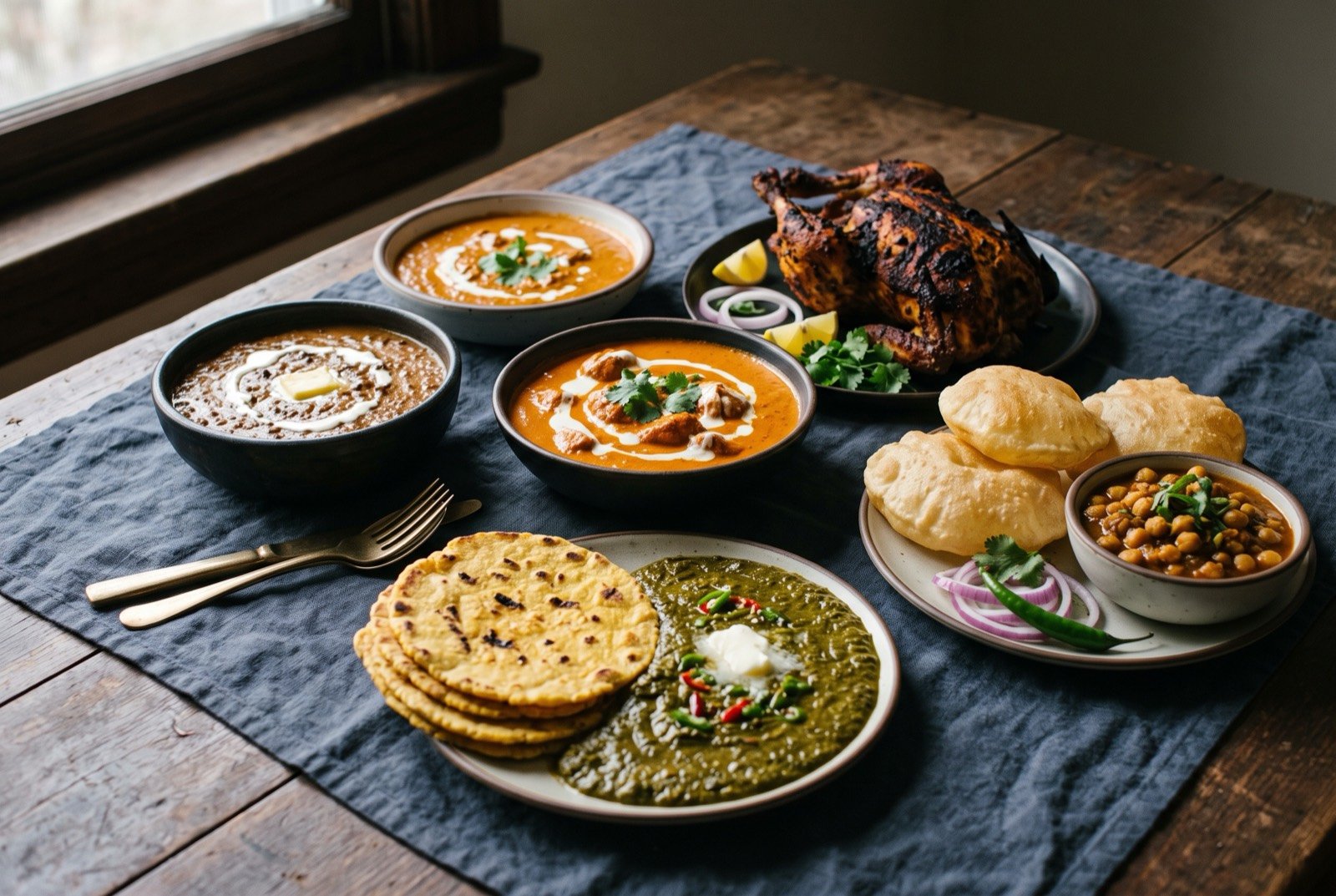
A wheat and dairy world built on some of the most intensively farmed land on earth, split down the middle by a border drawn in five weeks in 1947 that still runs through the middle of what was, and in every way that matters to a kitchen still is, one food culture. Amritsar and Lahore sit under an hour's drive apart and share a river system, a language and a cooking grammar; the border between them now decides which passport you need to eat a dish that used to belong to both cities equally. Delhi sits at the edge of this world rather than its centre, but it is where that world's most famous restaurant story actually happened, and where two families are, as this chapter is written, suing each other in the Delhi High Court over who really invented butter chicken. Every dish as tradition built it, then what a modern chef would change. This chapter tries to hold two things together that most retellings flatten into one: that Punjab's food is genuinely one of the oldest, best-documented wheat-and-dairy cuisines in the world, and that its single most famous export, the tandoori-and-cream register of restaurant Punjabi food most of the world actually eats, is a twentieth-century Delhi invention with only a loose, contested relationship to how Punjab has always eaten at home.
Sources and review · What this chapter does not assert · How we research · Spotted something wrong?
A Sense of Place
Punjab means, literally, the land of five rivers: the Beas, Chenab, Jhelum, Ravi and Sutlej, all Indus tributaries, running down from the Himalayan foothills across a flat, intensively irrigated alluvial plain that has grown wheat continuously for longer than almost anywhere on earth. The 1947 border cut straight across this single ecological unit rather than following any natural line, so a reader should picture not two Punjabs but one Punjab wearing two flags: Indian Punjab today is roughly a third the size of the old undivided province and overwhelmingly Sikh in its rural heartland; Pakistani Punjab is the larger remainder, overwhelmingly Muslim, and is itself Pakistan's most populous province by a wide margin. Delhi sits just outside this river system, on the Yamuna rather than the Indus system proper, but its food became inseparable from Punjab's own after 1947 for reasons this chapter spends real time on.
The wheat-and-dairy logic holds on both sides of the border in a way few things do. Bread, not rice, is the staple starch: atta, whole wheat flour, rolled into roti and paratha at home, or slapped onto a tandoor's clay wall for naan and kulcha in a dhaba. Dairy is not a garnish here but close to a second staple: buffalo milk, not cow's, is the region's dominant dairy source, richer in fat and better suited to the region's own defining technique, hand-churning yoghurt into butter and then clarifying that butter into ghee, a single continuous process this chapter treats as its own technique rung below. Mustard, sown as a winter crop and pressed for its own pungent, pale-gold oil, is Punjab's other defining flavour, especially on the Pakistani side, where a 2026 survey of the country's agriculture ministry found 82 per cent of Pakistan's entire mustard-growing area sits inside Punjab province specifically, feeding both the kitchen and, via its high-protein oilcake, the dairy herd that produces the region's milk.
That dairy herd has a genuinely cross-border name. The Sahiwal, one of the most important dairy cattle breeds on either side of the line, is named for Sahiwal district in central Pakistani Punjab, but its documented breeding tract runs into Ferozpur and Amritsar districts on the Indian side as well; a heat-tolerant, tick-resistant zebu breed and the heaviest milker among the zebu breeds, rich enough in butterfat, 4.5 to 5.5 per cent, that it is essentially a dedicated ghee cow. It is not a metaphor for shared Punjab. It is a literal, living, cross-border agricultural institution that has never noticed the Wagah checkpoint exists.
A table of peoples, logic and dishes
| Region | Defining logic | The dishes that carry it |
|---|---|---|
| Majha, Amritsar and the Golden Temple hinterland | wheat, mustard, buffalo dairy, and a Sikh institution of daily, free, egalitarian eating | dal makhani, sarson da saag, Amritsari kulcha and macchi, lassi |
| Old Delhi, Shahjahanabad | Mughal court cooking pushed downmarket onto the street, decades before Partition | nihari, Karim's aloo gosht, Delhi's own chaat culture |
| Post-Partition Delhi and Indian Punjab's refugee dhabas | tandoor and dhaba culture carried across the new border by displaced Punjabi Hindus and Sikhs | tandoori chicken, murgh makhani, chole bhature |
| Lahore and central Pakistani Punjab | the same wheat-and-dairy world, Muslim-majority, now its own capital | karahi gosht, siri paye, halwa puri, Lahori and Amritsari fish, the fading das kulcha |
| Multan and the Saraiki south | a distinct South Punjab language and food identity, related but not identical to central Punjab's | sohan halwa, moringa and jachnar-blossom curries, Multani chaamp |
The History in Layers
Indigenous core. Wheat and dairy pastoralism on this alluvial plain is genuinely old; several popular sources cite named archaeologists, B.B. Lal's Kalibangan excavations and separately Vasant Shinde's work at Harappan sites, for clay ovens comparable to tandoors alongside charred chicken bones dated to roughly 3000 BCE. This is worth stating carefully rather than triumphantly: it is a real, named claim, not an invented one, but it reaches this chapter only through popular science and heritage journalism, never a peer-reviewed excavation report read directly. Treat it as archaeologists have argued this rather than as settled fact, and hold the two things that are genuinely certain apart from it: that this plain has farmed wheat continuously for an extraordinarily long time, and that the tandoor as a documented, modern restaurant technology has a precise, twentieth-century Peshawar-to-Delhi history this chapter can actually verify, below.
Trade layers. Two separate trade histories run through Punjab, and they left different marks. The older one is the Silk Route and Mughal court kitchen: Lahore and Amritsar both sat on real trading corridors, and the Mughal empire's own Persian-inflected court cooking, keema (the word itself Chaghatai Turkic, qimah, minced meat), tikka, pulao, the whole marinated-and-skewered grammar, filtered down from palace kitchens into the ordinary dhaba over centuries, most visibly in Old Delhi, where Karim's still serves what its founder's own family calls royal food for the common man. The newer, twentieth-century trade layer runs the other way, restaurant Punjab exporting itself outward: after 1947 the tandoor and its cooking repertoire spread, in Pushpesh Pant's own phrase, "from Ladakh to Kanyakumari," carried the length of India by refugees who had nothing else portable to trade in but a technique.
Religion and ritual. The single most important religious institution in this chapter's whole scope is langar, the Sikh community kitchen, and it deserves to be treated as seriously as this atlas treats the Ethiopian fasting calendar or the Yemeni qat hour. Guru Nanak Dev began feeding hungry mendicants with money his father had given him for trade, in the late fifteenth century; his successor, Guru Angad Dev, institutionalised the practice at Khadur Sahib and fixed the custom of sitting together in one row, pangat, regardless of religion, caste, gender or wealth; the third Guru, Amar Das, is credited with the dictum "pahile pangat pachhe sangat", sit and eat together first, only then meet, said to have required even the Mughal emperor Akbar to sit in pangat with commoners before being received. This was a deliberate social intervention against caste hierarchy in Guru Nanak's own lifetime, not a later add-on dressed up as ancient. At the Golden Temple in Amritsar today the Guru Ramdas Langar operates 24 hours a day, 365 days a year, feeding a reported 50,000 to 100,000 people daily, more on festivals, across two halls that each seat up to 5,000 at a time, roughly 90 per cent of the work done by volunteer sevadars peeling, chopping, rolling and serving without payment. The precise daily quantities repeated in popular coverage, roughly 12,000kg of flour and 200,000 chapatis, come from viral secondary reporting rather than a primary institutional account and should be read as indicative of scale rather than as an audited figure. What no source in this chapter's research could pin down, in Punjabi or in English, is exactly which dal is served day to day; that is stated here as a real gap rather than papered over with the commonly assumed answer. On the Pakistani side of the border, Islam shapes the table differently but just as structurally: halal slaughter, no pork, and a Ramadan calendar that gives Lahore's own street food, halwa puri above all, its defining breakfast rhythm.
The Columbian Exchange. Three of this chapter's own defining ingredients are New World imports, arriving centuries after the wheat-and-dairy base was already old. Maize, the grain behind makki di roti, and the tomato that underwrites both karahi and the modern butter-chicken gravy both reached the subcontinent this way; kidney beans, rajma, are native specifically to central Mexico and Guatemala, reaching India via Portuguese trade routes around the sixteenth century, landing first on the southwest coast before spreading inland to become, centuries later, one half of dal makhani's own defining bean.
The colonial economy. British rule reshaped Punjab's agriculture directly rather than incidentally: the canal colonies the Raj built across what is now Pakistani Punjab created entire planned agricultural cities from raw land, Lyallpur, renamed Faisalabad only in 1979, chief among them, engineering the very wheat monoculture this chapter treats as ancient. Independent India's own Green Revolution, launched in 1966 to 1967 after back-to-back droughts forced large wheat imports, chose Punjab as its first implementation site specifically because that colonial-era irrigation infrastructure was already there to build on; by 1970 Punjab alone was producing 70 per cent of India's total food grain. The Revolution's real costs, soil degradation, pesticide-dependent monoculture, indebted farmers, are acknowledged even in broadly celebratory Indian accounts of it, and this chapter does not write around them.
The modern moment, and the rupture that actually organises this whole chapter. Partition, in August 1947, cut British Punjab in two along a line the Radcliffe Commission finished drawing only days before it took effect, and the human cost, an estimated one to two million dead and roughly fifteen million displaced across the whole partitioned subcontinent, was concentrated with particular violence in Punjab itself, the one province split clean through the middle rather than divided at its edges. What this did to food is not, on the evidence this chapter's research actually found, primarily a story of lost recipes. Culinary specialist Vernika Awal's own framing, in a piece written from the Indian side, is the sharpest available: "Partition was not merely the division of land or the displacement of millions of people. It was also the rupture of living cultures, and food was one of the most profound casualties of that upheaval." Families could carry a recipe in memory. What they could not carry across the new border was the actual agricultural ecosystem that had produced it, specific lentil varieties, particular local dairy, a familiar salt, so the loss this chapter is really telling is one of terroir and supply chain as much as of technique.
The clearest, most concrete evidence for this runs through named, dated, checkable cases rather than through any single sweeping claim, and this chapter leans on those cases deliberately. Punjabi Hindu and Sikh refugees fleeing West Punjab, Peshawar, Rawalpindi, Sheikhupura, Lahore itself, after 1947 brought tandoor culture and dhaba culture into Delhi and Indian Punjab wholesale, reshaping both. Kesar Da Dhaba, founded 1916 in Sheikhupura near Lahore, relocated its entire business, and its own claim to have originated the dish that became dal makhani, to Amritsar after 1947, and still trades there under the same family. Kundan Lal Gujral and Kundan Lal Jaggi's Moti Mahal, the single restaurant this chapter's Voices section returns to repeatedly, made the identical journey from Peshawar to Delhi's Daryaganj that same year, and the tandoor itself, not just a recipe for what to put in it, travelled with them. The traffic ran the other way too, and just as concretely: nihari, this chapter can now state with real confidence, is not an old Lahori dish at all, but a genuinely old Mughal-era Delhi one, sold at the steps of Jama Masjid for centuries before Partition, and its presence in Lahore today is itself a dated, documented post-Partition import, carried west from Chandni Chowk by migrating families and taking root in named Lahori shops only from the 1970s onward. Whole neighbourhoods changed hands the same way: Lahore's own Gawalmandi food street exists because families migrating from Amritsar after 1947, unable to find employment, opened small food shops in front of their own new houses, the seed of what is today one of the city's best-known food destinations. And at the most human scale this chapter's research found anywhere, an Amritsari family who had planted a bread tradition called das kulcha in pre-Partition Lahore returned across the new border after 1947, taking their own direct lineage with them; the recipe survived regardless, passed down an unrelated Lahori tandoor family's own oral memory across generations, until it reached one man, Zahid Butt, working near Sheranwala Gate today, who is by every account this chapter could find the last person in the city still making it.
Nobody who lived through this thought of themselves as building two cuisines. A 1941 census gives undivided Punjab's religious composition as roughly 53 per cent Muslim, 29 per cent Hindu, 15 per cent Sikh, living genuinely mixed across districts; some families kept a home in one city and a business in the other. This should not be romanticised into total frictionlessness, food-specific religious caution did exist even then, Hindus were reportedly wary of food cooked by Muslim hands even as they had no comparable hesitation seeking treatment from Hindu or Sikh physicians, a precise, narrow detail worth keeping rather than smoothing away. But the deeper unity chef Amninder Sandhu points to has a specific historical anchor, not a vague sense of shared pre-modernity: the Sikh Empire of Maharaja Ranjit Singh, which bound Lahore, Multan, Peshawar and Kashmir together by trade and culinary exchange for decades before the British annexation of 1849, a genuinely unified food world with a real date on it. The Federal's own reporting names a handful of dishes it calls Punjab's culinary ghosts, Pon di Bhurji, Adrak Di Chitt, Kharode da Shorba, Gobhi Vadi, effectively lost to the rupture, and one still-living case of the border's memory persisting in a dish's own name on the winning side: Lahori Chawal, a rice dish that survives today in Indian Punjab under a name that still marks exactly where it came from, the way Pindi Chole, chickpeas named for Rawalpindi, is now made and eaten far from Rawalpindi, the dish's own name the only surviving trace of its origin point.
This chapter treats the courtroom drama at its own centre, the live Moti Mahal versus Daryaganj lawsuit over who invented butter chicken and dal makhani, as this history's own uncomfortable modern coda: eighty years on, two families both descended from the same 1947 refugee restaurant are fighting in the Delhi High Court over sole legal credit for a dish born, on every honest account, out of a shared, urgent, collective act of post-Partition survival cooking that was never meant to have a single named author at all.
The Flavour Arsenal
Seeds and pods. Mustard seed, pressed for its own pungent, pale-gold oil, is Punjab's defining fat on both sides of the border, structural in sarson da saag in a way no substitute quite replaces; its own seeds also finish achaar. Ajwain, carom seed, recurs across this chapter's whole dish list, in tandoori marinades, in Amritsari macchi's batter, where Romy Gill calls it "the soul of this recipe," and, unusually, as a traditional digestive pairing for fried fish specifically. Garam masala, the region's own warming spice blend, and kasoori methi, dried fenugreek leaf, are the two finishing notes that separate a Punjabi gravy from a generic curry-house one.
Leaves. Sarson, mustard greens themselves, define the region's one unmissable winter dish, cut with spinach and, where it can be found, bathua, a wild green related to fat hen, and methi. Fresh coriander and green chilli, ground raw rather than cooked, run through sahawiq-style relishes and the batter for Amritsari and Lahori fish alike.
Ferments and preserved staples. Dahi, yoghurt, is the base of both the tandoor marinade and the lassi that this chapter treats below as one continuous dairy process with butter and ghee. Achaar, particularly a mixed Amritsari-style pickle built on mustard oil and long sun fermentation, is this region's own preserving discipline, one this chapter is honest about being a real practical barrier for most UK kitchens to replicate from scratch, discussed further in Sourcing below.
Chillies. Green chilli, used raw and generously rather than dried and ground, is the region's own register of heat, present in everything from sahawiq-adjacent relishes to the marinade for tandoori chicken; Kashmiri red chilli, milder and prized for its colour over raw heat, does the work of turning a gravy the characteristic deep red without overwhelming it.
Starches and staples. Wheat, ground into atta for roti, naan and kulcha, is the true staple starch here, not rice; maize, makki, is its winter understudy specifically for makki di roti, milled coarser and handled without gluten's help. Basmati rice, grown further south and east rather than on this wheat plain itself, still carries the region's festive pulao and biryani-adjacent dishes. Urad dal, whole black gram, and rajma, red kidney beans, are the two pulses this chapter's central legume dish is built from, and chana, chickpeas, carry both chole bhature and Lahore's own breakfast chana tradition.
The Technique Ladder
The argument, from inside
Nearly everything that separates a real version of this food from a bad diaspora or takeaway version comes down to heat, time and dairy handled honestly rather than shortcut. Chef Naved Nasir's own blunt point about chicken tikka masala, that it is a genuinely British invention with no Indian original to fall short of, is a useful corrective against forcing every dish in this chapter into a decline-from-authenticity story; but for the dishes that do have a real, documented Punjabi original, tandoori chicken, dal makhani, karahi, the gap between the real thing and its shortcut version is almost always one of these six mechanisms, skipped for speed.
Rung 1. The tandoor: radiant clay heat and the steam-driven wall slap
A tandoor is a large, vase- or bell-shaped clay oven, traditionally buried neck-deep in the ground to concentrate heat where fuel was scarce, though modern commercial and domestic versions are often freestanding. Fired with wood or charcoal, its thick clay walls absorb the internal fire's heat and then radiate it directly onto food, unlike a conventional oven, which mainly surrounds food with hot air; wall temperatures are commonly cited around 480°C, with the point of naan contact closer to 300°C. Flattened dough slapped by hand onto the vertical, red-hot interior wall sticks for two reasons working together: the dough's own tackiness, helped by a light wetting of the underside, and, critically, the moisture inside the dough flashing almost instantly into steam on contact with the scorching clay, that steam pressure pushing outward from inside the dough against the wall is what actually holds bread against a vertical surface without it falling, not stickiness alone, and the same steam drives the rapid puff and blister-char that follows.
What a cook does with this rung. No conventional oven with its door shut can replicate this: there is no vertical hot clay surface to slap dough against, and no oven holds a tandoor's sustained radiant mass. A dedicated home clay tandoor is, unusually for this atlas, a genuine, multiple-supplier UK retail category rather than an extrapolation, and is the honest recommendation for a reader who wants to commit properly. Short of that, a Big Green Egg or other kamado run hot and closed gets closer to the radiant heat and smoke profile for suspended meat than any oven will, though its own dome wall is, by the community's own repeated account, poorly suited to dough-slapping; the workable naan substitute there is a preheated pizza stone or plate setter run around 500 to 600°F, dough laid rather than slapped, with one flip. This is this atlas's own reasoning from the physics rather than sourced Punjabi practice, and is presented as such.
Rung 2. Tadka: blooming whole spice in fat before it meets liquid
Whole spices, cardamom, cloves, peppercorns, cinnamon, are sautéed in hot ghee or butter for a couple of minutes before anything wet joins them, releasing fat-soluble aromatic compounds that plain simmering in a watery gravy would never draw out at all. Sanjeev Kapoor's own butter chicken gravy follows this exactly: butter melted, whole spices bloomed two minutes, ginger and garlic paste sautéed a further two minutes, only then the tomato.
What a cook does with this rung. The tell is smell, not the clock: whole spices are ready the moment their aroma turns from raw to toasted, a matter of judgement rather than a fixed count, and burning them past that point, easily done in the seconds it takes to be distracted, ruins the whole dish rather than merely dulling it.
Rung 3. The ember-simmer: why dal makhani needs unhurried heat, not just long heat
Kesar Da Dhaba, Amritsar, whose own dal makhani predates Moti Mahal's Delhi version, cooks it in a copper vessel for 8 to 12 hours overnight; Bukhara's Dal Bukhara runs 18 hours, put on before the kitchen closes and never taken off the fire until it is served the next day. This is not simply "long cooking": the point is heat low and steady enough that the urad dal's starch breaks down gradually into a genuinely creamy body rather than collapsing into grit, while the whole lentils and beans slowly render fat and gelatine into the gravy around them, a texture no quick pressure-cooked version, however long its total elapsed time, actually reaches.
What a cook does with this rung. A slow cooker or a very low oven overnight is the honest domestic substitute for a dying tandoor's embers; the giveaway that it has worked is texture, a dal that holds together in a spoon rather than one that has simply gone soft, and no restaurant appears to publish its own gram-and-hour recipe for this dish, so a home cook is genuinely reconstructing from technique description rather than following a guarded original.
Rung 4. The dry braise: karahi's no-water rule
Lahore's own defining contribution to karahi gosht, a dish this chapter is honest actually originates in Khyber Pakhtunkhwa's Landi Kotal rather than Punjab, is a specific, named technical rule, stated plainly in Pakistani Urdu food journalism: "کڑاہی گوشت میں واقعی پانی نہیں ڈالا جاتا", water is genuinely not added to karahi meat. The meat is browned hard, then cooked down using only its own rendered fat and the moisture the tomatoes release as they break down, reduced until the liquid has evaporated back into a thick, oily gravy that clings to the meat rather than pooling around it as a stew would. Nihari runs on a related logic over a much longer timescale: some Old Delhi stalls carry over "taar", a small portion of each day's finished stock stirred into the next day's fresh pot, concentrating flavour across time the way karahi concentrates it across a single cooking session.
What a cook does with this rung. Resist the instinct to add water when a pan looks dry partway through; that dryness, followed by the fat separating visibly from the meat, is the actual sign the dish is working, not a sign it has gone wrong.
Rung 5. The double fry: a shattering crust on Amritsari and Lahori fish
A besan-based batter, distinctively flavoured with ajwain, is fried twice at two different points: a first fry, roughly ten minutes, to cook the fish through and set the coating, then the fish is rested and cooled before a short second fry, two to three minutes, purely to crisp and colour the crust. Frying only once, however long, cannot separate these two jobs, cooking the interior and shattering the exterior, cleanly, and tends to leave a coating that is either underdone in the middle or greasy and soft on the outside by the time the centre catches up.
What a cook does with this rung. Let the fish rest fully between fries, ideally to room temperature, rather than returning it to the oil hot; a genuinely cooled first fry is what lets the second fry crisp rather than simply reheat.
Rung 6. The churn: lassi, makhan and ghee as one process, not three ingredients
In traditional rural practice these are not three separate purchases but one continuous domestic act. Yoghurt is diluted with water and churned with a madhani, a wooden dasher; the butter, makhan, separates out and is skimmed off during that same churning, the remaining thin liquid chilled and drunk as lassi, salted or sweetened. Ghee is then clarified from that same butter by slow, patient heating, a caramelised, nuttier result than a quick clarified-butter shortcut gives.
What a cook does with this rung. Real ghee and a cheap substitute fat are not interchangeable in a dish where dairy carries real weight, sarson da saag's finishing knob of butter above all; a reader buying rather than churning should look for a genuine bilona or hand-churned label as the nearest available proxy for what this process actually does, discussed further in Sourcing below.
Sourcing in Britain
Verified this research pass. Britain has one of the largest Punjabi diasporas in the world, and it is genuinely dual: a Sikh Punjabi diaspora, overwhelmingly from Indian Punjab, settled from the 1950s and 1960s, concentrated in west London, the West Midlands and Leicester; and a Pakistani Punjabi diaspora that is itself split between people from Punjab proper and the much larger British Mirpuri or Kashmiri population, roughly 70 per cent of British Pakistanis, ethnically and linguistically close to Punjab but self-identifying as Kashmiri, not Punjabi. This chapter's own research found no UK retail area that is unambiguously Pakistani-Punjabi in the way Southall is unambiguously Sikh Punjabi, and says so rather than inventing a clean symmetry the source material does not support.
The ranked list: what decides great from grim
- Genuine mustard oil, chosen with eyes open about the label. Pure mustard oil sold in Britain carries a "For External Use Only" label, a real regulatory workaround under erucic acid rules rather than folklore; South Asian communities have cooked with it regardless for decades, with no confirmed human toxicity cases behind the restriction, which stems from 1970s animal studies. KTC's own Edible Mustard Oil Blend, a 51 per cent mustard to 49 per cent rapeseed blend legally cleared as genuinely food-safe, sold through Morrisons and Asda, is a real, distinct, milder alternative. For sarson da saag specifically, where mustard oil's pungency is structural, this chapter lays out both honest options rather than picking one silently: the traditional pure oil, used exactly as the diaspora itself does, or KTC's blend.
- Whole, unhulled urad dal for dal makhani, not the split urad dal dhuli sold for other dishes. Widely stocked under NATCO, TRS, FUDCO and other specialist brands; genuinely good rajma is often specifically sourced to Jammu-grown beans in the trade, "laal rajma" prized for meaty texture, "chitra" for a creamier bean.
- Real, chapati-grade atta, not ordinary wholemeal bread flour. Aashirvaad and Pillsbury are the two dominant brands, distinguished from Western wholemeal by a finer grind and by being milled for soft, pliable flatbread dough rather than bread's own gluten development.
- Ghee genuinely made by slow clarification, or the bilona hand-churned method, over a quick industrial shortcut. Amul is the most recognised name; smaller specialist importers marketing themselves explicitly as "bilona" or "A2" are making this quality distinction the point of their product.
- Shan for a Pakistani-Punjabi household's own cupboard, MDH or Everest for a more general Indian one. Shan carries genuine cultural weight beyond retail presence, described as constitutive of Pakistani identity itself; its garam masala omits star anise and fennel, sitting closer to Punjabi than pan-Indian proportions.
- A dedicated home clay tandoor, if committing properly, rather than only a kamado workaround. Unusually for this atlas, this is a genuine, multi-supplier UK product category, not an extrapolation: Tandoor Store, Puri Tandoors, Tandoor Master and Doori all sell real clay charcoal home tandoors, roughly £290 upward. A Big Green Egg is a legitimate, community-attested substitute for naan specifically, using a preheated pizza stone rather than the dome's own wall, but is weaker for a whole roasted joint or skewer, where the geometry of a true tandoor matters more.
- A jarred Amritsari-style achaar, a genuine and honest recommendation, not a compromise. Mother's Recipe "Punjabi Pachranga" is the most consistently available named commercial version; proper Amritsari pickle needs weeks of mustard-oil sun fermentation, a real practical barrier for most UK kitchens, so a decent jar earns its place here differently to how this atlas usually treats a shortcut condiment.
Physical shops and restaurants, by city
Southall, west London, is the flagship, home to the largest Punjabi community outside the subcontinent and Europe's oldest South Asian community, ten gurdwaras including Guru Singh Sabha Southall, one of the largest outside India, serving up to 20,000 langar meals a week. Dokal & Sons and Quality Foods are the area's long-standing cash-and-carry grocers; the Broadway and South Road together function as an open, walkable spice bazaar. Ambala, founded 1965, is the area's best-known sweet shop chain. No named, dedicated fresh-paneer maker or dedicated tandoor and kitchenware shop could be verified physically in Southall, despite direct searching, a real, disclosed gap rather than an oversight.
Birmingham gives two real but distinct South Asian retail clusters, not one: Soho Road and Handsworth, broadly Indian and Sikh-Punjabi-inflected, and Sparkbrook and Alum Rock, explicitly Pakistani-Mirpuri-majority rather than Punjabi. Leicester's Belgrave Road, "the Golden Mile," is majority Gujarati, serving Leicester's smaller Punjabi population alongside its own community, not a Punjabi-specific centre on Southall's model. Wolverhampton is the genuine birthplace of East End Foods, founded 1972 by five Sikh brothers from New Delhi, and KTC, founded the same year by the Sikh Khera family: two of the biggest South Asian grocery brands stocked in every UK Asian grocer trace directly to Sikh Punjabi entrepreneurship in the West Midlands, not to India. Bradford's Manningham Lane is a real, continuous South Asian grocery corridor, but the city's Pakistani community is majority Mirpuri, not Punjabi, and should not be presented otherwise. Glasgow's Pollokshields, Albert Drive and Shields Road, is the thinnest-verified city in this research, one named restaurant and no independently verified named grocer. Wembley's Ealing Road, marketed as "Little India," is overwhelmingly Gujarati and should not be read as a Punjabi retail pocket; Slough is the better-evidenced smaller, real Punjabi and Pakistani-mixed retail example outside Southall, with a named butcher, Punjabi Meat Mart, and several grocers and restaurants.
For eating rather than cooking: Brilliant and Madhu's, both Southall, both Punjabi-with-Kenyan-influence cooking carried by families who left East Africa in the 1970s; Madhu's is reported as the first restaurant in Southall listed in the Michelin Guide. Gymkhana, Mayfair, London's first two-Michelin-star Indian restaurant, is run by the Sethi siblings, described as "Punjabis from Delhi," their newer venture Ambassadors Clubhouse named directly for their maternal grandfather's summer residence in Dalhousie, a hill town historically in Punjab, a genuinely documented family lineage rather than a marketing gesture.
Voices and Sources
From inside the tradition
- Pushpesh Pant, food historian, writing in The Tribune, the single strongest named voice behind this chapter's Partition and displacement material, and the source of its scepticism about single-inventor origin claims.
- Vir Sanghvi, having personally interviewed both the Gujral and Jaggi families, whose own assessment that the true individual history "may be unknowable" anchors this chapter's handling of the butter chicken dispute.
- Marryam H. Reshii and Karishma Kuenzang, whose separate work argues that real Punjabi home cooking is not the cream-heavy restaurant register the world now associates with the name, a corrective this chapter has tried to carry through its own headnotes rather than smoothing over.
- Kesar Da Dhaba, Amritsar, founded 1916 in Sheikhupura by Lala Kesar Mal and his wife Parvati, whose family's own oral, never-written-down dal makhani recipe stands as this chapter's clearest living link between a pre-Partition village dish and its modern restaurant form.
- Zahid Butt, Sheranwala Gate, Lahore, the last keeper this chapter's research could find of the das kulcha tradition, preserved through an unrelated family's oral memory after the Amritsari family who planted it in the city returned across the border in 1947.
- Fazal Din, known as "Phajja," founder of Phajja Siri Paye, Lahore, an institution famous enough to have been fought over in a documented 2015 trademark dispute, though no source could establish its actual founding date.
- Romy Gill MBE, British-Punjabi chef, whose own family recipe for Amritsari macchi, and whose insistence that fish was festive rather than everyday food in Punjabi homes, corrects a real assumption this chapter might otherwise have made.
- Asim Hussain, chef-owner of New Punjab Club, Hong Kong, the first Pakistani restaurant in the world to receive a Michelin star, whose stated identity, "Lahore is a big part of who I am," and whose imported Lahori seekh skewers and his own father's tandoors, is this chapter's clearest example of Lahori technique carried seriously into the world.
- Karam Sethi, Gymkhana, London, whose family holidays in Dalhousie inform a genuinely documented, not merely marketed, Punjabi lineage behind Britain's most critically decorated Indian restaurant.
The gap, named plainly
This atlas has documented, in other volumes, cases where a single well-resourced institution has taken on the work of rescuing a threatened food tradition before living memory of it is lost. No comparable single institution exists for either half of Punjab's own culinary history, on either side of the border; what exists instead is scattered, genuinely excellent individual reporting, Dawn's own recurring "پکوان کہانی" column above all, a real, serious, named-author food-history beat rather than thin content, alongside The Tribune's Amritsar coverage and The Federal's Partition-focused reporting from the Indian side. This is real documentation, but it is journalistic and periodic rather than institutional and systematic, and this chapter names that difference rather than overstating what has actually been preserved.
Things this chapter has deliberately not asserted
- Which specific city, Peshawar or Delhi, and which specific decade, the 1930s or the 1950s, butter chicken was actually invented in. The Gujral family's own public statements contradict each other across time, and no independent primary document exists.
- Which of Kundan Lal Gujral or Kundan Lal Jaggi personally invented butter chicken and dal makhani in the kitchen, or any verdict in the ongoing Moti Mahal versus Daryaganj lawsuit, unresolved as of the most recent reporting located, September 2026.
- Whether Gujral and Jaggi were cousins or unrelated childhood friends and business partners. Sources disagree and this was not resolved.
- The Indus Valley and Harappan "tandoor and charred chicken bones" archaeological claim as settled fact. A real, named claim, reached only through popular science journalism, never a primary excavation report.
- That nihari is an old, indigenous Lahori dish. It is a genuinely old Delhi one; its Lahore presence is a documented, dated post-Partition import.
- That karahi gosht is a Punjabi or Lahori invention. Every source traces its origin to Khyber Pakhtunkhwa's Landi Kotal; Lahore's real, defensible claim is its "no water" technique, not the dish itself.
- That chapli kebab belongs to this volume. It is Peshawar's, and belongs to the neighbouring Pashtun and Frontier volume.
- That the sarson da saag and makki di roti pairing became iconic because of Partition-era street food. Unsourced beyond a cluster of English-language blogs, and contradicted by the dish's much older, better-attested rural working history.
- That Sikhs introduced gajar ka halwa to the Mughal court. Explicitly flagged as legend by the source that carries it.
- Chole bhature's specific Delhi founder. Two separate, unreconciled named lineages exist in the sourcing; both are presented as competing claims.
- Which specific dal is served day to day in the Golden Temple's own langar, or precise, audited figures for its daily quantities. Searched directly in Punjabi and English and not found; the widely repeated figures trace to viral secondary reporting, not a primary institutional account.
- A single, authoritative, dish-by-dish account of pre-Partition unified Punjabi cuisine. The material this chapter draws on is genuinely good but assembled from several partial, named, dated cases rather than one comprehensive source.
- Gujranwala's "city of foodies" reputation, or any distinct Faisalabad culinary identity, at the level of named dishes or real evidence. Both epithets are genuine but could not be substantiated beyond the epithet itself in either English or Urdu-language search.
- Any UK "Moti Mahal" restaurant, including the one trading in Southall since 1972, as a licensed or family-connected outpost of the Delhi Gujral-family brand. Actively searched for and not confirmed; the name is not unique enough in India itself to assume a shared lineage.
- A properly sourced, quantified recipe for Lahori halwa puri, or for nihari with hard gram quantities rather than an indicative reconstruction. Genuine gaps, named rather than papered over with invented numbers.
- A clean "Sikh Punjabi retail centre versus Pakistani Punjabi retail centre" opposition in Britain. The evidence does not support it: Bradford and Birmingham's Alum Rock are predominantly Mirpuri and Kashmiri, not Punjabi, and Wembley's Ealing Road is Gujarati, not Punjabi.
Volume Four of the Indian Subcontinent, Not Just Stew. Research briefs: AS-13-tradition.md and AS-13-modernist-sourcing.md. Sourcing verified September 2026.
The tandoor: radiant clay heat and the steam-driven wall slap
A tandoor is a large, vase- or bell-shaped clay oven, traditionally buried neck-deep in the ground to concentrate heat where fuel was scarce, though modern...
Tadka: blooming whole spice in fat before it meets liquid
Whole spices, cardamom, cloves, peppercorns, cinnamon, are sautéed in hot ghee or butter for a couple of minutes before anything wet joins them, releasing...
The ember-simmer: why dal makhani needs unhurried heat, not just long heat
Kesar Da Dhaba, Amritsar, whose own dal makhani predates Moti Mahal's Delhi version, cooks it in a copper vessel for 8 to 12 hours overnight; Bukhara's Dal...
The dry braise: karahi's no-water rule
Lahore's own defining contribution to karahi gosht, a dish this chapter is honest actually originates in Khyber Pakhtunkhwa's Landi Kotal rather than Punjab...
The double fry: a shattering crust on Amritsari and Lahori fish
A besan-based batter, distinctively flavoured with ajwain, is fried twice at two different points: a first fry, roughly ten minutes, to cook the fish through...
The churn: lassi, makhan and ghee as one process, not three ingredients
In traditional rural practice these are not three separate purchases but one continuous domestic act.
The dishes
- Tandoori chicken Delhi, out of Peshawar
- Murgh makhani (butter chicken) Delhi, Moti Mahal
- Dal makhani Amritsar and Delhi
- Sarson da saag with makki di roti Punjab, both sides of the border
- Chole bhature Delhi, out of Partition
- Amritsari kulcha Amritsar
- Amritsari and Lahori fish Amritsar and Lahore
- Nihari Old Delhi, out of the Mughal court
- Karahi gosht Landi Kotal, by way of Lahore
Sources and review
- Reviewed
- Not yet reviewed from inside the tradition
- Cooked
- Not yet cooked and reported
Where this volume comes from
3 research briefs on file for this volume, researched to the rules on How we research. Published 4 September 2026. Last changed 8 September 2026.
The brief's own account of its sources
Indian Punjab and Delhi thread: roughly 45 sources consulted. Genuinely found via Punjabi-language (Gurmukhi) search: roughly 5 to 6 (Punjabi Tribune, Punjabi Wikipedia entries, Punjabipedia). Genuinely found via Hindi-language search: roughly 8 to 10 (Aaj Tak, Amar Ujala, foodviva.com, Grehlakshmi, The Better India Hindi edition, NextIAS).