The Indian subcontinent · Volume 13, The Tandoor Wall, the Wagah Line and a Contested Butter Chicken
Karahi gosht
Landi Kotal, by way of Lahore
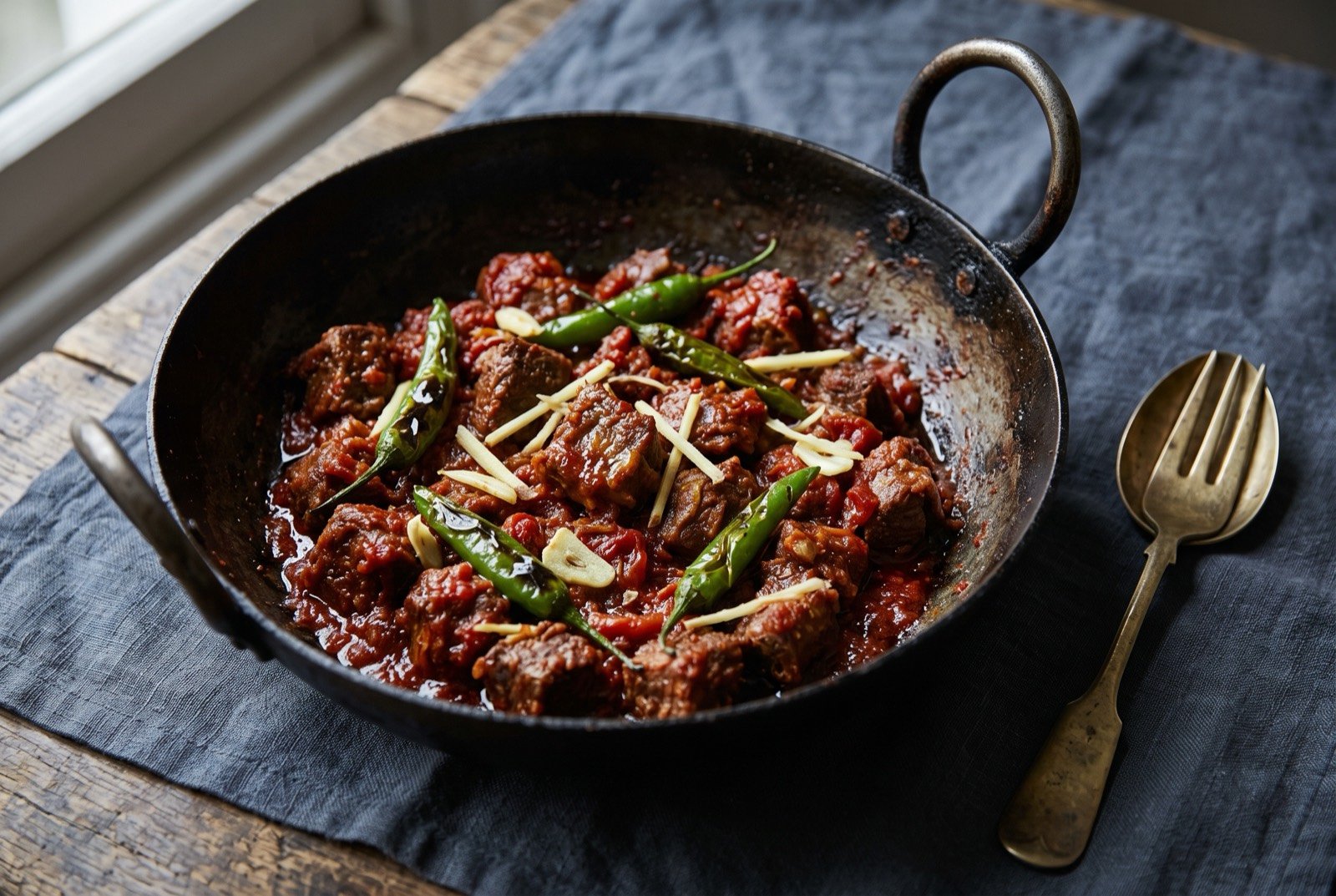
An illustration of the dish, not a photograph of it cooked.
- Time
- 45 minutes
- Reviewed
- Not yet reviewed from inside the tradition
- Cooked
- Not yet cooked and reported
Meat, traditionally goat or mutton, browned hard and then cooked down with tomato, chilli, garlic and ginger in a heavy, round-bottomed karahi, without added water, until the tomato's own liquid has evaporated back into a thick, clinging, oily gravy. Multiple Pakistani sources, in both English and Urdu, trace the dish's real origin to Landi Kotal, a Pashtun town on the Khyber Pass, home to the Shinwari and Afridi tribes, travelling into Punjab and beyond via dhabas and restaurants rather than being invented there. This chapter is honest that karahi is not Lahore's own dish by birth; what is genuinely Lahore's, and Punjab's more widely, is the strict, named "no water" technique that defines how it is cooked correctly today.
As tradition built it
Serves 4 to 6. About 45 minutes.
Ingredients
- 1.8kg goat leg meat, cubed
- 900g tomatoes, chopped
- 7 to 10 green chillies, sliced
- to taste salt
- 0.5 cup oil, or rendered fat from the meat itself
- as available garlic and ginger, added toward the end
Method
- Heat the oil, or the meat's own rendered fat, in a heavy karahi over high heat.
- Brown the goat leg meat hard with salt, in batches if needed, adding no liquid at any point.
- Once the meat has released its own fat, add the tomatoes and chillies, and cook down, uncovered, until the tomato liquid has fully evaporated and a thick, oily gravy clings to the meat, roughly 30 minutes.
- Add the garlic and ginger toward the end of cooking, so they finish rather than stew.
What a modern chef changes
The dry braise judged by fat, not by a timer.
Rung 4
Method
- Watch for the fat visibly separating and pooling at the pan's edge, the genuine sign the dish is ready, rather than cooking to a fixed time regardless of what the pan shows.
- Resist adding water at any point, including if the pan looks close to catching; lower the heat instead, since water at this stage changes the dish into something else entirely, per the technique's own name.
- Use a well-seasoned, heavy karahi or a similarly heavy wok, whose mass holds and evens out the high, sustained heat this dry technique genuinely needs.