The Indian subcontinent · Volume 13, The Tandoor Wall, the Wagah Line and a Contested Butter Chicken
Nihari
Old Delhi, out of the Mughal court
Illustration
- Time
- 12 hours
- Researched
- Researched from 83 sources in the brief
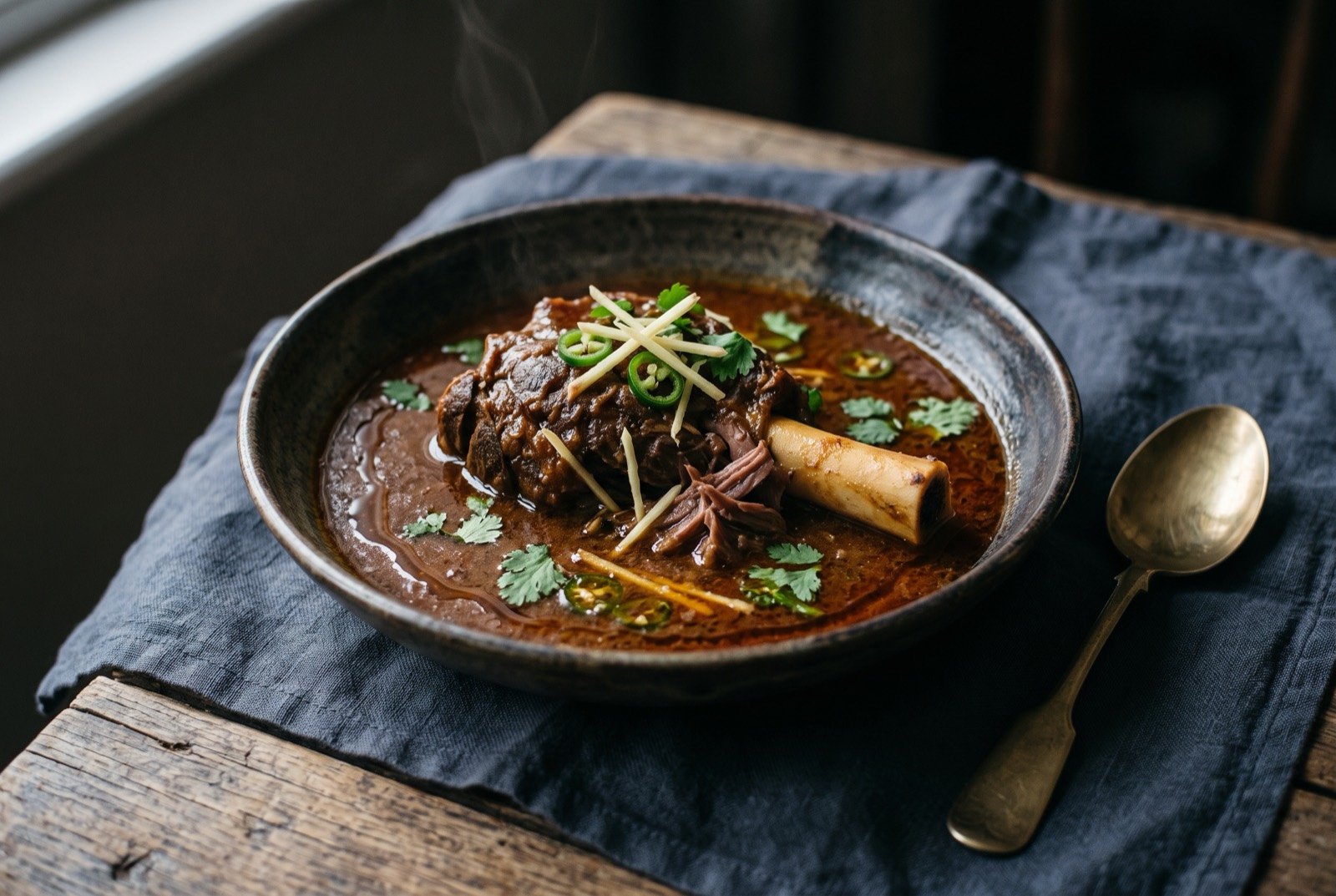
A slow-simmered shank stew, traditionally beef or mutton, cooked overnight so long that some Old Delhi stalls carry over "taar," a small portion of each day's finished stock stirred into the next morning's fresh pot, some claiming an unbroken taar lineage running over a century. The name derives from Arabic nahaar, morning, and the dish was historically eaten by Mughal nobility as a heavy breakfast after Fajr prayer to sustain a day of cold or exertion; sourcing places its real origin in seventeenth-century Delhi, sold traditionally at the steps of Jama Masjid, with Karim's, founded 1913 by a family descended from a Mughal court cook, one of its most visible modern carriers. This chapter can now correct a common assumption: nihari's presence in Lahore is not old at all. Dawn's own reporting names named, dated Lahori shops, Haji Nihari, whose founder's grandson describes his grandfather having sold nihari on Delhi's Chandni Chowk before migrating to Lahore, almost certainly at Partition; Waris Nihari House, founded roughly 1980 by a former butcher who learned the method from a Delhi visitor; Muhammadi Nihari, founded roughly 1965 to 1975. Present nihari as belonging fully to Old Delhi's own pre-Partition tradition, and Lahore's version as a documented, dated post-Partition transplant, not the reverse.
As tradition built it
Serves 6. Overnight, plus at least 4 hours simmering.
Ingredients
The method as the tradition gives it, with the ingredients named. Quantities follow as we verify them, lead dishes first.
- 1.5kg beef or mutton shank, bone-in
- ghee or oil
- onion, ginger, garlic
- whole spices: bay leaf, cloves, black cardamom, cinnamon
- red chilli powder, coriander powder, turmeric
- wheat flour, mixed with water into a slurry
- for garnish fresh coriander, green chilli, ginger julienne, lemon, to finish
Method
- Brown the beef or mutton shank hard in ghee with the onion, then add ginger, garlic, the whole spices and the red chilli powder, coriander powder and turmeric.
- Add water to cover generously, bring to a simmer, and cook, covered, at a bare simmer for at least 4 hours, ideally overnight, until the meat is meltingly tender and beginning to fall from the bone.
- Thicken with the wheat flour slurry, stirred in gradually, and simmer a further 20 to 30 minutes until the gravy coats a spoon thickly.
- Finish with fresh coriander, green chilli, ginger julienne and a squeeze of lemon at the table.
Notes
No source consulted for this chapter gave precise quantities or a full ratio for nihari, unlike this chapter's karahi and fish recipes; the method below is an indicative reconstruction from the dish's consistently described technique and should be adjusted by feel rather than treated as a tested standard.
What a modern chef changes
The reduction treated as the whole point, not a side effect.
Rung 4
Method
- Reserve a small portion of the finished nihari specifically to carry over into your next batch, a home-scale echo of the taar tradition, deepening the base with each repetition rather than starting cold every time.
- Do not thicken the gravy until the very end, letting the long simmer itself do the reducing first, so the flour slurry only needs to finish the texture rather than mask an underdeveloped one.
- Serve the garnishes separately rather than stirred in, so the finished dish's own long-built depth is not diluted by fresh, raw ingredients added too early.