Asia · Volume 19
The Northeast, Assam and the Hill States
The Ash Pot, the Bamboo Basket and a Border the Map Draws Wrong
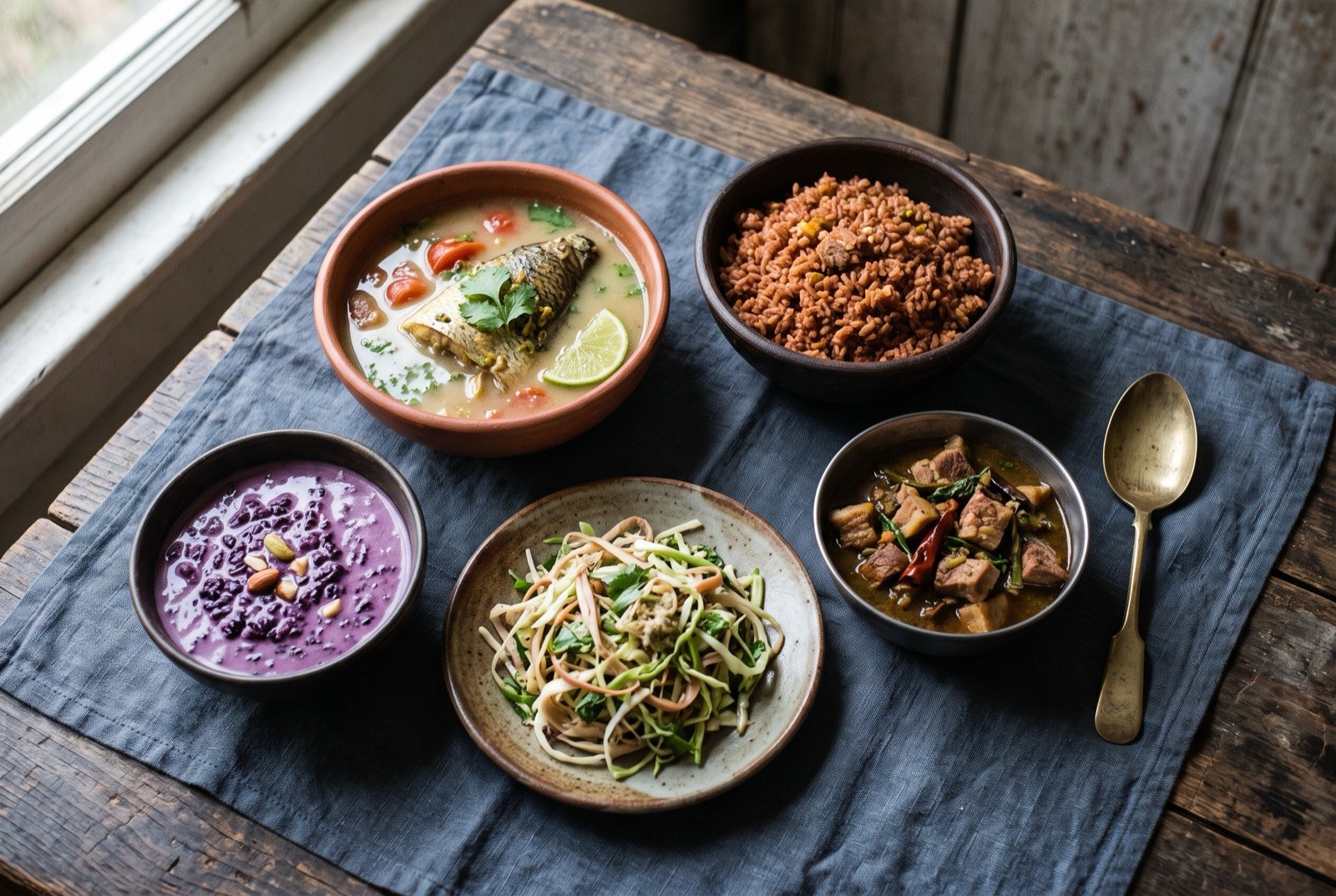
Draw a line from Guwahati to Kohima to Shillong to Imphal to Aizawl and you have crossed, on paper, one Indian state into four more. Cook your way along the same line and the border stops meaning anything. What you find instead is a food world built on fermentation rather than dried spice, on bamboo and forest greens rather than ground masala, on pork and rice as the shared staples of Naga, Khasi, Meitei and Mizo kitchens that otherwise share almost nothing else, and on an alkaline ash water that Assamese Hindu cooks and Garo cooks in Meghalaya reach for by two different names without ever having compared notes. Ecologically and technically this chapter's five hill and valley worlds sit closer to Upper Myanmar and Yunnan than to Delhi or Chennai, and the chapter says so plainly rather than treating that as an aside. It also says, just as plainly, what a tidy "Northeast Indian food" narrative usually hides: Assam's Brahmaputra valley is Hindu, caste inflected and rice wealthy in a way its neighbouring hills are not; Nagaland alone holds sixteen recognised tribes with real culinary differences, and this chapter could find dish level detail for barely half of them; Meghalaya's Khasi, Garo and Jaintia peoples share a state and very little else at the table; Manipur's valley and hills have spent the years since 2023 divided by conflict as well as by ecology; and Mizoram's Presbyterian church has spent the better part of three decades trying to ban the one drink every other hill tradition in this chapter still makes. Fermentation, smoke and rice are the real unity here. Everything else is a border drawn by someone who was not thinking about food.
Sources and review · What this chapter does not assert · How we research · Spotted something wrong?
A Sense of Place
The organising ecological fact is altitude and rainfall rather than any single crop. The Brahmaputra valley floods every monsoon and drains rich silt across the plain, which is why Assam grows rice wealthy enough to support both a caste hierarchy and, further up its own hills at Dima Hasao, a genuinely different Dimasa foodway barely thirty miles from the valley floor. Climb into Nagaland, Meghalaya's plateau, Manipur's surrounding hills or Mizoram's ranges and rice remains the staple but stops being reliably irrigated: it shares the terrace with maize, millet and above all bamboo, which grows fast enough on these slopes to function as a renewable building material, a cooking vessel and a fermentable vegetable all at once. Refrigeration never existed here until very recently and salt had to be carried in over hill tracks, which is the whole reason this chapter's food runs on fermentation and smoke rather than the oil and ground spice of the plains further west: a pig slaughtered at Christmas or for a festival has to survive months without either, and hanging it in strips above the household fire, or packing soybean, taro leaf, mustard green, fish or bamboo shoot into a leaf parcel and letting bacteria already living on the leaf do the preserving, are the two technologies that make that possible.
Peoples, defining logic, dishes that carry it
| People or place | Defining ecological or social logic | Dishes that carry it |
|---|---|---|
| Assamese Hindu, Brahmaputra valley | A meal traditionally opens with khar and closes with tenga rather than combining them; caste history still shapes who eats boiled rice and dal with whom | Masor tenga, khar, hah mangxo, pitha |
| Tea garden Adivasi, the "Tea Tribes" | Descended from indentured central Indian labour brought in from the 1860s onward; keep a festival calendar and drink of their own, distinct from Assamese Hindu practice next door | Haria rice beer, Karam Puja food |
| Sümi Naga | Bacillus fermented soybean, three to seven days, as the region's most internationally documented ferment | Axone, smoked pork with axone |
| Ao Naga | Fermented taro leaf, a genuinely different microbiology from soybean fermentation | Anishi |
| Angami and Chakhesang Naga | Rice beer brewing as a living but, by Nagaland's own press, declining ritual craft | Zutho, galho |
| Zeliangrong Naga (Zeme, Liangmai, Rongmei) | Smoked pork simmered with fermented bamboo shoot at the Assam-Manipur-Nagaland tri-junction | Smoked pork with bamboo shoot |
| Khasi | Matrilineal land and market control; rice cooked in pork stock enriched with pork blood | Jadoh, tungrymbai, doh nei-iong |
| Garo and Jaintia, Meghalaya | Share a state with the Khasi and are not the same food, and are markedly thinner documented in English | Nakham bitchi, kharang, kiad |
| Meitei, Manipur valley | A women run market economy (Ima Keithel); an anaerobic fish ferment that runs six months to a year, far longer than any other ferment in this chapter | Singju, chak-hao kheer, ngari, eromba |
| Kuki-Zo, Manipur hills | Fermented mustard leaf as a staple; a four course Zomi meal structure; a food culture reshaped by displacement since the 2023 conflict | Ankamthu, sathu, mehpok |
| Mizo | Christian identity actively suppressing the one tradition, rice beer, that every other hill people in this chapter still keeps | Bai, bekang, sa-um, sawhchiar |
The History in Layers
The deepest layer here is not political but microbial: an eastern Himalayan and upper Southeast Asian fermentation belt that runs, unbroken by any modern border, from Assam through Nagaland, Manipur, Mizoram and Meghalaya into Myanmar's Kachin and Sagaing regions and on into Yunnan. The Slow Food Foundation's own documentation of axone states this plainly, and Naga oral tradition among the Konyak specifically traces their own migration from the upper Irrawaddy valley in present day Myanmar. Burmese pè bok is the same Bacillus fermented soybean under a different name, and Yunnan's sour bamboo shoot relies on the same lactic acid bacteria as Assamese khorisa and Manipuri soibum. This chapter treats that continuity as the region's real ecological identity, and treats the Republic of India's eastern border, which cuts straight through it, as the historically recent overlay that it is.
Assam's own pre colonial history is genuinely deeper than the rest of this chapter's, thanks to the Ahom kingdom, founded by the Tai leader Sukaphaa and ruling much of the Brahmaputra valley from 1228 to 1826. The Ahom are credited, in at least one academic source, with the khar tradition itself, alongside eri silkworm cookery and bamboo cooked rice, though the Ahom court's own chronicles, the buranjis, are administrative and genealogical records rather than culinary ones, and this chapter found no primary source describing an actual Ahom court kitchen. Sankardev's fifteenth and sixteenth century Ekasarana bhakti movement layered a second, genuinely distinct food world onto the Hindu valley: its sattra monasteries eat strictly vegetarian, without onion or garlic, a discipline that appears to sit apart from ordinary Assamese Brahmin households, where chicken, mutton, duck and fish are all commonly eaten, though the contrast rests on partial sourcing rather than one settled comparison and this chapter states that honestly rather than smoothing it into a tidier claim than the evidence supports.
Empire arrived in Assam specifically as a tea economy, and it is worth being precise about what that actually did to the region's food, because it created two entirely separate populations rather than one. Wild Camellia sinensis var. assamica was identified in Assam's forests in 1823 by Robert Bruce of the East India Company, and by 1862 the Assam Tea Company alone oversaw more than 160 gardens, worked by roughly a million indentured labourers recruited from Chota Nagpur, today's Jharkhand and Odisha, from the 1860s onward. Recruiters reportedly told prospective workers that money grew on Assam's tea trees and that they could pick it themselves; families were deliberately split across different gardens. Those communities, now grouped under a shared Adivasi political identity uniting some sixty distinct tribal groups still fighting for Scheduled Tribe status, kept their own festival, Karam Puja, and their own drink, haria, entirely separate from the Assamese Hindu valley culture around them. A second, wholly different population, Anglo-Indian planter families, ran the same gardens and cooked a third cuisine again: European cakes, pastries and stews adapted to local aromatics, documented almost entirely through one family's handwritten recipe notebook and now nearly vanished as planter families left after independence. One food writer who worked from that notebook calls colonial food history "a blind spot in Assam," and this chapter repeats that admission rather than papering over it with invented detail. Three genuinely separate culinary populations, indentured Adivasi labourers, Anglo-Indian planters and Assamese Hindu valley households, share one geography in this chapter's Assam section, and should not be read as one story.
The hills tell a different colonial story again, and it is a religious one more than an economic one. British and American missionary contact from the 1890s onward, above all in Mizoram, converted the great majority of the hill population to Christianity within a couple of generations; Mizoram is roughly 87 per cent Christian today. The academic literature is direct about the consequence: Mizo culture has been, in one paper's own phrase, "blatantly influenced" by Western culture in food as in dress and music, the pre-Christian festival calendar faded, and Christmas replaced it as the primary festival, with active efforts now under way to revive the older Chapchar Kut. The clearest single fact this produced sits at the centre of this chapter's fermented drinks section below: the Presbyterian church, which counts roughly half of Mizoram's population as members, pushed the state to ban rice beer outright in 1997, a ban that held eighteen years, lifted in 2015, and was reimposed in 2019. Nagaland's hills carry a harder history still, the mid twentieth century Naga insurgency and decades of continuing political negotiation with the Indian state, which this chapter does not attempt to narrate; what belongs here is only the honest observation that Nagaland's own English language press, cited throughout this chapter, writes about food from inside that history rather than around it, and that a Naga owned restaurant opening in Kohima in 2009, at a moment of real civic tension in the town, did so explicitly to bring community life back, which is a food fact worth keeping even where the politics behind it are not this book's subject.
Manipur's modern layer is the most recent and the least settled. The Meitei-Kuki violence that began on 3 May 2023 cut supply chains between the Imphal valley and the surrounding hills, driving up commodity prices and disrupting agriculture, fisheries and trade between exactly the two populations, Meitei valley and Kuki-Zo hill, that this chapter treats as distinct food worlds. This chapter states that disruption as fact and does not adjudicate the conflict's causes or its rights and wrongs; it matters here only because it has genuinely reshaped the record available to research Kuki-Zo food since 2023, and because the strongest single piece of writing this chapter found on Kuki-Zo cooking treats the pantry itself, specifically the fermented mustard leaf ankamthu, as an act of cultural survival under displacement, which is now honestly part of that food's history rather than an unrelated backdrop to it.
The most recent layer across the whole chapter is institutional recognition, arriving late and unevenly. Naga king chilli became, in December 2008, the first product from Nagaland to receive a Geographical Indication tag; chak-hao black rice and joha rice hold their own GI protections; Dimasa judima rice wine was GI-tagged as recently as 2021. Against that same institutional backdrop sits a genuinely uncomfortable fact, documented by Naga anthropologist Dolly Kikon: in 2007, Delhi Police issued a handbook cautioning Northeast Indian students and migrant workers in the capital against cooking akhuni and other fermented foods in shared housing, an official document treating a defining Sümi Naga ingredient as a public nuisance. Both things, the GI tags and the police handbook, are true of the same decade, and this chapter holds them together rather than choosing the flattering one.
The Flavour Arsenal
Ferments and preserved proteins
| Ingredient | What it does |
|---|---|
| Kolakhar (khar) | An alkaline filtrate from burnt banana peel or pseudostem ash, chiefly bhim kol banana; its alkalinity comes from potassium carbonate, and it opens an Assamese meal as both a cooking liquid and, historically, a salt substitute |
| Khorisa, bastenga, soibum | Fermented bamboo shoot under three names for genuinely different techniques: Assamese khorisa in pits or pots, Naga bastenga packed in bamboo baskets for two to three weeks, Manipuri soibum sealed for three to twelve months, the longest of the three by a wide margin |
| Axone/akhuni | Sümi Naga Bacillus fermented soybean, boiled, leaf wrapped and fermented above the fireplace three to seven days, pounded to a coarse crush rather than a smooth paste |
| Anishi | Ao Naga fermented taro leaf, wrapped and left to yellow about a week, then ground, pressed into cakes and smoked or sun dried; a genuinely different microbiology from axone, not an interchangeable "Naga ferment" |
| Tungrymbai | Khasi and Jaintia Bacillus fermented soybean, related to axone but its own tradition, with a distinctive charcoal smoking step inside the fermenting basket that axone's method does not share |
| Hawaijar | The Meitei valley's own alkaline soybean ferment, three to five days, unsalted and sticky, a third genuinely separate soybean tradition alongside axone and tungrymbai |
| Ngari | Manipuri fermented fish, salted, sun dried three to four days, then sealed in clay for six months to a year, the slowest and longest ferment in this whole chapter |
| Hentak | A Meitei paste of dried powdered fish and alocasia petiole, fermented sealed seven to nine days, traditionally given to expectant mothers |
| Bekang | Mizo fermented soybean, boiled with a little wood ash, ready in three days, directly comparable to Japanese natto |
| Sa-um | Mizo fermented pork fat, packed and held over the fireplace three days or slightly more; genuinely linked in peer reviewed research to elevated Type 2 diabetes risk in the Mizo population, a fact worth carrying alongside its flavour |
| Judima, zutho, kiad, haria | Four distinct rice beers or wines, Dimasa, Angami/Chakhesang, Jaintia and tea garden Adivasi respectively, none of them one tradition under different names, and one of them, Mizo zu, banned rather than brewed |
Chillies
| Ingredient | What it does |
|---|---|
| Bhut jolokia, raja mircha, u-morok | One chilli under three regional names, Assamese, Naga and Manipuri; GI protected to Nagaland since 2008 as "Naga Mircha" |
Seeds and aromatics
| Ingredient | What it does |
|---|---|
| Perilla seed (bhangjeera, thoiding) | A nutty, faintly aniseed thickener in Naga and Manipuri cooking, the same plant as the Korean pantry staple deulkkae |
| Black sesame (nei-iong) | The Khasi flavouring base for doh nei-iong, roasted and ground to a thick paste |
| Thekera, ou tenga | Two distinct Assamese souring fruits, Garcinia pedunculata and elephant apple, not interchangeable with each other or with tamarind |
Starches and staples
| Ingredient | What it does |
|---|---|
| Joha rice | Assam's short grain, naturally aromatic rice, GI protected since 2017, occupying only about five per cent of the state's rice growing area |
| Chak-hao | Manipur's glutinous, anthocyanin rich black rice, a genuinely different grain from Chinese "forbidden rice" despite the resemblance |
| Bamboo | Staple, cooking vessel (chuanga saul, bamboo cooked rice) and fermentable vegetable all at once across every hill tradition in this chapter |
| Taro | Ao Naga anishi's raw material, and a shared hill vegetable wherever rice terracing is not reliable |
The Technique Ladder
Rung 1. Burn the ash, then filter it, not the other way round
Kolakhar is made by sun drying banana peel or pseudostem for about a week until completely free of moisture, then burning it; water is poured over the cooled ash and filtered through cloth once it has settled overnight. The chemistry is potassium carbonate leaching into the water as a genuine alkali, not a flavouring trick, which is why khar tenderises pulses and vegetables and why it was historically a salt substitute in a region where salt had to be carried in.
Rung 2. Ferment soybean with heat and smoke, not just time
Axone's method is specific: soybeans boiled until tender, wrapped in banana or Macaranga leaf, and set on a shelf above the household fire, not simply left at room temperature, for three to seven days, longer in winter, judged ready "when it smells right" rather than by the clock. Tungrymbai does the same fermentation with an added step, hot charcoal blocks placed directly on the leaf wrapped beans inside the basket, a materially different technique from axone's method even though both are the same Bacillus fermentation on the same bean.
Rung 3. Match the fermentation timeline to the raw material, not to habit
This chapter's ferments range from three days (bekang, sa-um) to three to seven days (axone) to two to three weeks (bastenga bamboo shoot) to three to twelve months (soibum bamboo shoot) to six months to a year (ngari fish). Treating "fermented" as one instruction rather than a spectrum of very different timelines is the single easiest way to get any of these ingredients wrong at home.
Rung 4. Smoke as the primary preservation method, not a finishing flavour
Naga hearth smoking hangs pork strips above the household fire for days, sometimes weeks, at a genuinely low, indirect heat, the goal being a firm, deeply smoke permeated, semi dried result rather than the moist, pulled texture a British barbecue aims for. The same low, extended, indirect logic, not a quick hot smoke, is what a Big Green Egg needs to be told to do if it is going to approximate this rather than produce conventional barbecue.
Rung 5. Boil and stew in minimal oil, and let fermentation carry the seasoning
Bai, tenga and most of the dishes in this chapter carry almost no ground spice and very little oil; the savoury depth comes from a fermented ingredient, bekang, ngari, khar, axone, doing the work that a fried onion and ground masala base does further west. This is the clearest single line separating this chapter's cooking logic from the rest of the Indian subcontinent, and it is also, not coincidentally, the logic shared with Upper Myanmar and Yunnan on the other side of the border.
The Ferment and Preserve Bench
This chapter has more genuinely distinct fermentation traditions than any other in the atlas so far, and the house style's caution against flattening applies here more than anywhere: axone, tungrymbai, hawaijar, bekang and akhone are not one ferment under five names, they are five related but separate Bacillus subtilis fermentations, run by the Sümi Naga, Khasi and Jaintia, Meitei, Mizo and other Naga communities respectively, differing in wrapping material, smoking or charcoal steps, and timeline. Kolakhar is a different chemistry entirely, an alkaline ash extraction rather than a bacterial fermentation, and should never be described as a ferment. Fermented bamboo shoot runs a third, lactic acid fermentation, with a genuinely enormous range of timelines depending on tradition, from bastenga's two to three weeks to soibum's three to twelve months. Ngari and hentak run a fourth process again, salted, sun dried fish sealed anaerobically for six months to a year, by far the longest and slowest process in this bench. A reader building a home fermentation habit from this chapter should keep all four processes mentally separate rather than treating "Northeast Indian fermentation" as one skill.
For a home version of axone: boil 500g dried soybeans until fully tender, roughly two hours, drain hot and wrap in banana leaf or, in its absence, a well washed fig or vine leaf, then set the parcel somewhere warm, ideally with a little ambient smoke from a wood fired oven or barbecue nearby, for three to seven days, checking daily; it is ready when the aroma turns distinctly pungent and ammoniacal rather than simply beany. Pound to a coarse crush rather than a smooth paste before using. Given the difficulty of sourcing genuine Sümi Naga leaf and hearth conditions in Britain, treat this as an approximation worth attempting rather than a guarantee of an identical result, and see the natto substitution used throughout the dishes above as the more reliable weeknight option.
Sourcing in Britain
This is the one volume in this atlas so far with no dedicated specialist grocer of its own anywhere in Britain. The Naga diaspora here is small and organised around advocacy rather than retail, and a reader cooking this chapter is assembling ingredients from four or five unrelated communities' shops rather than one specialist source, which is worth knowing before you start rather than discovering halfway through a recipe.
Bhut jolokia, raja mircha, u-morok, one chilli under three names, is the best served ingredient in this whole chapter. South Devon Chilli Farm sells fresh Bhut Jolokia direct in season, and Sea Spring Seeds sells fresh Dorset Naga, a related but distinct UK bred cultivar, close in heat and character but not the identical Assamese landrace. Fresh Naga Morich also moves through the British Bangladeshi grocery trade, flown from Bangladesh; Kashmir Watan Foodstores in Preston and One Stop Chilli Shop both list it for UK delivery. Dried and powder forms are well established through Chilli Wizards, Spices on the Web and The Rye Spice Co, and for a sauce, Weymouth 51 Dorset Naga Chilli Sauce, genuinely UK grown with fifty per cent real chilli content, is the house pick.
Fermented bamboo shoot in its genuine Assamese or Naga form is not available from any UK retailer. Sous Chef's fermented hot bamboo shoot and Thai Food Online's preserved and sour bamboo shoot range are the realistic substitute, the same lactic acid fermentation as khorisa and soibum run on Southeast Asian bamboo rather than the Indian article, close enough to be genuinely useful and honest enough not to claim as identical.
Axone, bekang and hawaijar are not obtainable in the UK in any form. Peer reviewed research confirms all three, along with Japanese natto and Korean cheonggukjang, share Bacillus subtilis as the dominant fermenting organism, producing the same family of umami compounds, which is why this chapter recommends natto, well stocked at Japan Centre, Yutaka Shop and Starry Mart, as the working substitute throughout, mashed and cooked out rather than served in its raw, sticky form.
Chak-hao has no confirmed UK stockist. Thai black glutinous rice, from Thai Food Online or Tuk Tuk Mart, is the better substitute over Chinese "forbidden rice," since it shares chak-hao's defining sticky texture even though it is a different regional variety.
Perilla seed, Naga bhangjeera and Manipuri thoiding, is one of the cleanest crossovers in this whole atlas: it is the same plant as the Korean pantry staple deulkkae, and Starry Mart's Choya Perilla Seed Powder is a genuine, not an approximate, match.
Elephant apple and thekera are genuinely unobtainable in the UK, fresh or dried, from any retailer found. Green mango is the closest honest substitute for masor tenga's sourness, with dried kokum a second choice and tamarind, sweeter and more resinous, the least accurate but most accessible fallback.
Joha rice, judima and zutho cannot currently be sourced in Britain at all. Use a fragrant Thai jasmine rice in joha's place, and treat the rice beers as something to describe to a dinner table rather than pour for one.
Ranked, the ingredients that decide great from grim
- Bhut jolokia in any form, since it carries this chapter's defining heat and fruitiness and is the one ingredient here you have no excuse to get wrong.
- Fermented bamboo shoot, even in its Southeast Asian substitute form, since omitting it changes a dish more than any honest substitution does.
- Axone or its natto substitute, without which Naga pork and bamboo dishes read as generically spiced rather than specifically Naga.
- A considered souring agent for masor tenga, green mango over a reflexive reach for the tamarind jar.
- Perilla seed, a smaller lever but one with no excuse for being skipped given how easily Korean grocers solve it.
Voices and Sources
Chef Joel Basumatari, founder of Slow Food Community Nagaland and a member of the Slow Food Foundation's international Chefs' Alliance, is the single strongest internationally documented figure in this chapter, having represented Nagaland at Slow Food's Terra Madre Salone del Gusto in Turin in 2014, 2016 and 2018, and his own stated philosophy, that Northeast cuisine needs innovation without ever losing touch with tradition, is close to this atlas's own argument. Chef Atul Lahkar of Heritage Khorikaa, Guwahati, remains Assamese cooking's clearest international touchpoint, via a 2009 appearance on Gordon Ramsay's Channel 4 series, now well over a decade old, and this chapter states that datedness honestly rather than implying a currency it does not have. Rynsan in Shillong, opened in 2022 by creative directors Hammarsing Kharhmar and Riyaki Jana, was named among India's Top 50 Restaurants in the Condé Nast Traveller India and Zomato Top Restaurant Awards 2025, the single most credible mainstream recognition found for any restaurant in this chapter, though a recent and national rather than international one, and no head chef could be identified in any source for this research. Kabyashree Borgohain's Project Otenga in Delhi, named for the elephant apple, and Nagaland's own Rovi Chasie, author of the pioneering Naga Cuisine: Ethnic Flavours, both represent the same project this book pursues: elevating an indigenous tradition on its own terms rather than smoothing it into something more generically palatable, in Borgohain's own words refusing to make the food "palatable to an imagined universal Indian diner." Tangkhul Naga writer Susan Zingkhai and Zomi writer Biaki Hangshing were the two most valuable first person, in tradition voices this research found, describing daily village cooking and the Zomi four course meal structure respectively with a specificity that secondary food writing about this region rarely reaches. Naga anthropologist Dolly Kikon's scholarship on akhuni and its treatment by the Indian state is the strongest single piece of writing this research found on why this region's food has struggled institutionally in mainland India, and deserves to be read in full by anyone taking this chapter further than a home kitchen.
Things this chapter has deliberately not asserted
- That "khar-tenga-mitha" is a fixed, named three part organising principle of an Assamese meal. Khar and tenga are certainly real and load bearing, but a formal "mitha" third leg did not survive independent Assamese language search and may be an English language simplification.
- That axone, tungrymbai, hawaijar and bekang are the same ferment under different names. They are related but genuinely distinct traditions, differing in community, wrapping material and, in tungrymbai's case, a materially different charcoal smoking technique.
- That there is a single, unified "Naga cuisine." Eight of Nagaland's sixteen officially recognised tribes, Chang, Khiamniungan, Phom, Pochury, Rengma, Sangtam, Yimchunger and the Nagaland Kachari, have no dish attributed to them in the English language sourcing this chapter could reach, and that gap is stated rather than filled with an invented dish list.
- That rice beer is uniformly celebrated across the hill states. It is legally banned in Mizoram under sustained Presbyterian church pressure, and described as a dying tradition even in Nagaland by Nagaland's own press.
- That chak-hao carries Slow Food Ark of Taste status. Searches found only Geographical Indication and commercial sourcing, no Ark of Taste listing.
- That any Northeast Indian restaurant or chef currently holds Michelin recognition, or a place on Asia's or the World's 50 Best lists. None was found, and the closest international touchpoints, Chef Lahkar's 2009 television appearance and Chef Basumatari's Slow Food links, are both real but neither is that.
- That a UK restaurant, pop up or specialist grocer serving this region's food currently exists. Deliberate search found none, and one London restaurant using the word "Naga" in its branding refers to chilli heat rather than Nagaland or Naga cuisine, and should not be mistaken for either.
- That Garo cuisine within Meghalaya, or Mizo food culture generally, is as well documented as Khasi or Naga cooking. Both rest on markedly thinner, more tourism adjacent sourcing, and this chapter's dish list reflects that imbalance rather than inventing parity. And, most importantly, that the 2023 conflict in Manipur is a settled or fully understood subject: this chapter reports only its documented effect on food supply chains and on the difficulty of researching Kuki-Zo food culture since, and takes no position on causes or blame.
Burn the ash, then filter it, not the other way round
Kolakhar is made by sun drying banana peel or pseudostem for about a week until completely free of moisture, then burning it; water is poured over the cooled...
Ferment soybean with heat and smoke, not just time
Axone's method is specific: soybeans boiled until tender, wrapped in banana or Macaranga leaf, and set on a shelf above the household fire, not simply left at...
Match the fermentation timeline to the raw material, not to habit
This chapter's ferments range from three days (bekang, sa-um) to three to seven days (axone) to two to three weeks (bastenga bamboo shoot) to three to twelve...
Smoke as the primary preservation method, not a finishing flavour
Naga hearth smoking hangs pork strips above the household fire for days, sometimes weeks, at a genuinely low, indirect heat, the goal being a firm, deeply...
Boil and stew in minimal oil, and let fermentation carry the seasoning
Bai, tenga and most of the dishes in this chapter carry almost no ground spice and very little oil; the savoury depth comes from a fermented ingredient...
The dishes
- Masor tenga Assam
- Omita khar Assam
- Hah mangxo Assam
- Smoked pork with fermented bamboo shoot Nagaland, Zeliangrong Naga (Zeme, Liangmai, Rongmei)
- Smoked pork with axone Nagaland, Sümi Naga
- Jadoh Meghalaya, Khasi
- Doh nei-iong Meghalaya, Khasi
- Singju Manipur, Meitei
- Chak-hao kheer Manipur, Meitei
- Bai Mizoram, Mizo
Sources and review
- Reviewed
- Not yet reviewed from inside the tradition
- Cooked
- Not yet cooked and reported
Where this volume comes from
3 research briefs on file for this volume, researched to the rules on How we research. Published 4 September 2026. Last changed 8 September 2026.
The brief's own account of its sources
Roughly two thirds of the citations behind this brief are local or in-tradition: Assamese-language press and Wikipedia, Nagaland's own English-language press (Morung Express, Eastern Mirror), the Slow Food Foundation's community-sourced Ark of Taste entries, peer-reviewed food-science papers by researchers working with these communities directly, and first-person writers from inside the traditions (Susan Zingkhai, Tangkhul; Biaki Hangshing, Zomi; Madeline Tham, Khasi; Rovi Chasie, Naga).