The Indian subcontinent · Volume 19, The Ash Pot, the Bamboo Basket and a Border the Map Draws Wrong
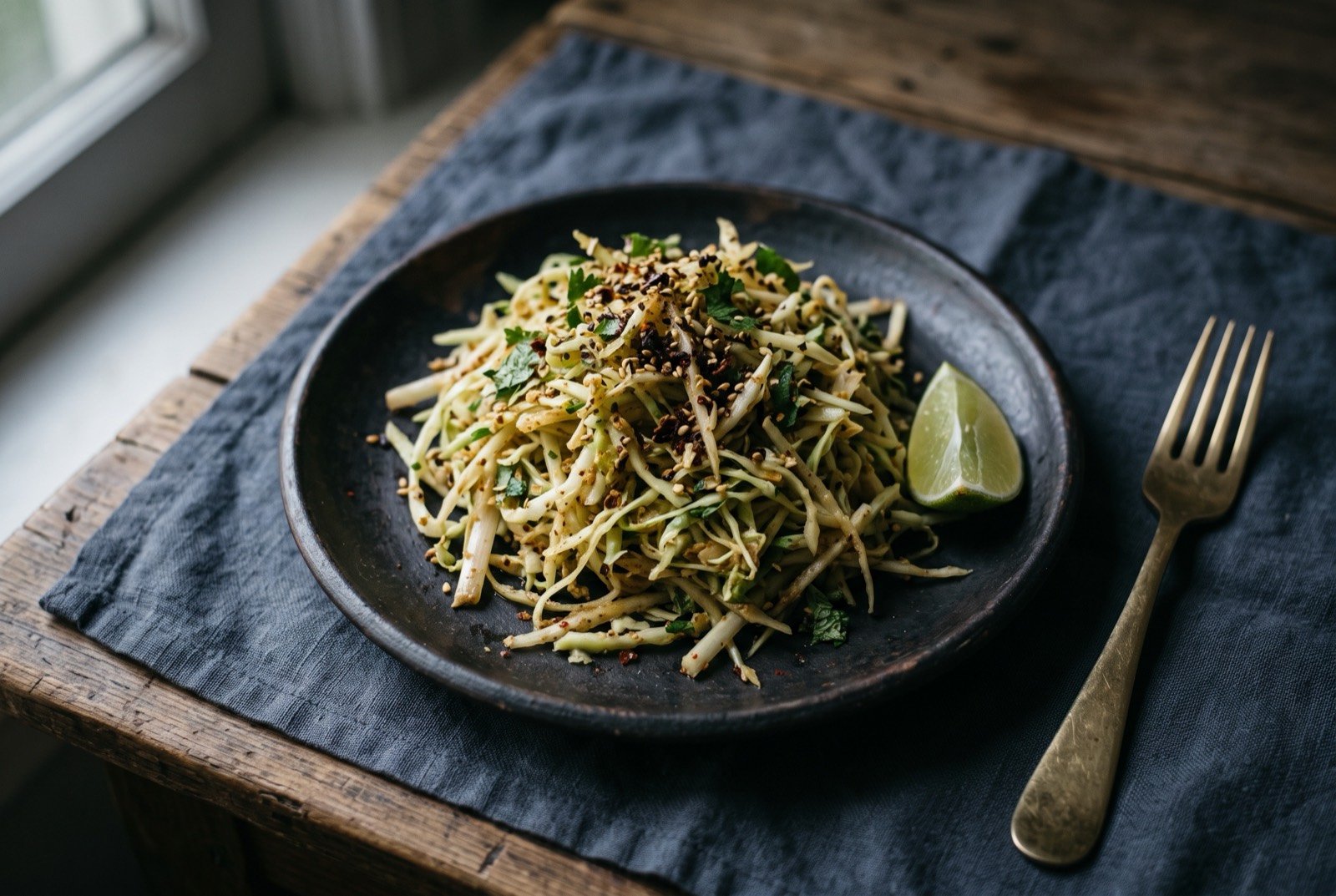
Singju
Manipur, Meitei
Illustration
- Time
- 20 minutes
- Researched
- Researched from 121 sources in the brief
A raw vegetable salad from Meitei culture that has since spread across most of Manipur's other communities, existing in two real variants: a ngari based version, more expensive and traditionally the more esteemed of the two, and a thoiding-besan based version, built on roasted perilla seed and chickpea flour, cheaper and more commonly sold from street carts.
As tradition built it
Serves 4. About 20 minutes.
Ingredients
For the salad
- 200 g white cabbage, shredded
- 100 g raw papaya, shredded
- 50 g lotus stem, thinly sliced
- 1 small red onion, sliced
- A handful a handful of chive, chopped
- A small handful a small handful of basil leaves
- 50 g white peas, boiled
- A squeeze lime juice, a squeeze
- A small handful a small handful of coriander, chopped
For the thoiding-besan dressing
- 2 tbsp gram flour
- 1 tbsp perilla seed
- 1/2 tsp salt
- 1 tsp dried chilli, crushed
- A small piece for the ngari version: a small piece of roasted ngari, mashed, in place of some of the gram flour
Method
- Shred the cabbage and papaya, and slice the lotus stem and red onion thinly.
- Add the chopped chive, basil leaves and boiled white peas.
- For the dressing, toast the gram flour and perilla seed separately in a dry pan until fragrant, then grind together with the salt and crushed dried chilli.
- Toss the vegetables with the dressing, lime juice and coriander just before serving, so the salad stays crisp.
- For the ngari version, work a small piece of roasted ngari, mashed, into the dressing in place of some of the gram flour.
What a modern chef changes
A mandoline julienne, controlled oven roasting and dehydrated lotus stem
Method
- First, cut every vegetable to a uniform, fine julienne on a mandoline rather than by hand, the kind of precision this dish's street food origins never needed but that makes the finished texture noticeably more even.
- Second, roast the perilla seed and gram flour separately at controlled, slightly different temperatures in a low oven rather than a variable pan, the perilla needing a gentler heat than the gram flour to avoid bitterness.
- Third, dehydrate a portion of the lotus stem into thin, crisp discs to scatter over the top, a textural counterpoint to the raw, crunchy vegetables beneath.
- Fourth, for the ngari version, roast the ngari over an open flame or on a Big Green Egg rather than a dry pan, closer to how it would traditionally be prepared before being worked into a dressing.