Asia · Volume 23
Andhra, Telangana and Karnataka
The Court, the Chilli and the Temple Kitchen
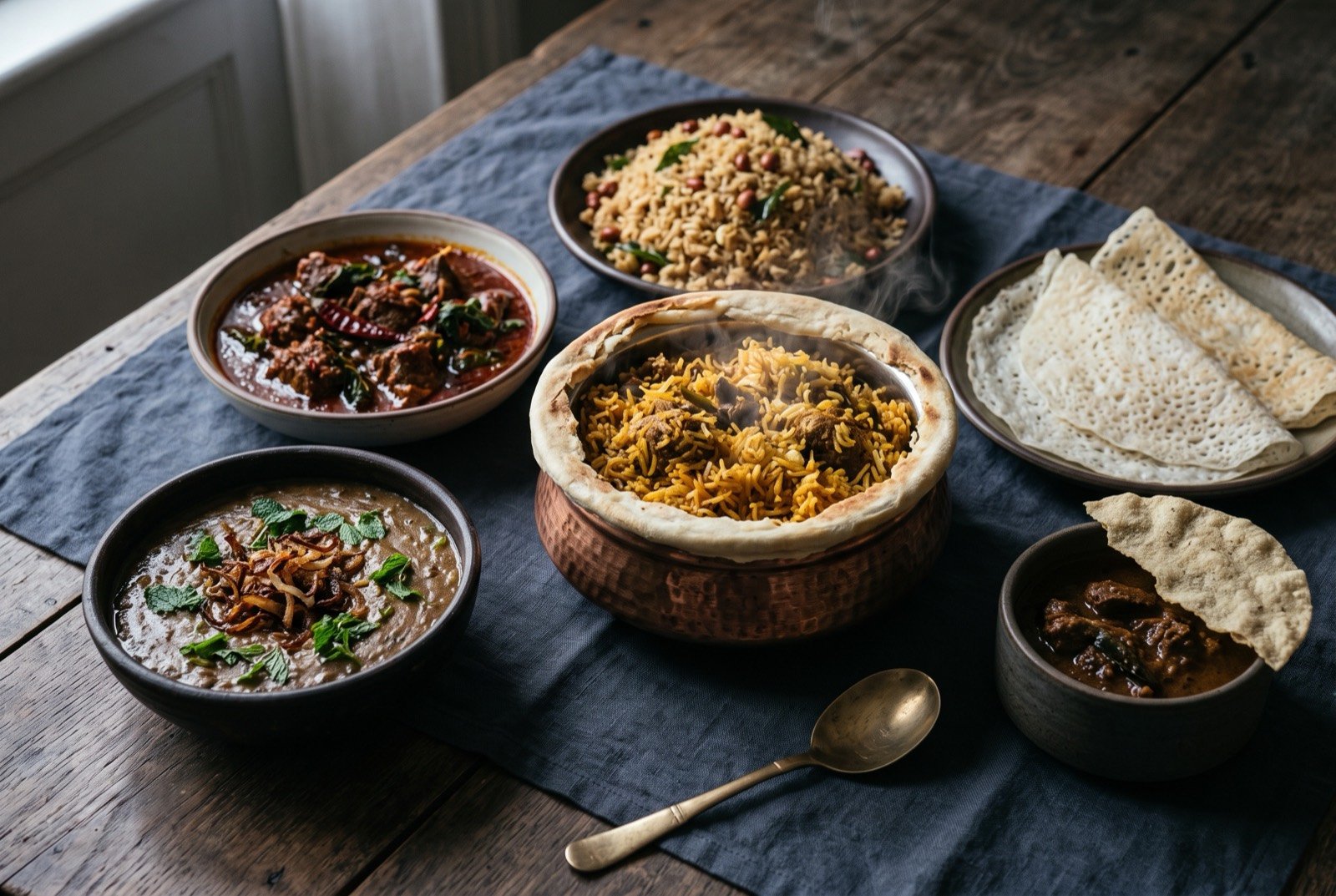
Three food worlds share one volume here because the Deccan plateau's own logic, not a modern state border, put them together. Andhra's coastal deltas and its harder, drier Rayalaseema interior grow the chilli that gives this whole stretch of India its reputation for heat. Telangana, the plateau proper, is a millet region wearing a rice-and-court-cuisine city, Hyderabad, inside it, where Qutb Shahi Deccani cooking and a specific, datable wave of refugee Awadhi court chefs after 1857 built something genuinely its own, not a regional flavour of "Mughlai." Coastal Karnataka sits on the volume's third side, coconut rather than chilli-oil, and is not one cuisine at all but at least seven: Udupi's Brahmin temple kitchen, Bunt, Gowda Saraswat Brahmin, Mangalorean Catholic, Beary, Kodava and north Karnataka's own millet plateau, several of them sharing no first language with each other. Every dish as tradition built it, then what a modern chef would change.
Sources and review · What this chapter does not assert · How we research · Spotted something wrong?
A Sense of Place
Draw a line down the Eastern and Western Ghats and this volume's whole geography follows: wet, irrigated coast on one side of each range, dry, rain-shadowed plateau on the other, and the food changes exactly where the rain stops.
Coastal Andhra and Rayalaseema: two ecologies, one state until 2014
Coastal Andhra is built on the deltas of the Godavari and Krishna rivers, the wet, rice-surplus part of the state; about 70 percent of the population depends on farming, and Andhra Pradesh is one of India's main rice-producing states. This is rice-and-seafood country: fish and prawns in tangy, spicy gravies, tamarind as the primary souring agent for fish curries (chepala pulusu) and prawn dishes (royyala iguru) cooked dry-style with a thick masala coating.
Rayalaseema, the drier interior, Kurnool, Anantapur, Kadapa and Chittoor, is ecologically a harder place: historically rain-fed, millet-and-groundnut country rather than delta rice country, and its food carries real flint. Less coconut, less coastal sweetness, more chilli, more meat. Regional press describes the cooking as built on abundant red chilli powder, groundnuts, dry fish, meat and millet, with named dishes including meka kalla rasam (lamb leg soup), kodi vepudu (village chicken with chillies), gongoora boti (lamb offal with sorrel leaves) and podi mamsam (lamb in dry masala). Traditional Rayalaseema and Uttarandhra food was mainly millet-based, seasonal, groundnut-heavy food, increasingly displaced by rice as rice became more available and more prestigious. Nellore, further along the coast, and Uttarandhra to the north, are both described as maintaining their own distinctly sweeter cooking against the rest of coastal Andhra's savoury-and-sour profile, a real internal variation this chapter states rather than flattens; specific, well-sourced food histories for Nellore and Kadapa beyond district-level dish-naming trivia could not be found, and that gap is named rather than papered over.
Coastal Andhra's fat, thickener, aromatic base, starch: sesame oil (nuvvula nune) and ghee as fat, sesame oil specifically credited with extending the shelf life of avakaya pickle; ground peanut and coconut pastes plus tamarind pulp itself for body; mustard seed, curry leaf, dried red chilli and onion-garlic-ginger tempering (popu) as the aromatic base; rice, overwhelmingly, as starch.
Rayalaseema's fat, thickener, aromatic base, starch: groundnut oil rather than coconut, less ghee-forward than the coast; ground peanut and sesame rather than coconut, since coconut is scarce inland; dry red chilli powder in much higher volume, plus tamarind, as the aromatic base; historically jowar and ragi, with rice now more common but millet retaining prestige as the "authentic" Seema food, particularly Kadapa's ragi sangati.
Telangana: a millet plateau wearing a rice-eating court city
Telangana sits on the Deccan Plateau proper: semi-arid, rain-shadowed relative to coastal Andhra, red lateritic soils poorly suited to wet rice cultivation outside irrigated tank and canal belts. The region's staple grain before the Green Revolution and the public distribution system pushed polished rice into every household was millet, not rice: jowar, sajjalu (pearl millet) and, to a lesser extent, ragi. The food researcher Salome Yesudas describes the older pattern directly: "hyper-local cuisine focused on millets, pulses, oilseeds and green, leafy vegetables," before PDS rice disrupted it. GV Ramanjaneyulu of the Centre for Sustainable Agriculture gives the water-use logic behind why this matters: "It takes 5,000 litres of water to produce a kilo of rice. Millets consume just 200 litres per kg." That is the ecological argument for why Telangana is a millet region with a rice-eating city inside it, rather than a rice region by nature.
Telangana's fat, thickener, aromatic base, starch, outside the court kitchen: groundnut and sesame oil as fat; toor dal as the everyday thickener and protein base; dry red chilli, tamarind and a spice powder called karam (roasted niger or linseed with salt and chilli) rather than a wet masala, as the aromatic base; jowar, sajja and maize flatbreads as the rural staple, alongside sarva pindi (a thick jowar pancake, pan-roasted rather than griddled thin) and sakinalu (a deep-fried sesame-rice ring, a Sankranti festival food).
Hyderabad's court kitchen runs on an entirely different stack: ghee rather than groundnut oil, fried onion (birista), ginger-garlic paste and whole warming spices, cardamom, cinnamon, clove, mace, star anise, as the aromatic base, saffron almost a signature that a dish is court food rather than home food, and fine basmati rather than millet as starch.
Coastal Karnataka: Malnad rain and the Tulu Nadu coast
Coastal Karnataka and the adjoining Malnad hill belt sit under the same monsoon regime: the Western Ghats block the south-west monsoon's rain-bearing winds from the Arabian Sea, producing extremely heavy rainfall on the windward side, exceeding 4,000mm a year in places. This is coffee, areca nut, pepper and cardamom country inland, shading into coconut palm coast at sea level. Malnad's own cuisine, distinct from the coastal strip proper, is foraged and steamed rather than fried: bamboo shoots, wild mushrooms, colocasia leaves and jackfruit, coconut rather than added oil supplying richness.
Tulu Nadu, the coastal strip proper, centred on Mangalore and Udupi, where Tulu is the home language, is where this volume's coastal Karnataka half actually sits: fish-forward rather than foraged-forest, coconut-forward in a curry-gravy sense rather than Malnad's plain steaming. Fat is coconut oil, overwhelmingly, not the sesame or groundnut oils of the Andhra side; thickener is fresh grated coconut and coconut milk; aromatic base is dried red chilli, specifically Byadagi or Kashmiri-type chillies chosen for deep red colour without matching heat, ground with coconut, tamarind or kokum for sourness, curry leaf and mustard-seed tempering; starch is rice, but in a wider range of forms than coastal Andhra's plain steamed rice, neer dosa and other rice-batter crepes, boiled-rice wafers for kori rotti, and fermented idli and dosa in the Udupi-hotel tradition.
North Karnataka, by contrast, sits on the dry Deccan plateau side and shares Rayalaseema's millet logic rather than the coast's coconut logic: jolada rotti, sorghum flatbread, is the everyday staple of most of North Karnataka, while ragi mudde is the dominant preparation further south in rural Karnataka, a north-south millet axis inside Karnataka itself, distinct from the coastal-versus-plateau axis. This is not coincidence: in both halves of this volume, the same Ghats rain-shadow effect is the deep cause of the coastal-versus-interior split.
"Mangalorean" is at least seven cuisines, not one
This matters enough to state plainly before the chapter goes any further. What gets marketed as a single "Karnataka cuisine" or "coastal Karnataka cuisine" is, on the evidence, at least seven distinct community traditions: the Bunts (Kshatriya, the most diverse non-vegetarian cooking on the coast), the Gowda Saraswat Brahmins (Konkani-speaking, coconut-and-kokum forward, straddling Karnataka and Goa rather than belonging cleanly to either), the Shivalli Brahmins of Udupi specifically (the temple-kitchen vegetarian tradition), Mangalorean Catholics (descended from Goan converts who migrated south between 1560 and 1763, carrying direct Portuguese-colonial technique), the Beary (Tulu-speaking Muslims with a claimed nine-and-a-half-century local history), the Kodava of Coorg (an entirely separate Dravidian ethnolinguistic group with its own language, not a hill variant of coastal cooking), and north Karnataka's Kannada-speaking plateau cuisine. Several of these do not share a first language with each other, Tulu, Konkani, Kodava, Byari, Kannada, and one, Mangalorean Catholic cuisine, has a directly Portuguese-colonial rather than indigenous-Dravidian food history. This chapter keeps them visibly separate rather than folding them into a single "Mangalorean" voice, the way the strongest reference restaurant for this cuisine, Bangalore's Karavalli, deliberately does.
A table of peoples, ecology and food logic
| Community | Zone | Fat | Thickener | Aromatic base | Starch |
|---|---|---|---|---|---|
| Coastal Andhra | Godavari/Krishna delta | Sesame oil, ghee | Peanut, coconut paste, tamarind | Mustard seed, curry leaf, dry chilli, popu tempering | Rice |
| Rayalaseema | Dry interior, Kurnool to Chittoor | Groundnut oil | Ground peanut, sesame | Heavy dry red chilli, tamarind | Jowar, ragi, increasingly rice |
| Telangana (rural) | Deccan plateau | Groundnut, sesame oil | Toor dal | Dry chilli, tamarind, karam powder | Jowar, sajja, maize |
| Hyderabad (Nizami court) | Hyderabad city | Ghee | Ground nut/pounded wheat | Birista, ginger-garlic, whole spice, saffron | Basmati rice |
| Tulu Nadu, coastal Karnataka | Mangalore/Udupi coast | Coconut oil | Grated coconut, coconut milk | Byadagi/Kashmiri chilli, curry leaf, mustard | Rice, many forms |
| Kodagu (Coorg) | Western Ghats hill | Coconut oil, pork fat | Coarsely ground spice | Kachampuli, black pepper | Rice |
| North Karnataka | Dry plateau | Groundnut oil | Peanut, sesame | Dry red chilli, tamarind | Jowar, ragi |
The History in Layers
Two courts, not one, and neither of them simply Mughal
The historical sequence in Hyderabad matters and the two courts that ran it did not do the same thing to the region's food. The Qutb Shahi dynasty (Sultanate of Golconda, 1518 to 1687) was a Persianate, Shia Muslim dynasty of Turkoman origin ruling a population that was overwhelmingly Telugu-speaking and Hindu, and it is the period in which "Deccani" as a synthesis culture, including Deccani Urdu itself, heavily inflected by Telugu and Marathi vocabulary and grammar, takes shape. Standard Deccan historiography describes "the evolution of a unique Deccani culture that seamlessly blended Persian, Turkic and indigenous Telugu traditions," and Sahapedia's essay on Hyderabadi cuisine, drawing on the historian Amanda Lanzillo's research, states that "Hyderabadi haute cuisine began to develop after the foundation of the Bahmani Sultanate and the Qutb Shahi dynasty, which promoted the native cuisine," meaning Qutb Shahi patronage sat on top of an existing Deccani/Telugu food culture rather than replacing it.
The Asaf Jahi dynasty, the Nizams of Hyderabad, 1724 to 1948, worked differently. Where the Qutb Shahis were a settled regional dynasty presiding over Telugu-speaking subjects for nearly two centuries, the Nizams ran an aristocratic court that deliberately imported culinary talent, gathering, in Lanzillo's phrase, "the best cooks and cooking practices from across arab-o-ajam," the Arab and Persianate worlds. That recruitment intensified sharply after 1857: when the Mughal court in Delhi and the Nawabi court in Lucknow were dismantled by the British following the Uprising, their unemployed master chefs looked for new patrons, and Hyderabad, one of the few princely states left with real wealth and a functioning court, absorbed them. Lanzillo's research names the specific case of Pir Ali, a chef who migrated from the Lucknow Awadhi court to Hyderabad after 1856. This is the direct, datable mechanism by which Awadhi dum pukht technique and Mughlai court vocabulary entered the Hyderabadi kitchen as a second, later wave layered on top of the older Qutb Shahi-era Deccani-Persian synthesis, not as its origin, and it is the reason this chapter avoids "Mughlai" as an umbrella term for what Hyderabad actually cooks.
The primary written evidence is a genuine culinary text: the Khwan-e Ne'mat-e Asafiya ("The Beneficent Table of the Asafiya Dynasty"), a 680-recipe cookbook compiled by Ghulam Mahbub Hyderabadi for Nawab Sir Asman Jah Bahadur, Hyderabad State's prime minister from 1887 to 1894, published under the sixth Nizam. It documents, among much else, roughly 30 named khichdi variants at the Nizami table, an "Asaf Jahi Khichdi" and a "Jahangiri Khichdi" among them, and over 26 distinct biryani variations, a level of internal elaboration within single dish categories that Awadh's own court is not documented as having matched. Siasat Daily's own feature on the cookbook frames the decline of this elaborate khichdi culture honestly, attributing it to "biryani's commercial rise and the impracticality of labor-intensive, ghee-heavy recipes for contemporary middle classes," a useful corrective to any assumption that biryani was always the centrepiece: the Nizami table's actual richness lay in variety across many rice-and-lentil dishes, of which biryani is the survivor.
What is genuinely Telugu wearing a Persian name, and what is genuinely imported
This is the sharpest question the research asked, and the honest picture is layered rather than binary. Baghare baingan is the clearest case of a Deccani dish wearing a Persianate name: its Urdu name describes a technique, baghar, tempering, blooming spices in hot oil, but the dish itself, a peanut-sesame-tamarind gravy over small whole aubergines, is structurally identical to the Telugu household dish gutti vankaya kura, and indeed carries Telugu names in parallel, nune vankaya kura or vankaya masala. The peanut-and-sesame thickening technique is the ordinary technique of Telugu-region vegetable cookery, not an import; only the name and the court association are Persian. Double ka meetha and khubani ka meetha, by contrast, sit at the genuinely-imported end: double ka meetha is explicitly modelled on the North Indian Mughal shahi tukda, reworked with local bread and regional flavourings, and khubani ka meetha is built on dried apricots, a fruit with no Deccan agricultural base at all, introduced to India via Central Asia, meaning the dish's core ingredient is itself an import, not merely its name.
Haleem: an Arab dish that arrived through soldiers, not through the court
Haleem's direct ancestor is harees, a wheat-and-meat porridge from the Arabian Peninsula whose name derives from the Arabic harasa, to mash or pound; harees was formally inscribed on UNESCO's Representative List of the Intangible Cultural Heritage of Humanity in December 2023. Its arrival in Hyderabad is a separate, later and better-documented route than the Persian court kitchen: the Chaush, Hadhrami and Yemeni Arab soldiers recruited into the Nizam's personal military household under the sixth and seventh Nizams, were settled in a purpose-built barracks district still known as Barkas, a corruption of the English word "barracks," now home to well over 200,000 people of Yemeni descent, a community The National newspaper describes reporting from the neighbourhood itself as "India's mini-Yemen." Local social activist Mabrook bin Muhammad AlSaari, quoted in that piece, describes the original settlers directly: "the men worked as warriors, personal and treasury guards and were given military barracks in the old city." The Arab dish these soldiers brought and cooked for themselves was gradually adapted with local spice, ghee and dried-fruit additions into the version now protected by Geographical Indication status, granted in 2010, the first non-vegetarian product in India to receive it, renewed in 2022 through to December 2029. Barkas has its own further variant, meethi haleem, sweet haleem, finished with ghee and sugar instead of savoury spice, evolved directly from the Yemeni aseed and eaten as an early winter breakfast, shops in Barkas typically selling out by nine or ten in the morning. Hyderabadi biryani, the more famous dish, holds no such protection: the Deccani Biryani Makers' Association's GI application was formally treated as abandoned after roughly nine years for failing to prove historic origin to the registry's satisfaction, a counter-intuitive fact worth stating plainly.
A crossover corrected: Hyderabad's kebab is not Lucknow's
This atlas treats Hyderabad, Awadh and Kashmir's Wazwan as three separately arrived-at Persian-influenced court cuisines, and the research for this volume supports that framing while sharpening one part of it. Galouti kebab, from Urdu galawat, melt in the mouth, is consistently sourced to late-18th-century Lucknow under Nawab Asaf-ud-Daula, its defining trick, raw papaya ground into the meat as an enzymatic tenderiser, developed there specifically, popular retellings say, for a toothless or ageing patron. That "toothless nawab" story recurs across enough sources to be treated as widely repeated folklore rather than documented history, but the papaya technique and the dish itself belong to Lucknow, not Hyderabad; nothing in this research documents galouti as a Hyderabadi court invention, and a "galouti kebab" on a present-day Hyderabad restaurant menu is best read as a generic pan-Mughlai menu absorbing a famous dish from elsewhere. Hyderabad's own, genuinely distinct kebab is shikampuri, Persian for "belly-full," developed in the Nizam's own kitchens and structurally the inverse of galouti: where galouti is a single, ultra-smooth, homogeneous disc with no textural filling, shikampuri wraps a spiced minced-mutton exterior around a cool, creamy filling of hung curd, mint, onion and green chilli, a deliberate hot-crisp-against-cool-cream contrast, closer in logic to a stuffed kofta than to galouti's melt. This chapter gives shikampuri its full recipe below rather than reaching for galouti as if the two courts shared a signature dish.
Telangana statehood and a food identity still being drawn
Telangana became India's 29th state on 2 June 2014, after decades of a distinct statehood movement, and food is a smaller but real part of the identity-assertion that followed. Post-2014 Telangana cultural promotion has increasingly foregrounded the region's own millet-and-rural food, jowar rotte, pachi pulusu, gongura, sakinalu, as distinctively Telangana rather than folding it into a generic "Andhra" or "Hyderabadi" identity, and the chef Chalapathi Rao's own framing of "three distinct culinary threads" within what was, until 2014, one Andhra Pradesh, is itself a statement of that impulse. Then chief minister K Chandrasekhar Rao's public "bottle gourd politics," declaring that Andhra and Telangana speakers use different words for the same vegetable as a marker of separate cultural identity, is a real, named instance of food-language politics becoming explicit state politics. A Telugu folk saying puts the popular version of the comparison plainly, and inverts this chapter's own working assumption in the process: "తెలంగాణ వంటలు కొద్దిగ కారంగాను, ఆంధ్ర వారి వంటలు చప్పగాను ఉంటాయి", Telangana cooking is somewhat spicier, Andhra cooking blander. Within Telugu-speaking country as a whole, which sub-region gets called "the spicy one" depends entirely on which other sub-region it is being weighed against, and this chapter does not adjudicate that ranking; both claims are locally made and both rest on real, if selectively framed, evidence.
Contested claims, named rather than settled
Dosa's origin is genuinely disputed between Tamil Nadu and Karnataka. The food historian K T Achaya dates dosa references in Tamil Sangam literature to around the first century CE, with the earliest written Tamil mention in eighth-century literature against a Kannada mention roughly a century later, favouring Tamil Nadu's priority claim by his own account; the historian P Thankappan Nair, by contrast, is cited as attributing dosa's origin to Udupi specifically. Both claims may be simultaneously true of different things: who invented "a dosa" against who invented "the crisp restaurant dosa" that Udupi hotel technique is specifically credited with popularising nationally.
Idli's origin is claimed by both states too, and Achaya is separately cited suggesting idli arrived in India from present-day Indonesia between roughly 800 and 1200 CE, which, if accurate, would mean neither state's claim to invention is straightforwardly correct, only a claim to having developed and popularised the dish once it arrived. This chapter treats that as an attributed theory, not settled fact.
Pulihora's origin carries the same pattern: sources trace its earliest documented temple-kitchen appearance to Tamil Nadu around 1010 CE, which would make Andhra's pulihora, and Karnataka's puliyogare and chitranna, later regional adoptions of a Tamil temple dish rather than independent Telugu or Kannada inventions. This rests on a single citation chain, not a specialist food-history source, and is named here as unverified rather than asserted as settled.
The Flavour Arsenal
Guntur, Byadagi and Kashmiri: three chillies, three different jobs
The single most important distinction this volume needs to draw precisely: these are not three points on one heat scale, they are grown and selected for entirely different purposes. Guntur Sannam, marketed internationally as "S4 type," is Andhra Pradesh's defining cultivar, registering 30,000 to 350,000 Scoville Heat Units, grown specifically for pungency and for capsaicin extraction as much as for direct culinary use; Guntur district alone produces roughly 15 percent of India's chilli-growing area, Andhra Pradesh as a whole around 40 percent of India's total chilli production, and the Guntur Market Yard is described as Asia's largest chilli market. Byadagi, named for the trading town in Karnataka's Haveri district, runs at 5,000 to 15,000 SHU and is prized overwhelmingly for its deep red colour rather than its comparatively negligible heat, holding a GI tag since February 2011. Kashmiri chilli, at 1,000 to 2,000 SHU, is milder still, used almost purely for colour. A cook substituting Kashmiri or Byadagi for Guntur in an Andhra dish because "red chilli powder is red chilli powder" will get the colour right and the heat and flavour entirely wrong, precisely the substitution error that flattens Andhra food into a generic, wrong-tasting version of itself.
Gongura, the souring leaf that stacks with tamarind rather than replacing it
Gongura, red sorrel, Hibiscus sabdariffa, known locally as puntikura, is Andhra's defining souring leaf, and its role is to stand independently of, and stack with, tamarind rather than substitute for it. The traditional preparation, per Guntur district's own government website, air-dries the washed leaves on cotton cloth for around ten hours in hot conditions until they wilt completely with no residual moisture, before being cooked down into pachadi. Telugu Wikipedia describes gongura pachadi affectionately as "ఆంధ్రా మాతా", Mother Andhra, a measure of its emotional weight in Telugu food identity.
Kokum and kachampuli: related fruit, distinct products, distinct cuisines
Kokum (Garcinia indica) and kachampuli are related but genuinely distinct products from related but distinct Garcinia species, used in different cuisines within this same volume: kokum in the Konkan and Mangalorean coastal cooking of GSB and Bunt households, kachampuli specifically in Kodava cooking. Kachampuli, the concentrated, fermented and reduced juice of Garcinia gummi-gutta, fermented for several days then simmered in clay pots to a syrup-thick, dark red-purple vinegar, holds its own entry in the Slow Food Foundation's Ark of Taste, the international catalogue of endangered traditional foods, which states plainly that "every home has a bottle" in the producing communities. Treating the two as interchangeable, or describing kachampuli as a bamboo vinegar, a confusion that circulates in retail copy, is a mistake this chapter corrects rather than repeats.
Millet: ragi and jowar, on a north-south axis inside Karnataka too
Ragi, finger millet, and jowar, sorghum, are the plateau's staple starches wherever coconut and rice do not reach, and the split runs on its own axis even inside a single state: north Karnataka's staple is jowar-based jolada rotti, while ragi mudde is the dominant preparation further south in rural Karnataka, distinct again from the coastal-versus-plateau divide. The same ecological logic separates Rayalaseema's millet-and-groundnut cooking from coastal Andhra's rice-and-coconut-adjacent table: the Ghats' rain shadow, not regional preference, is the deep cause.
Coconut, only on the wet side
Coconut oil, milk and fresh grated flesh are the defining fat and body of coastal Karnataka cooking, essentially absent from Rayalaseema and rare in rural Telangana, exactly tracking the wet-versus-dry ecological line drawn above; where a recipe in this chapter calls for coconut, it belongs to the coastal Karnataka side of the volume, not the Andhra or Telangana side.
The Technique Ladder
Rung 1. Seal the vessel completely, and manage heat from both directions
Hyderabadi biryani's kacchi, raw, method layers raw marinated meat directly with parboiled rice while both are still underdone, and the entire dish finishes cooking together inside a sealed pot, cooked by the rice's own steam and the meat's own juices with no separate pre-cooking step at all. The seal, a rope of wheat-dough pressed around the rim of a heavy handi, traps rising moisture as vapour that cannot escape, condenses against the cooler rice and lid, and drips back down, a closed convective cycle rather than simple steaming. Syed Samiullah Hussaini, a fourth-generation Old City cook, describes the actual heat management recipe blogs never capture: "the basic culinary art of biryani making is adjusting the fire that happens only while cooking with the firewood," heat applied from below at the start, then live charcoal placed on the sealed lid itself so the dum finishes with heat from above as well as below. What a cook does with this rung. A Big Green Egg's sealed dome, run indirect with a deflector plate below the pot and a separate small tray of hot coals or a cast-iron lid weight resting on top of a well-sealed casserole, approximates this two-directional heat far better than an oven, which only ever heats from all sides evenly and never replicates the specific top-down finish the Old City method depends on. Do not lift the lid to check: the entire discipline of kacchi is that the cook gets one shot, and breaking the seal partway through ruins the closed system the technique exists to create.
Rung 2. Pound past the point of stew, not just until tender
Haleem's defining act is not long cooking but ghota, prolonged pounding: once wheat, meat and lentils are cooked down to tenderness, typically over many hours in a bhatti kiln-hearth, two-person teams work the pot with long wooden paddles, continuously mashing and stirring the steaming mixture until meat fibres, softened bone and starch are fully homogenised into a single smooth, sticky paste with no distinguishable component texture remaining, a wooden hand masher called a ghotni doing the equivalent job at home scale. What a cook does with this rung. A stand mixer's paddle attachment or a high-power blender's pulse function can approximate the mechanical breakdown, but the traditional method's slow, hand-paced pounding also incorporates air and works the ghee through gradually rather than emulsifying it violently; pulse in short bursts rather than running continuously, checking texture by hand between bursts, and fold the ghee in by hand at the very end rather than blending it in, to keep some of that same gradual, aerated quality a machine run flat-out cannot give.
Rung 3. Choose the chilli for the job, then roast and grind it yourself
Guntur, Byadagi and Kashmiri chillies are not interchangeable grades of one ingredient, they are grown for three different jobs, heat, colour, or mild colour, and a dish's whole character depends on using the right one rather than whichever red powder is nearest to hand. What a cook does with this rung. Buy Guntur chilli by name specifically where a dish's heat is the point (Andhra chicken and mutton curries, gongura pachadi); reserve Byadagi or Kashmiri for where colour without matching heat is the point (coastal Karnataka's gravies, tempering oil); and where a dish calls for whole dried chillies rather than powder, dry-roast them briefly in a dry pan before grinding in a dedicated spice grinder, since pre-ground chilli powder loses its aromatic top notes on the shelf in a way whole dried chilli does not.
Rung 4. Ferment deliberately, or leave it unfermented deliberately, and know which dish wants which
Coastal Karnataka runs both traditions side by side rather than treating one as the default: fermented, crisp restaurant-style dosa and idli, driven by wild yeast and bacteria on urad dal combined with soaked rice, against neer dosa, a Tulu Nadu dish whose whole technical identity is that it is not fermented at all, rice soaked, ground fine with water to a thin, pourable batter, and cooked immediately into a thin, lacy, soft crepe. What a cook does with this rung. Where a dish wants ferment, a longer, cooler rest, overnight in a cool larder rather than a warm kitchen for a few hours, with fenugreek seed added to aid both fermentation and flavour, builds real acidity rather than a fast, gassy rise; where a dish wants no ferment at all, resist the urge to let the batter sit "to be safe," since a batter that begins to ferment by accident will toughen and sour a dish built specifically on freshness.
Rung 5. Work the paste with real force, and know when it has actually come together
Ragi mudde, the finger millet dumpling, is made by stirring a ragi flour and water paste into boiling water and continuing to mix vigorously with a wooden stick until a smooth, lump-free, dough-like mass forms, a genuinely physical technique rather than a simple stir-and-set porridge. What a cook does with this rung. A stand mixer fitted with a dough hook, run on a low, steady speed, can finish the last stage of this work more evenly than a tired arm managing a wooden stick against a heavy, resistant paste, but check by hand at intervals regardless, since the dish is done exactly when the mass turns smooth and elastic and pulls cleanly from the sides of the pan, a point better judged by feel than by time on a clock.
The Ferment and Preserve Bench
1. Gongura pachadi
The foundational Andhra preserve behind gongura mamsam above: washed sorrel leaves air-dried on cotton cloth for around ten hours in hot conditions until completely wilted with no residual moisture, then cooked down with dry red chilli, garlic and tempering spice into a thick, intensely sour, long-keeping pickle, eaten with hot rice and ghee. Long-storage "nilava" versions, relying on the leaf's own acidity plus tamarind pulp as preservative, keep for a year without refrigeration.
2. Guntur chilli, dried and traded
Guntur Sannam is as much a preserved, traded good as a fresh culinary ingredient: harvested chillies are sun-dried until fully cured before sale, the step that fixes both colour and capsaicin content for the year-round market, and the Guntur Mirchi Yard trades the dried product by cultivar and grade in a way fresh chilli never could be. Naming this preservation step matters, since it is exactly what separates a genuine Guntur Sannam purchase from a generic "hot red chilli powder" of unstated origin and unstated cure.
3. Kachampuli
The Kodava souring vinegar behind pandi curry above, covered in full at section 3 and in the technique ladder: the fermented and reduced juice of Garcinia gummi-gutta, simmered in clay pots to a syrup-thick, dark red-purple vinegar, holding its own Slow Food Ark of Taste entry as an endangered traditional product, distinct from the more widely available kokum despite the two fruits' close botanical relationship.
Sourcing in Britain
The honest headline: this volume's ingredients split sharply between well-stocked and genuinely thin, and the chapter should say which is which rather than implying uniform ease. Ragi and jowar flour, kokum, aged basmati, Kashmiri chilli and gongura itself are all real, verifiable, multiple-stockist UK purchases. Guntur chilli by name, and kachampuli, are real but genuinely specialist, single-retailer or near-single-retailer purchases, and this chapter treats them that way rather than pretending Britain's South Asian grocery trade serves this volume's three states as fully as it serves Punjab or Gujarat.
The ranked list: what decides great from grim
- Guntur chilli, bought by cultivar name, not substituted with generic "chilli powder." Diaspora Co. sells single-origin Guntur Sannam chilli, whole and ground, sourced from the Narne family farm in Guntur district, stocked on Ocado in the UK, the only verified UK stockist for the name specifically. No mainstream UK South Asian grocery brand, Natco, TRS, Rajah or East End, sells a powder labelled "Guntur." Where it is unavailable, Kashmiri chilli powder is the realistic substitute for colour, with cayenne or a hotter standard chilli powder added alongside to recover the heat Guntur would have supplied, tasted and adjusted rather than measured to a fixed ratio.
- Kachampuli, correctly sourced rather than assumed to be a bamboo vinegar or a straight kokum swap. Genuinely available from specialist sellers, CoorgShoppe, Nilgiri Marten and NativeBag among them, but not from any mainstream UK chain, exactly the tell of a genuinely specialist ingredient rather than a generic one. Where unavailable, kokum is the closer, more widely stocked alternative, but a milder one, and the chapter's own pandi curry recipe above states the adjustment plainly rather than implying a direct swap.
- Aged basmati rice, correctly sourced rather than any long-grain rice to hand. Daawat and India Gate both genuinely market their rice as aged up to two years, a verifiable, not marketing-only, claim: aging reduces moisture and firms the starch structure so grains separate rather than clump, precisely what kacchi dum biryani depends on since the rice's own structure is the only thing preventing it turning to mush once sealed raw with the meat. Tilda, stocked in mainstream UK supermarkets, is the easiest route to an equivalent grade without a specialist shop.
Ingredients, shop by shop
Guntur chilli and its substitutes. Diaspora Co. via Ocado, above, is the sole verified UK stockist under the Guntur name. Byadagi chilli is available the same way, via Diaspora Co., and as whole dried chilli on Amazon UK; Kashmiri chilli powder is far more established, Natco's line widely stocked across Amazon UK, Sous Chef, Bazaar Foods and Taj Stores, and is a safe substitute for Byadagi specifically, the two being close enough in heat and colour, though not a safe substitute for Guntur without a heat correction.
Ragi and jowar flour are both genuinely well stocked: Natco, TRS, Anil, Organic Swaad and Supreme brands for ragi via Taj Stores, Lakshmi Stores UK, The Indian Shop and SaveCo Bradford; Jalpur, Organic Swaad and, notably, Shipton Mill, a genuine British stoneground mill rather than an Indian import brand, for jowar. Both flours turn rancid faster than wheat flour once milled, so buy from a shop with real turnover and check the pack date; freshly milled ragi should smell faintly earthy and nutty, never musty or bitter.
Gongura is genuinely available fresh, in 200g bunches, from Veenas, Desicart, Lakshmi Stores UK and Amazon.co.uk, a real and notable finding for a leaf this specific to one Indian region; it ships as a perishable and should be bought close to cooking day. As pickle, 777 Andhra Gongura Pickle and Priya Foods' garlicked version are both real UK-trade products.
Kokum is meaningfully easier to source than kachampuli, via Spice Mountain, The Spicery and The Asian Cookshop, and is the safer ingredient to build a UK-facing recipe around wherever a dish can genuinely take either.
Saffron and rosewater. Steenbergs, based in York, is Organic Food Federation certified and gives real, usable quality markers: the best saffron grades are deep red, "coupe" for Kashmiri and Spanish saffron, "sargol" for Iranian, with a noticeably yellow strand a sign of poor quality or adulteration with safflower, the most common saffron fraud; genuine culinary rosewater should list only water and rose petal extractive, with a product cut by glycerine or added fragrance a cosmetic grade, not a food grade. Steenbergs is a credible general UK spice house, not a Nizami cuisine specialist as such, and this chapter presents it that way rather than implying a bespoke connection that does not exist.
Physical shops
Wembley and Southall remain London's best-documented South Asian grocery hubs, and Pick N Save, 202 to 204 Kenton Road, Harrow, is a real, physically verifiable Indian and Asian grocery supermarket serving Wembley by delivery. No physical shop specifically branding itself around Andhra, Telangana or Karnataka groceries, as distinct from general South Asian stock, could be verified anywhere in Britain; the UK's Telugu-speaking population, estimated at around 33,000, is genuinely small relative to the Gujarati and Punjabi communities that dominate this retail trade, a real structural reason no dedicated chain exists. The honest claim this chapter makes is that this volume's ingredients are obtainable through the general South Asian grocery trade in Wembley, Southall, Harrow, Leicester and Birmingham, not that a curated Telugu or Kannada shop exists to seek out.
Kit
A genuine handi, clay, terracotta or heavy aluminium, for dum sealing is available via CookGear UK's dedicated biryani pot category, and via individual sellers on eBay and Etsy UK, roughly £14 to £30; "biryani pot" is sometimes used loosely by sellers for any large lidded pot, so look specifically for a well-fitting lid suited to a dough seal rather than a generic stockpot. A flat or slightly concave cast-iron tawa, not a specialist neer dosa pan, is the correct kit for that dish, via Vinod Cookware UK and Lakshmi Stores UK.
Restaurants
Quilon (Buckingham Gate, London), Michelin-starred since 2008, the first South Indian restaurant in the world to hold a star, chef Sriram Aylur previously head chef of Karavalli in Bangalore, is the single strongest UK reference point for coastal Karnataka's Karavali cooking at a serious level, though its own menu leans toward the wider southwest coast rather than this volume's territory alone. DUM Biryani House (Soho), founded by Dhruv Mittal, specialises in Hyderabadi-style dum biryani cooked in a genuinely sealed handi. Hyderabad Tastes (Hounslow) names gongura specifically on its own menu, the most directly relevant verified restaurant for this volume's Andhra material. Sagar (three London branches) is a genuine, longstanding Udupi-style vegetarian reference point, its chefs from Udupi by its own marketing, though its menu is broader pan-South-Indian vegetarian than narrowly Udupi. No restaurant in the UK markets itself as dedicated Telangana, as distinct from Andhra or Hyderabadi, cuisine, and none as a dedicated Kodava restaurant.
Voices and Sources
From inside the tradition, in India
- Vignesh Ramachandran and Sampath Tummala, T3, Hyderabad: Ramachandran on method, "no techniques shall be forced upon a dish for the sake of using it," and Tummala on the limit of elevation, "we will never have a wasabi pappu or wasabi rasam," the clearest statement found anywhere in this research of this atlas's own animating idea, independently arrived at by a chef inside this specific tradition.
- Rizwan Khader, Terrāi, Hyderabad: builds a "neo-Telangana kitchen" menu around millets and pulses sourced entirely from the Deccan Development Society, a cooperative of roughly 5,000 Dalit farmers, 95 percent women, a genuine supply-chain fact rather than a heritage-grain marketing claim.
- Naren Thimmaiah, Karavalli, Bangalore: over three decades treating coastal Karnataka as five distinct communities' worth of cooking rather than one "Mangalorean" style, trained originally by food consultant Camellia Panjabi's direct transmission from home cooks in Mangalore.
- Syed Samiullah Hussaini, a fourth-generation traditional cook, Kalapathar, Hyderabad Old City: the strongest named source on kacchi dum's actual firewood heat management, quoted directly in section on the Technique Ladder above.
- Amanda Lanzillo, historian, via Sahapedia: the source for the specific, datable 1856 to 1857 migration of Awadhi court chefs, Pir Ali named among them, into the Nizam's kitchens, the single strongest correction this chapter makes against a generic "Mughlai" framing.
- Mabrook bin Muhammad AlSaari, social activist, Barkas: on the Chaush community's original settlement, "the men worked as warriors, personal and treasury guards and were given military barracks in the old city."
- Salome Yesudas, T Radhika Ravi, Sudhakar N Rao and Chalapathi Rao, quoted in Open magazine's feature on Telangana food, the strongest single source for rural, non-Nizami Telangana cooking and its post-2014 identity assertion.
The UK diaspora
- Dhruv Mittal, DUM Biryani House, Soho: trained at Le Cordon Bleu London and in Michelin-starred kitchens, runs the single closest thing found in Britain to a modernist, technique-aware Telangana and Andhra reinterpretation.
- Sriram Aylur, Quilon: previously head chef of Karavalli itself, the clearest direct transmission line between this volume's Karnataka research and a Michelin-recognised UK kitchen.
The gap, named
No restaurant in Hyderabad or Bangalore carries Michelin recognition, because Michelin does not currently operate a Guide in India at all. Listicle language claiming "Michelin-star-like experiences" for named Indian restaurants is marketing framing, not fact, and this chapter does not repeat it. UK representation for this volume's three states is genuinely thin: no dedicated Karnataka, Udupi or Mangalorean restaurant at any level of ambition was found anywhere in Britain, and Andhra and Telangana's UK presence is real but modest, cheap, delivery-oriented and largely invisible to UK food criticism, unlike Bengal, Gujarat, Punjab or Kerala's far more developed UK scenes. This chapter states that gap directly rather than inflating a thinner picture to match its neighbours.
Things this chapter has deliberately not asserted
- An exact rice-to-meat weight ratio for kacchi biryani, or an exact dum temperature in degrees or duration in minutes. Only the qualitative principles, full insulation of the meat by rice, and low, two-directional heat until both finish together, are asserted as fact.
- That mirchi ka salan carries a specific, documented Nizami court origin story. Its Telugu/Deccani technique is well described; no source gives it a court pedigree comparable to biryani or haleem.
- That shikampuri kebab's tenderness comes specifically from raw papaya, in the way galouti's does, or that the "toothless nawab" origin story for galouti itself is verified history rather than a widely repeated anecdote.
- That Hyderabadi biryani carries Geographical Indication protection. It does not; only Hyderabadi haleem does, granted 2010, renewed to 2029, a counter-intuitive fact this chapter states directly.
- A confident, sourced answer to whether post-2014 Telangana state cultural policy treats Hyderabadi Muslim court food as Telangana's own heritage or holds it at arm's length as a separate city tradition.
- Any single, agreed origin for biryani's ultimate ancestry, Persian pilaf synthesis against indigenous Indian rice-and-meat cookery reaching back to Tamil Sangam literature. Serious historians disagree, and this chapter reports the disagreement rather than adjudicating it.
- That Andhra cuisine is India's hottest, full stop, as an adjudicated fact rather than a widely repeated claim resting on real but partial evidence, Guntur chilli's production dominance among it, that this chapter's own research found inverted by a Telugu folk saying comparing Telangana against Andhra rather than Andhra against the rest of India.
- Dedicated, well-sourced food histories for Nellore and Kadapa beyond district-level dish-naming trivia.
- Pulihora's or idli's claimed origins, Tamil temple cooking around 1010 CE for the former, Indonesian arrival between roughly 800 and 1200 CE for the latter, as settled fact rather than attributed, contested historical claims.
- A specific community attribution for kori rotti beyond a generic Tuluva claim, or that Farmlore, Bangalore, is a Karnataka or Udupi specialist restaurant rather than a regional South Indian one spanning Chennai to Hyderabad.
- That any UK stockist for a curved appam kadai, or any dedicated Andhra, Telangana or Karnataka community grocer distinct from general South Asian retail, exists in Britain. Neither was found, and this chapter says so rather than naming one it cannot verify.
Volume AS-23, the Deccan chilli heartland of the Indian subcontinent, Not Just Stew. Research briefs: `AS-23-tradition.md` and `AS-23-modernist-sourcing.md`. Sourcing verified September 2026.
Seal the vessel completely, and manage heat from both directions
Hyderabadi biryani's kacchi, raw, method layers raw marinated meat directly with parboiled rice while both are still underdone, and the entire dish finishes...
Pound past the point of stew, not just until tender
Haleem's defining act is not long cooking but ghota, prolonged pounding: once wheat, meat and lentils are cooked down to tenderness, typically over many hours...
Choose the chilli for the job, then roast and grind it yourself
Guntur, Byadagi and Kashmiri chillies are not interchangeable grades of one ingredient, they are grown for three different jobs, heat, colour, or mild colour...
Ferment deliberately, or leave it unfermented deliberately, and know which dish wants which
Coastal Karnataka runs both traditions side by side rather than treating one as the default: fermented, crisp restaurant-style dosa and idli, driven by wild...
Work the paste with real force, and know when it has actually come together
Ragi mudde, the finger millet dumpling, is made by stirring a ragi flour and water paste into boiling water and continuing to mix vigorously with a wooden...
The dishes
- Hyderabadi kacchi dum biryani Hyderabad, the Nizami court kitchen
- Haleem Hyderabad, via Barkas
- Shikampuri kebab Hyderabad, the Nizami court
- Gutti vankaya kura, also cooked as baghare baingan Andhra household cooking and the Nizami table
- Gongura mamsam Andhra, coastal and Rayalaseema
- Pulihora Andhra, temple and household
- Naatu kodi pulusu Andhra, coastal and interior
- Neer dosa Tulu Nadu, coastal Karnataka
- Kori rotti Tulu Nadu, coastal Karnataka (Bunt)
- Pandi curry Kodagu, Coorg (Kodava)
Sources and review
- Reviewed
- Not yet reviewed from inside the tradition
- Cooked
- Not yet cooked and reported
Where this volume comes from
3 research briefs on file for this volume, researched to the rules on How we research. Published 4 September 2026. Last changed 8 September 2026.
The brief's own account of its sources
This combined brief draws on two independently researched parts, each of which ran its own local-language search obligation (Part A: Telugu and Urdu/Deccani Urdu; Part B: Telugu and Kannada) and each of which logged its own detailed provenance notes; those notes are preserved in full in the two source agent files (AS-23-tradition-hyderabad.md and AS-23-tradition-andhra-karnataka.md) and summarised here.