Asia · Volume 16
Rajasthan, the Desert Food World
The Ember Pit, the Merchant’s Table and a Desert That Wastes Nothing
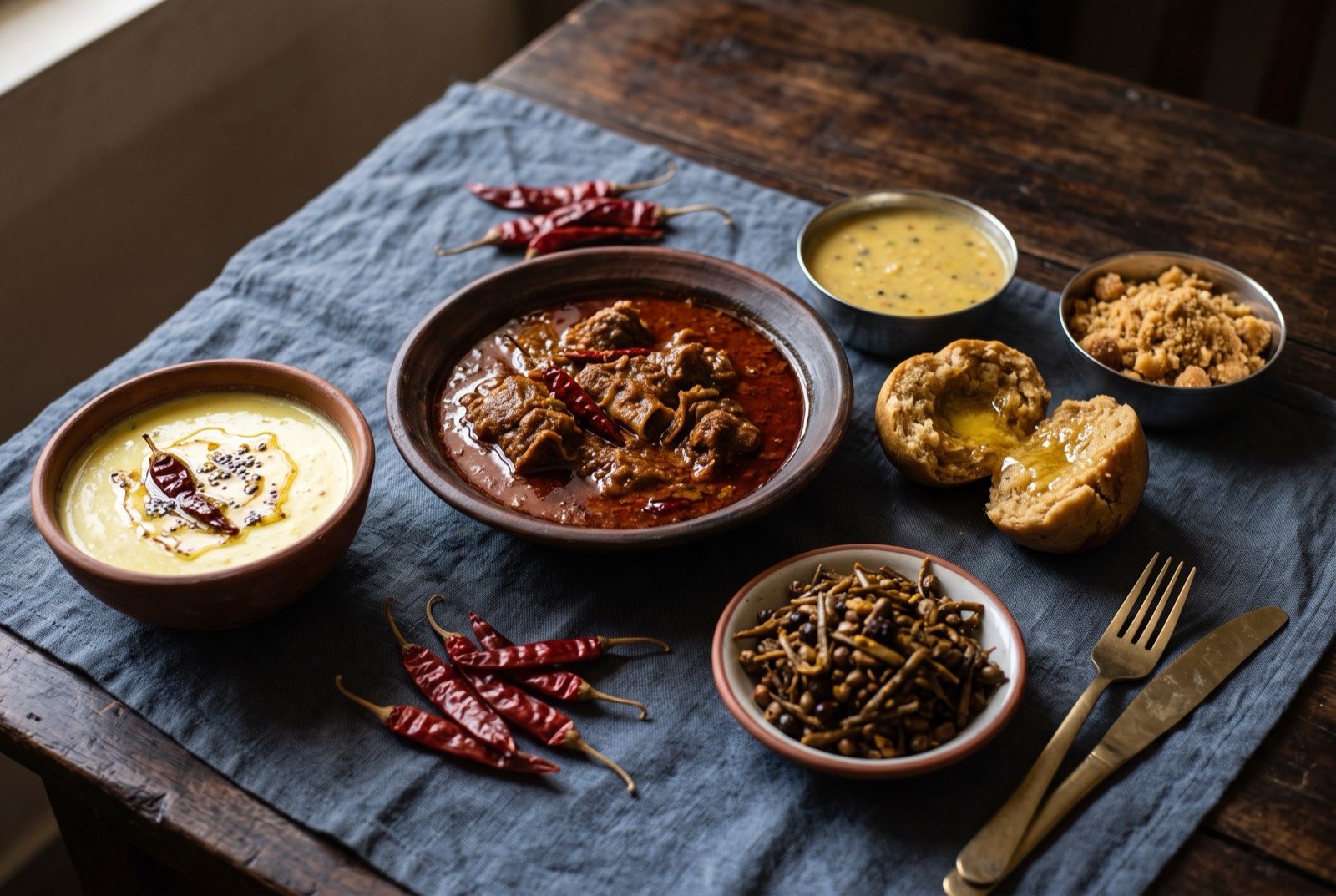
Rajasthan, the Thar desert's food world, taken seriously: a chilli-red hunting and warrior table of the Rajput courts of Jodhpur and Udaipur set against a completely meat-free Marwari and Jain merchant table, built from the same short list of drought-proof ingredients, and every dish as tradition built it, then what a modern chef would change.
Sources and review · What this chapter does not assert · How we research · Spotted something wrong?
A Sense of Place
Two tables sit inside the same desert, and neither one is the whole story on its own. One belongs to the Rajput warrior and hunting courts of Jodhpur and Udaipur: chilli-red meat, seared hard and braised long, cooked in pits dug so the smoke would not give a hunting party away. The other belongs to the Marwari and Jain merchant houses who traded out of the same country and built, deliberately and on religious grounds, a completely meat-free cuisine from the same short list of drought-proof ingredients: gram flour, pearl millet, buttermilk, and whatever could be dried, pickled or sun-cured against the months when nothing grew. Both tables answer to the same landlord, the Thar desert, which decides what can be grown, what must be preserved, and what a kitchen simply cannot afford to waste. This chapter tries to hold both tables at once, rather than letting the louder one, laal maas's chilli heat, stand in for a cuisine that is at least as much about a besan dumpling simmered in yoghurt as it is about a hunter's fire.
Rajasthan is India's largest state by area and its driest: most of the west and centre sits inside or on the fringe of the Thar desert, a belt where rainfall can fall as low as 100mm a year and the difference between a good and a catastrophic harvest is a matter of a few weeks' monsoon. That aridity is the single fact that organises the cuisine more than any other, and it cuts across religion and caste rather than sitting neatly on one side of the meat-eating line: a Rajput household and a Jain merchant household a street apart in Jodhpur are both, for different reasons, cooking around the same shortage of fresh vegetables and running water.
The state's two historic power centres, Marwar (the Jodhpur kingdom) and Mewar (the Udaipur kingdom), each produced their own royal kitchen tradition, staffed by their own specialist cook castes: Wahri cooks served the Marwar court, Bhoi cooks served Mewar's, and the specialisation inside those kitchens ran deep enough that, according to Chef Akshraj Jodha, whose own family lineage traces to Jodhpur's founder Rao Jodha, no single cook mastered a whole dish end to end; the work was compartmentalised across roles, which is a large part of why so much of it nearly disappeared once the princely kitchens were dissolved after Independence. Jodhpur and Udaipur do not agree on how to cook their own signature dish: Jodhpur's laal maas is built in ghee, Udaipur's in unrefined, first-pressing mustard oil, and only the Udaipur version is smoked. A chapter, or a reader, treating "laal maas" as one fixed recipe is already flattening something Rajasthan itself does not flatten.
Caste and community decide who eats meat at all, and the lines are more specific than a simple Hindu-vegetarian, Muslim-and-Rajput-carnivore split. A genuinely institutional source on this, the Indira Gandhi National Centre for the Arts' own published research on Mewar's food customs, names Brahmin communities as avoiding meat, onion and garlic entirely, while Rajput, Kayastha (a scribal and administrative caste) and Dhamai jatis ate meat as a normal part of life: goat, fish, deer, pork, partridge and duck. Further down the social order, Bhil, Meena and Harijan communities faced no dietary restriction at all, and could eat meat from any source, including animals that had died naturally, which the meat-eating upper castes would not touch. The same act, eating meat, carried entirely different social weight depending on who was doing it and how the animal had died, and this chapter tries not to smooth that into one line about "Rajasthan eats meat."
Running alongside and through all of this is the Marwari trading diaspora: a linguistic and regional-origin category out of Marwar rather than a single caste, containing several merchant jatis (Agrawal, Khandelwal, Maheshwari, Oswal chief among them) of which some, notably Oswal, are predominantly Jain, and others, notably Maheshwari, are predominantly Hindu Vaishnav. Marwari is not a synonym for Jain, and this chapter treats them as overlapping rather than identical categories throughout. What both groups share, whatever their formal religion, is a food culture markedly shaped by Jain dietary norms even in households that are not themselves Jain: no root vegetables, and a kitchen built to travel, because Marwari merchant families migrated out of Rajasthan in real numbers from the early nineteenth century, first pushed by Maratha and Pindari raiding that made the old trade routes unsafe, later drawn by an 1820 treaty opening British-controlled towns such as Calcutta to easier trade. By 1900 a Marwari settlement existed in nearly every business town of northern India, carrying this cooking with it; Marwari businessmen reportedly still account for around a quarter of Indian names on the Forbes billionaires list today, a scale of commercial success built, in no small part, on a diet designed to be cooked simply, without fresh produce, wherever the next posting happened to be.
| Community | Defining ecological or religious logic | Dishes that carry it |
|---|---|---|
| Rajput, Kayastha, Dhamai (meat-eating castes) | Warrior and hunting-court tradition; meat as a normal, sanctioned part of diet | Laal maas, jungli maas, safed maas, khad khargosh |
| Brahmin | Meat, onion and garlic avoided entirely | The onion-free vegetarian repertoire shared with Jain cooking |
| Marwari merchant jatis (Agrawal, Khandelwal, Maheshwari) | Trading diaspora carrying a portable, non-perishable vegetarian cuisine across India | Dal baati churma, gatte ki sabzi, kadhi, papad ki sabzi |
| Jain (predominantly the Oswal jati among Marwaris) | Ahimsa extended specifically to root vegetables, plus eating only before sunset | The same repertoire, cooked without onion, garlic or other kandmool |
| Bhil, Meena, Harijan | No dietary restriction; meat from any source, including naturally dead animals, eaten without the status anxiety attached to upper-caste meat-eating | Not separately documented in the sourcing behind this chapter; named here so the caste picture is not flattened to two tiers |
The History in Layers
The deepest layer here is not political at all. It is the Thar's aridity, which has been forcing the same set of adaptations, drought-resistant grains, dairy in place of fresh vegetables, and sun-drying against the lean season, onto every community in the region regardless of religion, for as long as anyone has farmed here. Rajasthan remains India's largest producer of both bajra (pearl millet) and moth bean, and the reason is agronomic rather than cultural: bajra is genuinely drought-tolerant and short-duration, viable across nearly all soil types with low input costs in low-and-erratic-rainfall conditions, and moth bean, at roughly 85% of India's crop grown here, will yield even at 50 to 60mm of annual rainfall against a normal legume's optimal range of 500 to 750mm. Besan, ground from the comparatively drought-tolerant chana dal, became the flexible base ingredient of the whole cuisine for the same reason: it carries roughly 20g of protein per 100g against about 12g for wheat flour, a genuinely important source in diets that, for Jains and Vaishnav Marwaris alike, exclude meat entirely.
Chilli is a far later arrival than most retellings of this cuisine admit, and getting the date right matters, because it directly unsettles the most repeated story about laal maas. Chilli reached India via Portuguese traders in the sixteenth century, but it reached interior Rajasthan considerably later, most likely carried inland through Maratha contact in the eighteenth century. The Mathania chilli specifically, the variety that gives laal maas its actual colour, is grown by families around Mathania village near Jodhpur who report, in reporting by the Hindi environmental journalism outlet Down to Earth, roughly seven to eight generations of cultivation, which works out to the late eighteenth or early nineteenth century. That means the popular claim that laal maas dates to the eighth century, usually attached loosely to Bappa Rawal, the real founder of Mewar's Guhil dynasty, cannot be true as the chilli-forward dish we know today: no source this chapter's research could find documents laal maas, or any chilli-based hunting dish, in connection with Bappa Rawal or his court, and a chilli-heat dish simply cannot predate the arrival of chilli in the region by a thousand years. What is plausible, and probably true in outline even if it cannot be dated, is an older hunting-camp tradition of masking game odour with pungency, using the region's pre-chilli heat source, black pepper, which Mathania chilli is reported to have "successfully replaced... as the main source of heat" once it was locally adopted. The specific, named dish "laal maas" most likely crystallised no earlier than the eighteenth century and was probably codified into something like its current form in nineteenth or twentieth century court kitchens. This chapter treats the eighth-century dating as folk etymology attached to a real dynasty's name, not documented history, and says so plainly rather than repeating it because it is the more romantic version.
The Mughal layer runs through the same royal kitchens, most visibly at Amber and Jaipur, where the Kachhwaha rulers maintained a close and well-documented alliance with the Mughal court. IGNCA's research on elite Mewar food practice names explicit Mughal culinary influence in royal households: pulao, murabba (fruit preserves) and kabuli-style roasted dishes were all adopted forms. Safed maas, the mild almond and cream curry usually presented as laal maas's cooler counterpoint, is popularly explained as a product of exactly this influence, built for palates that found unrelenting chilli heat unpalatable. That explanation is plausible given the documented Kachhwaha-Mughal relationship, but it needs to be said honestly that no source behind this chapter, including the IGNCA piece, actually documents safed maas by name, by court, or by date. It survives in the record only as recipe-blog and lifestyle-magazine consensus, and this chapter is not going to dress that consensus up as settled history.
Independence closed the door on the tradition's actual hunting economy. India's Wildlife (Protection) Act, 1972, enacted 9 September that year, made shikar illegal and is the real, dateable event, not a vague "changing times," that ended royal hunting and forced the shift from wild boar, venison and game birds to farmed goat, mutton and rabbit in dishes that had genuinely been built around wild meat. Maharaja Gaj Singh II of Jodhpur, quoted in Upper Crust India, put the loss plainly: "a whole lot of Rajasthani traditions had been killed, game food was one," recalling personally hunting wild duck, geese, partridge, sand grouse, pheasant and wild boar before the ban. The princely kitchens themselves did not long survive Independence either: once the specialised, caste-divided cook staff of a working royal household had nowhere left to be employed, a great deal of technique that had never been written down, because it did not need to be while the household still existed, began to disappear with them. Much of what chefs like Akshraj Jodha are doing today, working from Mehrangarh Fort archive material recovered via INTACH, the Indian National Trust for Art and Cultural Heritage, is reconstruction of exactly that loss, not a living, unbroken line.
The Marwari half of the story is not a hunting-and-court history at all. It is a nineteenth and twentieth century migration and trading success story, running in parallel to and largely independent of the Rajput royal narrative, and this chapter has been careful throughout not to let the louder, more romantic hunting story crowd it out. By the 1970s Marwari-owned firms held most of India's private industrial assets, per Thomas Timberg's standard history of the community, and one of the clearest, most concrete pieces of evidence for how far that success reached back into the region's own food is Haldiram's: founded in 1937 in Bikaner by Ganga Bhishen Agarwal, whose signature bhujia was made distinctively from moth dal rather than the usual besan, a specifically desert-adapted product that a Marwari merchant family eventually built into a snack brand exporting to more than eighty countries.
The present moment is being written, tentatively, by a small number of named chefs rather than by an established restaurant category. Dr Saurabh Sharma, who holds a PhD specifically on Rajasthan's culinary heritage and built his restaurant RajRasa on fieldwork travelling from village kitchens to palace scrolls recording grandmothers' techniques directly, and Vineet Bhatia, the first chef of Indian origin ever to win a Michelin star, who opened Mewar by Vineet at Udaipur's Oberoi Udaivilas on 1 October 2025, represent two genuinely different routes into the same project: one an academic reconstruction project, the other a French-trained fine-dining sensibility turned back onto Mewar's own ingredients and slow, coal-and-clay-pot cooking. Neither had accumulated independent reviews at the point this chapter's research was done, and the sourcing behind this chapter found no restaurant, anywhere in the world, with sustained serious food-press coverage treating Rajasthani cuisine as its own category the way South Indian or Keralan cooking now receives in Britain. The clearest single piece of outside validation this cuisine has actually received sits, tellingly, inside a restaurant that is not Rajasthan-specific at all: Chintan Pandya's James Beard Award in 2022 for Dhamaka in New York, whose hardest-to-book dish is a whole rabbit cooked, in the restaurant's own words, "the way hunters in Rajasthan would."
The Flavour Arsenal
Chillies
| Ingredient | What it does |
|---|---|
| Mathania chilli | Grown almost exclusively around Mathania, near Jodhpur; prized for depth of colour, aroma and a smoky, faintly sweet flavour rather than raw heat, moderate by Indian standards. The chilli that actually makes laal maas red rather than merely hot; cultivated area has collapsed from over 10,000 hectares in the late 1990s to roughly 1,000 today, with a live campaign for Geographical Indication protection under way |
Starches and staples
| Ingredient | What it does |
|---|---|
| Bajra (pearl millet) | The desert's base grain; drought-tolerant, short-duration, viable on poor soil where wheat and rice fail |
| Besan (gram flour) | The single most flexible ingredient in the whole repertoire: dumpling (gatte), gravy thickener (kadhi), flatbread additive (missi roti), sweet (besan chakki). Roughly 20g protein per 100g, a real protein source in a meat-free diet |
| Moth dal (moth bean) | Rajasthan grows roughly 85% of India's crop; yields even at 50 to 60mm annual rainfall, the pantry's clearest single proof that this cuisine exists because of aridity, not despite it |
| Wheat | The baati and roti grain, alongside bajra rather than in place of it |
Dairy
| Ingredient | What it does |
|---|---|
| Ghee | Used in real quantity throughout, not as a finishing touch; Jodhpur-style laal maas is built on it directly |
| Buttermilk (chhaas) | The desert's substitute for fresh water-hungry vegetables, and the base of both kadhi and rabodi |
| Khoya/mawa | Reduced milk solids, the base of the region's milk sweets |
Dried, foraged and preserved
| Ingredient | What it does |
|---|---|
| Ker | The dried berry of Capparis decidua, foraged wild, no irrigation needed |
| Sangri | The dried pod of the khejri tree (Prosopis cineraria), the desert's nitrogen-fixing "tree of life"; picked green between April and June, historically one of the few nutrition sources in famine years |
| Kachri | A wild desert melon, dried, part of the panchkuta preservation mix |
| Papad, khichiya papad | Sun-dried lentil or rice wafer; khichiya, the thinner, rice-based papad, is the specifically Rajasthani and Marwari style, as against the generic urad dal papad found across India |
| Rabodi | Sun-dried buttermilk-and-maize or sorghum dumplings, made in season and stored for the vegetable-scarce months |
Aromatics
| Ingredient | What it does |
|---|---|
| Ajwain | Carries the flavour of baati and missi roti; also credited, in circulating but unverified nutritional claims, with aiding digestion |
| Asafoetida (hing) | A pungent everyday spice, and a load-bearing one in Jain cooking specifically, where it stands in for the onion and garlic aromatic base that dietary law removes entirely |
The Technique Ladder
Rung 1. Khad: the pit built so the smoke would not give you away
Khad cooking developed, per the accounts behind Rajasthani shikar (hunting) cuisine, so that Rajput soldiers and hunters could cook without visible smoke or firelight betraying their position. Meat, traditionally wild rabbit, partridge or boar, is marinated in a chilli-forward paste, wrapped first in roti, then in banana or gulmohar leaves, then in a damp jute sack, and buried two to three feet deep among hot coals for two hours or more; one account describes a copper pipe inserted into the parcel so ghee can be topped up mid-cook without unearthing it. This is, mechanically, a wood-fired, low-and-slow, moisture-sealed cooking method, and it is the clearest indigenous ancestor in this whole chapter of a sous vide bag or a Big Green Egg run low and slow with the lid shut: the logic, seal moisture in, let time and gentle heat do the work no direct flame can do without drying the meat out, is identical, only the tools have changed.
Rung 2. Bhunna: sear the meat dry before it ever meets liquid
Every credible laal maas recipe this chapter's research turned up sears or fries the meat first, not simmers it from raw. This bhunna technique, slow, dry, fat-based browning, is named specifically by Rajasthan's own royal-kitchen tradition as a method that does not translate well to a modern domestic gas burner, because the heat profile of a wood or charcoal fire differs from a controllable gas flame; the browning it produces is doing real Maillard work that a wetter, faster-heated pan will not reproduce.
Rung 3. Build the gravy on fat and yoghurt, not water
Desert-campaign cooking, as described by chefs working from Mehrangarh's own archives, relied on ghee, onion, garlic and yoghurt rather than water-based gravies, for both flavour and, in a landscape where water itself could not be relied upon, sheer practicality. This is not a stylistic preference; it is the same aridity logic that shapes the pantry generally, applied directly to how a sauce gets built.
Rung 4. Gatta: poach it, then simmer it, never just one or the other
A firm besan dough, seasoned with ajwain and yoghurt, is rolled into ropes and poached in simmering water until it floats, roughly eight minutes, then sliced and finished a second time in a separate yoghurt gravy, kept from splitting by constant gentle stirring. Two distinct cooking stages, in two different liquids, produce a dumpling with a set exterior and a soft, still-tender interior that a single-stage method could not give it, and the technique exists specifically because Rajasthan's aridity limited the fresh vegetables that would otherwise have carried a dish like this.
Rung 5. Bake bread in embers, not an oven
Baati is traditionally cooked buried in the hot sand or ash of a wood-and-cow-dung-cake fire, or in a household angithi brazier, a method credited across Hindi sources with a distinctive smoky, earthy quality (saundhapan) that no domestic oven or gas tandoor reproduces. Every source describing the traditional method names dung cake or wood as the fuel; every source describing the modern method names oven or gas tandoor, framed openly as a concession to changing times rather than an improvement.
Rung 6. Preserve against the season that has nothing in it
Ker, sangri, kachri, khichiya papad and rabodi are all, in different ways, the same move: take what the brief wet season gives you and dry it, so there is something to cook when the dry season gives you nothing. This is not a decorative pickling tradition; it is the mechanism by which a household in the Thar eats a vegetable at all for most of the year.
The Ferment and Preserve Bench
1. Ker and sangri, dried
Foraged, dried whole and stored for use through the year; the base ingredient for the ker sangri dish above and for panchkuta. No irrigation, no cultivation in the usual sense, simply gathering and drying what the khejri tree and Capparis decidua give in season.
2. Panchkuta
Five dried desert ingredients, ker, kummat, sangri, kachri and lasoda, combined and usable year-round as vegetable, pickle or spice mix. A claimed traditional use for digestive and joint complaints rests on an unnamed study with no author given, and should not be repeated as established fact; the preservation logic itself, however, five ingredients that would otherwise spoil or simply not exist out of season, is well evidenced across multiple sources.
3. Khichiya papad
A thinner, rice-based papad distinct from the generic urad dal papad found across India, sun-dried and stored, and worth naming as a specifically Rajasthani and Marwari product rather than defaulting to the generic term.
4. Rabodi
Sun-dried buttermilk-and-maize or sorghum dumplings, made when maize is plentiful and stored airtight for the season when fresh vegetables are scarce, then rehydrated in boiling water and cooked through in buttermilk with spices. This chapter's research found this to be the weakest-sourced dish in the whole repertoire, the only source available being a retailer's product description, and it is also, as covered in Sourcing below, entirely unavailable to a UK cook through any verified retail channel. It is named here honestly as a real technique worth understanding, not one this chapter can currently hand a reader real quantities for.
Sourcing in Britain
Mathania chilli, the ingredient that most defines this cuisine's signature dish, is not stocked by any mainstream UK spice house: TRS, Rajah, Natco, Spice Mountain and The Spicery were all checked directly and none list it by name. It is genuinely buyable, but only from individual Indian sellers exporting via Etsy and eBay, shipping from Jodhpur, at a real premium (roughly £20 for 100g rising past £70 for a kilogram) and with no established, multi-year UK supply chain behind any given listing. Where that feels like too large a gamble for a specific cook date, the honest substitute is Kashmiri chilli for colour, which most UK supermarkets and every specialist spice shop stock, blended with a smaller quantity of a hotter dried chilli, bird's eye or Guntur, if the recipe wants more punch than Kashmiri alone provides; this two-chilli approach is used by Indian sources themselves when Mathania is unavailable outside Rajasthan, not a compromise invented for this chapter.
Ker and sangri, somewhat surprisingly, are better supplied than almost anything else in this chapter: both Amazon UK and Etsy UK carry real dried products, including a specifically branded Rajasthani panchkuta mix, with genuine review histories suggesting repeat rather than one-off supply. Expect to pay several multiples of the Indian price, £14 to £40 for packs of 150g to 400g, and to find stock genuinely thin, so order ahead of a planned cook rather than assuming availability on the day. Rabodi, by contrast, is a real and currently unclosable gap: no UK retailer of any kind was found stocking it, and a reader wanting to attempt the dish will need to make it from scratch, which the dehydrator makes genuinely feasible, since the traditional method is exactly sun-drying a soaked maize-and-buttermilk mixture.
Bajra flour and besan have both, to different degrees, gone mainstream. TRS Bajri Flour is stocked, though sometimes patchily, by specialist South Asian retailers; besan itself now sits on Tesco's and Sainsbury's own shelves under the Koh-I-Noor, Virani and KTC labels, and does not need a special trip at all. Asafoetida is well served by UK Indian grocers, LG and Vandevi both confirmed live and stocked; buy a recognised brand rather than the cheapest unbranded jar, since compounded hing (resin cut with rice flour or gum arabic) is what most households actually use, and brand reputation matters more than chasing a "pure" version that is, for everyday cooking, the wrong product anyway. Ghee is worth real care: Amul Pure Ghee is the reliable, widely available, verified choice, but marketplace reviews report real batch variation, so buy from a retailer with a genuine review history rather than the cheapest listing, and treat a bad batch as a real risk rather than an unlucky exception. Amchur, and khichiya papad specifically (the Saras brand, verified live on Amazon UK), are both properly stocked and worth naming by brand rather than sending a reader on an unnecessary hunt.
No dedicated Rajasthani or Marwari grocer exists anywhere in the UK, a genuine, checked absence across London (Southall, Wembley, Tooting), Leicester and Birmingham; the category is served entirely by general South Asian grocers plus the marketplace sellers above. For eating this food before cooking it, Chokhi Dhani London (2 Riverlight Quay, SW11 8AW) is the one restaurant that can be recommended with real confidence: its own current menu carries a genuine dedicated Rajasthani section, dal bati churma, laal maas, gatte curry, and full thalis naming bajra rotla, missi roti, khichia and sangri pickle by name, a level of specific regional detail well beyond a couple of token dishes bolted onto a generic Indian menu. Kanishka by Atul Kochhar in Mayfair has run an occasional "Flavours of Rajasthan" tasting menu built around a deconstructed laal maas, and is worth knowing about as evidence a Michelin-recognised UK kitchen takes this cuisine seriously, though as a special rather than an everyday menu. A restaurant on Brick Lane trading as Taste of Jaipur brands itself as London's authentic Rajasthani specialist, but its own visible menu, checked directly, shows no laal maas, dal bati churma or other core dish, only the marketing strapline; treat that branding claim with real scepticism rather than as equivalent to Chokhi Dhani.
On kit: the reader's existing equipment needs nothing added for this cuisine. Baati specifically is worth reframing rather than merely accommodating: traditional baati is baked buried in wood or dung-cake embers, not in an oven, which makes a Big Green Egg run with a deep bed of lump charcoal and the lid shut genuinely closer to the traditional cooking environment than a domestic oven would be, not a convenience substitute standing in for the real thing but arguably a better match for it.
Ranked, the ingredients that decide great from grim: ghee quality first, since it is used in real quantity throughout and a poor batch is immediately tasteable; Mathania chilli or its honest Kashmiri-plus-heat substitute second, since a generic chilli powder alone produces a red meat curry that is not recognisably laal maas at all; ker and sangri third, for which there is no real substitute if panchkuta is the goal; bajra flour freshness fourth, since millet flour goes rancid faster than wheat and a retailer's stock turnover matters more here than brand choice; besan fifth, now genuinely commodity-grade and not worth worrying over; and rabodi last, ranked there only because it is currently unobtainable through any verified UK channel, a dish to understand rather than, for now, to cook.
Voices and Sources
From inside the Rajput tradition
Chef Akshraj Jodha, Executive Chef at ITC Windsor, Bengaluru, and custodian of Rajasthani cuisine across the ITC Hotels group, is the single most significant living voice behind this chapter's Rajput material. His own ancestry traces to Rao Jodha, founder of Jodhpur, and his professional training runs through ITC Maurya's Dum Pukht kitchen under the noted chef Imtiaz Qureshi; he has drawn directly on historical recipes recovered from the Mehrangarh Fort archives via INTACH, and his account of dishes like junglee maas and khad khargosh, reported at length by the food writer Kaveri Ponnapa and independently by Scroll.in, is the strongest single source this chapter has for what a working Rajput royal kitchen actually did, as against what tourist-facing food media assumes it did. Ponnapa, author of The Vanishing Kodavas and Coorg: The Cookbook, is exactly the kind of serious in-tradition Indian food historian this atlas depends on. Priya Deshingkar's research into laal maas's real history, sourced to a recipe obtained directly through the Khansama of the Maharana of Udaipur's household, is the strongest single source for the dish's regional Jodhpur/Udaipur fork and for the honest admission that its actual age cannot be pinned down. Forbes India's own reporting on Rajasthan's vanishing royal cuisine, naming the Bhoi and Wahri cook castes and the household experts Shatrunjay Singh of Deogarh and Thakur Man Singh of Kanota, corroborates and extends this material independently.
The merchant tradition, and today's chefs
On the vegetarian merchant tradition, the Indira Gandhi National Centre for the Arts' published Hindi-language research on Mewar's food and drink customs, by Amitesh Kumar, is the single genuinely institutional source behind this chapter's caste and diet section, and should anchor any future revision of it. James Laidlaw's Riches and Renunciation: Religion, Economy and Society among the Jains (Oxford, 1995), based on fieldwork among Jaipur's own Svetambara Jain community, is the standard scholarly account of how Jain dietary practice functions as identity formation rather than mere rule-following, though this chapter could only access it through secondary summaries, not the full text, and a future revision should try harder to obtain it directly. K.T. Achaya's food-historical scholarship, reached here only through a secondary citation, underlies the kadhi dating above. On the modern, contemporary side, Dr Saurabh Sharma's PhD-grounded fieldwork behind RajRasa, reported independently by Outlook Traveller and Tribune India, and Vivek Singh's own first-person writing for Great British Chefs on returning to the Rajasthan he lived in for three years before founding The Cinnamon Club, both represent chefs thinking seriously about this cuisine's actual mechanics rather than its tourist shorthand. Vineet Bhatia MBE, the first chef of Indian origin to win a Michelin star, now mentoring Mewar by Vineet at Udaipur's Oberoi Udaivilas, and Chintan Pandya, whose 2022 James Beard Award for Dhamaka in New York rests substantially on a whole rabbit cooked by named Rajasthani hunting technique, are this chapter's two clearest points of serious outside recognition, for what that recognition is worth against how little of it there actually is.
Things this chapter has deliberately not asserted
- That laal maas, or the specific role Mathania chilli plays in it, dates to the seventh or eighth century. This is chronologically impossible given chilli's documented arrival in interior Rajasthan no earlier than the eighteenth century; the popular dating is folk etymology attached to Bappa Rawal's real dynasty, not documented history.
- That safed maas has any demonstrated royal origin, court, date or genuine Mughal-influence history beyond recipe-blog and lifestyle-magazine consensus.
- That the Rajput-battlefield origin story for baati, soldiers burying dough balls in hot sand during campaigns, is historically true; an Indian source investigating the dish's actual history states there is no solid evidence for it, and treats the parallel churma-invention legend as folklore.
- That "khad ka pind," as a specific named technique with a documented pit construction, rests on a strong primary source; the broader practice of pit-cooking on hunts is better evidenced through Chef Jodha's own named account.
- That clay ovens excavated at Kalibangan represent a documented, unbroken ancestor of later Rajput-era cooking technique; the archaeology is real, roughly 2600 to 2700 BCE, but no source connects it to historical-period Rajput kitchens across the roughly 3,500 intervening years and a civilisational collapse.
- That dhungar smoking is a purely Rajasthani or Marwari invention; a serious Indian culture outlet attributes its origin instead to Maharashtra, and even within Rajasthan only the Udaipur laal maas is smoked, not the Jodhpur version.
- That laal maas was always, or was never, made from wild game rather than goat; credible sources directly contradict each other on this point and this chapter has not resolved it.
- That ker sangri is formally listed on Slow Food's international Ark of Taste; this could not be confirmed either way.
- That any precise statistic exists for what fraction of the Marwari community is Jain as against Vaishnav Hindu.
- That any UK restaurant beyond Chokhi Dhani London can be relied on for authentic core Rajasthani dishes without a fresh, firsthand check; Taste of Jaipur's own visible menu does not bear out its stated branding, and neither Kanishka's occasional tasting menu nor a 2016-sourced dish at a Birmingham restaurant could be confirmed as currently live.
- That any UK restaurant, anywhere, is specifically and identifiably Marwari as against generically Indian-vegetarian or Gujarati-Jain; the UK's well-documented Jain community, in Leicester and Harrow/Wembley, is Gujarati Oshwal, a distinct diaspora from the Rajasthani Marwari-Jain community this chapter covers, and the two should not be conflated.
- And that any named contemporary chef, anywhere, is doing for Marwari or Jain vegetarian cuisine what Ikoyi, Akoko or Chishuru do for West African cooking. No such figure turned up in the research behind this chapter, and inventing one would be worse than naming the gap honestly.
Khad: the pit built so the smoke would not give you away
Khad cooking developed, per the accounts behind Rajasthani shikar (hunting) cuisine, so that Rajput soldiers and hunters could cook without visible smoke or...
Bhunna: sear the meat dry before it ever meets liquid
Every credible laal maas recipe this chapter's research turned up sears or fries the meat first, not simmers it from raw.
Build the gravy on fat and yoghurt, not water
Desert-campaign cooking, as described by chefs working from Mehrangarh's own archives, relied on ghee, onion, garlic and yoghurt rather than water-based...
Gatta: poach it, then simmer it, never just one or the other
A firm besan dough, seasoned with ajwain and yoghurt, is rolled into ropes and poached in simmering water until it floats, roughly eight minutes, then sliced...
Bake bread in embers, not an oven
Baati is traditionally cooked buried in the hot sand or ash of a wood-and-cow-dung-cake fire, or in a household angithi brazier, a method credited across Hindi...
Preserve against the season that has nothing in it
Ker, sangri, kachri, khichiya papad and rabodi are all, in different ways, the same move: take what the brief wet season gives you and dry it, so there is...
The dishes
- Laal maas Jodhpur and Udaipur, Rajasthan
- Jungli maas Rajput hunting camps, Rajasthan
- Safed maas Rajasthan (a popularly claimed, but unconfirmed, Kachhwaha court origin)
- Dal baati churma Marwar, Rajasthan
- Gatte ki sabzi Marwari and Jain households, Rajasthan
- Ker sangri The Thar desert, Rajasthan
- Kadhi Rajasthan-Gujarat desert belt
- Papad ki sabzi Marwari households, Rajasthan
Sources and review
- Reviewed
- Not yet reviewed from inside the tradition
- Cooked
- Not yet cooked and reported
Where this volume comes from
3 research briefs on file for this volume, researched to the rules on How we research. Published 4 September 2026. Last changed 8 September 2026.
The brief's own account of its sources
Rough split. Combining both agents' source pools: roughly 45 to 55% of Part A's substantive citations are genuinely Indian/local-language or in-tradition (IGNCA, Down to Earth Hindi, Sahapedia, Kaveri Ponnapa interviewing Chef Akshraj Jodha, Forbes India, Scroll.in, Priya Deshingkar sourced to a royal Khansama, Hindi Wikipedia and Bharat Discovery for basic dating only, the Wildlife Protection Act's primary legal text).