The Indian subcontinent · Volume 16, The Ember Pit, the Merchant’s Table and a Desert That Wastes Nothing
Laal maas
Jodhpur and Udaipur, Rajasthan
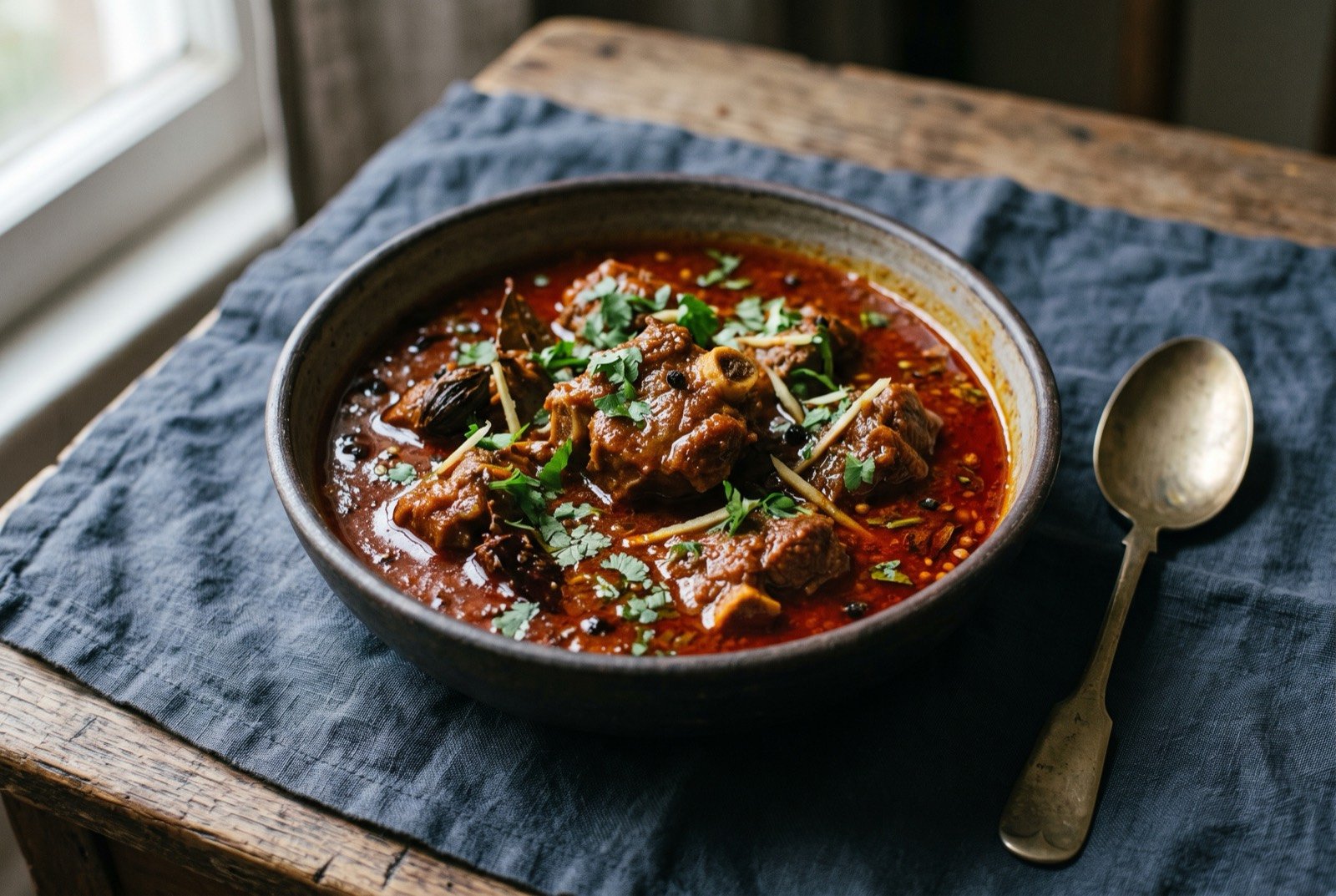
An illustration of the dish, not a photograph of it cooked.
- Time
- Hands on 1 hour 30 · Waiting 30 minutes
- Reviewed
- Not yet reviewed from inside the tradition
- Cooked
- Not yet cooked and reported
Rajasthan's best-known dish, and the one whose popular history most needs correcting before it is cooked. This is not, on the evidence available, an eighth-century recipe; it is a hunting-camp tradition of masking gamey meat with pungency, refined into its current chilli-forward form no earlier than the eighteenth century, once the Mathania chilli that actually defines it had reached the region, and most likely codified into the recipe recognisable today inside nineteenth or twentieth century court kitchens. Jodhpur and Udaipur do not cook it the same way: Jodhpur uses ghee for a saucier gravy; Udaipur uses unrefined mustard oil for a drier finish and, in some accounts, smokes the dish afterwards, a step Jodhpur's version skips entirely. Sources genuinely disagree on whether the dish was ever built from actual wild game, one credible in-tradition account, sourced to a working Khansama (head chef) of the Maharana of Udaipur's household, states it was always goat, while other widely repeated sources describe a shift from wild boar or venison after the 1972 hunting ban. This chapter is not going to adjudicate that disagreement; it is naming it so a reader is not handed false certainty.
As tradition built it
Serves 4 to 6. About 1 hour 30 minutes, plus 30 minutes soaking.
Ingredients
For the meat and chilli paste
- 800 g goat leg or mutton shoulder, cut into large chunks
- 15 to 20 whole Mathania chillies (or a blend of Kashmiri chilli plus a smaller quantity of a hotter dried chilli, see Sourcing below)
- 4 tbsp ginger-garlic paste
For the gravy
- 50 g ghee (Jodhpur style; or 2 tbsp unrefined mustard oil, heated until smoking, for a Udaipur-style version)
- 4 medium onions, sliced
- 1 tsp cumin seeds
- 2 tbsp coriander seeds
- ¼ tsp turmeric
- 1 bay leaf
- 2 black cardamom
- 4 green cardamom
- 2 cinnamon sticks
- 250 g plain yoghurt
- 1 tsp salt
- 2 tbsp coriander leaf, chopped, to finish
Method
- Cut the goat leg or mutton shoulder into large chunks.
- Soak the Mathania chillies (or the Kashmiri-plus-hotter-chilli blend) in hot water for 30 minutes, then blend to a smooth paste with the ginger-garlic paste.
- Heat the ghee, or the mustard oil for a Udaipur-style version, heated until smoking, in a heavy pot and fry the sliced onions until deeply browned, the bhunna stage, this should take a genuine 12 to 15 minutes, not five.
- Add the meat and sear it hard on all sides in the same fat until it has properly coloured, not merely turned grey.
- Stir in the chilli paste, cumin seeds, coriander seeds, turmeric, bay leaf, black cardamom, green cardamom and cinnamon sticks.
- Fold through the yoghurt a spoonful at a time so it does not split, season with salt, cover and simmer gently for 45 minutes to an hour, until the meat is tender and the gravy has reduced and deepened in colour.
- Finish with chopped coriander leaf.
What a modern chef changes
A precise sous vide braise, and the Jodhpur/Udaipur fork served side by side
Rungs 1 and 2
Method
- Sear in batches over full heat. Apply rung 2 properly: sear the meat in batches over the highest heat a Big Green Egg run wide open can give, rather than in a crowded pan, so every piece actually browns rather than stewing in its own released liquid.
- Split the chilli paste in two. A fresh-blended portion for brightness and a portion fermented 48 hours beforehand for a genuine acid depth the fresh paste alone cannot give, a controlled version of the sourness a long, slow braise would otherwise have to develop on its own.
- Cook the meat sous vide. At 62°C for six hours to a precise, evenly tender doneness, then finish it in the reduced, fully spiced gravy for the final ten minutes so it takes on colour and flavour without ever having been allowed to overcook.
- Serve both versions side by side. Jodhpur and Udaipur, ghee-based and mustard-oil-based, smoked and unsmoked, exactly the regional fork this chapter has argued the dish actually contains but that almost no source outside Rajasthan itself preserves.