The Indian subcontinent · Volume 16, The Ember Pit, the Merchant’s Table and a Desert That Wastes Nothing
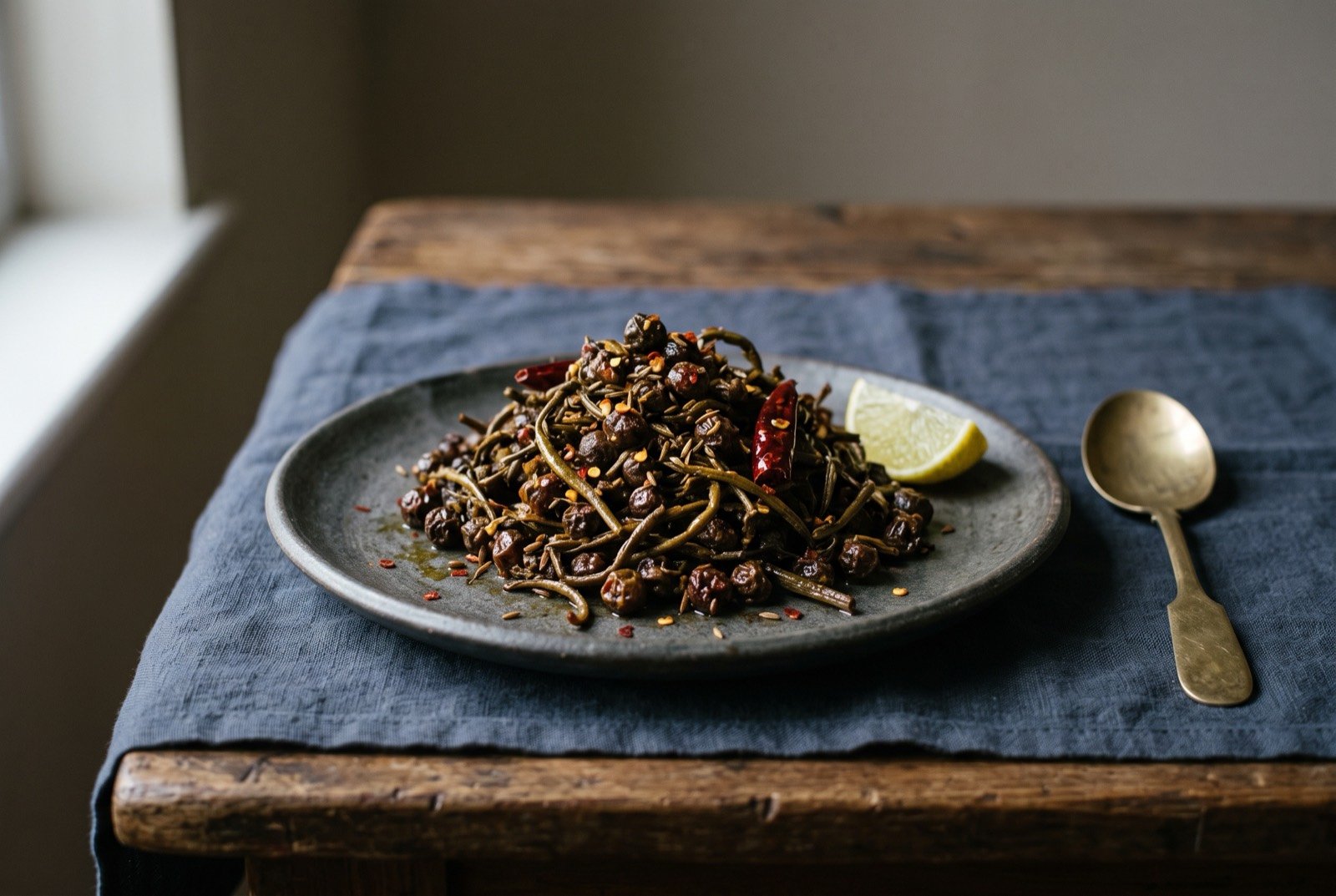
Ker sangri
The Thar desert, Rajasthan
Illustration
- Time
- 8 hours 30
- Researched
- Researched from 17 sources in the brief
The signature dish of the desert-foraged repertoire, and the clearest possible statement of the region's no-waste ecological logic. Ker, the dried berry of Capparis decidua, and sangri, the dried pod of the khejri tree, both grow wild in the Thar without irrigation, and khejri specifically tolerates 40 to 45°C summer heat, under 10°C winter cold, and as little as 100mm of annual rainfall, fixing nitrogen in the soil as it grows. Sangri pods, picked green between April and June, were historically one of the few reliable nutrition sources in famine years, a fact worth holding onto against the dish's current status as an expensive delicacy: this was survival food before it was a specialty.
As tradition built it
Serves 4 as a side. About 30 minutes, plus 6 to 8 hours' soaking.
Ingredients
- 100 g dried ker, soaked separately
- 100 g dried sangri, soaked separately
- 3 tbsp mustard oil
- 1 tsp cumin seeds
- 1 pinch a pinch of asafoetida (hing)
- 2 a couple of dried red chillies
- ½ tsp turmeric
- 1 tsp red chilli powder
- 1 tsp coriander powder
- to taste amchur (dried mango powder), to taste
- to taste salt
Method
- Soak the ker and sangri separately in water for 6 to 8 hours or overnight, then drain and rinse.
- Pressure-cook briefly, around two whistles, discard the cooking water, and rinse again.
- Heat the mustard oil until smoking, and temper with cumin seeds, asafoetida and dried red chillies.
- Add the ker and sangri along with turmeric, red chilli powder, coriander powder, amchur and salt.
- Cook, stirring, for 10 to 15 minutes until the oil separates and the mixture is dry, not saucy; this is a dry, spiced dish, not a curry.
What a modern chef changes
A two-stage rehydration, and an open-flame char the ecology would recognise
Rungs 1 and 6
Method
- Rehydrate in two stages. An initial long soak followed by a brief sous vide at 85°C in the soaking liquid, for a more even, controllable texture than a single pressure-cooker cycle gives.
- Char a portion of the sangri. Directly over the Big Green Egg's open flame before it joins the pan, a smoky note the traditional dry-spiced version does not have but the ecology around it, cooked mostly over open fire historically, would recognise as honest rather than foreign.
- Dry your own amchur. Dry a portion of fresh mango in the dehydrator to control its exact sourness rather than relying on a shop-bought powder of unknown strength.
- Serve alongside panchkuta. The related five-ingredient dried mix, ker, kummat, sangri, kachri, lasoda, so a reader tastes the single dish and the wider preservation tradition it belongs to side by side.