Asia · Volume 25
Sri Lanka and the Maldives
The Roasted Spice, the Palmyrah Coast and the Coral Atoll
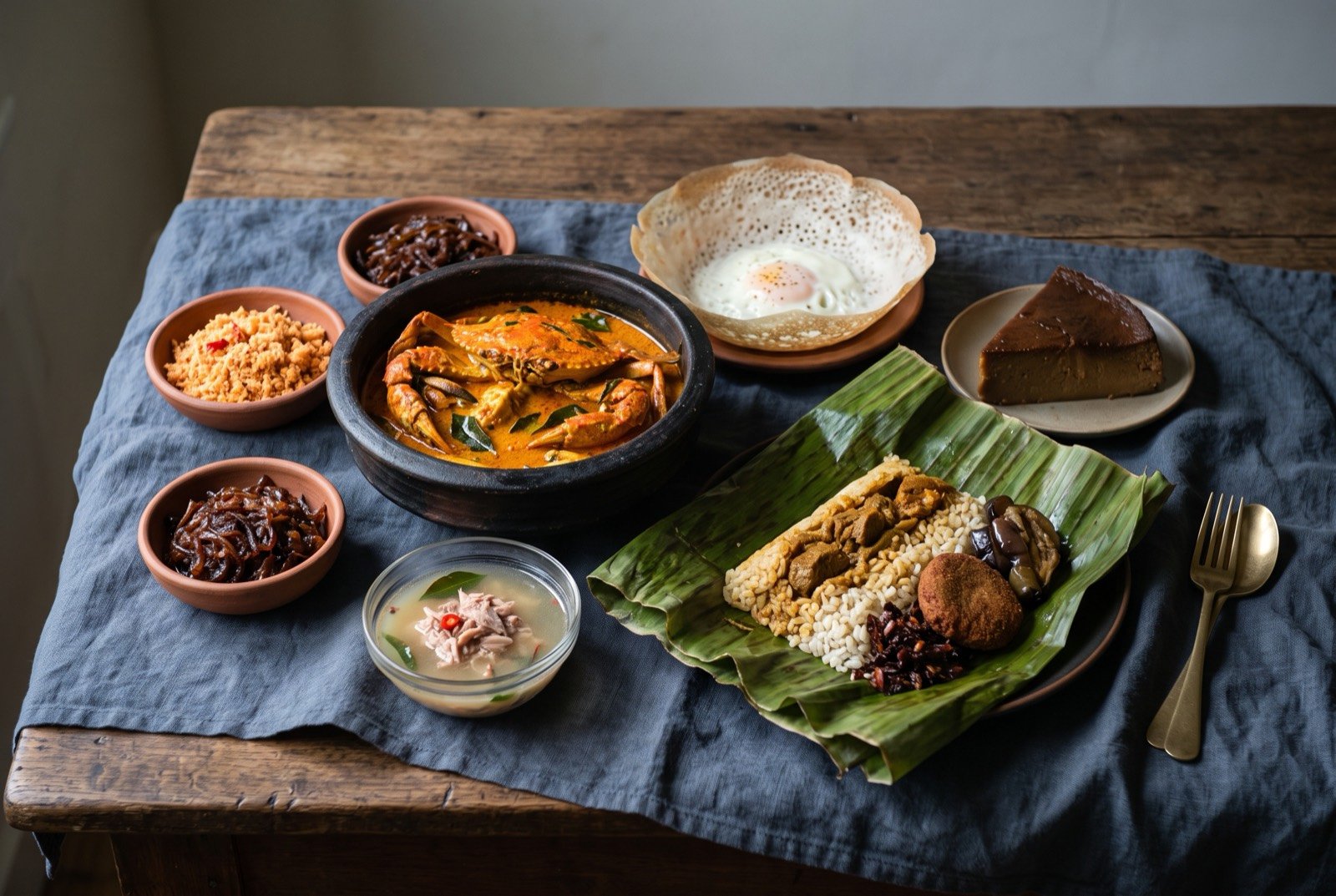
Sri Lanka earns the same treatment Sicily got in this atlas: a single island, coastal kin to the mainland just across the water, that stands apart on its own terms. What sets it apart is not distance. It is a home roasted curry powder tradition no part of mainland South India shares, a multi community table, Sinhala Buddhist, Tamil Hindu, Moor Muslim, Dutch Burgher, that argues honestly over who invented what, and a run of colonial layers, Portuguese, Dutch, British, thick enough to have renamed half the pantry without erasing what was underneath it. Beside it, folded in as its own closely related but ecologically distinct world, sits the Maldives: a nation with no arable land beyond the coconut palm, built entirely on tuna, coconut and imported rice, whose own elevated cooking has, on the evidence this chapter found, not yet been written by a Maldivian hand. Every dish as tradition built it, then what a modern chef would change.
Sources and review · What this chapter does not assert · How we research · Spotted something wrong?
A Sense of Place
Sri Lanka's food map is set by three ecological zones and by which community actually farms each one, and the Maldives sits beside all three as a fourth world again, a coral atoll nation that grows almost nothing at all.
The wet zone, the dry zone, and the hill country
The wet zone, the south west quadrant running from Colombo down to Galle and up into the hill country foothills, gets rain year round, supports paddy on a shorter cycle, and is the historic home of coconut cultivation at scale. The dry zone, the north, the east and the ancient Rajarata heartland around Anuradhapura and Polonnaruwa, depends on the monsoon and on the tank, or wewa, irrigation system the classical Sinhala kingdoms built to store water for a single main paddy cycle a year. The dry zone's forest system and surrounding wetlands let households move between ecological niches over short distances, the classical basis of Sinhala dry zone subsistence.
The hill country, the central highlands around Kandy and Nuwara Eliya, is cooler and wetter on its windward slopes, reshaped from the mid nineteenth century onward by British coffee and then tea planting. That single fact is the direct reason a large Tamil population lives there today, a population genuinely distinct from the one in the north, and this chapter holds that distinction throughout rather than collapsing it, for reasons the next section sets out.
Jaffna: a peninsula with no rivers, farmed like nowhere else on the island
Jaffna and the north are ecologically their own thing entirely. A flat limestone peninsula with no real river system, water drawn from shallow wells, its agriculture built around the palmyrah palm and around intensive irrigated cash cropping of red onion, green chilli and tobacco rather than paddy as the dominant crop. Jaffna District's agriculture, crop and livestock together, contributes around 65 percent of district GDP, and in 1990, 57 percent of the entire country's red onion crop came from Jaffna alone. Palmyrah products remain a real part of the district economy, though increasingly a niche and diaspora facing one.
Two Tamil communities, not one. Sri Lankan, or Jaffna, Tamils are a centuries old population of the northern peninsula, speaking a dialect described as preserving archaic features of Old Tamil predating the Tolkāppiyam. Their food economy runs on palmyrah, seafood and irrigated dry crop vegetables and pulses, not on estate labour. Malaiyaha, or hill country, Tamils, a self designation preferred over the colonial "Indian Tamil" or "estate Tamil," descend from indentured labourers brought from South India in the nineteenth and twentieth centuries specifically to work coffee, tea and rubber plantations in the central highlands. Their food tradition developed under conditions Jaffna food never experienced: estate line rationed provisioning, a diet historically constrained by what the estate stores sold, and real geographic and social isolation from both Jaffna in the north and the Kandyan Sinhala villages around them. The two communities are explicitly described in Sri Lankan and diaspora sources as ethnically distinct, and this chapter treats them as such. It is also honest about a real gap: almost no local language culinary material was found comparing hill country Tamil and Jaffna Tamil cooking dish by dish, and the Malaiyaha table is under documented here in a way Jaffna's is not.
The Moors and the Dutch Burghers
Sri Lankan Moors are the descendants of Arab and Persian traders intermarrying with South Indian Muslim traders and local populations, historically concentrated on the east coast and in trading communities across the island. The label reflects religion, not ethnic origin: it was chosen because of the Islamic faith of these people, and was not a reflection of their origin. The east coast Moor population is substantial and geographically concentrated, forming a meaningful share of Batticaloa, Trincomalee and Ampara districts.
The Dutch Burgher community descends from Dutch, and earlier Portuguese, colonial settlers who intermarried with the local population from the mid seventeenth century, when the Dutch took maritime Sri Lanka from the Portuguese in 1658, through to the British arrival in 1796. Its own name for itself in Sinhala, Lansi, derives from Dutch Hollandsche, inhabitant of Holland. It is a community that has shrunk dramatically, from roughly 0.8 percent of the population in the 1940s to an estimated 15,000 to 30,000 people today out of a national population of 21.67 million.
The Maldives: coconut, fish and imported rice, and nothing else grows
The Maldives is a coral atoll nation with essentially no arable land beyond the coconut palm, breadfruit, taro and a handful of other tolerant crops. Everything else, above all rice, is imported. Maldivian cuisine rests on three items and their derivatives: coconuts, fish and starches. Beyond imported rice, the real indigenous starch layer is taro, sweet potato, cassava, breadfruit and screwpine, and it varies genuinely island to island: on Fuvahmulah specifically, taro grown in flooded fields, not rice, is the actual staple. Protein is tuna, overwhelmingly: skipjack primary, plus little tunny, yellowfin, frigate tuna, bigeye scad, wahoo, mahi mahi and mackerel scad. One striking, well attested point of contrast against most other Pacific and Indian Ocean island cultures is worth carrying into everything that follows: Maldivians do not traditionally eat raw fish. Everything is cooked, cured, smoked or dried, and that single fact shapes the whole flavour arsenal below.
Pole and line tuna fishing, specifically, is old, real and still practised, and it is a genuinely different thing from industrial purse seine fishing. It is thought to have originated in the Maldives, passed through the generations for hundreds of years, using live bait kept in a circulating seawater system aboard the traditional dhoni, a small open boat historically built from coconut wood. The main dhoni building centre is Alifushi in Raa Atoll, where apprentices are still trained and a timber vessel takes roughly sixty days to build. Pole and line still accounts for the large majority of Maldivian skipjack and yellowfin catch, genuinely low bycatch since fish are taken one at a time; the fishery was MSC certified in 2012, catches roughly 100,000 tonnes of tuna a year, the country's largest export, and supports about 30,000 people, some 15 percent of the national workforce. Ibrahim Nadheeh, a fisheries officer with the International Pole and Line Foundation, put the pride in it plainly: these days, they are proud to say that they are fishermen, they know that they are the world champions.
A table of peoples, ecology and food logic
| Community | Zone | Defining agriculture | Fat / medium | Starch | Souring / thickening | Aromatic base |
|---|---|---|---|---|---|---|
| Sinhala, wet zone | South west | Paddy, coconut plantations | Coconut oil and milk | Rice, many named varieties | Goraka, tamarind, lime | Roasted/raw curry powder, curry leaf, rampe, Ceylon cinnamon |
| Sinhala, dry zone | North central | Tank irrigated paddy, chena cultivation | Coconut oil | Rice | Tamarind more than goraka | Same arsenal, historically leaner on imported spice |
| Sri Lankan (Jaffna) Tamil | Jaffna peninsula | Palmyrah, irrigated onion/chilli/tobacco, lagoon and sea fishing | Coconut oil, gingelly oil | Rice, palmyrah flour preparations | Tamarind, heavy chilli | Jaffna curry powder, hotter, tailored per household |
| Malaiyaha (hill country) Tamil | Central tea belt | Tea/rubber/coffee estate labour | Coconut oil where affordable | Rice, historically via estate stores | Tamarind | South Indian spicing, adapted separately under estate conditions |
| Moor | East coast and trading towns | Trade, fishing, market gardening | Coconut oil | Rice | Tamarind | South Indian, Arab trade and Malay inflected spicing |
| Dutch Burgher | Colombo and coastal towns | No agricultural base of its own | Butter, coconut oil | Rice, wheat bread | Vinegar, tamarind | Dutch Indonesian VOC trade spicing: cardamom, cinnamon, clove, lemongrass |
| Maldivian | Atolls, Indian Ocean | Coconut palm, pole and line tuna fishing | Coconut oil | Rice, entirely imported, plus taro, breadfruit | Lime | Chilli, lime, dried and reduced tuna |
The History in Layers
The indigenous base, and what the Tamil literary record actually says
Rice, coconut and curry leaf form the deep substrate of both Sinhala and Tamil cooking on the island, and the antiquity of that pairing is attested from within the Tamil literary tradition itself. The classical Sangam era poem Pattinappalai references "ஈழத்துணவு," the food of Eelam, or Ceylon, alongside the food of other regions, direct evidence that Jaffna's food identity as something distinct was recognised in Tamil literature from the classical period. Separately, string hopper type foods, idiyappam, appam, idli, dosai, vada, are described as attested in pre historic Tamil country transport literature from around the first century AD. Chola period and South Indian dynastic culinary transmission into Jaffna at dish level, by contrast, is a real gap in what this chapter's research could reach: general South Indian influence is asserted everywhere, but nothing with the dish level specificity this chapter would need to state it as more than plausible background. That is named here as an open gap, not filled with invented detail.
Portuguese and Dutch names on Sinhala food, and what that does and does not mean
A cluster of dishes and words in "traditional" Sri Lankan cooking trace straight to colonial contact, and naming them plainly matters more than smoothing them into unbroken antiquity. Paan, bread, comes from Portuguese pão; the Rajavaliya chronicle apparently records locals first calling it kudugal, crumbled stone, not recognising it as food at all. Tiriňgu, wheat, comes from Portuguese trigo. Moju, a pork curry and pickle preparation, comes from Portuguese molho, sauce or gravy. Kokis comes from Dutch koekjes. Ismoru, a beef curry in spicy coconut sauce historically associated with the more affluent classes of British Ceylon, comes from Dutch smoor, to braise, echoing the Indonesian Dutch colonial dish semur. This means a claim like "kokis is ancient Sinhala festival food" needs qualifying: the technique, deep fried rice flour batter through a mould, may be older, but the name and the sugar syrup and egg batter tradition specifically associated with Dutch period confectionery vocabulary is not indigenous by name, and this chapter says so rather than asserting unbroken antiquity for every "traditional" sweet.
Pol sambol and seeni sambol are a genuinely different case worth flagging the same way. Both carry the word sambol, or sambal, which entered Sinhala via Malay Indonesian sambal, spread through Dutch colonial trade networks in the seventeenth and eighteenth centuries. The techniques, grated coconut ground with chilli, slow cooked caramelised onion with dried fish and tamarind, may well be older than the word that now names them.
The tea estate, and a labour history Jaffna's food never shared
Malaiyaha Tamils were brought from South India, predominantly from drought affected regions of what is now Tamil Nadu, in the nineteenth and twentieth centuries specifically as indentured labour for coffee, then tea and rubber plantations. This is a genuinely separate history from anything that shaped Jaffna, and it produced a genuinely separate food tradition, one this chapter can describe only in outline given how thin the available local language material is on it specifically.
The Buddhist to Islamic conversion, and the Maldive fish trade
Buddhism was the dominant Maldivian religion for close to a millennium. The last Buddhist king, Dhovemi, converted to Islam in 1153, though some copper plate grants give a later date. Islamisation is described as gradual, driven substantially by the importance of Arab traders in the twelfth century Indian Ocean; historical accounts differ on who gets the credit, Ibn Battuta attributing the conversion to Abu al Barakat Yusuf al Barbari of Morocco, later sources crediting a Persian, Yusuf Tabrizi, a genuinely contested point this chapter names rather than adjudicates. Its effect on food culture is structural rather than dramatic: a nation converting to Islam while remaining almost totally dependent on tuna, generally permissible across Islamic schools, did not need to reconcile its protein base with religious law, so the conversion reshaped ritual and social eating, halal slaughter for the small amount of imported meat and poultry, Ramadan practice, alcohol restricted to resort tourism today, without disrupting the tuna centred core of the diet.
The Maldive fish trade is the best documented single thread in this whole chapter's Maldivian history. Cured tuna, valhoamas in Dhivehi, was processed across the islands as both a staple food and, for most of the twentieth century, the country's dominant export and income source: formerly, the Maldives shipped ninety percent of its tuna catch in dried form to Sri Lanka, where it is known as umbalakada in Sinhala and masikkaruvadu in Tamil, genuinely embedded in Sri Lankan cooking rather than exported and forgotten. That trade broke in 1971, when Sri Lanka reduced how much Maldive fish it wanted to import, forcing the Maldives to find new markets and processing methods, which directly precipitated the 1979 formation of the Maldives Nippon Corporation, a joint venture with Japan's Marubeni, to can and process fresh fish. It is a clean, causally coherent piece of twentieth century economic history: the shift from an artisanal export trade to a Japanese joint venture canning industry, driven by the loss of a single export market.
The civil war, and what a blockade does to a food culture
The war's effect on Jaffna specifically involved sustained blockade and supply interdiction, not just violence. By 2006, roughly 600,000 people in Jaffna were queuing for hours at army run ration shops for a few kilos of rice, lentils, flour, a packet of biscuits and milk powder per family per month, and escalating violence had driven around 60,000 people, nearly half of them children, into displaced persons camps that year. Wheat and wheat bread became widespread in Jaffna specifically through government subsidy and wartime rationing pressure rather than as an old staple, and one account attributes the extreme sweetness of Jaffna's local ice cream tradition directly to saccharine substitution during wartime sugar scarcity, a specific, checkable claim about how deprivation left a permanent flavour signature. No source found by this chapter's research documents whether anyone was recording Jaffna's food culture during the blockade itself; that is an open gap, not inferred either way.
Post war revival is real, and so is its limit. Multiple Sri Lankan sources describe genuine recovery, a 2011 piece calling it "post-war Jaffna rising amidst reassuring consumerism," a 2010 account of local restaurants unable to keep up with demand from returning visitors, closing early because they could not cope with the volume. Set against that, Chef Wettivelu Yajanthinan of Hotel Lux Etoiles, Jaffna, states plainly that authentic Jaffna cooking struggles commercially even now: "No one in the restaurants wants to cook Jaffna food, they all want fast food... Jaffna food takes time, it is not fast food." A named, on the record local voice saying real Jaffna food survives mainly in home cooking, not in most Jaffna restaurants themselves.
Three contested attributions, named rather than settled
Kottu roti's origin is genuinely disputed inside Sri Lanka itself. Sinhala institutional sources point to Matara in the south; Sri Lankan food journalism elsewhere attributes it to Batticaloa on the east coast, and a 2022 controversy over an attempt to patent or trademark "kottu" made the dispute live public news. This chapter names both claims and settles neither.
Wattalapam is not simply a Moor dish, and the checklist assumption behind this chapter needed correcting. The name corrupts Tamil vattil, cup, and appam, cake, into vattilappan, but the dish was originally unknown to the Tamils, so a Tamil derived name sits on a non-Tamil dish. Its likely true origin is Malay: it is thought to derive from serikaya, a steamed Malay custard of eggs, coconut milk, palm sugar and pandan, brought to Sri Lanka by Sri Lankan Malays who arrived from Indonesia, via Dutch colonial transport, as exiles, soldiers and political prisoners, in the eighteenth century. The documentary trail is real: Louis Nell, writing in An Explanatory List of Dutch Words Adopted by the Sinhalese in 1888 to 1889, records that the Dutch word vla, a custard, was applied by the Moors to a custard which has a vernacular name in vattil-appan, evidently of Tamil origin. This chapter's position: wattalapam is a Malay dish that became, and is now overwhelmingly identified as, a Moor dish, adopted, named and popularised by that community rather than originated by it.
Lamprais is not a European import, and this correction matters just as much. It is not European in origin, rather an improvisation of the Burghers, fusing Asian staple rice and spices with a technique adapted from the Javanese and Indonesian dish lemper, shredded seasoned meat and glutinous rice wrapped in banana leaf, which the Dutch in Ceylon most likely picked up from the Dutch East Indies and reworked locally, probably from around the sixteenth to eighteenth centuries. The correct attribution is Dutch Burgher invention, built from an Indonesian technique inherited via the VOC's own trade network, not a dish imported ready made from the Netherlands.
The Flavour Arsenal
Curry powder, in two structurally different forms
This is the single most important technical distinction Sri Lankan cooking draws against mainland Indian cooking, and it is a distinction of process, not just ratio.
| Curry powder | What it is, and why it matters |
|---|---|
| Thuna paha, unroasted | The foundational blend: coriander, cumin, fenugreek, turmeric, pepper, multiple named local chillies, ginger, garlic, clove, cinnamon, cardamom and nutmeg, combined without a fixed recipe. Sri Lankan sources describe the whole tradition as fundamentally unmeasured, judged by eye, colour and smell rather than a standardised recipe, and this chapter treats that as a fact worth stating directly rather than only implying. Used for vegetable and lentil curries. |
| Bathapu thuna paha, roasted | The same family, dry roasted until near black before grinding: a smoky, almost cocoa like depth structurally different from the raw, ochre yellow "curry powder" sold as a generic South Asian catch all elsewhere. A cross referenced core ratio is 4 parts coriander seed to 2 parts cumin seed to 1 part fennel seed, roasted separately by spice, coriander, cumin, fennel and fenugreek first, then cinnamon alone, then rampe, then curry leaf last, until each element is individually coloured, then ground once cooled. No source consulted anywhere in this chapter's research, local or Western, gave a numeric roasting temperature, only colour and time cues, and this chapter treats that absence as itself a real finding: this is craft knowledge transmitted by demonstration, not by thermometer. Used for meat and fish curries. |
| Jaffna curry powder | A structurally distinct, hotter regional blend: dried red chilli plus coriander, fennel, mustard, cumin and fenugreek, roasted in two batches, the drier spices together, the chillies separately, then ground fine. Its defining characteristic, repeated everywhere this chapter's research reached, is that the heat level is tailored per individual household rather than fixed. |
Coconut, curry leaf, pandan and Ceylon cinnamon
Coconut oil and coconut milk are the dominant fat and liquid medium across Sinhala cooking, a real point of contrast against most mainland Indian dal traditions outside South India, which typically do not add coconut milk to lentils at all. The traditional grating tool is the hiramanaya, a low wooden stool fitted with a serrated semicircular blade the cook straddles, grating coconut flesh directly into a vessel below; the Maldivian equivalent, the hunigondi, a long low chair with a serrated steel blade, does the same job. Rampe, pandan leaf, is tied in a loose knot and dropped into rice, curry or a milk based dessert while it cooks, its heat drawing out a gentle, nutty sweetness. Ceylon cinnamon, Cinnamomum verum, the true species native to the island, is repeatedly distinguished from cassia, the harsher bark sold as "cinnamon" almost everywhere else: paler, more delicate, sweeter, thin bark rolled into fragile quills a person can crumble by hand, against cassia's thicker, single curled, harder bark.
Goraka: a genuine, distinct fruit, not a synonym for tamarind
Garcinia quaesita, called goraka in Sinhala and kodukkaippuli in Tamil, is a tree found only in Sri Lanka, and it is worth stating plainly: goraka is not another name for tamarind, it is a different fruit with a different, smokier, more astringent sourness. In everyday speech, goraka, the closely related Garcinia morella, and the pan Indian Ocean species marketed as Malabar tamarind or Garcinia cambogia are frequently conflated, and Garcinia morella specifically is the species more commonly actually used in traditional Sri Lankan cooking. The dried, sun blackened rind sours and, crucially, preserves: its acidity inhibits spoilage, which is precisely why ambul thiyal below functioned historically as a way to keep fish edible without refrigeration.
Rihaakuru and Maldive fish, the Maldivian umami base
Rihaakuru is the single most distinctive Maldivian technique, a thick, dark, intensely savoury reduced tuna paste eaten almost daily in every household. Tuna is boiled in water with salt, scum skimmed continuously through the boil; once cooked, the flesh, bones, heads and guts are removed, leaving the broth, this is the same base as garudhiya below, plus bondi, scraps of tuna scraped off the bones. That remaining liquid is kept at a low simmer until nearly all the water has evaporated, becoming a thick brown paste. It is directly related to Maldive fish production, made from the stock remnant after the boiling of fish during the curing of Maldive fish itself, a genuine by product of the curing process rather than a separate preparation from separate fish.
Maldive fish itself, the cured product: fresh tuna is gutted, skinned and cut into longitudinal pieces called ari, which then go through a three stage cure, boiling, smoking, then sun drying, until they acquire a wood like appearance, at which point the product keeps indefinitely without refrigeration. Defective or leftover pieces were traditionally pounded to a powder for seasoning, including in mas huni. Chilli and lime function as the fresh finishing register against this otherwise deeply savoury, cured and reduced palate, a pattern, concentrated umami base cut with acid and heat at the point of eating, that runs through mas huni, garudhiya and fihunu mas alike.
The Technique Ladder
The argument, from inside
The clearest statement of this whole chapter's animating idea, that this island's own technique is already restaurant grade, does not come from Colombo. It comes from the diaspora. Cynthia Shanmugalingam, chef patron of Rambutan in London, born in Coventry to Sri Lankan Tamil parents from Jaffna, spent six months in Sri Lanka researching and testing the eighty recipes in her book before opening the restaurant: "My idea of authentic is we roast and make all our own spice mixes in the restaurant; we don't buy them powdered, and we don't have stale spices." In Colombo itself, Dharshan Munidasa, of Nihonbashi, Ministry of Crab and Kaema Sutra, makes the case in practice rather than in words: relocating Kaema Sutra to the Shangri-La, he insisted on made-to-order lamprais against the tradition of eating it hours after it is made, and runs deliberate inventions on top of tradition, a Black Hopper with squid ink among them, evidence a modernist tier is real in Colombo even where a chef has not stated the underlying argument on the record. In Sydney, Peter Kuruvita names the plainest failure mode in diaspora cooking generally: "Walk into your cupboard and throw away all your spices, because I guarantee that I would say more than half the population's spices are at least a year old." This chapter's research could not find a Sri Lankan or diaspora source stating in so many words why bad diaspora Sri Lankan food specifically fails, over simplified pre ground curry powder, wrong ratios, no home roasting, conflation with generic curry house South Asian food, but the technique ladder below is built from what named chefs and cooks actually do, which amounts to the same diagnosis stated in practice rather than in argument.
Rung 1. Roast your own curry powder, and trust colour over a clock
Bathapu thuna paha is roasted separately by spice, coriander, cumin, fennel and fenugreek first, judged individually golden brown by eye, then cinnamon alone, then rampe, then curry leaf last, until each element is visibly coloured, and no source this chapter's research reached anywhere gave a numeric endpoint. What a cook does with this rung. A spice grinder is only the last step; the roasting itself wants a dry, heavy pan and full attention rather than a recipe's clock. Roast each spice separately in small batches over a low to medium flame, shaking constantly, and stop each one by its own colour rather than a shared timer, coriander and cumin toward a deep, even golden brown, fennel slightly paler, fenugreek darkest and most bitter if pushed too far. Grind while still faintly warm in a dedicated spice grinder, and use within a few weeks: the roasting is exactly the step a jar of shop bought "curry powder" skips, and it is the single biggest reason home cooked Sri Lankan food tastes specifically of Sri Lanka rather than of a generic South Asian catch all.
Rung 2. Ferment the batter, and know what you are trading away by not doing it the old way
The traditional fermenting agent for hopper batter is palm toddy, the fermented sap of the coconut or palmyra palm, added as a starter to a rice flour and coconut milk batter. In contemporary practice, especially urban and diaspora practice, yeast has substantially displaced toddy, since most cooks cannot simply pick it up at the corner shop, and this chapter states plainly that toddy fermented batter is the older, more flavourful method: the difference in resulting sourness is real, not merely nostalgic. What a cook does with this rung. Where toddy is unavailable, a small quantity of fresh yeast plus a longer, cooler ferment, overnight rather than the hour some modern "instant" recipes allow, gets closer to toddy's tang than a fast rise does. A pinch of sugar feeds the yeast without needing toddy's own natural sugars, and resting the batter somewhere genuinely cool slows the ferment enough to build real acidity rather than just gas.
Rung 3. Sour and dry until the liquid is gone, not until the dish looks cooked
Ambul thiyal's whole method is built on removing water, not adding sauce. Goraka is ground into a thick paste with roasted curry powder, black pepper and cinnamon, massaged into cubed tuna, then cooked slowly, traditionally in a clay pot, until the liquid has essentially evaporated, leaving the fish dry, dense and heavily crusted rather than sitting in gravy. The dish reportedly keeps for about a week in its own clay pot without refrigeration, goraka's acidity and the near total removal of moisture doing the preserving. What a cook does with this rung. A wide, heavy, uncovered pan, not a lidded casserole, lets the liquid reduce properly rather than steaming the fish; resist the instinct to add water or stock partway through, since the whole technique depends on the pan running dry rather than staying saucy, and a final few minutes over slightly higher heat, watched closely, is what actually crusts the spice paste onto the fish rather than leaving it merely coated.
Rung 4. Reduce a stock past the point of soup, into a spoonable paste
Garudhiya, the Maldivian tuna and pandan broth, and rihaakuru, the thick reduced tuna paste, are the same stock at two different points on one continuous reduction: stop early and it is a clear, drinkable broth for rice; keep reducing, skimming as it goes, and the water leaves entirely, until what remains is a dark, intensely savoury paste used almost daily in every Maldivian household. What a cook does with this rung. A wide pan, uncovered, over the gentlest possible heat lets a home cook control exactly where on that spectrum the reduction stops, and a dehydrator tray set at a low, steady temperature can finish the last stage of moisture removal more evenly than a stovetop can manage without scorching the base. Skim constantly rather than occasionally: the traditional method's continuous skimming through the boil is what keeps the finished paste clean tasting rather than muddy.
Rung 5. Seal the parcel, and let the leaf do work an oven cannot
Lamprais is not simply rice and curry served together, it is rice and curry cooked together inside a sealed banana leaf parcel, and the seal is functional, not decorative. Curry leaves and pandan leaves are browned in butter, boiled rice added, then meat stock, with a muslin wrapped spice bundle of cardamom, cinnamon, cloves, lemongrass and peppercorns flavouring the rice as it cooks; a portion of that rice, a spoonful each of several meat curries, and exactly two frikkadels are parcelled with the condiments inside a banana leaf warmed over a flame for pliability, then baked until the banana aroma has genuinely penetrated the rice. What a cook does with this rung. A banana leaf bought fresh or frozen from a Thai or South Asian grocer needs a moment held over an open flame or a hot dry pan before folding, exactly as tradition does, since a cold, unwarmed leaf splits rather than folds. A vacuum sealed bag is not a substitute here in the way it can be elsewhere in this atlas: the banana leaf's own aroma is doing real, irreplaceable work, and this is a rung where the traditional method should simply be followed as written rather than modernised away.
The Ferment and Preserve Bench
1. Rihaakuru
The thick, reduced Maldivian tuna paste, covered in full technique detail at Rung 4 and Dish 9 above: a genuine by-product of Maldive fish production, the stock remnant from boiling fish for curing, reduced further until nearly all its water is gone.
2. Maldive fish
Fresh tuna gutted, skinned, cut into longitudinal pieces called ari, and taken through a three-stage cure, boiling, smoking, then sun-drying, until it acquires a wood-like appearance and keeps indefinitely without refrigeration. Defective pieces are traditionally pounded to a seasoning powder rather than discarded.
3. Goraka
Dried, sun-blackened Garcinia rind, the sour agent behind ambul thiyal, covered in full at section 3 and Rung 3 above. Its acidity is a genuine preservative, not only a flavour, which is exactly why ambul thiyal keeps for about a week in its own pot without refrigeration.
4. Kithul treacle and jaggery
The island's native palm sweetener, tapped from the kithul palm's flower stalk and reduced by boiling, distinct from both coconut sugar and cane jaggery in flavour, closer to a dark, mineral, faintly smoky maple syrup than to either. Used across sweets, including wattalapam above, and increasingly marketed in the UK as a specialist product in its own right rather than a generic sweetener.
Sourcing in Britain
The headline finding is a genuinely good one for this cuisine, and worth stating plainly rather than hedging: UK Sri Lankan ingredient retail is real and commercially substantial, built on an established UK Sri Lankan Tamil community concentrated in and around East Ham, Wembley and Croydon. It is, materially, a better sourcing picture than several other under-served cuisines in this atlas.
The ranked list: what decides great from grim
- Roasted, dark Sri Lankan curry powder, correctly sourced. The single biggest tell. A true roasted blend, thuna paha or Jaffna curry powder, is dark brown to near-black, not the bright ochre-yellow of a raw, generic South Asian "curry powder." Reputable sellers state "roasted" or "dark roasted" explicitly as a separate line from an unroasted or raw version of the same product, itself a useful test of whether a seller understands the distinction. Larich, a Sri Lankan brand sold via The Asian Cookshop and Veena's, runs the full range: Dark Roasted, Roasted, All In One, Jaffna and Roasted Chilli Powder, confirming roast level as a genuine, deliberate product variable rather than incidental description.
- Goraka, correctly sourced rather than assumed to be tamarind. Genuinely available from specialist Sri Lankan grocers, essentially absent from generalist South Asian shops, exactly the tell of a retailer that understands specifically Sri Lankan cooking. Confirmed UK stockists: Srilankan Grocery Store, Grocerylanka and Taste of Sri Lanka, dried and paste forms.
- Maldive fish, correctly sourced rather than substituted with a generic dried fish. A distinct product from Japanese katsuobushi, harder, smokier, saltier, and used crumbled directly into dishes rather than shaved for dashi. Confirmed UK stockists: Lakshmi Stores UK (BTM brand), Alli Bhavan and specialist Etsy sellers.
Ingredients, shop by shop
Curry powder. Larich's full range, above, via The Asian Cookshop and Veena's. MD (Lanka Canneries Limited), a genuine, long-established Sri Lankan brand, does not currently sell a standalone curry powder line via its own site, though its Kithul Treacle reaches the UK via Alli Bhavan; do not assume "MD" is a curry powder brand. Suryaa, Niru and Kings are sold as Sri Lankan curry powder brands via Veena's, though their Sri Lankan manufacturing origin rests on the retailer's own description rather than independent confirmation. "Suhada" does not appear to exist as a currently stocked UK brand and should not be used. UK spice houses including Spice Mountain, Spice Kitchen and Ceylon Cinnamon UK sell their own curated, Sri Lankan-style roasted blends aimed at a UK specialist-cooking audience, a legitimate second tier rather than the diaspora supply chain itself.
Kithul treacle and jaggery are genuinely well stocked: MD Kithul Treacle via Alli Bhavan, Ceylon Kithul Jaggery via Loli Products, kithul jaggery bars via Bakers Street.
Rice flour for hoppers and string hoppers. The specific product needed is red rice string hopper flour, pre-roasted and milled, not plain rice flour: Suryaa and MDK brands, via Desicart and Alli Bhavan.
Ceylon cinnamon versus cassia. Roughly ninety percent of what UK supermarkets sell as "cinnamon" is cassia; look explicitly for "Ceylon cinnamon," "true cinnamon" or "Cinnamomum verum" on the label, since plain "cinnamon" with no species named is, in practice, almost always cassia. Ceylon Cinnamon UK and Ceylon Cinnamons Limited are two separate dedicated UK importers of the genuine article, and it is worth seeking out specifically: cassia carries substantially higher coumarin, a compound with an EU/UK dietary-exposure guidance limit, while Ceylon cinnamon carries only trace amounts.
Pandan leaf and curry leaf are widely available fresh or frozen, though pandan is more consistently sold under a generic "Thai pandan leaf" label, the same species used across South and Southeast Asia, a labelling issue rather than a botanical one.
Physical shops. Seelans Superstore, East Ham (332 to 338 High Street North, Manor Park), is the most cleanly verified physical hub: Companies House confirms Seelans Superstore.com Limited as an active company, and the Food Standards Agency's most recent inspection, March 2025, rates it Generally Satisfactory across all three assessed areas. Malar Supermarket, Wembley (541 to 543 High Road), rated Good for hygienic handling and facility cleanliness at its July 2025 inspection. Best Foods Supermarket, Croydon (257 to 261 London Road), holds a 5, Very Good, FSA rating, though the inspection on record dates to November 2018 and is worth a live re-check before relying on it as current. Tooting is well documented for eating Sri Lankan Tamil food, Jaffna House, self-described as London's oldest Sri Lankan restaurant, Apollo Banana Leaf and Kothu among them, but this chapter could not independently verify a dedicated Sri Lankan grocery shop on Tooting High Street itself, an honest gap rather than a claim either way.
Online retailers. Several flagship diaspora-facing online Sri Lankan grocers, Grocerylanka, Taste of Sri Lanka, Srilankan Grocery Store, Alli Bhavan and Koodai among them, all confirmed to stock real, specific product lines, do not resolve cleanly to a live Companies House entry under their trading name, most plausibly because they trade as sole traders or partnerships, which legitimately do not appear on the company register. The Asian Cookshop and Veena's, both broader South Asian specialists that also carry Sri Lankan lines, are the two most cleanly verified online retailers, with confirmed active Companies House registrations.
Kit. A hopper pan (appachatti), a specific deep, curved-bottomed pan a flat frying pan cannot replicate, is genuinely available via Binara Online UK and Ceylon Supermart. A string hopper press is available the same way, traditionally a wooden hand-press with interchangeable perforated discs, also sold as a modern stainless steel version. A hand-crank coconut scraper, meaningfully different from a food processor's wetter, less textured shred, is available from Taste of Sri Lanka and Etsy UK; an electric version imported as "Regnis Lakro" and wired for South Asian voltage also surfaces on Amazon UK and needs a plug and transformer check before use, worth flagging rather than recommending without qualification.
Substitutions. Goraka is the one ingredient genuinely worth an honest substitution note. Tamarind is an adequate, not equivalent, substitute: sourer and less smoky than goraka, and a reader substituting should use noticeably less than a straight swap suggests, roughly 2 tablespoons of tamarind pulp in place of 5 to 6 pieces of goraka, and should be told plainly the dish will taste different, not just close enough. Given goraka's genuine, confirmed UK availability from at least three named retailers, this substitution should be read as "use this if you cannot get goraka in time," not as the default path.
Restaurants. Hoppers, Soho and other JKS Restaurants branches, holds a Michelin Bib Gourmand, first awarded 2016, still current in the 2026 guide. Kolamba, founded by Colombo-born Eroshan and Aushi Meewella, sources several dishes directly from home cooks, the fish cutlets from Eroshan's own mother's recipe. Rambutan, Borough Market, chef-patron Cynthia Shanmugalingam, sources spices, rice and wild mango seed directly from Sri Lanka. Paradise, Soho, the most contested of the four critically, pairs Sri Lankan ingredients with seasonal British produce in a tasting-menu format. Jaffna House, Tooting, London's oldest Sri Lankan restaurant, trading over thirty years, the community-facing counterpoint to the critically-fêted Soho and Borough scene.
Voices and Sources
From inside the tradition
- Dr. Pabilis Silva, Mount Lavinia Hotel: began as a kitchen worker in 1956, rose to Director of Culinary Affairs there, author of Publis: Traditional Cookery, Sri Lanka and of Mahasupavanshaya, a major Sinhala-language culinary encyclopaedia. Holder of two Guinness World Records for Sri Lankan food.
- Roar Media's food desk, Sri Lanka-based English-language journalism, cited throughout this chapter for its research on Jaffna cuisine, on colonial etymologies in "traditional" dishes, and on the island's traditional kitchen tools, a legitimate local-English source per this atlas's own house style.
- Chef Wettivelu Yajanthinan, Hotel Lux Etoiles, Jaffna, the strongest on-the-record local voice on the current state of real Jaffna food.
- Asiff Hussein, author of Sarandib: An Ethnological Study of the Muslims of Sri Lanka, the most comprehensive single work found on Sri Lankan Muslim society and the strongest in-tradition source for the Moor community's own food history.
- Deloraine Brohier, historian and author of A Taste of Sugar & Spice: Cuisine of the Dutch Burgher Huisvrouw in Olde Ceylon, whose research began with a manuscript found in her father's library, and Stephanie Herft, founder of Lansi, both quoted directly on lamprais's real history and correct technique.
The UK diaspora
- Cynthia Shanmugalingam, Rambutan, London: British-Sri Lankan Tamil chef and author of Rambutan: Recipes from Sri Lanka (2023), a New York Times Top 10 Cookbook of the Year, who spent six months in Sri Lanka researching the book and gives, in her own words, the clearest statement in this chapter's research of what elevation actually means: making your own spice mixes, and never letting them go stale.
- Eroshan and Aushi Meewella, Kolamba: both born in Colombo, building a menu directly from home recipes rather than professional kitchen invention.
- Karan Gokani, Hoppers: not himself Sri Lankan, an Indian chef who adopted the cuisine as his subject, credited as the catalyst for the wider UK surge in Sri Lankan food's popularity, and a genuine, articulate voice on technique nonetheless.
- Peter Kuruvita: Sri Lankan-Australian chef, the clearest named diagnosis in this research of a real diaspora failure mode, stale, unroasted spice.
The gap, named
This chapter's research found no strong named in-tradition Maldivian food authority. Nearly all secondary material on Maldivian food traces back to a single non-Maldivian scholar, Xavier Romero-Frias, mediated through Wikipedia's own citation of his work rather than his text directly. The closest thing to a Maldivian food voice found is a personal blog, Nadiya's Tastes of Maldives, whose author's full name could not be confirmed. The Maldives has no equivalent, in this chapter's research, to Sri Lanka's Deloraine Brohier or Asiff Hussein, and this chapter states that plainly rather than papering over it. Similarly, no modernist or fine-dining Maldivian restaurant scene was found to exist. What Maldivian resort dining offers is overwhelmingly imported cuisine, European, Chinese, performing a Maldivian setting rather than elevating Maldivian food; the one named domestic culinary-competition winner found in this research states his own path to elevation is fusion with outside method, not refinement of tradition.
Things this chapter has deliberately not asserted
- The precise geographic origin of kottu roti, Matara against Batticaloa. Sri Lankans themselves argue about this, including a 2022 public controversy over an attempt to patent or trademark the dish, and this chapter names both claims without settling either.
- A flat "wattalapam is a Moor dish" or "lamprais is a Dutch dish" attribution. The documentary trail supports something more precise for each: wattalapam as a Malay dish adopted, named and popularised by the Moor community; lamprais as a genuine Dutch Burgher invention built from an Indonesian technique, not a dish imported ready-made from the Netherlands.
- Chola-period or medieval South Indian dynastic culinary transmission into Jaffna at dish level. General South Indian influence is asserted everywhere in the secondary material available; nothing found gave this chapter the dish-level specificity it would need to state more than that as fact.
- A detailed, dish-level account of historical Malaiyaha, hill-country, Tamil estate cooking, as distinct from Jaffna Tamil cooking. The community's origin and identity are well documented; its specific historical food culture is not, in what this chapter's research could reach, and the chapter has not filled that gap with invented detail.
- A numeric roasting temperature or endpoint for curry powder. No source, Sri Lankan, diaspora or Western, gave one anywhere in this chapter's research. This appears to be genuinely oral, demonstration-transmitted craft knowledge, and the chapter states that rather than inventing false precision.
- The exact ratio of goraka to spice in ambul thiyal, or a settled traditional cooking time for it. The recipe given rests on cross-referenced recipe consensus rather than a single primary source, and is presented as such.
- A claimed 80 percent reduction in fish histamine from goraka, a figure that surfaced in commercial and retail sourcing but could not be traced to a primary Sri Lankan food-safety source.
- That fihunu mas is traditionally grilled specifically over coconut-husk fires. This detail is plausible and repeated across several sources but could not be corroborated against a strong Maldivian source, and should be read as commonly described rather than settled fact.
- A named Maldivian chef or restaurant with genuine international critical recognition for elevating indigenous Dhivehi cooking. None was found. What exists is resort dining that imports other cuisines, and one domestic trade-competition title.
- Dharshan Munidasa's own explicit argument that Sri Lankan technique does not need imported French method. His practice, made-to-order lamprais, deliberate inventions built on tradition, demonstrates something close to this claim; no source has him stating it in his own words.
- The string-hopper biryani variant, or the specific story that "buryani" derives from Hotel de Buhari's 1930s Colombo establishment. Both are repeated across general food-history web writing but rest on no named historian, and neither could be corroborated against a second independent source.
- A specific community attribution, Moor or Burgher, for mas ismoru. Its Dutch etymology suggests Burgher-adjacency, but no source consulted stated this directly, and this chapter treats it as an open question rather than settling it by inference.
Volume AS-25, the island volume of the Indian subcontinent, Not Just Stew. Research briefs: AS-25-tradition.md and AS-25-modernist-sourcing.md. Sourcing verified September 2026.
Roast your own curry powder, and trust colour over a clock
Bathapu thuna paha is roasted separately by spice, coriander, cumin, fennel and fenugreek first, judged individually golden brown by eye, then cinnamon alone...
Ferment the batter, and know what you are trading away by not doing it the old way
The traditional fermenting agent for hopper batter is palm toddy, the fermented sap of the coconut or palmyra palm, added as a starter to a rice flour and...
Sour and dry until the liquid is gone, not until the dish looks cooked
Ambul thiyal's whole method is built on removing water, not adding sauce.
Reduce a stock past the point of soup, into a spoonable paste
Garudhiya, the Maldivian tuna and pandan broth, and rihaakuru, the thick reduced tuna paste, are the same stock at two different points on one continuous...
Seal the parcel, and let the leaf do work an oven cannot
Lamprais is not simply rice and curry served together, it is rice and curry cooked together inside a sealed banana leaf parcel, and the seal is functional, not...
The dishes
- Egg hoppers (appa) Pan Sri Lankan
- String hoppers (idiyappam) Pan Sri Lankan
- Jaffna crab curry Jaffna
- Pol sambol and seeni sambol Pan Sri Lankan
- Polos curry (young jackfruit) Sinhala, wet zone
- Ambul thiyal (sour dry fish curry) Southern Sri Lanka
- Wattalapam Sri Lankan Moor, likely Malay in true origin
- Lamprais Dutch Burgher
- Garudhiya (Maldivian clear tuna broth) The Maldives
- Kottu roti Matara or Batticaloa, contested
Sources and review
- Researched
- No outside sources linked
- Reviewed
- Not yet reviewed from inside the tradition
- Cooked
- Not yet cooked and reported
Where this volume comes from
3 research briefs on file for this volume, researched to the rules on How we research. Published 3 September 2026. Last changed 8 September 2026.
The brief's own account of its sources
Sri Lankan Sinhala and Tamil thread. Sinhala-language [SI]: genuine Sinhala Wikipedia articles were read directly and are cited by name throughout (ඉඳි ආප්ප / idiyappam, සාම්ප්රදායික සිංහල අහාර / traditional Sinhala food, කොත්තු / kottu, වියළි කළාපයේ පස / dry zone soil). These represent real, successful Sinhala-script searches and fetches, not English queries with a Sinhala word bolted on. Roughly 4 to 5 sources.