Asia · Volume 22
Kerala and Tamil Nadu
The Coconut Coast, the Stone Grinder and the Chettiar’s Spice Road
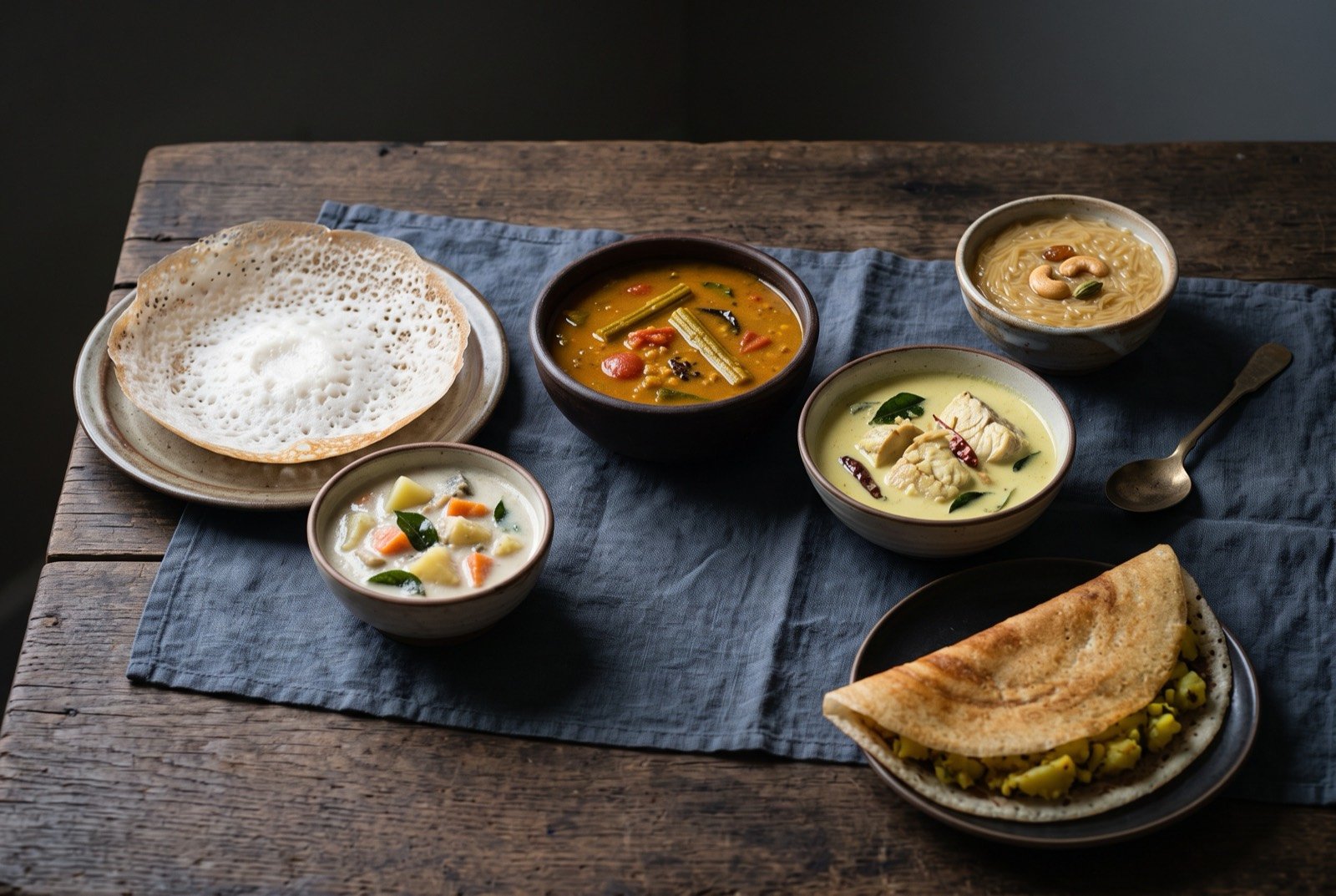
Kerala and Tamil Nadu share a coastline, a language family and a larder: rice, coconut, tamarind, curry leaf, a stone grinder in every kitchen. What they do not share is a cuisine. Kerala's food is a wet, coconut-oil world split three ways between a Hindu table itself layered by caste, a Syrian Christian table with roots the community traces to the apostle Thomas, and a Mappila Muslim table built on a thousand years of Arab trade on the Malabar coast. Tamil Nadu's food is a drier, tamarind-and-gingelly-oil world split between an orthodox Tamil Brahmin kitchen codified in print in 1951, a wealthy trading caste's kitchen built on spice routes into Burma and Malaya, and a wider non-Brahmin table that has no cookbook of its own and survives mostly in memory. Both are properly Dravidian, both cook rice and coconut and lentil into the same broad grammar of sambar, rasam, dosa and idli, and both would be misrepresented by treating that grammar as one cuisine wearing two names. Every dish as tradition built it, then what a modern chef would change.
Sources and review · What this chapter does not assert · How we research · Spotted something wrong?
A Sense of Place
Kerala: a narrow shelf between the sea and the Ghats
Kerala runs in three ecological bands. The backwaters and Kuttanad, a network of lagoons, canals and the Vembanad Lake system, are farmed 1.5 to 2 metres below sea level, reclaimed from the Vembanad floodplain from the early nineteenth century, held back by bio-bunds of coir, banana waste, bamboo and clay. The United Nations designated Kuttanad's below-sea-level farming a Globally Important Agricultural Heritage System in 2013. The Malabar coast, Kozhikode, Kannur, Thalassery, Kasaragod, is the historic pepper coast, a cosmopolitan trading littoral and the home of Mappila Muslim cuisine. The highlands, Idukki and Wayanad, are the spice hills proper, cardamom and pepper country, home to Kerala Agricultural University's dedicated pepper and cardamom research stations and to indigenous cultivars with their own names, Aimpiriyan from Wayanad, Neelamundi from Idukki.
Kerala's food is often flattened into a single "Kerala cuisine" in English-language writing, but the state runs at least three distinct communal tables sharing one ecology and one larder. Hindu cooking is itself layered by caste: Namboothiri Brahmins were historically strictly vegetarian and are the community most associated with codifying the Onam and Vishu sadya, the elaborate vegetarian feast served on a banana leaf, so thoroughly that a nineteenth-century Malayalam dictionary glosses the very word "sadya" as a Brahmin's daily food. Nair practice was looser, fish and occasional meat eaten particularly away from home. Ezhava and Thiyya communities were hereditarily linked to toddy tapping, and Thiyya custom in Malabar genuinely differs from Ezhava custom further south, so even this is not one uniform block. Syrian Christian, the Nasrani community descended, by its own tradition, from converts of the apostle Thomas, is concentrated in central Kerala and is essentially non-vegetarian, its coconut-oil-based cooking absorbing Portuguese, Dutch and British contact by reworking European cream stews into coconut-milk versions, because coconut, not cream, was what was actually to hand. Mappila, or Moplah, Muslim cooking is concentrated on the Malabar coast and traces communal origin to Arab traders who settled and intermarried from as early as the seventh century CE; the community's own leading culinary chronicler, Ummi Abdulla, describes regional literature by the 1870s as already carrying allusions to more than a hundred Mappila dishes.
Coconut oil is not a stylistic choice here, it is the medium the cuisine was built around: avial, fish moilee, thoran and the whole sadya are conceived with coconut oil as the fat. Two souring agents do different jobs and are not interchangeable: tamarind, used across the south generally, and kudampuli, the dried rind of Garcinia gummi-gutta, native to the Western Ghats, sharper, smokier and rounder than tamarind, used specifically in coastal fish curry. This needs stating precisely because English-language writing routinely gets it wrong: what Sri Lanka calls goraka is usually a different, Sri Lanka-endemic species, Garcinia quaesita, and the two fruits are prepared almost identically but are not the same thing.
Tamil Nadu: four zones, three tables
Tamil Nadu's food geography is not one thing either. The Kaveri delta, Thanjavur above all, is the rice bowl, irrigated wet-zone paddy, the historic Chola heartland and the seat of the Thanjavur Maratha court from 1674 to 1855, and it is where Tamil Brahmin cuisine is most codified. Chettinad, a cluster of roughly seventy-five to ninety-six villages around Karaikudi in Sivaganga district, is historically dry and agriculturally marginal, home territory of the Nattukottai Chettiar merchant caste, whose wealth came from trade rather than land. The dry interior, Kongu Nadu, Coimbatore, Erode, Salem, is a millet economy rather than a rice one: kambu and ragi and their porridge and dosa forms are the older staple, not a modern health-food rediscovery. The coast and the far south, including Nanjil Nadu around Kanyakumari, turns toward fish, coconut and a genuinely Kerala-adjacent palette, a useful reminder that ecology, not the state border, is what actually separates these two cuisines in the south.
Three structural strands run through it. Tamil Brahmin (Iyer and Iyengar) cuisine is orthodox, lacto-vegetarian, no onion or garlic in its strictest Iyengar form, built around the sambar-rasam-kootu-poriyal-curd rice sequence, and it has something none of the other strands in this volume have: a founding printed text, S. Meenakshi Ammal's Samaithu Paar, "Cook and See", first published in 1951, the document that moved Tamil Brahmin domestic cooking from oral transmission into writing. Chettiar cuisine is a wealthy trading caste's food, built on imported spice access rather than local abundance, and non-vegetarian in ways Tamil Brahmin food is not. The wider non-Brahmin, rural and coastal table is the majority tradition by population, gingelly oil rather than ghee its working fat, and it has no Meenakshi Ammal of its own: it survives in oral tradition, in Tamil-language food journalism, and in temple and festival practice, and this chapter tries not to let its absence from print stand in for absence from the table.
Gingelly oil, cold-pressed sesame oil, nallennai in Tamil, is the default cooking fat across non-Brahmin and everyday Tamil cooking, used in tempering, pickles, podi and the spoonful stirred over curd rice that is a recognisable Tamil gesture; ghee is kept for Brahmin ritual and festival cooking rather than being the everyday medium. This is a clean structural difference from Kerala's coconut-oil default, worth stating plainly rather than letting "South Indian cooking" flatten it. Tamarind is Tamil Nadu's own dominant souring agent, the base liquid in sambar, rasam, puliyodharai and vatha kuzhambu.
A table of peoples, ecology and food logic
| Community | Region | Defining agriculture | Fat | Starch | Souring agent | Aromatic base |
|---|---|---|---|---|---|---|
| Hindu (Namboothiri, Nair, Ezhava/Thiyya) | Kerala, all zones | Paddy, coconut plantations | Coconut oil | Rice, tapioca in Kuttanad | Tamarind, kudampuli | Curry leaf, mustard seed tempering |
| Syrian Christian (Nasrani) | Central Kerala | Paddy, plantation, coastal fishing | Coconut oil | Rice | Kudampuli, vinegar in later dishes | Curry leaf, coconut oil tempering, black pepper |
| Mappila (Moplah) Muslim | Malabar coast | Trade, coastal fishing | Coconut oil, ghee for festival dishes | Kaima/jeerakasala rice for biryani | Tamarind, lime | Arab-inflected whole spice, curry leaf |
| Tamil Brahmin (Iyer, Iyengar) | Kaveri delta, Thanjavur | Irrigated paddy | Ghee | Rice | Tamarind | Asafoetida standing in for onion/garlic, curry leaf, mustard seed |
| Chettiar (Nattukottai Chettiar) | Chettinad, around Karaikudi | Trade, not agriculture | Gingelly oil | Rice, Burmese-influenced puttu-style rice | Tamarind | Star anise, kalpasi, marathi moggu, imported via Burma/Malaya |
| Non-Brahmin, coastal and rural | Coast, Kongu interior, far south | Fishing, dry-crop and millet farming | Gingelly oil | Kambu and ragi in Kongu Nadu, rice elsewhere | Tamarind | Curry leaf, dried chilli, coconut where coastal |
The History in Layers
The pepper coast, and a trade older than any empire that fought over it
The Malabar coast's spice trade is genuinely ancient, not a colonial-era invention. Muziris, near modern Kodungallur, appears in Sangam-era Tamil sources and in Graeco-Roman texts, the Periplus of the Erythraean Sea and Pliny the Elder, as a major hub of the Indo-Roman pepper trade; Pliny estimated in 77 CE that Rome spent fifty million sesterces a year on pepper, and a customs document from Alexandria in 176 CE shows pepper at thirty-five percent of spice-import value. The widely repeated detail that Alaric the Visigoth demanded three thousand pounds of pepper as part of Rome's ransom in 408 CE is worth including as colour, but this chapter has not independently re-verified it against a primary source and treats it as illustrative anecdote rather than settled fact. Muziris's prominence declined with Rome's own from the late fifth century. Calicut under the Zamorin inherited that trade as a religiously plural port, Arab, Persian, Chinese and local merchants coexisting, until Vasco da Gama landed at Kappad, near Kozhikode, on 20 May 1498 and opened a direct European sea route that began a long, often violent contest, Portuguese against the established Arab merchant class, then Dutch against Portuguese, then British against Dutch, for control of it.
Two founding legends, two disputed histories
Kerala's two minority communities each carry a founding story the community itself treats as settled and historians treat with more caution, and this chapter states both sides of each rather than picking one. The Nasrani community's own tradition, the Thomma Parvam, holds that the apostle Thomas landed near Maliankara in 52 CE and founded seven churches, including at Kodungallur, Palayoor and Kollam; the community regards this as unbroken tradition, while historians note the supporting evidence, oral tradition, literary texts, genealogies, stone crosses and copper plates, attests early Christian presence on the Malabar coast from the second or third century CE, which is good evidence for Christianity arriving early, not proof of the specific apostolic date. The Mappila community's foundational legend holds that the last Chera king, Cheraman Perumal, travelled to Arabia, met the Prophet, converted, and sent Malik Ibn Dinar back to found the Cheraman Juma Masjid at Kodungallur in 629 CE; some scholars date the mosque's actual construction to the fourteenth or fifteenth century and regard the conversion story as legendary. Two communities, two structurally identical situations: a strong internal tradition, a shakier external record. This chapter names both and adjudicates neither.
What the Portuguese, the Dutch and the British actually put on the plate
The colonial layer on Kerala's plate is well evidenced and worth stating precisely rather than vaguely. The Portuguese, from 1498, with permanent fort-building from the early 1500s, introduced or accelerated chilli, which gradually displaced or supplemented pepper as the everyday heat source in home cooking, alongside tomato, potato, groundnut, guava, pineapple and cashew, planted at Kannur from 1505 under Kolathiri permission. Fish moilee and Kerala beef fry both carry Portuguese-contact fingerprints in technique, and possibly, in moilee's case, in name. Dutch-associated bakery survivals, breudher, a sweet Dutch-Eurasian bread, persist in Fort Kochi. The British brought club and plantation food culture, cutlets, bread, biscuits and tea-drinking, particularly through Anglo-Indian and Syrian Christian households, and the twentieth century saw Nair "military hotels" open as ex-servicemen returned from British battalions.
Tapioca deserves a specific correction, because Kuttanad's own food identity leans on it as if it were ancient and it is not. Tapioca arrived from Brazil via the Portuguese into the Malabar region generally, but its adoption as a Travancore dietary staple is a late nineteenth-century event. Popular Kerala food writing credits Visakham Thirunal Rama Varma, who ruled Travancore from 1880 to 1885, with actively promoting tapioca cultivation as famine relief following the Great Famine of 1876 to 1878, reportedly on his botanist brother's advice, and with personally demonstrating preparation methods to the public. It became known as the poor man's meal in Travancore and mattered again during the World War II rice shortage. Kappa and fish curry now feels like the oldest thing in Kuttanad. It is barely a century and a half old, and this chapter says so.
The Chettiar road to Burma and Malaya, and what it did to a spice cupboard
Tamil Nadu's own trade history runs a different, more recent route. The Nattukottai Chettiars trace their own migration to the port of Kaveripoompattinam, destroyed by flood, after which the community resettled inland around Karaikudi under Ramnad kingdom patronage; their wealth came from salt, pearls and moneylending, not agriculture. From the late nineteenth century, under British imperial expansion, Chettiar merchant-bankers moved into Burma, Malaya and Ceylon running micro-finance networks, and by the 1930s Chettiars are reported to have owned close to half of all cultivable land in Burma and to have controlled significant tin-trade financing in Malaya. This is the trade network credited with reshaping Chettinad's spice palette: Tellicherry pepper, Ceylon cardamom, Southeast Asian nutmeg, clove and star anise entered the Chettinad kitchen through this route, alongside a documented shift toward non-vegetarianism as the community established itself abroad from the late eighteenth century, and Burmese influence specifically is credited with the Chettinad use of dried and fermented prawn and fish for flavouring. Tamil Wikipedia's own Chettinad cuisine article independently confirms this, noting Burmese-influenced puttu-style rice preparation adopted because of the community's commercial relations there.
Temple food, Sangam poetry, and a caste politics this chapter attributes rather than adjudicates
Tamil temple food is genuinely varied by temple rather than one uniform Brahminical tradition, and it is worth stating that plainly because the assumption otherwise is easy to make. Akkaravadisal, a rice-milk-jaggery sweet, is named directly in Andal's Nachiyar Thirumozhi, ninth or tenth-century Tamil devotional poetry, and remains the principal offering at the Srivilliputhur Andal temple today, a rare case of a named dish with textual pedigree running back over a millennium. Puliyodharai, tamarind rice, is widely served as prasadam at Vaishnavite temples, its non-perishable, travel-stable character repeatedly given as the practical reason for its role at festivals. Srirangam temple serves chapati and keerai kootu as a midday offering, attributed locally to the legend of Tuluka Nachiyar, a Muslim princess venerated at the temple, a genuine syncretic thread inside an orthodox Vaishnavite temple. Madurai's Muniyandi temple festival is reported to serve mutton biryani as prasadam during its January festival, a useful and honest counterexample to any assumption that Tamil temple food is uniformly vegetarian.
Sangam literature, broadly dated from around 300 BCE to 300 CE though the dating is itself contested among Tamil scholars, carries genuine, specific food references rather than vague retrospective claims: rice as staple and medium of inland exchange, foxtail millet rice "which looked like crab eggs" served with milk to bards at the Pallava court, the poet Avvaiyar's description of a summer lunch of steamed rice, smoked mashed aubergine and buttermilk, the poet Mudathama Kanniyar's description of a royal Chola lunch of skewered goat meat, fried vegetables, rice and over sixteen dishes. The food historian K. T. Achaya, working from these same literary sources, dates references to sevai and idiyappam to around the first century CE.
Food and caste politics in Tamil Nadu is a live, contested question, not a settled historical footnote, and this chapter's sourcing on it is English-language secondary rather than a Tamil-language primary source from inside the movement, a real limitation named honestly rather than smoothed over. The Self-Respect Movement, led by E. V. Ramasamy, Periyar, from 1925, was explicitly anti-Brahminical and anti-caste, and one concrete, documented food-politics episode belongs to it directly: segregated seating and serving for Brahmins versus others in railway station restaurants was abolished in March 1941 as a result of Periyar's campaigning. More broadly, vegetarianism in the Tamil Nadu context, as across India, functions as a marker of upper-caste, specifically Brahminical, identity, and the public assertion of non-vegetarian eating, including beef, has been used by Dravidian and Dalit movements as a deliberate rejection of that hierarchy, a claim this chapter attributes to the scholars and movements who make it, Dravidian-movement historiography and Dalit-studies food-politics scholarship, rather than presenting as neutral background.
The Ambur road, and the Tamil Muslim biryani this chapter refuses to treat as a footnote
Distinct from the Chettiar route into Southeast Asia, Tamil Nadu carries its own colonial-adjacent Islamic food history through the Madras Presidency and the Arcot Nawabate. The Ambur and Vaniyambadi biryani tradition is attributed by local and regional food writers to the Nawabs of Arcot and Mughal-Nawabi kitchen migration into the area, with a specific named point of commercial origin: Hasin Baig, said to have set up shop in Ambur in 1890 to bring "royal" biryani to ordinary people. This is a genuinely distinct thread from the Tamil Brahmin and Chettiar strands above, the Tamil Muslim contribution to the state's food, and it earns a full recipe in this chapter rather than a passing mention, precisely because most English-language "Tamil food" writing gives it one.
The Flavour Arsenal
Two fats, two philosophies
Coconut oil and gingelly oil are not interchangeable, and using one where the tradition specifies the other changes a dish's whole register, not just its cooking medium. Kerala's coconut oil, high in saturated and medium-chain fats, does not oxidise readily and carries a faint sweetness that is doing real flavour work, not merely frying work, in avial, fish moilee and thoran. Tamil Nadu's gingelly oil, cold-pressed sesame, is nuttier and more savoury, used in tempering, pickles and the finishing spoonful over curd rice that marks a Tamil table. Ghee sits above both as the enrichment reserved for Brahmin ritual and festival cooking rather than the everyday medium.
Tamarind and kudampuli: a distinction worth defending
Tamarind (puli) is the shared souring agent across the whole Dravidian south. Kudampuli, the dried, often smoked rind of Garcinia gummi-gutta, is Kerala's own, coastal, fish-curry-specific souring agent, sharper and smokier and rounder than tamarind, and genuinely not a substitute for it in a proper meen curry. It should not be confused with Sri Lanka's goraka, a different, endemic species prepared almost identically but botanically distinct, and English-language recipe writing conflates the two often enough that this chapter corrects it directly rather than repeating the error.
The Chettinad trio: kalpasi, marathi moggu, star anise
Three ingredients define Chettinad's imported spice signature, and English-language sources routinely mangle at least two of them. Kalpasi, also called dagad phool or black stone flower, is Parmotrema perlatum, a lichen, not a flower or a spice plant in the botanical sense; it has almost no smell or taste raw, and releases an earthy, smoky note only when fried in hot oil with the other whole spices. It is also a defining ingredient of Maharashtrian goda masala, a genuinely interesting echo given the Thanjavur Maratha court's own presence in this chapter's history. Marathi moggu is most commonly described as the dried flower buds of a caper species, picked and sun-dried with the stem still attached; its name is Kannada for "bud," a Tamil regional spice carrying a Kannada name via trade routes. This chapter flags its exact botanical identity as unresolved in the sourcing available to it, and a reader who wants certainty should treat the caper-bud description as the working consensus, not settled fact. Star anise is the unambiguous case, a genuine Southeast Asian import via the Chettiars' own Burma and Malaya trade, not indigenous to South Asia at all.
Pepper, and what the name Tellicherry actually means
Kerala is pepper's original home, and Tellicherry is a real, named, verifiable grade rather than marketing language: larger, more mature peppercorns, picked later and left to develop more flavour than standard black pepper, named for the port of Tellicherry, modern Thalassery, on the Malabar coast.
Rice, and the point at which "just rice" stops being true
Idli rice is a specific parboiled processing, not any short-grain rice; substituting ordinary rice produces a batter that will not ferment properly. Kaima, also called jeerakasala, is the short, highly aromatic rice used in Malabar biryani, needing none of basmati's pre-soak and post-drain handling. Seeraga samba is the short, fragrant native Tamil Nadu rice behind Ambur-style biryani. None of these three are interchangeable with the others or with basmati, and the volume treats each correctly by name rather than folding them into a generic "rice" ingredient.
Urad dal, the ferment's real engine
Whole, unsplit urad dal (black gram) carries the wild lactic acid bacteria and yeast that drive idli and dosa fermentation, and its own mucilage, the gel-like compound in its bran layer, feeds them; the same batter attempted with heavily processed or polished dal ferments less reliably, because processing damages the bacteria the whole method depends on.
The Technique Ladder
The argument, from a stone mortar in a New York kitchen
The clearest technical case for this chapter's whole animating idea, that Dravidian technique is already restaurant grade and does not need imported French method to become one, comes not from Kochi or Chennai but from Vijay Kumar, chef of Semma in New York's West Village. Kumar grew up in Arasampatti, a farming village in Tamil Nadu's Dindigul district, at the edge of the Chettinad belt, hunting and foraging as a child with his grandparents; those dishes reappear on his menu, which won a Michelin star in 2022, the first ever awarded to an exclusively South Indian restaurant, and has held it every year since. On the kal ural, the stone mortar and pestle, he is direct: "It offers a different texture to spices when you grind them, and the flavors are deeper." His stated mission, through the restaurant group Unapologetic Foods, is to expose New York "to authentic flavors from real home cooks in South India, and not a version made to fit an American palate," making everything from scratch "just like the way our mothers did at home." His own favourite simple dish, notably, is plain idli with sambar. In Chennai, Ajit Bangera's Avartana at the ITC Grand Chola runs the same argument through a tasting menu built entirely on South Indian ingredients: "You may not recognise the food when it comes to the table but when you eat it, it would ring a bell." This chapter's research could not find a single named chef stating outright why bad diaspora South Indian food specifically fails, but the technique ladder below is built from what these named cooks actually do, which amounts to the same diagnosis in practice: pre-ground spice, an electric grinder run too hot, and batter fermented in a sealed, filtered kitchen with no wild yeast left in the air to catch.
Rung 1. Grind on stone, not in a blade, and let the paste stay a little rough
A stone grinder, ammikallu in Malayalam, kal ural in Tamil, crushes spices and aromatics slowly and generates very little heat, so the volatile oils that carry a curry paste's aroma stay largely intact until they hit hot oil in the pan. An electric mixer-grinder works fast and generates real heat through friction, driving off some of those same aromatic compounds before the dish is even cooked, and it chops rather than crushes, producing a finer, more homogenous, less textured paste. What a cook does with this rung. A granite mortar and pestle, worked in short bursts rather than one long grind, keeps the paste cooler than a food processor run continuously; grind wet spices and aromatics to a deliberately slightly coarse paste rather than chasing total smoothness, since the texture itself is part of what a mixer-grinder erases. Where a stone grinder genuinely is not available, pulsing a food processor in short bursts with pauses to let it cool, rather than running it continuously, gets meaningfully closer to the stone's result than a single long blend does.
Rung 2. Ferment on ambient yeast, and compensate for a sealed kitchen
Idli and dosa batter depends on naturally occurring lactic acid bacteria on whole urad dal converting the batter's starches to lactic acid over an overnight ferment, and the process partly depends on capturing wild yeast from the ambient air, which is exactly why a modern, filtered, air-conditioned kitchen can genuinely struggle to reproduce real fermentation character even with correct ingredients and method: a traditional open Indian kitchen simply carries airborne cultures a sealed one does not. What a cook does with this rung. Grind the urad dal separately from the rice and whip it well to aerate the batter before combining, since the dal's own gas-trapping proteins are what give idli its sponge. Add salt only after fermentation, not before, since salt measurably slows the process. Leave the batter somewhere genuinely warm rather than trying to force a fast rise, and where a British kitchen is simply too cold or too clean to ferment reliably, a small pinch of live yogurt culture stirred into the batter at the start gives the bacteria a head start the ambient air will not.
Rung 3. Dry-roast per dish, not once for the year
Chettinad cooking is organised around fresh dry-roasting and stone-grinding of whole spices for each individual dish rather than reaching for a pre-mixed masala powder, specifically to preserve volatile essential oils that degrade once spices are ground and stored. Marathi moggu in particular has a narrow correct window: dry-roasted in a dry skillet over medium heat until aromatic, and turned unpleasant if pushed past that point. What a cook does with this rung. Roast each spice separately by type rather than together, since different spices colour and release aroma at different rates; grind immediately while still faintly warm, and treat any pre-mixed "Chettinad masala" bought in a jar as a benchmark to taste against, not a shortcut to take.
Rung 4. Sun-dry and buttermilk-cure a vegetable before it goes anywhere near the pot
Vatha kuzhambu's vathal, sun-dried vegetables or wild berries, most distinctively manathakkali (dried black nightshade berries), are first soaked in buttermilk, then sun-dried, a genuine piece of pre-refrigeration food technology rather than a flavour affectation: the buttermilk's own lactic fermentation begins a light cure before the sun finishes the drying. What a cook does with this rung. A dehydrator tray, set low and steady, reproduces the sun's slow, even drying far more reliably than a British climate ever will; soak the vegetable in buttermilk for several hours before it goes on the tray, not just a rinse, since the buttermilk soak is doing real preservative and flavour work, not merely a coating.
Rung 5. Sour with kudampuli, then let the dish rest before it is judged
Kudampuli is used specifically, not interchangeably with tamarind, in Kerala's coastal fish curries, and Regi Mathew of Kappa Chakka Kandhari in Chennai makes a direct, attributable claim about timing: he serves his kudampuli fish curry a day after cooking, arguing the rest deepens flavour absorption, meaning a curry eaten fresh off the stove, as most restaurants serve it, is inherently inferior to one that has sat. What a cook does with this rung. Cook the curry a full day ahead where the schedule allows, cool it uncovered, then refrigerate and reheat gently to serve, rather than treating same-day serving as the standard; the kudampuli's own sourness continues to work into the fish overnight in a way no amount of extra cooking time on the stove will replicate.
The Ferment and Preserve Bench
1. Idli/dosa batter
Covered in full technique detail at Rung 2 and Dishes 1 and 2 above: whole urad dal's own mucilage and surface bacteria, combined with rice and left to ferment overnight on ambient yeast, is this cuisine's single most important piece of everyday fermentation, load-bearing for two of its most iconic dishes.
2. Kudampuli
The dried, often smoked rind of Garcinia gummi-gutta, covered in full at the Flavour Arsenal and Rung 5 above: Kerala's coastal fish-curry souring agent, genuinely distinct from tamarind and from Sri Lanka's goraka, and a curry made with it improves with a day's rest before serving.
3. Vathal
Sun-dried, buttermilk-cured vegetables and berries, most distinctively manathakkali, covered in full at Rung 4 and Dish 8 above: a genuine pre-refrigeration preservation technique, the buttermilk's lactic fermentation beginning a light cure before the sun finishes the drying.
4. Toddy, and yeast as its honest modern replacement
Traditional appam and kallappam batter was leavened with toddy, the fermented sap of the coconut or palm flower, unavailable outside Kerala itself and, in the UK, unavailable at all, a fresh, actively fermenting, short-shelf-life product with an alcohol content that puts it outside normal retail channels. Dried or instant yeast has effectively become the standard replacement even in Kerala today, alongside a cooked-rice-flour starter some cooks use instead. The yeast version is milder and lacks toddy's faint funk; this chapter states that as a real, honest difference rather than pretending the substitution is invisible.
Sourcing in Britain
The headline finding, worth stating plainly: Britain's large, long-established Tamil and Malayali communities make this one of the better-sourced UK retail pictures in this atlas. Most of this volume's core ingredients, fresh curry leaf, coconut oil, tamarind, idli rice, urad dal, Tellicherry pepper, are stocked by name-brand UK retailers with verifiable trading history, not merely gestured at.
The ranked list: what decides great from grim
- Fresh curry leaf, never dried. The single ingredient this chapter is most insistent about, because dried curry leaf carries almost none of the volatile aroma that makes the fresh leaf worth using at all, and because fresh leaf is genuinely, reliably available: a normal stock item at South Indian and Sri Lankan grocers across London, cheaply sold (£1 to £2 for a small bag), and it freezes well once picked from the stem. Spices of India, Veena's, Lakshmi Stores UK and Sujash all sell it online with UK-wide delivery; East Ham and Tooting's grocers, and Drummond Street near Euston, stock it in person as a matter of course.
- Cold-pressed, virgin coconut oil, correctly distinguished from refined. Kerala cooking runs on coconut oil the way Mediterranean cooking runs on olive oil, and refined, deodorised oil, the bland default in most UK supermarkets, has had the aroma doing real flavour work stripped out of it. KLF Nirmal (klfnirmal.com and UK Indian grocers), Flavors of Kerala (Amazon UK, 250ml and 500ml) and Kapiva (eBay UK) are named, verified cold-pressed brands; read the label on anything generic, since much of what supermarkets sell as "coconut oil" is refined, not virgin.
- Kudampuli, correctly sourced rather than assumed to be tamarind. Genuinely the weak point in this sourcing picture: not stocked routinely even by strong South Indian grocers, and no established UK chain, Lakshmi Stores, Veena's, Ganapathy among them, was confirmed to carry it as a catalogue item. A UK-based Etsy listing for "Garcinia Gummi-gutta, Malabar Tamarind" is the most reliable channel found; otherwise it is an India-ships-to-UK proposition with customs exposure. This one genuinely cannot be casually walked into on a Saturday in Tooting the way curry leaf can, and this chapter says so rather than papering over it.
Ingredients, shop by shop
Idli rice and urad dal, the two components of every fermented batter in this chapter, are well stocked: idli rice under the Sri Annam, Shankar, Chozha and Udaiyam brands via Lakshmi Stores UK; urad dal under Natco, TRS, Fudco, Topop, KCS and Udaiyam, whole, split and skinless, via Veena's and Lakshmi Stores UK. Whole, unpolished urad dal ferments more reliably than heavily processed dal, a real quality variable a UK buyer can act on.
Chettinad's imported trio is mixed. Star anise is a completely mainstream UK spice-rack item. Kalpasi, stone flower, is not confirmed available from any mainstream UK South Indian grocer; a reader will likely need to go without or seek a specialist India-focused spice seller. Marathi moggu turns up via a small Etsy seller trading as "Planet Spices," of uncertain scale and unverified Companies House status, the most reliable channel this research could find. Sakthi and Aachi curry powders, stocked at Lakshmi Stores UK and Smartbazaar UK, are useful as a benchmark for what a shop-bought Tamil curry powder tastes like, though this chapter's own dry-roasted, stone-ground blend, per Rung 3, should be the standard a reader actually cooks toward.
Tellicherry pepper is a genuine UK sourcing success story. Bart Ingredients, a substantial, Companies House-registered Bristol manufacturer, part of the Fuchs Gruppe, sells Tellicherry peppercorns explicitly sourced from the Malabar coast; Spice Mountain does the same. This is not marketing fiction, and a British reader can buy the real, named grade from an established UK spice company rather than only from a marketplace seller of uncertain provenance.
Physical shops. Wembley (Ealing Road) carries a genuinely strong South Indian and Sri Lankan range alongside its better-known Gujarati trade: Ganapathy Cash & Carry, 34 to 38 Ealing Road, and Bestfoods Supermarket, 13 Ealing Road. East Ham (High Street North) is a genuinely dense Tamil retail strip: Tamil Kadai, 182 to 184 High Street North, a Tamil-specific grocer by name and stock, and Seelans Superstore, 332 to 338 High Street North, trading today under an active online presence despite its originally registered company showing as dissolved at Companies House, most plausibly an informal continuation or restructure this research could not trace, noted honestly rather than glossed over. Tooting and Croydon carry dense general South Asian retail with a real South Indian and Sri Lankan Tamil presence; Harrow, home to the registered Tamil Community Centre, has an established Tamil and Sri Lankan community whose shops this research could not pin down to a single named flagship with the same confidence as the other three areas.
Online. Lakshmi Stores UK (Lakshmi Stores and Traders Limited, Companies House no. 11244890) is the single most comprehensively useful UK online retailer for this volume's whole ingredient list. Veena's and Bart Ingredients round out the strongest options, the latter the one fully corporate, substantial UK manufacturer in the list, proof that Malabar pepper sourcing does not depend solely on diaspora retail.
Kit. An idli steamer, a cast iron dosa tawa and a coconut scraper are all easily bought (Lakshmi Stores UK, Vinod Cookware UK, Etsy UK). The genuinely distinctive purchase is a stone wet grinder, ammikallu's modern descendant: the standard named brand is Elgi Ultra, whose slow-turning stones produce a lighter, more aerated batter than any high-speed blender can replicate, sold configured for UK electrical use via Buy Indian Kitchen. This is a real investment purchase, not an impulse buy; a good blender pulsed carefully in short bursts is a realistic substitute for occasional idli-making. An appachatti, the Kerala appam pan, is sold by Prestige via UK stockists, and is close enough in shape and function to the appa/hopper pan already covered for Sri Lanka in Volume AS-25 that one pan reasonably serves both traditions.
Substitutions, honestly assessed. Kudampuli's honest replacement is ordinary tamarind, which will not replicate the smoky depth; the chapter treats this as a genuinely different dish rather than a faithful substitution. Kalpasi and marathi moggu are, in practice, worth simply omitting from a home Chettinad masala rather than chasing a poor substitute, and this chapter says so rather than suggesting a fake fix. Toddy's replacement, dried yeast, is not really a substitution any more, it is the standard method even in Kerala today.
Restaurants. Quilon, St James's, chef Sriram Aylur since 1999, first Michelin star 2008, held for close to two decades, per multiple sources the first South Indian restaurant anywhere to hold one, is the single strongest UK reference point for serious Kerala cooking. Rasa, Stoke Newington, founded 1994 by Das Sreedharan, the pioneer that first brought real Kerala home cooking to a London audience outside the diaspora, and the longest continuously running of anything named in this chapter. Kayal, with branches in Leicester, Nottingham, Leamington Spa and West Byfleet, proves serious Kerala cooking in Britain is not a London-only phenomenon. For Tamil Nadu specifically: Chettinad, Percy Street, London, explicitly themed and named for the region; Dosa n Chutny, Tooting High Street; Chennai Dosa, East Ham. No UK restaurant with current Michelin recognition specific to Tamil Nadu or Chettinad, as opposed to Kerala, was found.
Voices and Sources
From inside the tradition
- Ummi Abdulla, the leading culinary chronicler of Mappila cuisine, cited via Sahapedia's direct interview and Scroll.in for the Thalassery-versus-Kozhikode biryani distinction this chapter carries directly into Dish 9.
- Abida Rasheed, Kozhikode, widely described as Kerala's best-known Mappila cook, working through pop-ups, hotel guest-chef stints and cooking classes rather than a fixed restaurant, on the record: "The key to Moplah cuisine is in the gravy. Once you have that, you can cook everything in it."
- S. Meenakshi Ammal, author of Samaithu Paar (1951), the founding printed document of Tamil Brahmin domestic cooking, discussed here via secondary profiles (The Better India, Scroll.in, The News Minute); her primary text was not directly accessed in this chapter's research.
- K. T. Achaya, the standard reference across Indian food history, cited throughout for Sangam-era dating and the idli/idiyappam textual record.
- Regi Mathew, Kappa Chakka Kandhari, Chennai and Bengaluru, who spent three years travelling Kerala researching home cooking directly with 265 housewives and staff from 70 toddy shops, and whose resting-time claim for kudampuli fish curry anchors Rung 5.
- Vijay Kumar, Semma, New York, whose stone-grinding quote anchors Rung 1 and whose career, a Tamil Nadu village childhood to a Michelin star and the 2025 James Beard Award for Best Chef, New York State, is this chapter's clearest single proof that Dravidian technique needs no imported method to read as world-class.
- Ajit Bangera, Avartana, Chennai, one of India's most senior hotel chefs, whose tasting-menu reinterpretation of South Indian food, staffed deliberately by south Indians trained in Continental technique, gives this chapter's modernist argument its clearest institutional expression, read with the caveat that the coverage available is closer to hotel-group promotion than independent culinary journalism.
- Naren Thimmaiah, Karavalli, Bangalore, whose kitchen has run continuously since 1990 on recipes sourced directly from home cooks across Kerala, coastal Karnataka and Goa.
- Suresh Pillai, Restaurant Chef Pillai, Kochi, a fourteen-year London kitchen veteran (Veeraswamy, Gymkhana) who brought that discipline home to Kerala rather than the more usual direction of travel.
The UK diaspora
- Das Sreedharan, Rasa, Stoke Newington, whose 1994 restaurant predates the current wave of elevated regional Indian dining in Britain by two decades.
- Sriram Aylur, Quilon, St James's, Kerala-born, leading the kitchen since 1999 and holding a Michelin star since 2008.
- Karan Gokani, Hoppers, whose kitchen's deliberate regional specificity, distinguishing a Bangalore benne dosa from a Tamil one, and a Dindigul-style short-grain biryani, is a genuine, articulate diaspora voice on this volume's whole argument that "South Indian" flattens real distinctions.
- Prince Durairaj, The Tamil Prince, Islington, cooking specifically the food of his home state in a small ex-pub restaurant, thinly covered in the press but a genuine Tamil-specific, not generic South Indian, London kitchen.
The gap, named
No named, current, fine-dining-level Chettinad specialist chef was found anywhere in this chapter's research, in India or in Britain. Every serious modernist reference this chapter could find, Avartana, Karavalli, Kappa Chakka Kandhari, Semma, treats Chettinad as one register among several southern cuisines rather than as a defining focus, and the strongest available Chettinad technique detail, the dry-roasting discipline behind Rung 3, rests on generalist food-content sourcing rather than a named chef's own words. This chapter states that plainly rather than inventing a stronger attribution than the research supports.
Things this chapter has deliberately not asserted
- A settled origin for sambar. Two live, differently sourced accounts exist, the Thanjavur Maratha court legend and a Tamil-precedence counter-claim resting on a 1530 CE Srirangam inscription. Neither is conclusively proven; this chapter names both and adjudicates neither.
- A single, uncontested origin for avial. At least three competing accounts circulate, including Kerala's own food media conceding the dish "was adopted from Tamil Nadu."
- Puttu as a Kerala invention. Malayalam sourcing itself states the earliest documented reference is Tamil, in Arunagirinathar's fifteenth-century Thiruppugazh.
- A settled etymology for fish moilee. Tamil "molee" against a Portuguese-contact colonial-fusion claim, both circulate, neither is definitively sourced.
- A single dating for idiyappam's origin. Sangam-era references place it around the first century CE; K. T. Achaya's own scholarship dates the specific steaming and fermentation technique to Indonesian contact between roughly 800 and 1200 CE. These do not reconcile, and this chapter has not silently picked the more dramatic of the two.
- The precise botanical identity of marathi moggu. Commonly described as dried caper buds in English-language cooking sources; not confirmed against a Tamil-language or botanical source in this chapter's research.
- A causal link between Kerala's 1957 to 1969 land reforms and any specific change in food practice. Plausible, and the reforms themselves are well documented, but no source found in this chapter's research draws that connective line with any specificity.
- The claim that "Tamil Nadu invented the dosa" without qualification. The plain dosa is genuinely old and Tamil; the masala filling is a nineteenth or twentieth-century Udupi, Karnataka, innovation, and the two should not be credited to the same place.
- Alaric the Visigoth's 408 CE demand for three thousand pounds of pepper as independently verified fact. Widely repeated in pepper-history writing; usable as hedged colour, not load-bearing history.
- A named, current Chettinad specialist chef at fine-dining level, in India or Britain. None was found in this chapter's research, and the gap is stated directly rather than filled with the nearest available name.
- Any UK restaurant carrying current Michelin recognition specifically for Tamil Nadu or Chettinad cuisine, as distinct from Kerala. None was found; Quilon and Kricket both carry Michelin recognition on the Kerala side, and this chapter does not manufacture a Tamil Nadu equivalent where none exists.
- A reliable, established UK retail channel for kudampuli or kalpasi. Both were traced only to small specialist sellers of uncertain scale, or, for kalpasi, to no confirmed UK channel at all; this chapter names the gap rather than asserting a sourcing solution the evidence does not support.
Grind on stone, not in a blade, and let the paste stay a little rough
A stone grinder, ammikallu in Malayalam, kal ural in Tamil, crushes spices and aromatics slowly and generates very little heat, so the volatile oils that carry...
Ferment on ambient yeast, and compensate for a sealed kitchen
Idli and dosa batter depends on naturally occurring lactic acid bacteria on whole urad dal converting the batter's starches to lactic acid over an overnight...
Dry-roast per dish, not once for the year
Chettinad cooking is organised around fresh dry-roasting and stone-grinding of whole spices for each individual dish rather than reaching for a pre-mixed...
Sun-dry and buttermilk-cure a vegetable before it goes anywhere near the pot
Vatha kuzhambu's vathal, sun-dried vegetables or wild berries, most distinctively manathakkali (dried black nightshade berries), are first soaked in...
Sour with kudampuli, then let the dish rest before it is judged
Kudampuli is used specifically, not interchangeably with tamarind, in Kerala's coastal fish curries, and Regi Mathew of Kappa Chakka Kandhari in Chennai makes...
The dishes
- Idli Pan-Dravidian (Kerala and Tamil Nadu)
- Masala dosa Tamil Nadu (dosa); Udupi, Karnataka (masala filling)
- Sambar Kerala and Tamil Nadu (contested)
- Appam and stew Kerala (Syrian Christian)
- Fish moilee Kerala (Syrian Christian)
- Avial Kerala (contested Tamil Nadu origin)
- Chettinad pepper chicken (milagu kozhi) Tamil Nadu (Chettiar)
- Vatha kuzhambu Tamil Nadu (Tamil Brahmin)
- Mappila (Thalassery) biryani Kerala (Mappila Muslim, Malabar coast)
- Ambur biryani Tamil Nadu (Tamil Muslim, Arcot Nawabate)
- Payasam Kerala and Tamil Nadu
Sources and review
- Researched
- No outside sources linked
- Reviewed
- Not yet reviewed from inside the tradition
- Cooked
- Not yet cooked and reported
Where this volume comes from
3 research briefs on file for this volume, researched to the rules on How we research. Published 4 September 2026. Last changed 8 September 2026.
The brief's own account of its sources
Kerala (Part A). Local/Malayalam-language sources: Manorama Online / onmanorama.com, Vanitha, Madhyamam, ml.wikipedia.org, Kerala Tourism's Malayalam-language food pages, Kerala Agricultural University and the state agriculture department, Sahapedia (a serious Indian cultural-documentation platform, used for a direct Ummi Abdulla interview). Roughly 35 to 40% of substantive claims trace to a Malayalam-origin or Kerala-institutional source. In-tradition English-language and diaspora sources (Ummi Abdulla via secondary coverage, Lathika George discussed via publisher/retailer copy, K. T.