The Indian subcontinent · Volume 22, The Coconut Coast, the Stone Grinder and the Chettiar’s Spice Road
Avial
Kerala (contested Tamil Nadu origin)
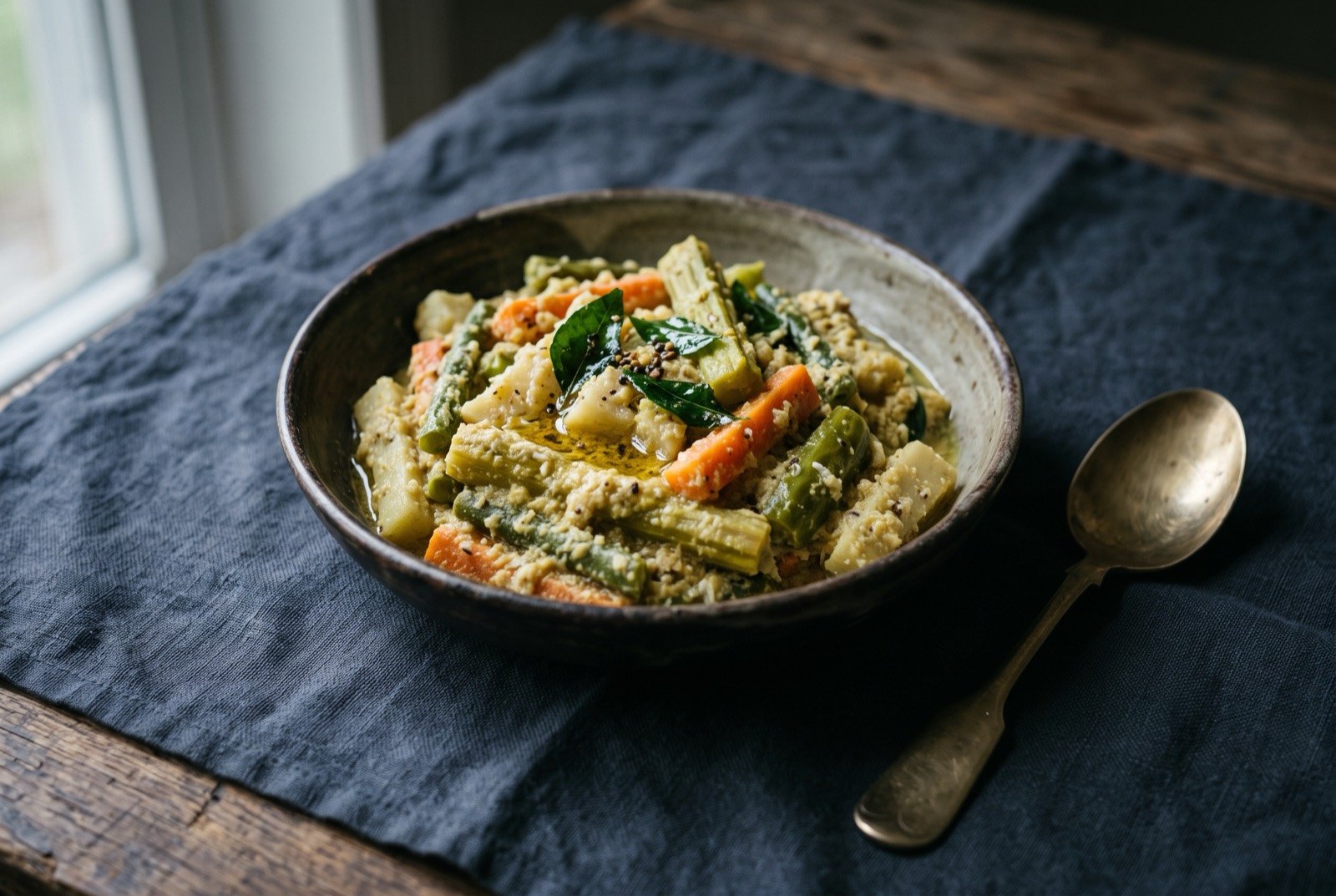
An illustration of the dish, not a photograph of it cooked.
- Time
- 30 minutes
- Researched
- No outside sources linked
- Reviewed
- Not yet reviewed from inside the tradition
- Cooked
- Not yet cooked and reported
Kerala's mixed-vegetable, coconut-and-curd dish, a fixture of the Onam sadya and, by Kerala's own food media's own admission, not an uncontested Kerala invention.
At least three competing legendary origins circulate for this dish, and none should be asserted as history: a Mahabharata legend of Bhima improvising it from mixed leftover vegetables while disguised as a cook; a Travancore-court legend of a king's cook improvising when supplies ran short during a feast; and, most tellingly, Onmanorama's own food desk noting plainly that avial "was adopted from Tamil Nadu, and we gave it a spin." This chapter treats all three as contested and asserts no founding narrative as fact.
As tradition built it
Serves 4 to 6 as a side. About 30 minutes.
Ingredients
- 4 cups mixed vegetables, cut into even batons (plantain, elephant yam, snake gourd, drumstick, long beans, carrot)
- ½ cup grated coconut
- 1 tsp cumin seeds
- 2 green chillies
- ½ cup yoghurt
- 2 tbsp coconut oil, a sprig curry leaves coconut oil, curry leaf
- to taste salt
Method
- Cook the harder vegetables (yam, carrot) first in a little water, adding the softer ones (snake gourd, beans, drumstick) in stages so everything finishes together rather than turning to mush.
- Grind the coconut, cumin and green chilli to a coarse paste.
- Stir the paste into the vegetables once they are tender, along with the yoghurt and salt, and warm through without boiling.
- Finish with a generous pour of raw coconut oil and a scatter of curry leaf stirred in off the heat, not fried.
What a modern chef changes
Vegetables cooked separately by density rather than together, and the coconut paste built to a controlled, deliberate texture
Rung 1, applied to vegetable density staging as well as spice grinding
Method
- Cook each vegetable separately, timed to its own density, and combine only in the final minute, so no single vegetable is ever over- or under-cooked to accommodate the others, an approach the traditional staggered method already gestures at but does not fully control.
- Grind the coconut paste on stone to a deliberately coarse, not smooth, texture, per Rung 1, so individual flecks of coconut remain distinct rather than disappearing into a purée.
- Warm the finishing coconut oil gently with the curry leaf before pouring, rather than adding both cold, so the leaf's aroma is already released without frying it into a tempering.