The Indian subcontinent · Volume 22, The Coconut Coast, the Stone Grinder and the Chettiar’s Spice Road
Mappila (Thalassery) biryani
Kerala (Mappila Muslim, Malabar coast)
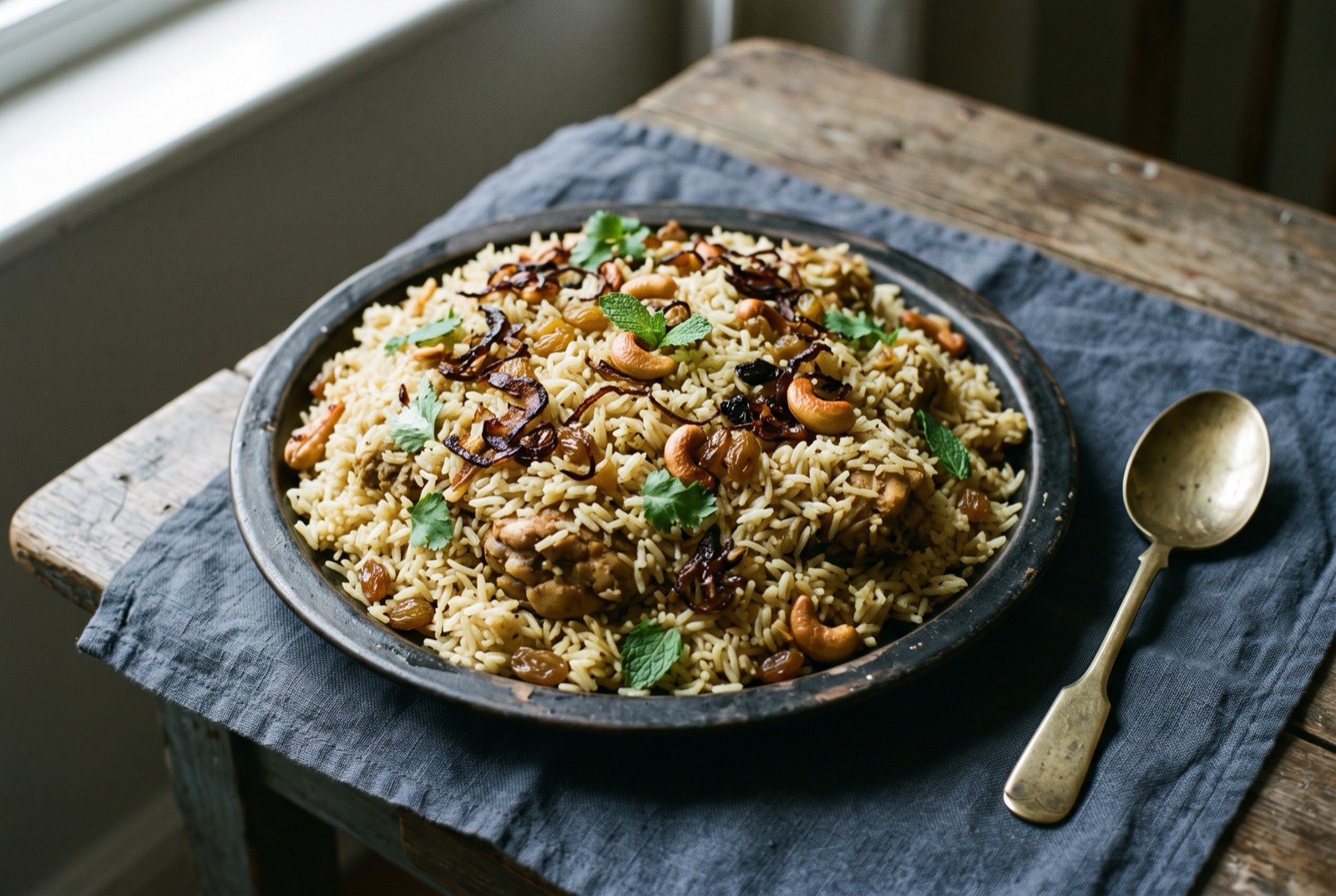
An illustration of the dish, not a photograph of it cooked.
- Time
- 1 hour 30
- Researched
- No outside sources linked
- Reviewed
- Not yet reviewed from inside the tradition
- Cooked
- Not yet cooked and reported
The Malabar Muslim biryani, structurally distinct from any Mughal-descended biryani by its rice alone.
As tradition built it
Serves 6. About 90 minutes.
Ingredients
- 500g kaima/jeerakasala rice
- 1kg chicken, jointed
- 4 onions, thinly sliced and deep-fried until dark golden
- 2 tomatoes, chopped
- 1 cup yoghurt
- 2 tbsp ginger-garlic paste
- 4 cloves, 4 cardamom pods, 2 small cinnamon sticks, 1 tsp fennel seeds, 1 star anise Malabar garam masala (fennel, cardamom, cinnamon, clove, star anise)
- 2 tbsp ghee, a handful each cashew and raisin, a small bunch coriander and mint ghee, cashew, raisin, coriander, mint
- to taste salt
Method
- Marinate the chicken in yoghurt, ginger-garlic paste and half the fried onion for at least an hour.
- Cook the marinated chicken with tomato and garam masala until nearly done, in a thick, well-reduced gravy.
- Rinse the kaima rice, which needs no long soak, and cook separately in salted water until just short of fully tender.
- Layer the part-cooked rice over the chicken gravy, scatter the remaining fried onion, coriander, mint, cashew and raisin, dot with ghee, and cook covered on the lowest possible heat, 20 to 25 minutes, until the rice is fully tender and has taken on the gravy's aroma.
Notes
Ummi Abdulla's own in-tradition distinction is worth carrying into the chapter directly: Thalassery biryani itself uses comparatively few spices, while Kozhikode-style biryani further south uses a much larger, more elaborate spice list, so "Malabar biryani" is not internally uniform, and this chapter does not flatten the two together.
What a modern chef changes
A rice cooked to a controlled, exact degree rather than judged by eye, and a final steam sealed properly rather than merely covered
Rung 3, applied to the garam masala
Method
- Dry-roast and grind the Malabar garam masala's whole spices fresh that morning, following Rung 3, rather than reaching for a bought blend.
- Par-cook the kaima rice to a precisely timed, tested degree, checking a single grain by bite rather than judging by eye, since kaima's short grain overcooks faster than basmati and the traditional method's margin for error is genuinely narrow.
- Seal the pot with a strip of dough pressed around the lid rather than relying on the lid's own fit, the dum technique, so the final steam genuinely stays inside the pot rather than escaping, and the rice finishes in its own trapped aroma rather than merely being covered.