The Indian subcontinent · Volume 22, The Coconut Coast, the Stone Grinder and the Chettiar’s Spice Road
Sambar
Kerala and Tamil Nadu (contested)
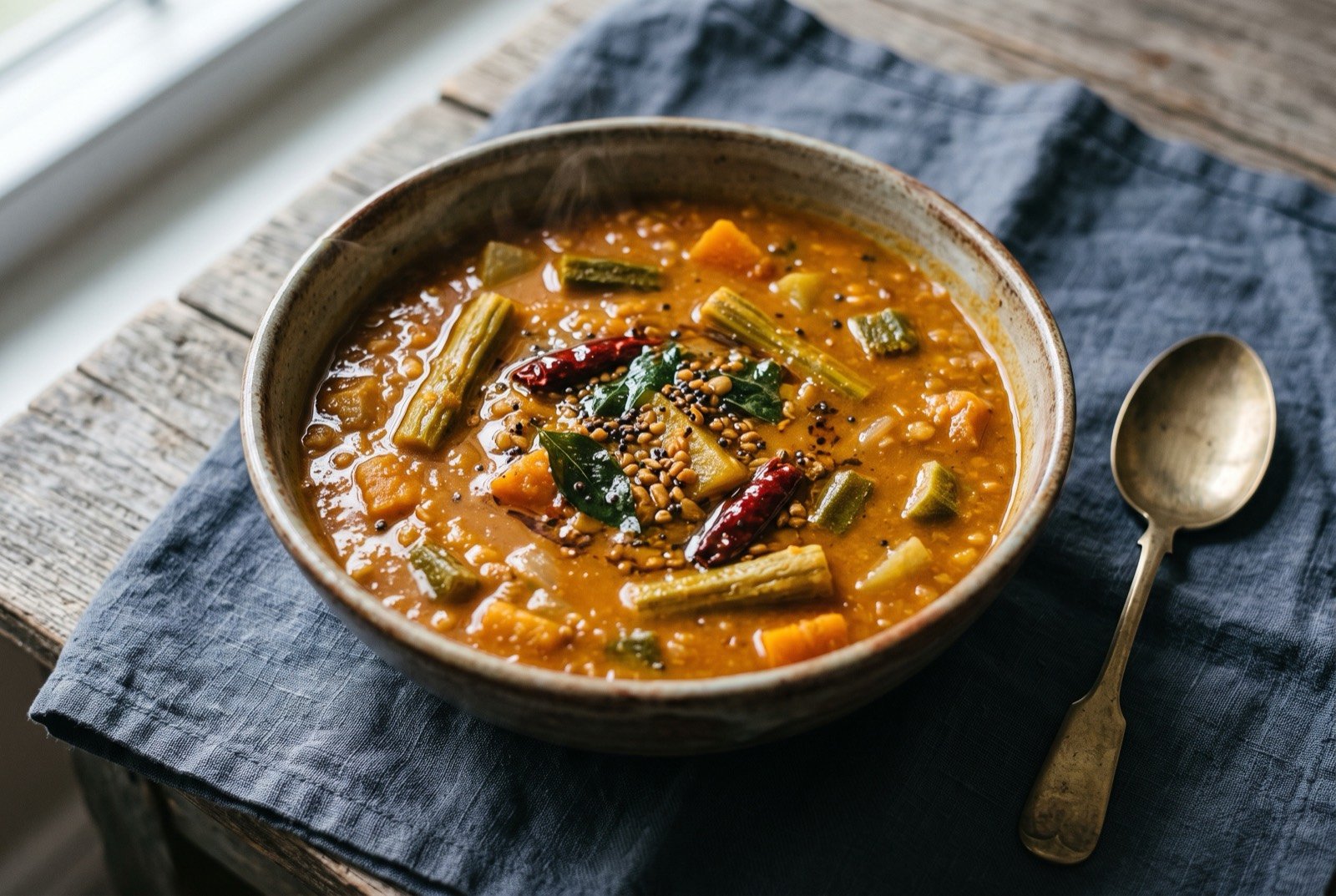
An illustration of the dish, not a photograph of it cooked.
- Time
- 45 minutes
- Researched
- No outside sources linked
- Reviewed
- Not yet reviewed from inside the tradition
- Cooked
- Not yet cooked and reported
Kerala's own coconut-based version against Tamil Nadu's leaner, more asafoetida-forward one, and a contested history this chapter states rather than settles.
The popular legend, repeated widely in English-language food media, holds that sambar was invented in the Thanjavur Maratha court under Raja Shahaji II, when his Maratha relative Sambhaji, attempting a rasam, substituted tamarind and pigeon pea for a missing Marathi ingredient, and the dish took his name. A Tamil-language Vikatan article gives this story more textual grounding, citing two manuscripts held at Thanjavur's Saraswati Mahal Library, while noting its own limitation that it does not conclusively establish where sambar was first made. Tamil Wikipedia's own sambar article cites a specific counter-claim worth taking seriously: a Tamil inscription dated 1530 CE from the Srirangam temple, reportedly referencing "pala sambaaram," many or varied preparations, which would predate the Thanjavur Maratha court by roughly a century and a half. Neither account is conclusively proven, the inscription evidence in particular needs stronger verification than this chapter could provide, and this chapter states both rather than adjudicating.
As tradition built it
Kerala version, coconut-based
Serves 4 to 6. About 45 minutes.
Ingredients
- ½ cup toor dal (pigeon pea), rinsed
- 2 cups mixed vegetables (drumstick, pumpkin, aubergine, okra), cut into chunks
- 2 tbsp tamarind pulp, soaked and strained
- 1 small onion, sliced
- 2 tomatoes, chopped
- 2 to 3 tbsp sambar powder
- ¼ cup fresh grated coconut
- 1 tsp cumin seeds
- 1 tbsp oil, 1 tsp mustard seed, a sprig curry leaves, 2 dried red chillies oil, mustard seed, curry leaf, dried red chilli, for tempering
- to taste salt
Method
- Cook the dal in plenty of water until soft and mashable, then set aside.
- Simmer the vegetables in the tamarind water with the onion and tomato until just tender.
- Grind the coconut and cumin to a smooth paste with a little water and stir it in with the sambar powder, then add the cooked dal.
- Simmer 10 to 15 minutes until the flavours combine and the sambar thickens slightly. Salt to taste.
- Finish with a tempering of oil, mustard seed, curry leaf and dried red chilli, fried until fragrant and poured over the top.
Notes
Tamil Nadu's version differs in one clear, structural way: no coconut grind, a leaner sambar built on tamarind, asafoetida and sambar powder alone, closer in register to the rasam that follows it than to Kerala's rounder, coconut-thickened bowl.
What a modern chef changes
A roasted-on-stone sambar powder in place of a shop tin, and a tempering finished twice
Rung 3
Method
- Dry-roast the sambar powder's component spices yourself the same morning and grind on stone, following Rung 3, for a depth a tin cannot match.
- Temper twice: once at the start, stirred into the base, and again at the very end, poured hot over the finished sambar rather than folded in, so the tempering's own aroma survives the final simmer.
- Cook the vegetables separately by density and combine only at the end, so the softest (okra, pumpkin) do not collapse before the firmest (drumstick) is done.