Maritime Southeast Asia · Volume 45, The Mortar, the Wok and the Roti Board
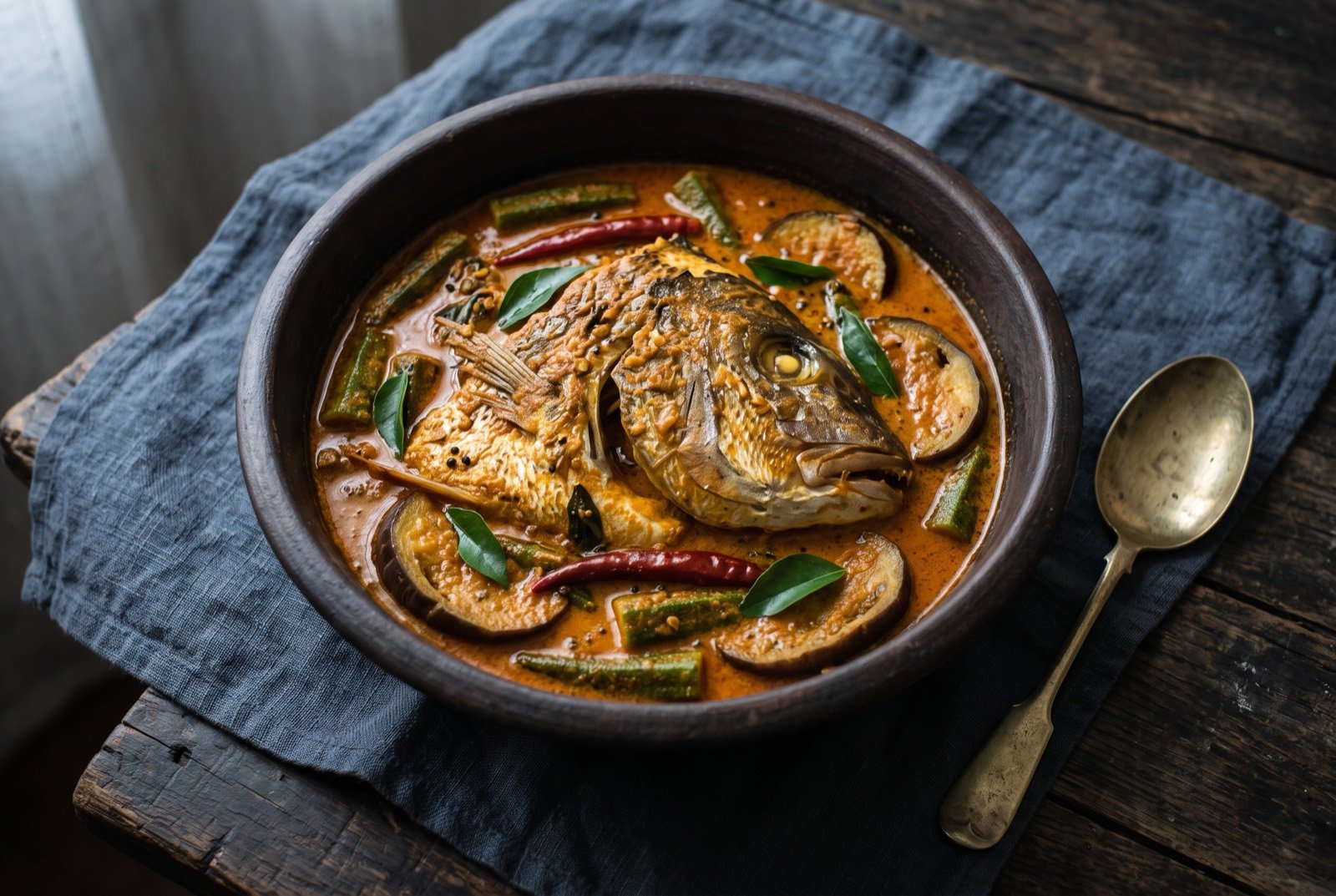
Fish head curry
Singapore (Kerala Malayalee origin, Cantonese refinement)
Illustration
- Time
- 15 minutes
- Researched
- Researched from 231 sources in the brief
The dish is usually summarised as a South Indian invention adapted locally, and that undersells how genuinely two-directional it was from the start. The best-documented account names Marian Jacob Gomez, a Malayalee Christian from Trivandrum, Kerala, not a Tamil Muslim, as the person who created curry fish head in Singapore in 1949, cooking a traditional Kerala coconut-and-tamarind curry at his Sophia Street restaurant. The fish head itself was not his idea: red snapper heads were unpopular and cheap, European households discarded them, and it was his Chinese customers, drawing on a long-standing Cantonese preference for fish head as a delicacy, who asked for the curry to be made with them.
As tradition built it
Serves 6 . Curry base cooked about 30 minutes, fish head simmered a further 12 to 15 minutes
Ingredients
- 700g fish head, split whole red snapper or similar large fish's head
- 150g grated coconut flesh, ground into the paste coconut flesh
- 700ml coconut milk, thin and thick coconut milk
- 4 fresh red chillies fresh red chilli
- 40g ginger ginger
- 6 garlic cloves garlic
- 20g fresh turmeric turmeric
- 2 tsp fennel seeds fennel
- 3 sprigs curry leaf curry leaf
- 3 tomatoes, cut into wedges tomato
- 1 aubergine, cut into 2-inch pieces aubergine
Method
- A whole red snapper or similar large fish's head, split, is simmered in a Kerala-style coconut and tamarind curry, coconut flesh and milk, fresh red chilli, ginger, garlic, turmeric, fennel, curry leaf, tomato and aubergine, the curry itself South Indian in every particular, the choice of cut Chinese in origin, since it was Cantonese customers, not the curry's own inventor, who asked for it to be made with the head specifically, prizing it as a delicacy where European diners had discarded it as offal.
- A hard blanch of the head first, the Cantonese technique of "flying water," strips blood and fishy odour before it ever meets the curry, the refinement that turned a good dish into the standard one.
What a modern chef changes
The cheek and collar confited apart, and the curry reduced tighter
Method
- Confit the fish cheek and collar separately at a controlled low temperature before the head goes anywhere near the curry, so the most delicate meat on the whole fish is protected from the curry's own long simmer, then reunite it with the sauce only at the point of plating.
- Reduce the curry base to a tighter, more concentrated sauce than the traditional soupy version, and serve the head itself, whole and split, as the centrepiece it always visually was but rarely gets treated as, rather than a component swimming in a shared pot.