Asia · Volume 45
Singapore, Penang and the Straits Creole World
The Mortar, the Wok and the Roti Board
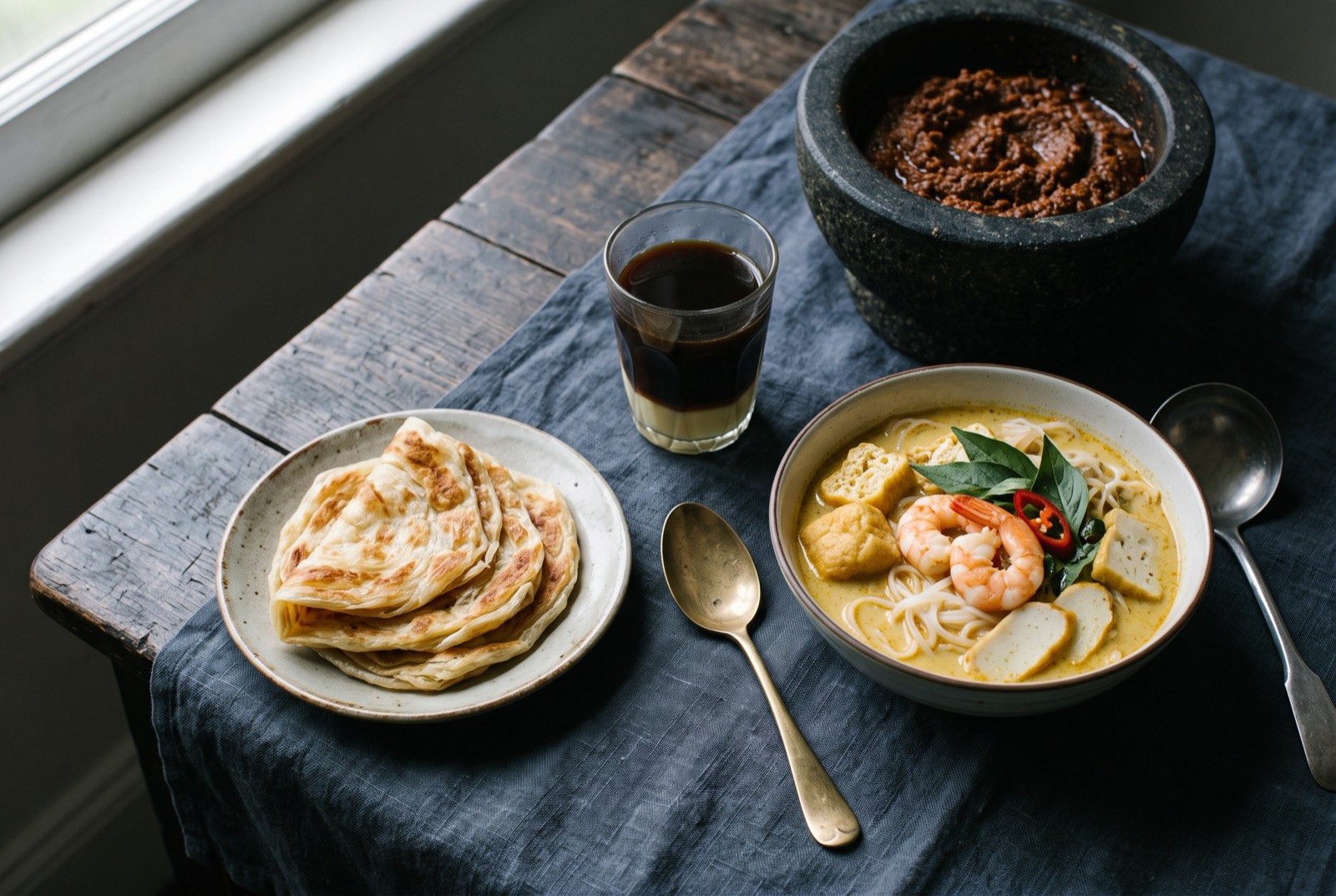
Singapore, Penang, Melaka and the old Straits Settlements, taken seriously as a creole food world rather than an indigenous one: a Malay ecological base overlaid by three separate migrations, Hokkien intermarriage into Peranakan cooking, southern Chinese labour migration into hawker and kopitiam food, and Tamil Muslim trade into mamak cuisine, none of them the whole of the story on its own. Every dish as tradition built it, then what a modern chef would change.
Sources and review · What this chapter does not assert · How we research · Spotted something wrong?
A Sense of Place
Every other volume in this atlas asks what a place's ecology, trade and empire did to an indigenous cuisine that was already there. This volume asks a different question, because there was no single indigenous cuisine here to begin with, only a Malay fishing and trading coast, and then a British trading company that decided three of its harbours, Penang from 1786, Melaka from 1795, Singapore from 1819, would be free ports open to anyone who wanted to move goods or themselves through them. People did, in numbers the ports themselves never planned for: Hokkien and Teochew traders and labourers from Fujian and Guangdong, Hainanese migrants a generation behind them and shut out of the trades the earlier arrivals had already claimed, and Tamil Muslim traders and labourers from the Coromandel Coast who had, in fact, been sailing this strait for a thousand years before the British ever arrived to administer it. None of them found an empty table. What they found was a Malay world with its own rice, coconut, chilli and fish, and over two centuries the three creole cuisines this chapter treats, Peranakan, Hainanese and Hokkien hawker food, and Tamil Muslim mamak cooking, all built themselves by marrying an incoming technique or an incoming community onto that same Malay ecological base, each in a different way, none of them slowly, all of them still visibly under construction in the ports' kitchens today.
This is why the volume map calls this world creole rather than indigenous, and why that word should not be read as a demotion. A creole cuisine is not a lesser, diluted version of somewhere else's food. It is what happens when several complete cooking traditions are forced by one specific historical event, in this case a free port and the labour migrations it pulled in, to solve the same daily problem, what to cook for dinner with what is actually for sale in this market, on this coast, this week, using hands trained somewhere else entirely. Nowhere in this atlas is the atlas's own argument, that ecology, trade, religion and empire outrank the nation state in deciding what a kitchen looks like, more nakedly on display than in a Penang kopitiam where a Hainanese proprietor fries a Cantonese-taught pork chop, a Hokkien clan association keeps its own festival foods a few streets over, and a mamak stall two doors down pulls tea until two in the morning, all three of them serving Malaysians, full stop, none of the three claiming to be the whole of Malaysian food.
Start with the strait itself, not the countries either side of it. The Strait of Malacca is the sea lane that has carried the monsoon trade between the Indian Ocean and the South China Sea since long before any European ship entered it, and Melaka, Penang and Singapore are not three unrelated cities that happen to sit on it, they are three successive attempts, five centuries apart, to control the same chokepoint. Melaka's Malay sultanate did it first, from the early fifteenth century, drawing Chinese, Indian, Arab and Javanese traders into one port under one sultan's protection. The Portuguese took Melaka in 1511, the Dutch took it from the Portuguese in 1641, and the British, arriving late to this particular contest, built their own version of the same idea slightly further along the coast: Francis Light at Penang in 1786, Stamford Raffles at Singapore in 1819, and Melaka itself passed to Britain from the Dutch in 1824. By 1826 the three were administered together as the Straits Settlements, and it is that specific administrative unit, not Malaysia and not Singapore, both of which did not yet exist as nations, that this chapter's food actually belongs to.
The ecology underneath all of this is equatorial and maritime: rice, coconut, chilli, tamarind, fish and shellfish from the strait itself, tropical fruit, and a monsoon calendar rather than four seasons. This is the same base ecology as the rest of Maritime Southeast Asia, the volume map's Java, Sumatra and Borneo chapters cover the same staples. What makes Singapore and Penang a food world of their own inside that wider region is not a different larder, it is a different demography stacked on top of an identical larder, three demographic waves in particular, each of which built its own way of cooking with what the market sold.
The first wave was Hokkien, from Fujian province, and it is the oldest: Chinese traders were doing business in Melaka under the sultanate itself, and the marriages between Hokkien men and local Malay women that resulted, over generations, in the Peranakan community, began as early as the fifteenth century, not under British rule at all. By the time the British arrived, a settled, multi-generational Chinese-Malay creole population, speaking a Malay-grammar creole called Baba Malay with a real Hokkien vocabulary layer, already existed in Melaka. Penang and Singapore each grew their own Peranakan communities as the British ports drew in fresh Hokkien traders who repeated the same pattern.
The second wave was also southern Chinese, but arrived under direct British recruitment for the tin and rubber economy of the 1800s to 1930s, and split by dialect group into distinct trades. Hokkien and Teochew migrants, arriving earliest and in the largest numbers, took the better trades and the better land, clustering around Singapore's river and Telok Ayer and forming some sixty per cent of Penang's Chinese population. Hainanese migrants arrived later, from the 1860s onward, after the 1858 Treaty of Tianjin opened Hainan's ports, and found every established trade already taken. This is not a small footnote, it is the specific historical accident that explains the entire Hainanese food story in this chapter: shut out of trade and land, Hainanese migrants took the jobs nobody else wanted, as domestic servants and cooks in British colonial households, hotels and clubs, and when the Depression of the 1930s collapsed many of those jobs, they opened their own coffee shops instead, cooking the only thing they knew how to cook professionally, simplified Western breakfasts and chops, for a general local market. Singapore's kopitiam culture, kaya toast, soft egg, dark sweet kopi, is not an accident of taste, it is the direct residue of one migrant community's exclusion from every better-paid trade in the colony.
The third wave predates British rule by centuries and is frequently the one forgotten. Tamil Muslim traders, called Chulias in the colonial-era record, from merchant lineages such as the Lebbai, Rawther, Marakayyar and Kayalar of India's Coromandel Coast, were sailing into the Malay world and Ceylon from at least the eighth century. A second, much better documented wave came under direct British colonial recruitment from the 1880s, structured by the Indian Immigration Ordinance of 1884, distinct from the indentured Tamil Hindu labour sent to the rubber estates: Tamil Muslim migration into the port cities was largely free, self-financed and directed straight into trade and food service, which is why the Chulia name survives today attached to streets, not plantations, Chulia Street in George Town, named by the British in 1798 once it was clear most of its residents came from Tamil Nadu specifically. This is the community that built the mamak stall, and it is worth stating plainly here because it is easy for an outside reader to compress "Indian food in Malaysia" into one undifferentiated category: mamak cooking is a specific Tamil Muslim tradition, not a Hindu one, and in 2026 the community is still actively correcting the assumption that speaking Tamil makes you Hindu.
A table of the three strands, and roughly what each one is built from:
| Community | Arrived | Excluded from / drawn into | Defining kitchen logic | Carries into |
|---|---|---|---|---|
| Hokkien traders, intermarrying with Malay women | 15th century onward, Melaka first | Married into the Malay world rather than staying separate from it | Chinese method (stir-fry, braise, ferment) worked onto Malay aromatics (rempah, coconut, belacan) | Peranakan/Nyonya cuisine |
| Hokkien, Teochew, Hainanese, Cantonese, Hakka labour migrants | 1800s to 1930s, British recruitment | Hokkien and Teochew into trade and land; Hainanese into colonial domestic service after being shut out of both | Southern Chinese hawker cooking, Hainanese cooking specifically absorbing British domestic-kitchen technique | Hainanese chicken rice, kopitiam culture, Hokkien/Teochew hawker noodle dishes |
| Tamil Muslim (Chulia) traders and migrants | 8th century trade, 1880s colonial recruitment | Into trade, transport and food service, largely free migration | South Indian technique (dough lamination, tempering, curry) adapted to local produce and a 24-hour trading rhythm | Mamak cuisine: roti canai, teh tarik, nasi kandar, murtabak |
None of this happened in isolation from the others. The clearest single proof of that is a Singapore street name: Kadayanallur Street, in the Maxwell Road area, renamed in 1952 for a Tamil Muslim community from Tirunelveli district, is today the address of Tian Tian Hainanese Chicken Rice, one of the city's most garlanded hawker stalls. A Hainanese dish sold on a Tamil Muslim street is not an irony this chapter needs to resolve. It is simply what a real creole port looks like once you stop expecting its communities to stay in separate lanes.
The History in Layers
The Peranakan founding story, told honestly rather than romantically. The popular version of how the Peranakan community began involves a Ming princess, Hang Li Po, sent to marry the Sultan of Melaka, commonly dated to Sultan Mansur Shah in the mid-fifteenth century, her Chinese retinue's marriages to local women producing the first Peranakans. It is a good story and it should not be told as history. No Ming dynasty record mentions her at all, and the earliest written source that comes close, the sixteenth-century Portuguese account the Suma Oriental, describes an unnamed Chinese woman married to a different, earlier sultan three decades before Mansur Shah's reign. Historians are genuinely divided on whether the legend reflects something real or was constructed later. The demographic reality behind the legend is more interesting anyway and does not need a princess to explain it: Hokkien traders settled in a rich, cosmopolitan Malay port over generations and married local women, repeatedly, ordinarily, the way trading communities generally do, and their descendants built a genuinely new culture, speaking Baba Malay, worshipping their Chinese ancestors in a Malay-inflected household, and cooking a cuisine that kept Chinese method and pork while adopting a Malay spice grammar wholesale.
What actually distinguishes Peranakan cooking from Malay cooking is not the rempah. This matters enough to state directly, because it is the single easiest thing about this cuisine to get wrong. A Peranakan spice paste, shallot, garlic, chilli, galangal, turmeric, candlenut, belacan, is compositionally almost identical to a Malay one, and no serious source argues otherwise. The differences that actually hold up are all downstream of the paste: Peranakan cooking keeps pork and pork fat, which halal Malay cooking cannot; it keeps specifically Chinese technique, slow soy-based braising, stir-frying, layered on top of the Malay aromatic base, rather than adopting Malay method wholesale; and its food carries genuine ritual weight inside Chinese ancestor worship, Cheng Beng grave-sweeping food, Chinese New Year dishes, that has no equivalent function in a Malay Muslim household even where the ingredients on the plate look almost the same.
Penang Nyonya cooking and Melaka or Singapore Nyonya cooking are not the same cuisine, and this too is real rather than a marketing distinction. Penang sits close enough to the Thai border, by both land and sea routes, to have absorbed genuine Thai and Peranakan-Thai influence, and its cooking leans sour, tamarind-forward, chilli-hot, and herb-heavy, using fresh daun kesum and torch ginger flower more than its southern cousins do. Melaka and Singapore Nyonya food runs richer and more coconut-based, generally sweeter in Melaka, somewhere between the two in Singapore. Laksa is the cleanest single illustration of the split, and it needs its own careful handling below, because the two things called laksa in this chapter are not variations on one dish, they are two structurally different broths that happen to share a name.
The tok panjang, the Peranakan long table, is worth naming as the social form all this food was built to serve. A full traditional Peranakan wedding once ran to twelve dishes and twelve days of ceremony, the couple's first meal together as husband and wife largely symbolic, silver chopsticks touched to each dish and then to each other's lips rather than a meal actually eaten. Almost no family runs the full twelve days now, but the format survives compressed into a single feast, and it is the frame that explains why so much of this cuisine's most demanding cooking, the buah keluak that takes days to prepare, the kueh that take a whole morning to steam in coloured layers, exists at all: it was built for an occasion large enough to be worth the labour, not for a Tuesday.
Two disputes worth stating plainly rather than smoothing over, because the tradition's own writers are still actively having them. The first: in 2022 the Singapore-Malay food historian Khir Johari argued in The Peranakan magazine that ayam buah keluak descends from the Javanese beef dish rawon, tracing the word to a twelfth-century Old Javanese poem. A fellow Peranakan writer, Baba Peter Lee, rebutted him directly in the same magazine, correcting the poem's actual title and its authoritative dictionary entry, which mentions no buah keluak at all, and proposing instead that a nineteenth-century Javanese cookbook's sambel keluwak is the true ancestor dish. Both writers agree the deeper point, that Peranakan and Javanese food and genealogy are closely entangled, and disagree entirely on the textual specifics. This chapter states both positions and adjudicates neither, because the people who actually own this history have not settled it either.
The second dispute is louder and has reached government level. In 2009 Malaysia's then Tourism Minister publicly accused neighbouring countries, Singapore chiefly, of having "hijacked" Malaysian dishes including laksa, a claim she later said had been misquoted. Most serious food writers on both sides of the Causeway now favour a different framing entirely: laksa belongs to the Peranakan culture of the Straits of Malacca as a whole, travelling with Peranakan settlement patterns from Melaka down to Singapore's own Katong district, with no single point of invention that predates both national claims. That framing is stated here as the most credible current position, not as a closed question, because national feeling about it is still very much alive.
Bak kut teh's origin is a third dispute, and here the local-language sourcing genuinely changes what can be said. English-language coverage treats this mostly as the same kind of national argument as laksa: Malaysia's tourism ministry credited a Chinese physician in Klang, Selangor, in the 1930s, and pushed back publicly against a documentary suggesting a Singapore origin as recently as 2024. But a Malaysian Chinese-language newspaper, Sin Chew Daily, names two specific 1930s Klang hawkers, Lee Boon Teh and Chan Sui, and states both came from Yongchun county in Fujian, a specific, named, in-tradition detail no English-language source carries. A Singapore food historian meanwhile argues the dish may predate the modern port city altogether, tracing its ingredients, pork, garlic, pepper, to gambier and pepper plantation settlements worked chiefly by Teochew labour from the 1730s, a century before Raffles founded Singapore's port. And the same Chinese-language source cites a mainland Chinese food scholar's view that the dish's actual roots lie several centuries back in the Fujian-Chaoshan border region generally, which, if taken seriously, undercuts both the Klang and the Singapore national claims equally. Three live, competing accounts, and this chapter declines to pick between them.
Fish head curry is the crossover this volume was asked to trace to the Indian subcontinent, and the honest version of its story is more interesting than the flattened one. The dish is usually summarised as a South Indian invention adapted locally, and that undersells how genuinely two-directional it was from the start. The best-documented account names Marian Jacob Gomez, a Malayalee Christian from Trivandrum, Kerala, not a Tamil Muslim, as the person who created curry fish head in Singapore in 1949, cooking a traditional Kerala coconut-and-tamarind curry at his Sophia Street restaurant. The fish head itself was not his idea: red snapper heads were unpopular and cheap, European households discarded them, and it was his Chinese customers, drawing on a long-standing Cantonese preference for fish head as a delicacy, who asked for the curry to be made with them. The dish's spread and refinement then came from the Chinese side again, specifically the Cantonese technique of "flying water," a hard blanch to strip blood and fishy odour before currying, applied by rival restaurants through the 1950s. By the 1970s it was standard across both Singapore and Malaysia, and it had even travelled back to Kerala. Malaysia disputes Singapore's claim to have invented it, but no named inventor or dated account on the Malaysian side has surfaced to weigh against Gomez's story, so this chapter reports the Singapore account as the best documented while stating the dispute exists.
Kueh pie tee, the crisp pastry cup unique to this cuisine, has an origin genuinely still under active investigation by Singapore's own National Library Board. Its earliest confirmed appearance in print is a 1954 newspaper description that reads as though the dish itself was still unfamiliar to readers. The word "pie tee" most plausibly derives from English "patty," taught in Singapore home-economics classes from 1913, though a parallel Dutch-colonial thread exists too, and the filling, braised jicama, bamboo shoot and taucheo, is close enough to popiah filling that some writers treat the whole dish as popiah served in a borrowed Western pastry shell rather than a separate invention. The library's own 2025 investigative piece calls this explicitly an unresolved "detective story." This chapter treats it the same way.
The Flavour Arsenal
The rempah base, shared across all three strands with real variation in what gets added. Shallot, garlic, fresh and dried chilli, galangal, fresh turmeric, lemongrass, candlenut and belacan, in roughly the proportion shallot to garlic to galangal to ginger to lemongrass of 2:1:1:1, are the working alphabet a Peranakan or Malay cook reaches for first. A mamak kitchen's spice grammar overlaps heavily but leans further towards dried whole spice, curry leaf and tempering technique carried directly from South India.
Buah keluak, the seed of Pangium edule, is this cuisine's single most demanding and most dangerous ingredient and deserves treatment with real care rather than novelty framing. Raw, it contains cyanogenic glycosides capable of causing vertigo, confusion and, in enough quantity, death. The nut is rendered safe in its country of origin, Indonesia chiefly, by a traditional process of boiling and then burial in ash for a period running from a week to over a month, a fermentation that the water-soluble cyanide leaches out of during, turning the kernel from creamy white to black. Even the pre-processed, shop-bought nut still needs a home-kitchen precaution before use: soaking three to five days, scrubbing and changing the water daily, discarding any nut that is light for its size, rattles when shaken, smells sour or fizzes when cracked. Spent soaking water and shells should go into general household waste, never a drain feeding a garden or a compost heap, because residual cyanide can still poison plants and animals. None of this is a reason to leave the ingredient out of the chapter. It is a reason to be exact about it.
Candlenut (buah keras), waxy and oil-rich, is the rempah's traditional thickener and carries a faint, deliberate bitterness that survives cooking and is part of the intended flavour, not a flaw. Kerisik, fresh grated coconut dry-toasted without oil until deep golden and, for pastes, pounded further until it releases its own oil into a buttery paste, is the source of a well-made rendang's nutty depth and is a distinct technique from, and additional to, coconut milk in the same dish.
The ferment and preserve bench. Belacan, shrimp and salt fermented several weeks then sun-dried into blocks, underlies nearly every rempah in this cuisine in small quantities. Cincalok, tiny raw shrimp fermented in salt and cooked rice inside a sealed jar for three to four days, is specifically a Melaka Peranakan and Kristang staple, pungent and sourish, eaten as a table condiment rather than cooked in. Taucheo, fermented soybean paste, is the backbone of babi pongteh and much other Nonya braising, salty and faintly smoky. All three predate significant Chinese contact as Southeast Asian techniques in their own right, per Singapore's own National Library Board scholarship, they were not imported wholesale by Hokkien traders, only joined by soy sauce and further fermentation method once those traders arrived from around the tenth century onward.
Leaves and aromatics distinct to this cuisine: daun kesum, laksa leaf or Vietnamese mint, sharp and peppery, essential to assam laksa specifically; pandan, for colour and a jasmine-adjacent aroma that degrades fast once processed, so fresh or frozen leaf beats bottled extract for anything but colouring alone; curry leaf, whose characteristic aroma comes from volatile compounds that dried leaf loses most of, a straightforward and unsentimental reason to insist on fresh.
Starches and staples: rice, both as the daily plate and as the specific aged, three-to-six-month rice a proper Hainanese chicken rice needs to fry without turning gluey; the flat rice noodle (kway teow) and the yellow egg noodle that between them carry char kway teow and the two Hokkien mees; wheat flour laminated with ghee for roti canai and murtabak; gula melaka, palm sugar specifically from the Melaka region, distinguishable in flavour, more burnt-caramel and smoky, from the plainer Javanese gula jawa most generalist retailers actually sell under the same "palm sugar" label.
The Technique Ladder
Rung 1. Pounding the rempah, and why the tool changes the result, not just the labour
A stone mortar crushes and tears aromatic cell walls unevenly as the pestle works, expressing essential oils progressively rather than shearing everything at once, and produces a rougher, more fragrant paste. A blender shears at speed, heating the paste slightly and emulsifying rather than expressing its oils, producing a smoother, flatter-tasting result even before it reaches the pan. Sharon Wee, documenting her own mother's Nonya kitchen, records that a properly conditioned mortar develops a smooth interior surface through use that stops paste catching in the way a blender jug's corners always will, and that mothers-in-law once judged a prospective daughter-in-law's cooking competence by the very sound of her pounding rhythm, which tells you how central the technique is to the cuisine's own idea of itself, not only to its flavour. A high-power blender gets closer than a cheap one, because it can process without much added liquid, but a rempah made this way needs a longer, hotter fry afterwards to drive off the extra moisture the blade retained, to reach the next rung.
Rung 2. Pecah minyak, "the oil breaks," the actual doneness test for a fried rempah
A wet paste and its frying oil look emulsified at first because the aromatics are full of water. Roughly eight to twenty minutes of steady frying drives that water off, the emulsion breaks, and the oil visibly separates out as a sheen or small pools at the pan's edge. This is a visual cue, not a timer, and it is the single most reliable sign that a curry's raw, harsh edge has cooked off into savoury depth. Skipping it is the most common reason a home-cooked Straits curry tastes flat.
Rung 3. Kerisik, coconut pushed past coconut milk
Dry-toasting grated coconut and, for a paste, pounding it further until its own oil comes free, adds a nutty, caramelised register no amount of coconut milk alone will supply, and is worth treating as its own step rather than a variation on the milk.
Rung 4. Wok hei, and an honest word about what a Big Green Egg cannot do here
The characteristic char and smoke of a properly fried char kway teow comes from Maillard browning combined with genuinely extreme, direct, instantly adjustable heat, single portions tossed constantly in a thin, responsive pan, conditions a Singapore or Penang hawker gas burner produces and almost no domestic kitchen equipment does. A Big Green Egg is built for the opposite profile, sustained, indirect, ceramic-retained heat, and will not deliver wok hei regardless of how it is used. The honest advice for this rung is to understand the mechanism so the dish can be judged fairly rather than to be sold a workaround that does not exist; the only real domestic fix is a dedicated high-output outdoor wok burner, not currently standard kit, and worth naming as a genuine gap rather than papering over.
Rung 5. Building a laksa broth, which is really two different technologies wearing one name
A curry laksa broth is a fried rempah finished with coconut milk and prawn-shell stock, and once the coconut milk goes in it must never boil hard, only the barest simmer, or the fat breaks out of the emulsion and the broth loses its body. An assam laksa broth is the opposite exercise entirely, a whole fish, mackerel most often, simmered briefly, flaked by hand, its bones and head returned to the pot with the spice paste for a long stock-building simmer, tamarind supplying the sourness a curry laksa gets none of. The reader's chinois is genuinely useful here, for straining every bone fragment from an assam laksa stock; the high-power blender is equally useful for breaking the fried rempah down finely enough to dissolve fully rather than sit as separate solids.
Rung 6. Banana-leaf parcel grilling, the one rung this reader's kit actually suits well
Otak-otak's spiced fish paste, wrapped and pinned in banana leaf, needs steady, moderate, indirect heat to char the leaf's exterior without burning through it before the paste inside sets, which is closer to what a Big Green Egg run indirect actually does well than almost any other technique in this chapter. It is worth telling the reader plainly that this is the rung where the kit and the tradition genuinely line up, after being told just as plainly, at rung four, where they do not.
The Ferment and Preserve Bench
This is a cuisine with a real ferment bench, not a token one, and it is worth keeping as a set.
1. Belacan
Shrimp and salt fermented several weeks then sun-dried into blocks, the base note under nearly every rempah in this cuisine. Buy it as a plain block, never a pre-made sambal, and toast it briefly before use to soften its rawest edge.
2. Cincalok
Raw tiny shrimp fermented with salt and cooked rice in a sealed jar for three to four days, a Melaka Peranakan and Kristang table condiment specifically, pungent and sourish, eaten as is rather than cooked into a dish.
3. Taucheo
Fermented soybean, salty and faintly smoky, is babi pongteh's backbone and turns up across Nonya and Chinese-influenced braising generally.
All three, per Singapore's own National Library Board scholarship, are indigenous Southeast Asian techniques predating significant Chinese contact, joined rather than introduced by the soy sauce and further fermentation method Hokkien traders brought with them from around the tenth century onward, a useful correction against any assumption that fermentation here is a Chinese import layered onto a passive Malay base.
Sourcing in Britain
The one genuine gap in this whole pantry is buah keluak. Six UK retailers checked directly, specialist and generalist alike, stock none of it, and the closest available channels, small Indonesian or Dutch-Indonesian sellers, either do not ship to Britain or carry no confirmed UK lane. There is no UK legal ban on the ingredient, this is a market-absence problem, not a prohibited one, but the honest advice for a British cook is to buy it in person on a visit to Singapore, Malaysia or Indonesia, where every wet market sells the pre-processed shell-on nut, or to ask a specialist grocer to source it as a special order, rather than attempt to process a raw, unprocessed seed at home from first principles. This is not a corner to cut.
Candlenut is buyable, but only through the Indonesian grocery trade under its Indonesian name, kemiri, and at a real premium; where it is out of stock, macadamia is a genuinely closer substitute than most lists admit, sharing the same waxy, oil-rich texture, though it lacks candlenut's faint bitterness and runs about half the size, so use more of it by weight, not by count, to get equivalent body. Belacan varies hugely in quality on UK shelves; buy plain block belacan from a Malaysian specialist grocer such as Pasar Mart UK or Kedai Runcit 888 rather than the pre-made sambal-belacan condiments the bigger pan-Asian chains tend to stock instead, and treat prominent MSG on the label as a sign of a cheaper, bulked-out product. Gula melaka is worth checking closely: much of what UK retailers sell as "palm sugar" is actually Indonesian gula jawa, sweeter and flatter, so look specifically for a product labelled gula melaka, Sure Rasa is a currently stocked, genuinely Malaysian example.
Curry leaf, fresh galangal and fresh turmeric are all reliably available through the Indian and Sri Lankan grocery trade, the correct channel for a genuinely pan-South-Asian and Malaysian-Indian staple rather than a compromise. Pandan is available fresh, frozen and as extract, fresh or frozen for anything where the aroma is doing real work, extract only for colour. Daun kesum, laksa leaf, is genuinely hard to find fresh in Britain and the realistic route is growing it: Manor Farm Herbs in Oxfordshire sells live cuttings suited to a warm windowsill or unheated greenhouse, since the plant does not reliably set seed in the UK climate. Kaffir lime leaf has a rare bright spot, Colonial Growers in Essex, the first kaffir lime grower outside Asia, supplies genuinely UK-grown fresh leaf to London's wholesale markets. Tamarind block, over bottled concentrate, gives a rounder, more controllable sourness for assam laksa specifically.
For kit, a genuine stone mortar and pestle is easily bought in Britain, sold generically rather than under its Malay name, and is worth the extra effort for anything where texture matters more than speed. A Chinese clay pot substitutes well for babi pongteh's own claypot cooking, unglazed earthenware that heats slowly and holds heat, the quality the dish actually needs. A carbon steel wok, not nonstick, tolerates the heat char kway teow demands, though as rung four made plain, no UK kitchen setup, this reader's Big Green Egg included, will produce a hawker stall's true wok hei, and that limit is worth accepting rather than chasing.
Eating it before cooking it
Singapore's Sambal Shiok in Holloway, run by Malaysian-born, Peranakan-heritage chef Mandy Yin, is the strongest and best-documented Straits kitchen in Britain, explicitly rooted in her own mother's recipes. Nanyang Blossom in Knightsbridge and the long-running Bugis Singapore Restaurant, both known particularly for Hainanese chicken rice, round out a small but real London scene. Outside London, this chapter has to be honest that no comparably documented Singaporean, Malaysian or Peranakan restaurant surfaced in Manchester, Birmingham or Edinburgh, this is a London-only recommendation, not a national one.
Voices and Sources
Institutions, press and writers
- Singapore's National Heritage Board and National Library Board. BiblioAsia's scholarly account of Straits-born cuisine is the strongest single source behind this chapter's historical framing.
- The Peranakan Association Singapore's own magazine, The Peranakan, including the Khir Johari and Baba Peter Lee exchange over ayam buah keluak's origins.
- Named Singaporean and Malaysian food writers and historians publishing in their own voice: Violet Oon, Sharon Wee, Khir Johari, Pamelia Chia, and the long-running Johor Kaki food-history blog.
- Malaysian and Singaporean national press: The Star, Malay Mail, Sin Chew Daily, Free Malaysia Today.
Chefs speaking about their own kitchens
- Malcolm Lee, Candlenut, Singapore.
- Han Li Guang, Restaurant Labyrinth, Singapore.
- Beh Gaik Lean, Auntie Gaik Lean's Old School Eatery, Penang.
- Damian D'Silva, whose Rempapa treats Singapore's Chinese, Peranakan, Eurasian, Malay and Indian home cooking as one continuum rather than a set of separate luxury categories.
Things this chapter has deliberately not asserted
- That Hang Li Po was a real historical princess rather than a later legend.
- That "roti canai" derives from Chennai, a popular but linguistically weak etymology. The Malay verb canai, to roll thin, is the better-supported reading.
- That volcanic ash actively neutralises buah keluak's cyanide through some specific mineral action. No scientific source supports the mechanism, only the plainer, better-evidenced fact that prolonged wet fermentation leaches the water-soluble toxin out.
- That assam laksa is a Peranakan dish in origin. It is Penang Malay hawker food the Peranakan community absorbed and is closely associated with, not one it invented.
- That either the Klang, Singapore River or Chu Kang plantation account of bak kut teh's origin, or either national claim to laksa itself, is settled. All remain live disputes among people with a genuine stake in the answer.
- That Malaysia's counter-claim to fish head curry's invention is evidenced. No named account on that side has surfaced to weigh against Singapore's well-documented one.
- That Candlenut's kitchen specifically uses sous vide equipment. That detail appears only in restaurant-adjacent marketing copy, not in the chef's own words, and is offered above as a plausible direction rather than a confirmed fact.
- That a Big Green Egg, sous vide bath or any other piece of this reader's kit can produce genuine hawker-stall wok hei at home. It cannot, and this chapter would rather say so than sell a workaround that does not exist.
Pounding the rempah, and why the tool changes the result, not just the labour
A stone mortar crushes and tears aromatic cell walls unevenly as the pestle works, expressing essential oils progressively rather than shearing everything at...
Pecah minyak, "the oil breaks," the actual doneness test for a fried rempah
A wet paste and its frying oil look emulsified at first because the aromatics are full of water.
Kerisik, coconut pushed past coconut milk
Dry-toasting grated coconut and, for a paste, pounding it further until its own oil comes free, adds a nutty, caramelised register no amount of coconut milk...
Wok hei, and an honest word about what a Big Green Egg cannot do here
The characteristic char and smoke of a properly fried char kway teow comes from Maillard browning combined with genuinely extreme, direct, instantly adjustable...
Building a laksa broth, which is really two different technologies wearing one name
A curry laksa broth is a fried rempah finished with coconut milk and prawn-shell stock, and once the coconut milk goes in it must never boil hard, only the...
Banana-leaf parcel grilling, the one rung this reader's kit actually suits well
Otak-otak's spiced fish paste, wrapped and pinned in banana leaf, needs steady, moderate, indirect heat to char the leaf's exterior without burning through it...
The dishes
- Ayam buah keluak Peranakan, Straits Settlements
- Laksa lemak (curry laksa) Peranakan, Straits of Malacca
- Assam laksa Penang, Malay hawker (absorbed by the Peranakan community)
- Hainanese chicken rice Hainanese, Singapore and Malaysia
- Char kway teow Penang and Singapore, Teochew and Hokkien hawker
- Roti canai Tamil Muslim (mamak), Straits Settlements
- Teh tarik Tamil Muslim (mamak), Straits Settlements
- Fish head curry Singapore (Kerala Malayalee origin, Cantonese refinement)
- Babi pongteh Peranakan
- Otak-otak Straits Malay/Peranakan; Muar, Johor, the best-known regional centre
- Bak kut teh Hokkien and Teochew, contested (Klang, Singapore or Fujian)
- Kaya toast, with kopi Hainanese, Singapore and Malaysia
Sources and review
- Reviewed
- Not yet reviewed from inside the tradition
- Cooked
- Not yet cooked and reported
Where this volume comes from
3 research briefs on file for this volume, researched to the rules on How we research. Published 3 September 2026. Last changed 8 September 2026.
The brief's own account of its sources
Overall balance. This research pass ran roughly 55 web searches and around 20 direct page fetches. Of the sources actually used: Singapore/Malaysia national heritage and government bodies (the strongest tier): National Heritage Board / roots.gov.