Asia · Volume 46
Borneo
The Sago, the Citrus Cure and the River Before the Road
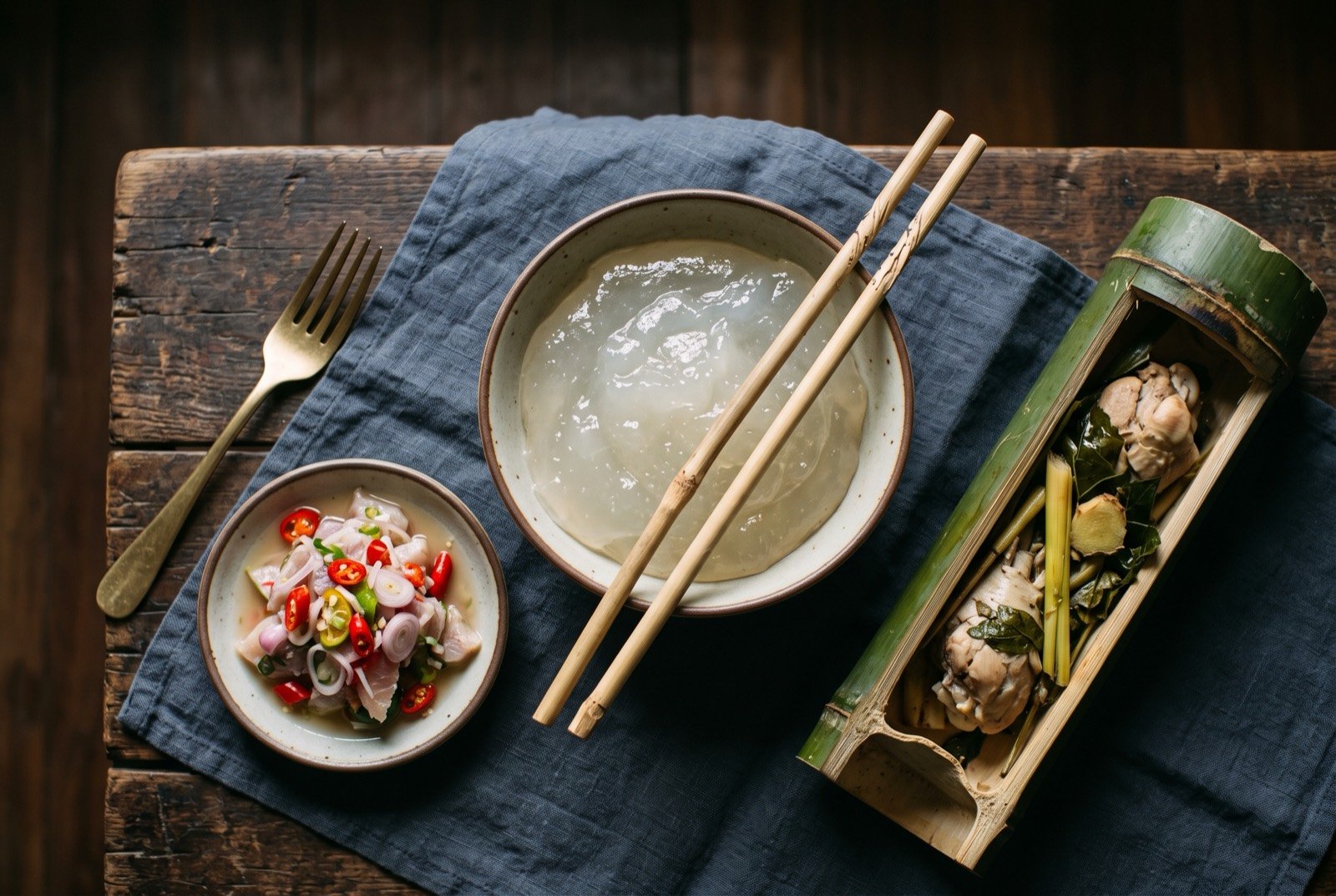
Sarawak, Sabah, Brunei and Indonesian Kalimantan, taken together as one rainforest island cut into four flags, and this chapter treats the cut honestly rather than folding it away. Rivers before roads, sago before rice in the coastal swamps, citrus and salt doing the work fire does elsewhere, and a longhouse or river-mouth settlement pattern that predates every border drawn across it. Every dish as tradition built it, then what a modern chef would change.
Sources and review · What this chapter does not assert · How we research · Spotted something wrong?
A Sense of Place
Borneo's indigenous settlement is riverine before it is anything else. The Iban, Bidayuh, Orang Ulu, Kenyah, Kayan, Penan, Melanau and Kadazan-Dusun built longhouses and villages along riverbanks, using rivers for transport, fishing, freshwater and farming. Coastal swamp and dense interior jungle worked against road-building well into the twentieth century, so raised log paths connected villages to their fields while rivers remained the actual highway. Under the Brooke dynasty in Sarawak (1841 to 1946), rivers became the principal administrative and commercial routes linking coast to interior, Chinese shopkeepers acting as the conduit between Singapore trading houses and up-river bazaars, exchanging manufactured goods for jungle produce and, later, rubber. In South Kalimantan, the same logic produced the pasar terapung, the floating markets of the Barito and Martapura rivers, a genuine economic and food-distribution system rather than a tourist invention, one of them, Muara Kuin, believed to predate the Banjar Sultanate itself. That market has now largely disappeared as roads improved and small traders shifted to bicycles and motorbikes; a second, Lok Baintan, remains active. The river economy this chapter describes is not a timeless survival. Parts of it are eroding under land transport competition right now, and this chapter says so rather than romanticising it as eternal.
The Iban are Sarawak's largest ethnic group, roughly 28.8% of the state's population and the largest indigenous group in Malaysia after the Malays themselves, living mainly in longhouses along the lowland rivers of Sarawak's interior, structures housing anywhere from 20 to 100 families under one roof, on a staple economy of wet and swidden rice supplemented by fishing and hunting. The Melanau hold the coastal delta from the Rejang east to Bintulu, and their identity is genuinely contested in the scholarship in a way that matters for how this chapter frames their food: linguistically and ethnographically they belong to neither the Dayak grouping (Iban, Bidayuh and others) nor the Malays, and the leading hypothesis places their homeland upriver among the Kajang before a coastal migration and, for many, a later conversion to Islam and re-identification as Sarawak Malay. The ethnonym "Melanau" was not even a traditional self-designation: it was introduced by Bruneians and Western sailors as a convenient blanket term for coast-dwellers who did not fit another category, and it spread widely only under the Brooke administration. What is not contested is sago's centrality to Melanau life. The academic literature states plainly that "the entire life of the Melanau group, from birth to death, is closely tied to sago," and for centuries the ethnonym has been functionally identical with "sago" in regional usage. Sago became a major Sarawak export in the mid nineteenth century, at one point supplying roughly half the world's sago, a scale worth holding against the pretty, small-scale image the dish tends to conjure today.
Sabah's Kadazan-Dusun are the state's largest indigenous group, historically rice agriculturists, dividing ecologically rather than as one bloc: highland Dusun communities around Mount Kinabalu on wet rice terraces, other Kadazan-Dusun communities on the coastal plains. Mount Kinabalu itself, Kadazan-Dusun Akina Balu, "the revered place of the dead," is the environmental and spiritual centre of Kadazan-Dusun cosmology, and the founding myth of Kinoingan the creator god, his wife Suminundu and their daughter Huminodun, who sacrificed herself so her body could be planted as seed to feed the people, underwrites the reverence given to Bambaazon, the rice spirit, and to Kaamatan, the harvest festival, still. Kalimantan's Banjar people, by contrast, are a river-mouth, trading, substantially Islamic identity from the start: descended from Dayak groups who converted to Islam and absorbed Malay, Javanese, Bugis and Chinese elements, conventionally divided into three sub-groups reflecting exactly that layering, with the coastal Banjar Kuala, Banjarmasin's own population, explicitly including Bugis-Makassar ancestry within it.
A table of peoples, logic and dishes
| World | Defining logic | The dishes that carry it |
|---|---|---|
| Iban, Sarawak interior | rice, longhouse communal cooking, bamboo-tube cooking | manok/ayam pansuh, tuak |
| Melanau, Sarawak coastal delta | sago as makan ruji, citrus-cured raw fish | umai, ambuyat/linut |
| Bruneian Malay | sago as national dish, everyday street food distinct from ceremonial food | ambuyat, nasi katok |
| Kuching's Chinese communities | Hakka and Cantonese noodle and paste traditions, standardised commercially | kolo mee, Sarawak laksa |
| Kadazan-Dusun, Sabah interior and coast | citrus-cured raw fish plus a native souring fruit, indigenous detoxifying ferments | hinava, pinasakan, bosou |
| Banjar, South Kalimantan river delta | turmeric-forward but dairy-free broths, a red chilli paste, Chinese and Arab trade layers | soto Banjar, ikan patin masak habang |
The History in Layers
The Brunei sultanate, older and larger than its modern borders suggest
The Sultanate of Brunei converted to Islam in the early 1360s under Awang Alak Betatar, who took the name Muhammad Shah, becoming Southeast Asia's greatest maritime kingdom after the fall of Melaka. Under its fifth sultan, Bolkiah, Brunei's reach extended across much of Borneo, the Sulu archipelago and neighbouring islands, a reach still evident when Magellan's expedition arrived in 1521. This is precisely why Brunei was able to appoint Melanau representatives at the mouths of Sarawak's major sago rivers, Oya and Mukah, as early as roughly four centuries before the present, to control sago-trade revenue, well before Sarawak existed as a separate polity at all. The formal social ranking the academic literature records among the Melanau, a class descended specifically from Brunei nobility sitting above the local nobility, commoners and enslaved, is the clearest single piece of evidence for how deeply the sultanate structured Melanau political life long before the Brookes arrived.
The Brooke Raj, and a food-trade economy reorganised by a specific war
James Brooke, an English adventurer with East India Company and Anglo-Burmese War military background, was made Rajah of Sarawak by the Sultan of Brunei in 1841 in gratitude for suppressing a Malay-Dayak rebellion, plus a payment of $2,000. The Brooke dynasty, James, then Charles, then Charles Vyner Brooke, ruled Sarawak as an independent, expanding personal kingdom until Japanese occupation in 1941 to 1945 and formal cession to the British Crown in 1946. They established a codified government, suppressed piracy and headhunting, incorporated the Iban into their expanding territory, used Malay chiefs as local administrators, and actively encouraged Chinese agricultural immigration. The clearest documented effect on food and trade specifically, more traceable than most "colonialism changed the food" generalisations, is territorial and administrative rather than culinary in the narrow sense: fighting around Mukah in 1861 transferred the Mukah and Oya districts, Sarawak's two most important sago-producing river mouths, from Brunei's control to Sarawak's, and the sago trade was reorganised around Kuching rather than Brunei town. A single war, a single reorganised export economy, a food history you can actually trace to an event.
Brunei's own path diverged sharply from Sarawak's. It became a British protectorate under an 1888 Treaty of Protection, sought at its own sultan's request to halt further territorial annexation, and remained a protectorate until full independence on 1 January 1984, following a 1979 Treaty of Friendship and Cooperation with the UK. Brunei is unique among Bornean territories in surviving the colonial period intact and re-emerging as a fully sovereign state, rather than being absorbed into a successor federation the way the rest of the island was.
Sabah under a chartered company, and a colonial drink tax that provoked resistance
Sabah was administered not by the Crown directly but by a chartered company, the British North Borneo Chartered Company, formed on 1 November 1881, one of the last such corporate-colonial arrangements in the British Empire. The territory became a British protectorate in 1888 but remained under company administration until 1946, when the Crown formally took it over as a Crown Colony. The company's priority was an extractive economy for shareholders, principally Western-owned tobacco and rubber estates and forest exploitation; it held full executive, legislative and judicial authority, could tax, raise armed forces and make treaties, and was itself only moderately profitable given its high overheads. A direct, food-specific example of what that extractive logic meant on the ground: in 1913, British colonial authorities imposed a tax on tapai, rice wine, among the Murut, provoking real resistance, since tapai was structurally embedded in births, deaths, Kaamatan itself, weddings, house-building, feud settlement and hospitality. A colonial administration taxed a fermentation practice load-bearing enough to hold an entire ritual calendar together, and the record of resistance to it is a sharper, more specific colonial-economy story than the general extraction narrative usually offers.
Kalimantan, never British, and a sultanate abolished by force
Kalimantan was never British at all. Dutch contact and pressure from the seventeenth century, competing with the English East India Company for pepper, gold, gambier and rattan, escalated to direct Dutch colonial control through the nineteenth century, culminating in the forced abolition of the Banjar Sultanate. Two dates recur for this in Indonesian sourcing and this chapter reports the discrepancy rather than silently resolving it: the sultanate is recorded as unilaterally dissolved by the Dutch on 11 June 1860 to pre-empt further rebellion, but organised resistance, the Banjarmasin War, continued from 1859 until 1905, ending only with the death in battle of Sultan Muhammad Seman on 24 January 1905, after which South Kalimantan passed fully under Dutch East Indies administration. Kalimantan then remained Dutch until Indonesian independence, its twentieth century political trajectory, joining the Indonesian republic, entirely distinct from Sabah's route into Malaysia via the 1963 federation and from Brunei's continued sovereignty.
This is the organising idea for the whole volume, and it is a genuinely strong one, not a stretch. All four territories sit on one island, share sago, rice, river-transport logic and a common Malay-Islamic coastal layer over indigenous Dayak, Dusunic and Melanau cores, yet ended the colonial period as, respectively, an independent personal kingdom under an English dynasty before Crown cession, a Malaysian state administered for sixty five years by a private company before Crown rule, a fully independent absolute-monarchy sultanate that never lost its throne, and an Indonesian province whose sultanate was abolished by force after a half-century of resistance. Shared ecology, four genuinely different political afterlives, and this chapter's own recipes and sourcing notes cannot be read apart from that.
Headhunting, Gawai Dayak, and what a modern harvest festival is actually built from
Headhunting, broadly connected to the cult of Singalang Burong, the Iban war deity associated with the hornbill, was a genuinely documented historical practice among Iban and other Borneo Dayak groups, tied specifically to feast and ritual culture: successful raids were understood to secure land fertility, harvest prosperity and spiritual protection for the longhouse. The Brooke administration actively suppressed headhunting through the nineteenth and early twentieth centuries, and bejalai, the Iban tradition of travelling from the longhouse for work, trade and personal prestige, still practised today as labour migration, has been analysed by Iban ethnographers as functioning in part as headhunting's institutional replacement, a socially sanctioned way for young men to earn status once headhunting itself was closed off. This chapter names that history plainly rather than sensationalising it, and it names the direct line from it to the present: the hornbill imagery central to modern Gawai Dayak celebration derives from Singalang Burong's historical association with headhunting-era ritual, carried forward as carved and celebrated imagery rather than active practice. Gawai Dayak itself is precisely a twentieth century political creation built on much older harvest-thanksgiving and headhunting-adjacent ritual: gazetted as a Sarawak public holiday on 25 September 1964 by Sarawak's first Chief Minister, Stephen Kalong Ningkan, first officially celebrated 1 June 1965. Do not read Gawai as simply ancient. The Melanau have their own, separate April festival, Pesta Kaul, marking the transition from monsoon to dry season with a boat procession appeasing the spirits believed responsible for illness and misfortune, tied to fishing and farming livelihoods rather than to rice-harvest thanksgiving the way Gawai is.
The Flavour Arsenal
Sago, and the honest relationship between ambuyat and linut
Ambuyat and linut are the same dish under different regional names: a translucent, sticky, essentially flavourless starch paste made by pouring boiling water over sago starch and stirring continuously until it forms a thick glutinous mass. Ambuyat is the term used in Brunei and, per some sources, parts of Sabah; linut, sometimes pinantung, is the Sarawak term, principally among the Melanau, Penan and Orang Ulu, though eaten by Sarawak Malays too. The Mukah Melanau ethnographic definition is precise and worth quoting: "sago porridge made by pouring boiling hot water onto a bowl of sago starch. The composite is stirred continuously until the sago starch becomes a thick glutinous mass. This warm, sticky starch is usually eaten with a hot thin sauce made from shrimp paste, dried anchovies, lemon grass, and other spices." Brunei calls its version ambuyat and treats it as the national dish, eaten with a pair of bamboo sticks called candas, twirled around the sago mass and dipped into a tangy, spicy sauce called cacah, commonly built from fermented durian, tempoyak, or shrimp paste, tamarind and chilli, the eating deliberately communal, shared from one large bowl.
A popular claim, repeated widely in Western travel content, holds that ambuyat was invented during the WWII Japanese occupation of Brunei, when Bruneians turned to sago out of wartime hunger. This chapter does not repeat that claim, and actively rejects it. It appears in no Malay-language source consulted, in no academic literature on Melanau and Bruneian sago use, and in none of Wikipedia's own cited sourcing on the dish. It is also inconsistent with what the record actually shows: sago starch preparation is a food technology many centuries old in this region, and Sarawak was already a major nineteenth century sago exporter, supplying roughly half the world's supply at its peak, long before any wartime shortage. This looks like an invented or garbled just-so story that has spread through low-quality English travel writing without a traceable primary source, and it belongs firmly with this chapter's other rejected claims, not repeated as fact simply because it circulates widely.
Bambangan, the Bornean wild mango, the single most distinctive ingredient in this book's arsenal
Mangifera pajang Kosterm., family Anacardiaceae, is endemic to Borneo and specifically associated with Sabah's Dusunic interior, cultivated by seed propagation around Kadazan-Dusun settlements rather than orchard-farmed at scale, and it is not the same species as common mango or kuini. There are two distinct culinary uses and this chapter keeps them separate. The grated kernel, used raw and fresh, is stirred directly into hinava and pinasakan as an aromatic souring and bittering agent: the seed is cut out, the inner membrane peeled away, the kernel grated finely. The whole fruit can also be salted and fermented into nonsoom bambangan, a pickle of diced flesh and grated kernel with salt, often shallots and bird's eye chilli, fermented at room temperature for roughly a week, tangy, sour and sweet, eaten with rice or sambal belacan.
The functional case for taking this ingredient seriously is not folk romance, it is measured chemistry. Universiti Malaysia Sabah and Universiti Putra Malaysia researchers have documented the edible pulp's flavonoid, phenolic acid and carotenoid content, and a human feeding study found a significant rise in plasma beta-carotene, ascorbic acid and total plasma antioxidant status after nine weeks of a juice-powder supplement. The word "underutilized" recurs across multiple Malaysian-authored paper titles on this fruit, a useful, quotable framing: this is not a marginal ingredient food scientists happen to have looked at once, it is a fruit Malaysian researchers are actively arguing deserves wider use. Functionally, bambangan kernel sours without citrus brightness, closer in role to sumac, green mango powder or unripe tamarind than to lime, and it is what actually differentiates hinava, Sabah's citrus-cured raw fish, from umai, its Melanau cousin, which has no bambangan at all.
Tuhau, midin and the ingredients that do not travel
Tuhau, wild ginger relish, is made from Etlingera coccinea, a torch-ginger relative native to Sabah's interior jungle around Tambunan, Keningau and Ranau, foraged rather than farmed and so genuinely seasonal. Despite being a ginger species its flavour is compared to lemongrass rather than to ginger itself. What is eaten is the stem, not the rhizome: peeled, finely sliced or pounded, mixed with bird's eye chilli, salt, sugar and vinegar into a pickled relish, jeruk tuhau. This chapter treats it precisely as that, a pickle, not a slow ferment: every workable method found describes a same-day or short-maceration preparation, and no source gave a multi-day or multi-week timeline the way bosou or bambangan get one. Midin, Stenochlaena palustris, is a wild jungle fern eaten young, almost always stir-fried hard and fast with garlic or belacan, and it must be cooked the same day it is picked because of rapid quality loss once cut, a genuine constraint this chapter will not pretend around in the sourcing section below.
Bumbu habang, South Kalimantan's own red spice paste
Bumbu habang, or masak habang, is the Banjar equivalent of a defining regional chilli paste, built from dried red chillies, which give a deep, dark red rather than a bright fresh-chilli colour, shallots, garlic, ginger, cinnamon, shrimp paste and a notably generous quantity of sugar, giving the finished paste a sweet-savoury profile rather than pure heat, with kencur, lesser galangal, adding a slightly camphor-like note not found in most other Indonesian red spice pastes. It was historically a dish for sultanate ceremonies, festivals, weddings and official events, only later becoming everyday food across all classes, a palace-to-common trajectory worth naming rather than flattening into "traditional home cooking" from the start.
The Technique Ladder
The argument, from inside
Sabah's OITOM, the strongest single fine-dining reference point in this whole volume, is built on exactly this atlas's own thesis. Chef Raphael Lee applies sinalau, the traditional Kadazan-Dusun technique for smoking wild boar meat, to fresh cheese sourced from a local Sabah dairy, and serves hinava built from cured and smoked grouper, a direct technique transfer of the raw-fish citrus cure combined with smoking. None of this imports outside method. It takes indigenous mechanism and applies it deliberately somewhere new, and that is the shape this technique ladder follows throughout.
Rung 1. Pour near-boiling water into starch violently, not gently, for a true gelatinised sago mass
Sago starch runs roughly 21.7 to 31.2% amylose and around 73% amylopectin, its granules oval, "temple bell" shaped, averaging 37.59 micrometres. Amylopectin, chains of glucose cross-linked into branches, is the fraction responsible for stickiness and adhesiveness on cooking; a higher amylose fraction correlates with less stickiness and a lower gelatinisation temperature. Ambuyat's characteristic sticky, glue-like, cohesive texture is a direct consequence of that high amylopectin content gelatinising fast when a large volume of near-boiling water is poured over a small amount of pre-wetted, nearly pure starch.
What a cook does with this rung. The pour has to be fast and the volume has to be large relative to the starch: a slow, gentle addition of water gelatinises unevenly and produces lumps rather than one smooth, extensible mass. Stir hard with a forked implement the entire time the water goes in, not after. A different starch, potato, tapioca or cassava, gelatinises at a different temperature and forms a different gel network entirely: substitution does not just mute the flavour, since sago starch is nearly flavourless anyway, it changes the actual eating texture the dish exists to deliver.
Rung 2. Cure fish in acid for texture, then freeze it first for safety, because the acid will not do that job
Citric acid denatures fish muscle protein: it disrupts the hydrogen bonds and electrostatic interactions holding the protein's folded shape, unfolding and reorganising the chains into a firmer configuration that looks and feels structurally similar to heat-cooked protein, opaque and firm. This is not thermal cooking. Heat above roughly 63°C kills the bacteria and parasites that make raw fish risky; acid denaturation does neither reliably. Academic food-safety literature on umai preparation in Bintulu flags that acid curing does not reliably kill fish-borne parasites such as Anisakis simplex, and separately notes citrus juice's antibacterial effect works by lowering intracellular pH and disrupting bacterial metabolism, a different mechanism from parasite killing, which requires freezing.
What a cook does with this rung. Freeze the fish solid for at least 96 hours before curing, standard UK Food Standards Agency practice for any dish serving fish raw or lightly cured, a step Bornean fishermen working with fish minutes from the water never needed and this chapter will not pretend a UK kitchen can skip. Then cure as tradition instructs: thin slices, citrus, aromatics, up to an hour at room temperature or overnight refrigerated for a stronger cure. Mackerel, umai's traditional fish, is easy to get well in the UK and freezes cleanly.
Rung 3. Seal the vessel, do not just cover the pot, for pansuh's bamboo-tube cooking
Chicken marinated with lemongrass, ginger, garlic, torch ginger flower and galangal, packed into a length of thick, mature bamboo along with cassava shoots, the opening stuffed and sealed with cassava leaves rather than a lid, no oil and, in the fullest traditional version, no added water: the chicken's own juices combine with the bamboo's natural moisture and the aromatics to create the cooking liquid as the sealed tube is propped upright over an open fire and rotated periodically so the whole culm heats evenly. Utusan Sarawak states the mechanism directly: no extra seasoning is needed because the bamboo itself releases a pleasant aroma as it heats, the culm's internal moisture and the volatile compounds released from green wood under heat perfuming the food as it steams inside a sealed chamber.
What a cook does with this rung. A Big Green Egg run indirect, plate setter in, at a steady 120 to 150°C for several hours is a genuinely close functional analogue: it is already the standard method for holding a low, even, moisture-retentive heat around a sealed or near-sealed parcel. What it cannot reproduce is the bamboo wall's own aromatic contribution, and this chapter states that loss plainly rather than implying cast iron and green bamboo are interchangeable.
Rung 4. Let salt ferment the poison out, not just preserve the food
Sabah holds more than one indigenous fermentation tradition that converts a difficult, sometimes actively toxic, raw ingredient into something prized, not merely preserved. Bosou, Sabah's fermented fish and rice condiment, co-ferments raw freshwater fish with cooked rice, salt and pangi, Pangium edule, for two weeks or more; raw pangi seeds are naturally toxic, containing cyanogenic glycosides, and the Kadazan-Dusun method of co-fermenting them is the traditional detoxification technique, converting a bitter, poisonous seed into something described as nutty, "like peanuts." Bambangan's roughly week-long salt ferment runs on materially the same timing and mechanism as tempoyak, fermented durian, meaning this is a real regional pattern, not three unrelated recipes.
What a cook does with this rung. Lactic fermentation under salt is a genuinely teachable, controllable process with a vacuum-seal bag and a stable warm spot, and it is worth presenting to a UK reader as exactly that, a controllable microbiology experiment with a real safety logic behind the salt percentage, rather than an exotic curiosity. Pangi itself is not sourceable in the UK and this chapter does not pretend a substitute reproduces its detoxification role; treat bosou honestly as a dish that needs sourcing trips or acceptance that it stays out of reach for now.
Rung 5. Feed a mixed mould-and-yeast starter cooled rice, never hot, for tuak
Ragi, a dried rice-flour starter cake colonised by environmental moulds, yeasts and lactic acid bacteria, is mixed into cooled cooked glutinous rice, critically only once cooled, since hot rice kills the living culture. Moulds including Mucor, Rhizopus and Amylomyces break the rice's starch down into fermentable sugars; yeasts, principally Saccharomyces cerevisiae alongside several named others, convert those sugars to ethanol; lactic acid bacteria contribute sourness and secondary flavour. Fermentation, packed airtight into earthenware, self-terminates as ethanol concentration climbs toward 16 to 20%, at which point the yeast population dies from its own alcohol output, which is why the prized two-month fermentation is slow rather than accelerated: it lets the mash clarify and develop before the yeast dies off.
What a cook does with this rung. This is directly comparable to koji-based fermentation, amazake, makgeolli, already familiar to a technically literate reader, and a dehydrator is genuinely useful for controlling the rice-cooling and starter-drying stages precisely. Do not rush a two-month brew by raising the temperature; that shortens fermentation at the cost of the clarity and complexity the timing is actually for.
Rung 6. Build a broth's body from a fried spice paste, not from added fat
Authentic soto Banjar uses no coconut milk and no dairy: its thick, cloudy texture comes purely from a wet paste of shallots, garlic, candlenut, ginger, turmeric, cinnamon, cloves, coriander and black pepper, ground and fried in oil or ghee until the paste's aromatics bloom and the raw edge cooks out, before the fried paste goes into a kampung chicken broth. This is worth treating as a technique point in its own right, a soup whose richness is a matter of spice technique rather than a fat addition, standing in contrast to how easily a Western kitchen reaches for cream or coconut milk to thicken a broth.
What a cook does with this rung. Grind the full spice list to a genuinely smooth wet paste in a high-power blender, then fry it in a wide pan over a lower heat than instinct suggests, long enough to watch the paste itself visibly darken and the oil separate at the edges, the same phase-separation signal this atlas uses elsewhere for a properly cooked curry base, before the stock goes in. A paste added raw to hot stock never develops this body and tastes thin regardless of how long the soup then simmers.
The Ferment and Preserve Bench
1. Tuak
Iban rice wine, glutinous rice fermented via a mixed ragi starter of moulds, yeasts and lactic acid bacteria, packed airtight into earthenware, brewed for an average of two months, longer fermentation prized for the clarity and yellow colour it brings. Brewed specifically for Gawai from the household's own harvested rice, and rarely available for sale in the ordinary market.
2. Nonsoom Bambangan
Fermented bambangan flesh and grated kernel, salted at roughly one tablespoon of salt to three fruits, or, per a separate food-science-cited formulation, a 2:1 salt-to-kernel ratio, fermented airtight at room temperature for about a week to ten days. Two conflicting ratios exist across sources and this chapter reports both rather than silently choosing one.
3. Bosou
Sabah's fermented fish and rice condiment, raw freshwater fish co-fermented with cooked rice, salt and pangi (Pangium edule) for two weeks or more, the pangi's own natural toxicity converted through the fermentation into a nutty, prized flavour rather than merely being neutralised. Kadazan-Dusun style uses pangi; Murut style does not, relying primarily on freshwater river fish alone.
4. Mandai
Fermented cempedak rind, the pith left over once the jackfruit relative's flesh is eaten separately, salted and fermented three to seven days via Lactiplantibacillus plantarum, up to a month for a stronger batch, turning meat-like, springy and sour-savoury, nicknamed "Banjarese steak." A genuinely striking economic detail: mandai, made from what is nominally a waste product, costs more than double the price of the whole fresh fruit once processed, real evidence of culinary value added by fermentation rather than poverty food.
Sourcing in Britain
Verified September 2026. Where a supplier could not be fully confirmed, that is said rather than smoothed over. Four of the ten ingredients this chapter checked have no UK source at all, and that ratio is itself the honest headline of this section.
The ranked list: what decides great from grim
- True sago starch, not "sago pearls," for ambuyat. The single highest-leverage decision in this whole chapter's spine. Most UK "sago pearls" (Tuk Tuk Mart, Wholefood Earth, BuyWholefoodsOnline) are, by the retailer's own product description, pure tapioca starch, a different plant that produces a different gel. Genuine Metroxylon sagu starch is confirmed live at Toko Indonesia's Tepung Sagu High Quality Sago Flour, 500g, £9.99, correctly identified as extracted from the actual sago palm.
- Belacan under its correct name, not a substitute wearing the wrong label. Genuinely well served: Tean's Gourmet Spicy Belacan Paste, 230g, £4.65 to £4.65 across Oriental Mart and Tradewinds Oriental Shop, both confirmed live. A correction worth flagging for anyone using this atlas's earlier volumes: a shrimp paste sold by Sous Chef as generic "Preserved Shrimp Paste," previously cited elsewhere as Vietnamese, is on direct inspection the Nang Fah brand, product of Thailand, not Vietnam and not belacan.
- Calamansi, better available than expected. Fresh, in stock at HuongViet Asian Supermarket, 200g, £3.99. Ordinary limes remain a sensible fallback, closer in acidity than most citrus but missing calamansi's distinct mandarin-like top note.
- Tamarind and banana leaf, both genuinely well served. Sous Chef's Khanum Seedless Tamarind, 400g block, £3.50, in stock; Longdan's frozen banana leaf, 1kg, £5.80, ships frozen with a dry-ice surcharge. No real gap on either.
- Bamboo tubes for pansuh, an honest gap. No UK retailer sells bamboo tubes marketed for this purpose. Food-safe fresh bamboo poles from a garden centre or specialist bamboo supplier are a genuine DIY route for a determined reader, but improvised kit, not a verified retail product; the more reliable route is the Big Green Egg method described under Rung 3.
- Tuhau, no UK source of any kind. Fresh young ginger, quick-pickled with lime, shallot and chilli, mimics the crunch-plus-sourness role without reproducing the actual aroma; galangal, despite the family resemblance, is a poor substitute, too earthy and medicinal for what tuhau does in a dish.
- Bambangan, fruit and kernel, no UK source. A firm green mango is the closest realistic substitute for the sour fruit flesh; nothing sold in Britain reproduces the kernel's specific savoury, faintly fermented depth, and this chapter does not pretend otherwise.
- Midin fern, no UK source, and no safe foraged substitute. Britain's native ferns, chiefly bracken, are actively advised against eating at all. Kangkung, water spinach, genuinely available fresh from UK Asian grocers, is the best-reasoned substitute, not for its texture but because it is cooked identically, stir-fried hot and fast with garlic or belacan, in the same belacan-forward register Malaysian cooks themselves reach for.
- General Malaysian and Indonesian pantry, well served. Longdan, Tuk Tuk Mart, Oriental Mart, Starry Mart and Toko Indonesia, the last specifically right for genuinely Indonesian items given Kalimantan's presence in this volume, cover the rest of this chapter's pantry without difficulty.
Where to eat this in the UK, honestly
Borneo Kitchen, 21 Strutton Ground, London SW1P 2HY, is the one confirmed find: a small, independent, currently-trading neighbourhood restaurant naming Sarawak laksa specifically on its menu. Mambow, East London, lists umai as a menu staple, the clearest single dish presence beyond that. No dedicated Kadazan-Dusun, Iban, Bidayuh, Melanau or Banjarese restaurant, and no Bruneian restaurant, pop-up or supper club of any kind, was found operating in the UK. This is a real, checked absence, not a search failure, and this chapter states it plainly rather than padding the section with generic Malaysian restaurants that happen to list Sarawak laksa among many regional styles.
Kit substitution, honestly
A Big Green Egg run indirect with a plate setter is the genuine, repeatable answer to pansuh's sealed bamboo cooking, and the closest a UK kitchen gets to ambuyat's dip-and-twirl vessel is simply a pair of chopsticks or purpose-bought candas sticks, sourceable from Asian kitchenware retailers, no real substitute needed there. A dehydrator's low or proving setting is the genuine, sourced way to hold tuak or nonsoom bambangan's fermentation at a stable warm temperature. A high-power blender handles soto Banjar and masak habang's wet spice pastes cleanly; a stone mortar gives a rougher, arguably more traditional texture for a reader who prefers it, but is not required the way it is for some other volumes in this atlas.
Voices and Sources
From inside the tradition
- Raphael Jay Peter Lee, OITOM, Kota Kinabalu. This volume's strongest fine-dining voice, applying sinalau smoking to fresh cheese and building a nine-course Sabah-sourced tasting menu from indigenous technique rather than imported method.
- Livan Lah, Lepau Restaurant, Kuching, and the Kayan, Iban, Bidayuh and Orang Ulu chefs of Kuching's small "restaurant revolution," Roots, Gypsy Badger, Pinggai Cafe and The Dyak among them, each building deliberately from tribal technique rather than flattening it into generic Malaysian cooking.
- Melvin Gatu, a Kadazan-Dusun chef from Ranau, working through digital platforms to popularise dishes such as Binuburan Manuk Kampung, a revived century-old family recipe.
- Chong Shin and James T. Collins, academic authors of the definitive Melanau sago ethnography, whose fieldwork underpins this chapter's account of linut, sago's centrality to Melanau identity, and the Melanau's own contested ethnic history.
- Nik Mohd Shahril Nik Mohd Nor et al., Universiti Teknologi MARA, authors of the peer-reviewed study of tuak as cultural communication that anchors this chapter's account of the drink's social role.
- Yee Yee Kyaw and the wider Rakhine-parallel pattern of displaced regional cooking, named elsewhere in this atlas, is echoed here by Chef Yulita Intan Sari, a South Kalimantan native and MasterChef Indonesia alumna, campaigning through Indonesia's state press for wider recognition of South Kalimantan food beyond soto Banjar.
The UK diaspora
- Mambow, East London, chef Abby Lee, the clearest documented instance of a named Bornean dish, umai, on a UK menu.
- Borneo Kitchen, London, a small, independent restaurant naming Sarawak laksa specifically.
- Aidan Low, Akar Dining, Kuala Lumpur, not in Borneo and not in the UK, but worth naming for where Bornean ingredients such as tuhau travel: a one-Michelin-star "progressive Malaysian" degustation built partly from Sabahan native ingredients.
The gaps, named
No Bruneian royal or court cuisine, as a historical repertoire distinct from ambuyat and nasi katok, could be established from any source reached in this research, Malay or English. No Brunei-domain source, a Brunei newspaper, the Brunei history centre, or the government gazette Pelita Brunei, was successfully reached at all; this chapter's Bruneian material rests entirely on Malaysian, Indonesian or generalist English sourcing filtered through those. No Kadazan-Dusun-language, Banjar-language or Iban-language food writing was found online in any meaningful volume. Iban Wikipedia is real and growing, launched as its own edition on 14 October 2024 and holding roughly 1,940 articles by its first anniversary, but a search for its own article on umai returned a 404: its food coverage is evidently patchy rather than comprehensive. Sarawak's largest indigenous ethnic group has almost no first-language web presence for its own food culture, and this chapter states that as a real and honest limitation rather than implying such sources exist and were simply not used. No fine-dining or chef-led elevation venue of any kind was found in Pontianak or Banjarmasin, checked directly in Indonesian as well as English; Kalimantan is the one part of this volume's geography with no documented modernist scene at all.
Things this chapter has deliberately not asserted
- That ambuyat was invented during the WWII Japanese occupation of Brunei. This claim circulates widely in English travel writing and appears nowhere in the Malay-language, academic or properly sourced English material this chapter's research reached; it is inconsistent with sago's documented centuries-long role as a Bornean staple and major nineteenth century export. This chapter names the claim specifically in order to reject it, since a reader is likely to encounter it elsewhere.
- A single origin for Sarawak laksa. Two mutually inconsistent originator stories circulate, a Teochew immigrant selling it on Carpenter Street from 1945, and a separate Cantonese lineage passing through several hands to the Tan family, whose Swallow brand paste standardised the dish commercially from the 1960s. No source treats either as settled, and this chapter presents both, attributed, without picking a winner.
- That bosou is a Melanau or Sarawak dish. An earlier working assumption behind this chapter's own research brief made this error. Every source consulted ties bosou specifically to Sabah's Kadazan-Dusun, not to Sarawak or the Melanau; the closest genuinely Sarawak/Iban-adjacent fermented fish tradition is pekasam, which this chapter presents as regionally present rather than as a marked Iban specialty, since no source documents an Iban-specific version with its own ratios or name.
- That tuhau is a fermented ingredient. Every workable method found describes a same-day or short-maceration pickle, not a multi-day ferment; this chapter treats it as pickled, not fermented, and does not assert a fermentation mechanism it could not find sourced.
- A single, correct ratio for nonsoom bambangan's salt content. Two credible but non-identical figures exist, roughly one tablespoon of salt to three fruits over about a week, against a separate food-science-cited 2:1 salt-to-kernel ratio over seven to ten days. Both are reported; neither is presented as the sole authoritative figure.
- A settled botanical identity for takob-akob, the souring fruit skin used in pinasakan, beyond a general description as mangosteen-like. Unlike bambangan and tuhau, no Latin binomial was found for it, and this chapter does not invent one.
- A precise founding date for the Banjar Sultanate. Indonesian sources give either 1526 or 1595; this chapter reports the discrepancy rather than silently resolving it.
- Any historical Bruneian royal or court cuisine repertoire beyond ambuyat and nasi katok. This is a genuine, stated gap rather than an implied absence of such a tradition, since no Brunei-domain source was reached to confirm or deny it either way.
- That any specifically documented Iban version of pekasam exists with its own name, salt ratio or timing distinct from the generic Malay, Malaysian and Indonesian pekasam tradition found elsewhere across the region.
- A current (September 2026) operating status for Lepau, Roots, Gypsy Badger or Pinggai Cafe in Kuching, or for any of Brunei's two named fusion venues; the sources behind this chapter's modernist material are not dated later than 2024, and a reader should verify before travelling to any of them specifically for this chapter's account.
Pour near-boiling water into starch violently, not gently, for a true gelatinised sago mass
Sago starch runs roughly 21.7 to 31.2% amylose and around 73% amylopectin, its granules oval, "temple bell" shaped, averaging 37.59 micrometres.
Cure fish in acid for texture, then freeze it first for safety, because the acid will not do that job
Citric acid denatures fish muscle protein: it disrupts the hydrogen bonds and electrostatic interactions holding the protein's folded shape, unfolding and...
Seal the vessel, do not just cover the pot, for pansuh's bamboo-tube cooking
Chicken marinated with lemongrass, ginger, garlic, torch ginger flower and galangal, packed into a length of thick, mature bamboo along with cassava shoots...
Let salt ferment the poison out, not just preserve the food
Sabah holds more than one indigenous fermentation tradition that converts a difficult, sometimes actively toxic, raw ingredient into something prized, not...
Feed a mixed mould-and-yeast starter cooled rice, never hot, for tuak
Ragi, a dried rice-flour starter cake colonised by environmental moulds, yeasts and lactic acid bacteria, is mixed into cooled cooked glutinous rice...
Build a broth's body from a fried spice paste, not from added fat
Authentic soto Banjar uses no coconut milk and no dairy: its thick, cloudy texture comes purely from a wet paste of shallots, garlic, candlenut, ginger...
The dishes
- Umai Melanau, coastal Sarawak
- Hinava Kadazan-Dusun, Sabah
- Manok/Ayam Pansuh Iban, Sarawak interior
- Ambuyat Brunei, shared as linut across Sarawak
- Sarawak Laksa Kuching
- Pinasakan Kadazan-Dusun, Sabah
- Soto Banjar Banjarese, South Kalimantan
- Ikan Patin Masak Habang Banjarese, South Kalimantan
Sources and review
- Researched
- 7 sources cited
- Reviewed
- Not yet reviewed from inside the tradition
- Cooked
- Not yet cooked and reported
Where this volume comes from
3 research briefs on file for this volume, researched to the rules on How we research. Published 3 September 2026. Last changed 8 September 2026.
The brief's own account of its sources
This brief rests on a genuine mix of Malaysian and Bruneian regional/national press (Utusan Borneo, Tatler Asia's Malaysia edition, Malay Mail, The Star), Indonesian national press (ANTARA News, Detik.com), trade/lifestyle press with named chefs and direct quotes (National Geographic's sponsored Malaysia feature, treated as moderate-reliability travel journalism rather than pure marketing), and, for the sourcing half, direct live fetches of UK retailer and restaurant listing pages, price, stock status and product description read from the page itself wherever marked [live].