Asia · Volume 50
The Philippines, Luzon and the Visayas
The Vinegar Line, the Sizzling Plate and the Whole Roast Pig
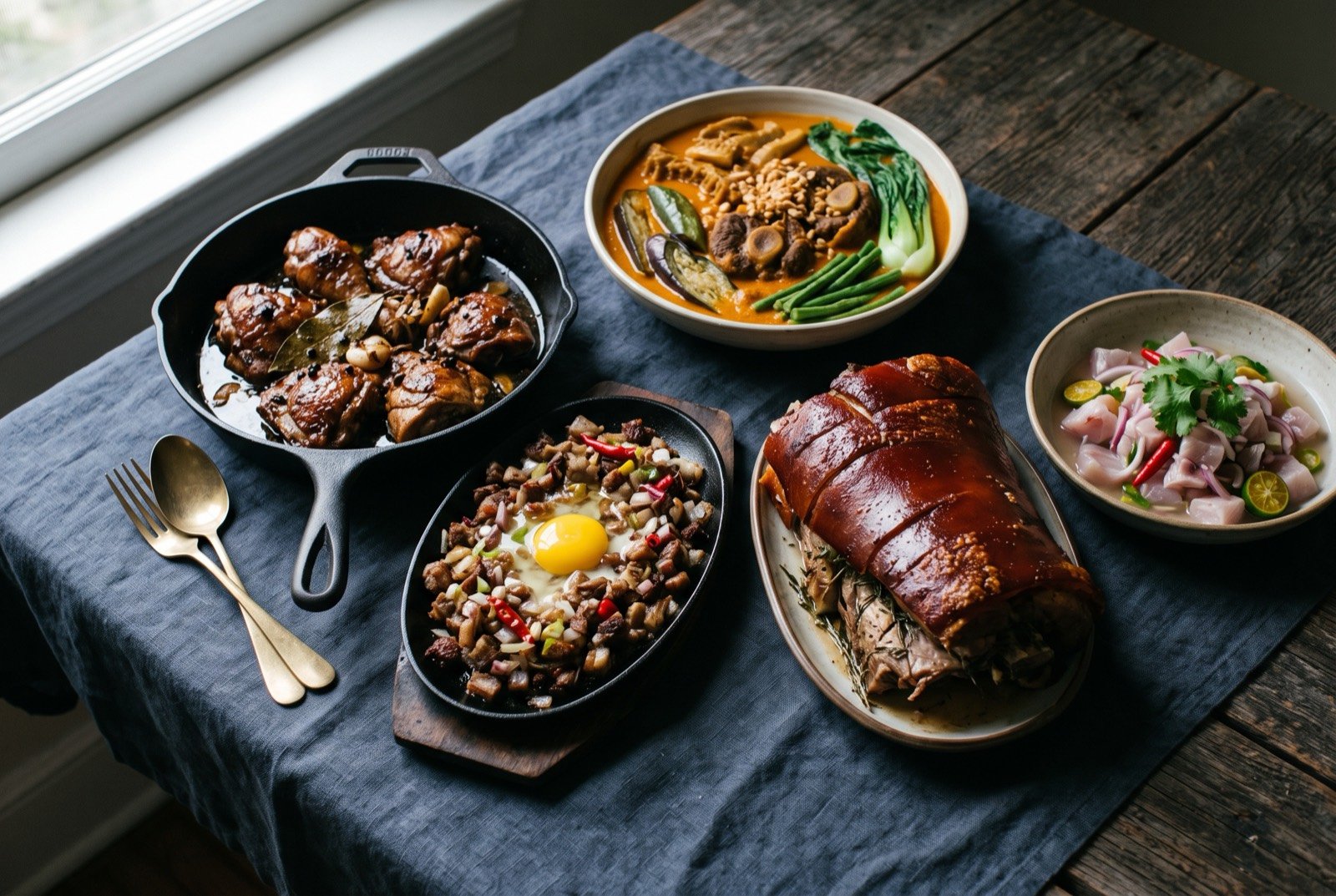
Luzon and the Visayas, taken seriously: three hundred and thirty three years of Spanish rule, a Chinese trading and migrant presence that never stopped, the American administration that followed it, and a Malayo-Polynesian base older than any of them. Not one national cuisine but five regional grammars, Tagalog, Kapampangan, Ilocano, Cebuano and Ilonggo, each reaching for its own way to sour a pot, and every dish as tradition built it, then what a modern chef would change.
Sources and review · What this chapter does not assert · How we research · Spotted something wrong?
A Sense of Place
Three hundred and thirty three years of Spanish rule, a Chinese trading and migrant presence that never stopped for those three centuries or the American one that followed it, and a Malayo-Polynesian base older than either. That is the whole argument of this chapter in one sentence, and it is worth saying plainly at the start because the food itself keeps proving it: a vinegar-braised chicken with a Spanish name and a precolonial technique underneath it, a wonton soup born in a Chinese trading district that formally became part of a Spanish-founded city, a peanut stew whose own name may be a Kapampangan joke about how badly it copies a curry nobody quite agrees was ever really there to copy. Luzon and the Visayas are two different food worlds sharing one archipelago, one language of trade empires and one instinct that both keep no matter what else changes: sour it with vinegar, or with a fruit that grows nowhere near where the next island's cook would reach for it, and taste the difference every time. That instinct, not any single dish, is the clearest signature this cuisine carries against the rest of maritime Southeast Asia, where coconut milk and chilli paste more often do the work vinegar does here.
Luzon and the Visayas are not one cuisine wearing two regional accents. They are two ecologies that received the same three historical forces, Spanish colonisation, continuous Chinese trade, and American administration, at different depths and in a different order, and the food shows the arithmetic.
Central Luzon is rice country in the plainest, most literal sense. Nueva Ecija alone produces roughly a third of the nation's rice, on land the Pampanga River system has fed for at least seven centuries of paddy agriculture, and the province took the "Rice Granary" title from Pangasinan only in 1921, once American-era commercial rice farming had scaled it past its older rival. The Ilocos coast, further north, runs a harder economy: a pronounced dry season from November to April, over ninety percent of its roughly 2,000 mm of annual rain falling in the wet months, and a hydrology erratic enough that a cuisine built on preservation, vinegar cures, salting, sun-drying, rendered fat, is not a cultural flourish but a plain response to what the climate allows you to keep. Pampanga sits between the two, and its reputation as the country's "culinary capital" is real but worth taking apart rather than repeating whole: it rests on a specific historical accident, Pampanga was among the first places Spain colonised, and Kapampangans who cooked for Spanish households gained early access to olive oil, butter and cured meats most of the archipelago did not see for generations. That produced not one Kapampangan cuisine but two running in parallel, an elite table built on that Spanish access, and a popular one built, like everywhere else nearby, on Chinese, Malay and later American food, both now flattened into a single regional brand by tourism copy and a Senate bill whose own reception this chapter could not fully verify.
Cross the water to Cebu and the ecology inverts. The island is limestone and karst, porous, lime-rich and fast-draining, corn rather than rice its highland staple, and it has never fed itself: Cebu has functioned as a trading and redistribution point for seafood since at least its documented role as a tenth-century port with links to China, Siam, India and the Malay world, and its main fish market today is still supplied by cargo truck from Zamboanga, Mindanao, Iloilo and Palawan rather than from Cebuano waters. Iloilo, on Panay, is the opposite case again: a river-delta rice economy, roughly seventy percent of its land in rice, corn and fruit, that grew rich in the nineteenth century as the colonial shipping port for the Negros sugar trade next door. That sugar wealth is not incidental colour. It built the haciendero class's conspicuous, "galante" spending, left Iloilo City the largest concentration of colonial-era ancestral mansions of any Philippine city, and is the documented root of a sweetness in Ilonggo cooking, and reportedly in Ilonggo temperament, that Cebu's more savoury table does not share to the same degree. Iloilo City became the Philippines' first, and so far only, UNESCO Creative City of Gastronomy in October 2023, a recognition that rests on exactly this depth rather than on novelty.
What structures the cooking across all four of these worlds, in different proportions, is fat (historically lard, now more often vegetable oil, though no source traces that transition for the Philippine case specifically), a souring agent that changes by region and by hand, rice as the unbroken starch, and an aromatic base of garlic, onion, tomato, bay leaf and peppercorn that survives every other regional variation intact. The souring agent is where the real map is drawn. Manila and Luzon reach for tamarind and, for a sharper cut, kamias. Ilocos leans on sukang Iloko, cane vinegar, applied with a preserving hand rather than a seasoning one. Iloilo uses batwan, and a named Ilonggo chef, Rafael Jardeleza Jr., has said plainly in the Philippine press that sinigang sa batwan, the version tourists and even some Tagalog cookbooks describe, is not a thing Ilonggos actually make: "it's a Tagalog thing," he says; Ilonggos use batwan for kansi, their own beef-shank-and-jackfruit soup, and reach for a different fruit, libas, for boiled beef. Cebu barely uses a named souring fruit at all, working instead through coconut vinegar and calamansi, most visibly in kinilaw. None of these four traditions is a variant of another. They are four answers to the same question, asked by four different coastlines.
| People and place | The defining logic | Dishes that carry it |
|---|---|---|
| Tagalog Manila and the central plain | Rice-basket abundance, tamarind souring, the deepest layering of Spanish, Chinese and American contact | Adobo, sinigang, kare-kare, arroz caldo |
| Kapampangan Pampanga | Early, privileged Spanish contact split against a popular Sino-Malay table; sourness and offal worked hard | Sisig, morcón, bringhe, relyenong bangus |
| Ilocano Ilocos | A dry, monsoon-shadow coast that preserves everything it can, vinegar-first | Bagnet, pinakbet, longganisa, dinengdeng |
| Cebuano Cebu and the Central Visayas | A trading port with no agricultural hinterland of its own, whole-animal roasting and vinegar-citrus curing | Lechon, kinilaw, sutukil, humba |
| Ilonggo Iloilo and Panay | A sugar-wealthy river delta with its own named souring fruit and a documented sweet hand | Batchoy, KBL, chicken inasal, piaya |
The History in Layers
Start with what the archaeology will actually support, because the popular version claims more than the record does. A 2021 peer-reviewed study of pre-colonial ecological change found that residue testing in Ifugao turns up taro and a sugarcane-like substance but no wet rice, and argues that the large-scale terraced wet-rice cultivation popularly imagined as ancient did not appear at scale until population growth under Spanish contact drove it. Rice was certainly a precolonial lowland staple. The specific image of timeless terraced rice country is a later layer wearing an older costume. What the record does support, richly, is that the islands were never a blank slate waiting for outsiders to arrive with flavour. When Pigafetta recorded Magellan's 1521 landfall in the Visayas, the meal the expedition was served was roasted fish with ginger, pork in broth, rice, bananas, coconuts and palm wine, and archaeological finds at a Butuan balangay site from the tenth to thirteenth centuries show fish bones cut in a manner consistent with the raw-cure cubing of kinilaw. Fermentation, too, is genuinely precolonial and archipelago-wide: rice, fruit, vegetables and palm sap turned into preserved food and drink long before any coloniser arrived, a technique family the Philippines shares with the fermented cassava traditions of Indonesia and Malaysia rather than one it invented alone.
Then Spain arrived twice, once at Cebu in 1565 under Miguel López de Legazpi, six years before Manila became the colonial capital, and the gap between those two dates matters more than it looks. Cebu's contact was garrison and trade contact, a single settlement absorbing Spanish whole-animal roasting technique without the three subsequent centuries of viceregal, friar-convent and galleon-trade cuisine that layered onto Manila as the seat of government. That is the structural reason Luzon's Spanish inheritance runs so much deeper and stranger than Cebu's: callos, cocido, paelya reworked with sticky malagkit rice instead of Spanish short grain, morcón and embutido on the Kapampangan elite table, a whole vocabulary of stuffed, rolled, sauced dishes that never took hold in the same way south of the strait. The Manila-Acapulco galleon trade, running from 1565 to 1815, is the specific and often overlooked conduit for tomato, chilli, maize, chocolate, pineapple, papaya, avocado and peanut, none of them native to the islands before 1565. A dish that reads today as timelessly and essentially Filipino, sinigang's tomato base, the chilli heat running through so much of this repertoire, acquired those defining ingredients only within the last four hundred and fifty years, carried across the Pacific from a different colony entirely.
Adobo is where this chapter has to be most careful, because it is the one claim every popular account states with a confidence the sources do not actually share. The version most often repeated, including in a Tagalog-language source that states it plainly, “bago pa man dumating ang mga Kastila, ang mga katutubong Pilipino ay gumagamit na ng suka at asin para mapreserba ang pagkain,” before the Spanish ever arrived, native Filipinos already preserved food with vinegar and salt, holds that the technique is indigenous and only the name is Spanish, borrowed from adobar, to marinate, after Pedro de San Buenaventura recorded adobo de los naturales in 1612. But Doreen Fernandez, the essential figure in Philippine food writing and the reference this house style asks every chapter to reach for first, argued a more cautious position: that adobo may have been indigenised from a Mexican adobo carried by the same galleon trade, on linguistic grounds, while noting plainly that the two dishes differ in preparation, one pickled with spices, lemon juice and condiments, the other with vinegar and spices. A third position, from food writer Sterling V. Herrera Shaw, argues the dish is simply the native paksiw, fish or meat cooked in vinegar, garlic and salt, wearing a Spanish label, and extends the same claim to menudo and arroz caldo, concluding that Spanish colonisation mostly renamed dishes it found rather than introducing them. None of these three positions has displaced the others, and this chapter is not going to adjudicate what three generations of Filipino food writers have not settled. What is worth remembering, and worth stating more prominently than most accounts do, is that Fernandez herself did not think adobo deserved its status as the presumptive national dish at all. In her essay “Why Sinigang” she wrote that “rather than the overworked adobo, so often identified as Philippine stew in foreign cookbooks, sinigang seems to me the most representative of Filipino taste,” precisely because sinigang adapts to every class, every budget, every season, in a way a single fixed dish cannot. This chapter leads with adobo because the international reader will expect it and because the technique repays close attention. It does not pretend Fernandez's objection is a footnote.
Chinese contact runs the entire length of this history rather than arriving as a single wave, which is the detail flattest retellings lose. Trade with the archipelago via the Rajanate of Butuan and the Kingdom of Tondo predates the Spanish by centuries; Binondo, established in 1594 for Catholicised Chinese immigrants, is widely credited as the world's oldest Chinatown; and continuous Hokkien migration across four subsequent centuries, not one settling event, is what gave Luzon pancit, from pian i sit, convenient food, lumpia, from lun, moist, and pia, cake, and siopao, alongside a genuinely separate Chinese contact point in the south, Molo, founded as its own Chinese settlement in Iloilo in 1637, distinct enough from Binondo that Iloilo's own wonton soup, pancit molo, carries a different family history from Manila's Chinese-descended noodle dishes despite looking, from a distance, like the same story told twice.
The American period, 1898 to 1946, deserves more than the punchline treatment it usually gets. Colonial authorities considered the traditional rice-and-fish diet inadequate and pushed canned goods and evaporated milk as substitutes; American “Thomasite” teachers ran home economics classes instructing, among much else, that rice be served as a vegetable; and a cafeteria-style school feeding programme addressed what colonial administrators judged malnutrition. Spam and canned corned beef, entering more decisively via wartime ration exchange, retain a documented prestige from the American association that neither ingredient carries in the country that exports them, and surface today unapologetically in portmanteau breakfasts like spamsilog. This is not a footnote about tinned meat. It is the same colonial-diet-management instinct the Spanish exercised through the friar kitchen three centuries earlier, run again by a different empire with a different toolkit.
Several claims in this history are genuinely contested and this chapter says so rather than picking a side. Whether “Filipino cuisine” as a single national category obscures real regional difference is a live question inside the Philippines itself: the country has no legislated national dish, and food professionals interviewed on the subject are reportedly reluctant to name one, on the reasoning that a good national dish cannot belong to any one region. Bicol Express, treated by most foreign accounts as ancient Bicolano cooking, was in fact invented in the 1970s by Cely Kalaw, a Laguna-born restaurateur, at her restaurant in Malate, Manila, and named as a pun on the PNR train line for the dish's heat, though chef Myke Sarthou has noted Bicol had a related coconut-chilli preparation that made the borrowed name feel less like an imposition than it might have. And the death of Lucia “Aling Lucing” Cunanan, the woman who gave sisig its modern form, is reported two different ways by sources this chapter trusts unevenly: a widely repeated diaspora account calls it a robbery gone wrong, while contemporary Philippine press from April 2008 reports parricide charges filed against her husband days after an initial robbery-homicide finding, on the strength of undisclosed circumstantial evidence and a housemaid's account of a commotion she says she ignored because the couple fought often. No source found here reports how, or whether, that case concluded. This chapter repeats neither the clean version nor an unproven accusation as settled fact, and says so plainly rather than choosing the tidier story.
The Flavour Arsenal
Ferments and preserved proteins. Patis, fish sauce fermented from a different mix of small fish, scad, herring, sardine, mackerel, than the mostly anchovy base of Thai or Vietnamese sauces, giving it a heavier, more assertive character that does not substitute cleanly for either. Bagoong isda, salted, fermented fish paste, thinner, darker and saltier, the Ilocano choice for pinakbet and dinengdeng. Bagoong alamang, fermented shrimp paste, firmer and more colourful, sold both raw and ginisang, sautéed and ready to eat, the version kare-kare and green mango actually want and cannot be swapped for its fish-paste cousin without changing the dish's identity, not just its intensity. Tausi, fermented black beans, a Hokkien import that is humba's one indispensable, non-negotiable ingredient. Tuyo and danggit, whole or filleted sun-dried fish. Longganisa and tocino, both cured pork traditions with real regional grammar of their own, covered under the dishes below.
Souring agents. Sukang Iloko, cane vinegar, Ilocos's preserving workhorse. Sukang tuba, coconut or palm vinegar, Cebu's souring base for kinilaw. Suka Pinakurat, a spiced Bohol and Mindanao coconut vinegar carrying chilli, garlic, ginger and onion, characterful enough to use as a table condiment rather than only a cooking ingredient. Tamarind, sampalok, the default sinigang souring fruit. Kamias, sharper and brighter, favoured for seafood sinigang. Batwan, the Ilonggo souring fruit reserved for kansi, not sinigang. Calamansi, the small archipelago-wide citrus that finishes almost everything, from sisig to inasal's dipping sauce.
Aromatics and colourants. Achuete, annatto seed, steeped in hot oil to give kare-kare, bringhe and inasal their characteristic red-orange. Lemongrass, tanglad, bundled whole inside a lechon pig or processed fine into an inasal marinade, two entirely different uses of the same plant. Garlic, onion, bay leaf, black peppercorn, the unbroken aromatic base beneath nearly every savoury dish in this chapter.
Starches. Rice, always, with real regional variety this chapter cannot fully resolve for a UK kitchen: dinorado and sinandomeng, the everyday soft, fragrant table rice varieties, and malagkit, glutinous rice, for bibingka, suman and biko, neither reliably available in Britain under its correct name, a gap named honestly in the sourcing section below.
Chillies. Siling labuyo, the small, sharply hot bird's eye chilli. Siling haba, the longer, milder green finger chilli that finishes dinuguan and much everyday cooking without dominating it.
The Technique Ladder
Rung 1. Cook the vinegar uncovered before you ever cover the pot
Vinegar's acetic acid needs headspace to drive off its harshest volatile notes; simmered with the lid off at the start, the sharpness that defines an amateur adobo's “raw vinegar” taste is allowed to escape, while a lid traps it in. The same acid is doing structural work at the same time, beginning to hydrolyse collagen and elastin in the meat, which is the real reason adobo tenderises tough cuts without a long dry braise. Sear the meat first, a step home recipes skip more often than any other, because the acid-forward sauce that follows will otherwise flatten whatever Maillard character the pan could have given it. Add soy only once the vinegar phase is established, since its lower acidity and higher salt content resist emulsifying cleanly with fat if introduced too early. Reduce with the lid off again at the end, to a near-emulsion, an oil sheen sitting on a concentrated vinegar-soy liquid, agitated by the meat's own rendered fat.
Rung 2. Match the souring agent to what you are souring, not to habit
Tamarind gives the cleanest, roundest sour and is the right default for a pork-and-vegetable sinigang. Kamias is sharper and cuts more decisively through oily fish. Batwan belongs to kansi, not sinigang, whatever a tourist menu tells you. Calamansi sours fast and lighter, right for a finishing squeeze rather than a long-simmered broth. This is not decoration. A Cebuano cook reaching for coconut vinegar and calamansi in kinilaw and an Ilonggo cook reaching for batwan in kansi are both being precise about what each acid does to protein and to a broth's body, not simply expressing regional preference.
Rung 3. Dry the skin long before it ever meets heat
Surface moisture is crackling's only real enemy. Traditional lechon achieves this across hours of turning over open fire, the skin slowly losing water as it roasts. A home kitchen achieves the same result differently: score the skin, salt it, and leave it uncovered in the fridge, or pass it through a dehydrator, so the surface is bone dry before it ever sees direct heat. Only then does a final hot, fast blast, a screaming pan, a torch, or the Big Green Egg run hard, blister the skin into shatter rather than chew.
Rung 4. Treat the last hot surface as a cooking step, not a serving step
Sisig's sizzling metal plate is not theatre. Pre-heated and brought to the table still working, it continues real Maillard browning on contact and stops the dish's crisp elements from softening in their own steam between kitchen and table, exactly the failure that afflicts sisig served on an ordinary plate held even a few minutes. Chicken inasal does the same work differently: the final minutes over live charcoal, basted repeatedly with annatto oil, are where the dish's colour, char and smoke actually happen, not an afterthought to a marinade that has already done all the real work.
Rung 5. Build bagoong and patis into the dish early enough that they cook, rather than splashing them on at the end as a seasoning afterthought
A ginisang bagoong sautéed into aromatics before the rest of a sauce joins it, or patis added early enough to a broth that its raw fermented edge has time to round out, reads as a coherent savoury backbone. Added at the very end, the same ingredients read as a fishy garnish sitting on top of a dish rather than inside it. This is the single most common flattening this chapter found in cooking that treats Filipino fish sauce and shrimp paste the way a Western kitchen treats table salt.
The Ferment and Preserve Bench
1. Patis
Fish sauce fermented from a mixed catch of small fish rather than a single species, giving it a heavier, more assertive character than its Thai or Vietnamese cousins.
2. Bagoong isda
Salted, fermented fish paste, the Ilocano choice, thinner and darker than its shrimp cousin.
3. Bagoong alamang
Fermented shrimp paste, sold both raw and ginisang, sautéed, the version kare-kare and green mango specifically want.
4. Tausi
Fermented black beans, a Hokkien import and humba's one indispensable ingredient.
5. Sukang Iloko and sukang tuba
Cane and coconut vinegar respectively, the preserving and souring backbone of Ilocos and Cebu.
6. Longganisa curing
Vigan longganisa is coarsely ground pork and fat with achuete, heavy garlic, black pepper and sukang Iloko, hang-dried in direct sun for around six hours to shed excess liquid, then refrigerated to cure a further three to five days. Lucban longganisa takes a different, herbal turn, coarse lean pork, sugar, garlic, onion, peppercorn, salt, vinegar and distinctively oregano, a Mediterranean-spiced profile against Vigan's vinegar-garlic sharpness.
7. Tocino curing
Cured pork marinated at least 24 hours in brown sugar, garlic, pineapple juice, vinegar, soy sauce and salt, then pan-cooked until caramelised, a genuinely Filipino sweet-savoury reworking one writer has fairly called a mashup of Chinese char siu and Western bacon.
Sourcing in Britain
The Philippines is one of Europe's largest source countries for NHS nursing and care work, and London's Earl's Court has carried the “Little Manila” label for decades. That community depth shows directly in the shelves: within about two hundred metres of Earl's Court tube station sit at least four separate, independently trading Filipino grocers, not one thin outpost, and dedicated shops reach as far as Aberdeenshire, Stockport and Southampton, a materially better-served list than several other volumes in this atlas can offer.
Patis
Datu Puti is the market leader and the easy UK find, lighter and cleaner-tasting, stocked at Zing Asia, H Mart UK and most of the specialist grocers below. Rufina, the older, darker, more traditional brand many home cooks specifically reach for, has no confirmed live UK stockist; a reader wanting it will need to check in person at Earl's Court or order from a US-facing site that ships internationally. Do not substitute Thai or Vietnamese fish sauce without adjusting quantity: patis is fermented from a heavier mix of small fish and is more assertive than either.
Bagoong
Barrio Fiesta is the dominant UK brand for both bagoong isda and bagoong alamang, confirmed at Asian Online Superstore UK, Kuya's Tindahan and Fresh and Green. Check the label for raw versus ginisang, sautéed, since the jar does not always make the difference obvious.
Vinegar
Buenas sukang Iloko is stocked at Zing Asia. Suka Pinakurat, the spiced Bohol and Mindanao coconut vinegar, is unusually well distributed, at Starry Mart, The Asian Cookshop and Oriental Mart among others, and is worth buying as a genuinely characterful bottle rather than treating as a mere substitute. Where a specific regional vinegar cannot be found, cut a cane or coconut vinegar with a splash of water rather than reaching for plain white vinegar, which loses the faint funk and sweetness that carries real flavour work in adobo and humba alike.
Calamansi
Fresh calamansi is this volume's clearest named gap: genuinely purchasable, from London Grocery and a small number of other importers, but expensive, at upwards of £11 for 250 g, and frequently out of stock. A concentrate exists from Kopi House, though made from Malaysian rather than Philippine fruit. For everyday cooking, lime juice with a little mandarin or orange zest gets closer to calamansi's floral, less sharp profile than lime alone; reserve real calamansi for the dish where it is the headline flavour.
Annatto, coconut milk, rice and banana leaf
Annatto seeds are widely available through general UK spice retailers, no need for a Filipino specialist. No Filipino-brand coconut milk was confirmed at UK retail; Thai brands (Aroy-D, Chaokoh) are a reasonable substitute. Named Filipino rice varieties, dinorado and sinandomeng, and Filipino-brand malagkit rice, were not confirmed under their correct names at any UK retailer; readers are working from generic substitutes whether they realise it or not. Banana leaves are best sourced fresh or frozen in person from the Earl's Court cluster or from Longdan's frozen section.
Ube
Much of what is sold worldwide as “ube flavoured” is purple food colouring plus vanilla rather than real yam, a genuinely documented controversy within Filipino food writing rather than a fringe complaint. Florence-brand ube jam is confirmed at Longdan. Fresh or frozen whole ube for a genuine scratch-made ube halaya was not confirmed available in the UK.
Named shops
In London: Manila Supermarket and Tindahang Pinoy, Earl's Court; Kuya's Tindahan, east London. Beyond London: Jessica's Filipino Foods, with shops in Aberdeen, Peterhead and Elgin; Rollan's Pinoystore, Stockport; MyPinoyShop, Southampton. Online, with real, verified Filipino ranges: Zing Asia, Oriental Mart and Longdan.
The ranked list
Fine to substitute with minimal loss: coconut milk, fresh aromatics, and everyday table rice. Genuinely changes the dish: patis brand, Suka Pinakurat versus plain vinegar, and bagoong alamang versus bagoong isda, which are not interchangeable. Simply unavailable or unreliable enough to name as a real gap: fresh calamansi, named-variety Filipino table rice, and fresh whole ube for a from-scratch halaya. A full lechon spit is also, honestly, beyond a home kitchen: the Big Green Egg's own rotisserie tops out around 18 to 25 kg, ruling out a whole pig and pointing firmly toward the rolled-belly adaptation given above.
Voices and Sources
From inside the tradition. Doreen Fernandez remains the essential reference for Philippine food writing, her essay “Why Sinigang” the single most useful corrective this chapter leant on. Amy Besa and Romy Dorotan's Memories of Philippine Kitchens, drawn from their New York restaurants Cendrillon and Purple Yam, both now closed, traces native Filipino food and its foreign layers from adobo through kinilaw to lumpia and sits alongside Fernandez as foundational. Nora Daza's Let's Cook with Nora (1969) remains the standard-bearer Filipino cookbook of its generation. Claude Tayag, Kapampangan chef and writer, is quoted directly on the Luzon-versus-Visayan lechon divide.
Restaurants worth knowing. In Manila, Toyo Eatery, where Jordy Navarra ferments his own patis, toyo, suka and bagoong from scratch and builds dishes like Bahay Kubo around the entire vegetable-preservation vocabulary of the Filipino pantry, and Gallery by Chele, where Spanish-trained José Luis González has built a Filipino-produce-led “terroir cuisine” rather than importing his training over the top of it. In Chicago, Kasama, Genie Kwon and Tim Flores's restaurant, holds two Michelin stars as of November 2025, the first Filipino restaurant anywhere to hold even one. In London, Sarap and Kasa and Kin carry the tradition forward without the fine-dining register, and Donia, Kingly Court, holds the UK's first and so far only Michelin Bib Gourmand for a Filipino kitchen.
The corrective, named plainly. Locavore, in Manila, markets itself as “Filipino food prepared with French techniques.” Set against this chapter's whole animating idea, that every technique elevating this food has an indigenous ancestor rather than needing an imported one, Locavore is worth naming as the honest counter-example, the way Ikoyi, Akoko and Chishuru are named as reference points rather than templates elsewhere in this atlas.
The UK gap, named. No Filipino restaurant in Britain currently holds a Michelin star; Donia's Bib Gourmand, awarded 2025, is the ceiling reached so far. This is worth stating plainly rather than either overstating London's Filipino dining scene or understating its real, quiet growth.
Things this chapter has deliberately not asserted
- Adobo's precolonial origin as settled fact. Three positions exist in serious Filipino food writing, indigenous technique with a borrowed Spanish name, Fernandez's more cautious Mexican-galleon indigenisation theory, and Herrera Shaw's argument that it is simply native paksiw relabelled, and none has displaced the others.
- That the Philippines has a single, agreed national dish. It does not, by the country's own account, and Fernandez herself argued specifically against adobo holding that position.
- Pampanga's “culinary capital” title as a formally settled or uncontested honour. The claim is real and widely repeated, but the paper examining Kapampangan reaction to the relevant Senate bill's non-enactment could not be retrieved, and this chapter does not know what that reaction actually was.
- The circumstances of Aling Lucing's death. This chapter states both the widely repeated robbery account and the parricide charges reported in contemporary Philippine press, and does not know how, or whether, that case was resolved.
- Whether Cebu lechon is cooked over charcoal or live fire made from coconut leaf ribs. A named Cebuano chef, quoted directly in the Philippine press, disputes the charcoal claim most tourist material repeats. Both are recorded here rather than one asserted over the other.
- Which town, Talisay or Carcar, is Cebu's real lechon capital, or which of two conflicting founding stories for CnT Lechon is accurate. Both rivalries are real and both are attributed rather than settled.
- That Anthony Bourdain praised Zubuchon by name. He could not have: his 2008 visit predates the restaurant's founding by at least a year. This chapter states the correction rather than repeating the popular myth.
- Any structural culinary difference between Cebuano and Ilonggo versions of humba. The research behind this chapter found none; humba reads in the sources as a Visayas-wide dish, not a case study in island-to-island contrast, and this chapter has not invented one.
- The exact chemical mechanism by which vinegar and citrus differ in curing kinilaw's raw fish. Both denature surface protein by a broadly similar route; no source found compares their diffusion rate or bonding chemistry with enough rigour to assert more than that.
- Precise historical frying temperatures and timings for bagnet, or a single canonical leche flan recipe attributable to one named source. Both exist in this chapter as a real technique sequence and a representative quantity range respectively, not as verified fixed numbers.
- Current live operating status for two restaurants named in passing research. Tadhanà in New York, whose closure is reported by one source and contradicted by another describing a new Manila outpost, and Charles Olalia's post-2022 restaurant activity, neither resolved by the sources available here.
Cook the vinegar uncovered before you ever cover the pot
Vinegar's acetic acid needs headspace to drive off its harshest volatile notes; simmered with the lid off at the start, the sharpness that defines an amateur...
Match the souring agent to what you are souring, not to habit
Tamarind gives the cleanest, roundest sour and is the right default for a pork-and-vegetable sinigang.
Dry the skin long before it ever meets heat
Surface moisture is crackling's only real enemy.
Treat the last hot surface as a cooking step, not a serving step
Sisig's sizzling metal plate is not theatre.
Build bagoong and patis into the dish early enough that they cook, rather than splashing them on at the end as a seasoning afterthought
A ginisang bagoong sautéed into aromatics before the rest of a sauce joins it, or patis added early enough to a broth that its raw fermented edge has time to...
The dishes
- Adobo Archipelago-wide; contested between regions and between historians
- Sinigang na Baboy Tagalog Manila and the central plain
- Sisig Kapampangan Pampanga
- Lechon Cebu and the Central Visayas, and Manila and Luzon
- Kinilaw Cebu and the Central Visayas
- Kare-kare Tagalog Manila and the central plain
- Batchoy Ilonggo Iloilo and Panay
- Chicken Inasal Ilonggo Iloilo and Panay
- Humba Cebuano Cebu and the Central Visayas
Sources and review
- Reviewed
- Not yet reviewed from inside the tradition
- Cooked
- Not yet cooked and reported
Where this volume comes from
3 research briefs on file for this volume, researched to the rules on How we research. Published 3 September 2026. Last changed 8 September 2026.
The brief's own account of its sources
This brief rests on a genuine and substantial mix of Philippine national press (Inquirer/Lifestyle.Inquirer, Rappler, PhilStar/PhilStar Life, GMA News, Manila Bulletin), Philippine regional press (Cebu Daily News, SunStar Cebu), Filipino food-history writing (Pepper.ph, Positively Filipino), Filipino-authored recipe sites used for ratios and technique rather than history (Panlasang Pinoy, Kawaling Pinoy), one directly quoted named Ilonggo chef (Rafael Jardeleza Jr.) and one academically grounded local researcher (Dr.