Maritime Southeast Asia · Volume 50, The Vinegar Line, the Sizzling Plate and the Whole Roast Pig
Lechon
Cebu and the Central Visayas, and Manila and Luzon
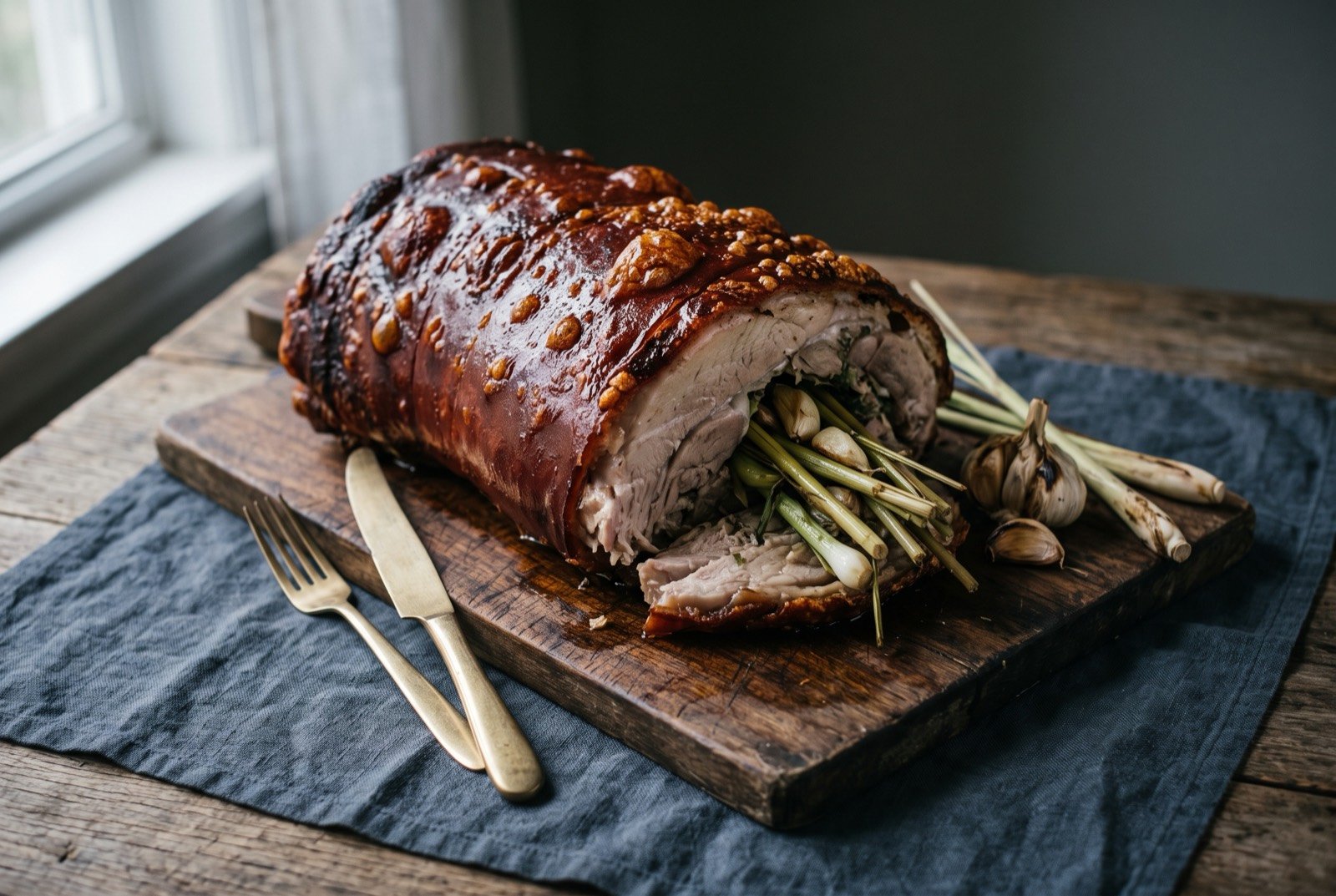
An illustration of the dish, not a photograph of it cooked.
- Time
- Not statedNo source states a time and the atlas has too few comparable dishes to estimate one.
- Reviewed
- Not yet reviewed from inside the tradition
- Cooked
- Not yet cooked and reported
Cebu's contact with Spain in 1565 was garrison and trade contact only, a single settlement absorbing Spanish whole-animal roasting technique without the three subsequent centuries of viceregal and friar-convent cuisine that layered onto Manila. That is the structural reason Cebu lechon is eaten unsauced, its seasoning built entirely into the cavity and the meat, while Manila and Luzon lechon leans on a separate liver sauce.
As tradition built it
A whole pig. Roughly an hour of roasting for every 5 kg of live weight, up to eight hours for a large animal.
Ingredients
- as available a whole pig
- as available lemongrass
- as available bay leaves
- as available spring onions
- as available star anise
- as available whole garlic
- to taste salt
- to serve liver sauce, to serve (Manila and Luzon style only)
Method
- Stuff the pig's cavity with a generous bundle of lemongrass, bay leaves, spring onions, star anise, whole garlic and salt, tied so the bundle holds through hours of roasting.
- Skewer the pig on a bamboo spit and roast it over live charcoal, turned continuously by hand, traditionally in relays of two or three cooks, for anywhere from a few hours to eight depending on the animal's size, roughly an hour of roasting for every 5 kg of live weight as a general guide.
- Cebu lechon is eaten unsauced, its skin crackling and its meat already aromatic from the inside out.
- Manila and Luzon lechon, by contrast, is minimally stuffed and relies almost entirely on a thick, sweet-tangy liver sauce served alongside, because the meat itself carries far less seasoning.
What a modern chef changes
The whole pig's stuffing logic built into a rolled belly
Rung 3
Method
- A whole pig is beyond any home kitchen's kit, so build the same stuffing logic into a pork belly roll instead.
- Butterfly a piece of pork belly, score the skin, and lay the same aromatic bundle, lemongrass, garlic, spring onion, star anise, bay, along its length before rolling and tying it tight.
- Vacuum and cook sous vide at 68°C for 10 hours, long enough for the fat to render fully and the meat to fall apart while the roll holds its shape inside the bag.
- Chill the roll, unwrap it, and dry the skin completely, a period uncovered in the fridge followed by a dehydrator pass, exactly Rung 3's principle, since a rolled joint has none of a whole carcass's hours of open-fire evaporation to do that work for you.
- Finish on the Big Green Egg run hot, skin close to the coals, until it blisters and cracks properly, then rest briefly before slicing into rounds that show the aromatic bundle spiralled through the meat.
- A crumble of dehydrated, flash-fried offcut skin scattered over the top gives back the crackling texture a rolled joint's smaller skin surface cannot provide on its own.
- Serve unsauced, in the Cebu style, letting the interior aromatics do the work the liver sauce does in Manila.