Asia · Volume 47
Bali
The Odalan Calendar, the Base Genep and the Island That Kept Its Pig
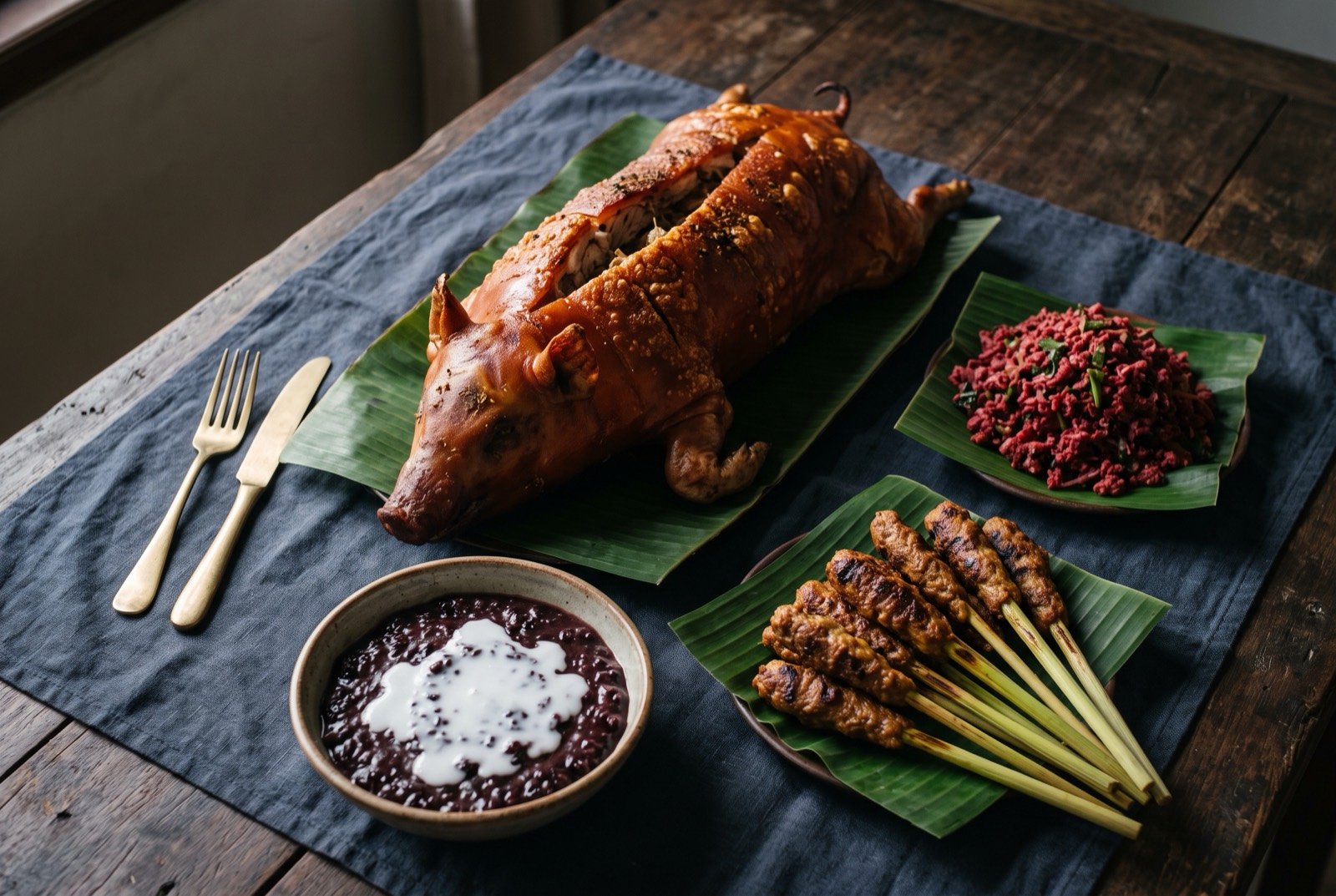
The one substantial Hindu-majority population left in an overwhelmingly Muslim archipelago, its whole feast calendar run by temple liturgy rather than harvest, and the island that kept its pig. Every dish as tradition built it, then what a modern chef would change.
Sources and review · What this chapter does not assert · How we research · Spotted something wrong?
A Sense of Place
Fly into Denpasar and the ecology reads as pure Java: wet-rice terraces climbing the flank of a volcano, coconut palms along a black-sand or white-sand shore, chilli and shallot and galangal in every market stall. Bali's staple starch is rice, grown on the same subak-managed, temple-governed irrigation system that has fed the island for a thousand years or more. Its fat is coconut oil. Its aromatic base is a spice paste built from shallot, garlic, ginger, galangal, turmeric, candlenut and chilli, the same family of ingredients that seasons a Javanese gulai one island to the west. On paper, Bali is a rice-and-coconut cuisine indistinguishable from most of the archipelago around it.
It is not one in practice, and the reason is not ecological. Bali is the one substantial Hindu-majority population left in an overwhelmingly Muslim archipelago, the result of the old Hindu-Buddhist Majapahit courts of Java retreating east to Bali as Islam spread across Java from the fifteenth century onward, and that religious fact reorganises the island's whole food calendar around a liturgical clock rather than a harvest one. A Balinese temple holds its odalan, its founding-anniversary festival, on one of two calendars: the Pawukon, a 210-day cycle built from the intersection of a seven-day week and a thirty-wuku rotation, or the Sasih, keyed to the lunar-solar Saka year, which runs a roughly 354 to 355-day cycle. A temple on the Pawukon system can hold two full odalan feasts inside a single solar year while the rice harvest outside its walls runs its course only once. Galungan and Kuningan, the paired festivals marking dharma's victory over adharma, run specifically on Pawukon: Galungan falls every Wednesday of wuku Dungulan, Kuningan ten days later on the Saturday of wuku Kuningan, and the Lontar Purana Bali Dwipa dates the very first Galungan to 882 CE. That is the actual mechanism behind this chapter's spine. Somewhere else in this atlas, a chapter's rhythm is set by when the rains come or when the fish run. Here, it is set by a calendar that has nothing to do with the weather at all.
The clearest single expression of that difference is on the plate rather than in the almanac. Pork is largely absent from Indonesia's everyday table, because Indonesia is overwhelmingly Muslim and pork is not halal; it survives at any scale chiefly in the handful of non-Muslim-majority provinces, Hindu Bali foremost among them. Babi guling, whole spit-roasted pig, is documented in the Lontar Sundarigama as a required ritual material for temple ceremony, and the Bali provincial government's own cultural encyclopaedia maps its use across all five branches of Balinese Hindu ritual obligation, birth, worship, exorcism, death and priestly ordination alike. A dish that is, within Bali, ordinary temple and family food functions simultaneously, seen from outside the island, as the clearest possible marker of Bali's religious difference from the archipelago around it. This chapter's whole argument sits inside that one fact: the same rice, the same coconut, the same spice grammar as Java, reorganised entirely by which god is being fed and on what day.
A table of zones, logic and dishes
| Zone | Defining logic | Carried by |
|---|---|---|
| The rice highlands (Kintamani, the Batur caldera, the subak-terraced interior) | Volcanic soil and a temple-governed irrigation cooperative (subak) older than any single dynasty; upland cool-climate produce; pig-keeping as the ordinary highland protein economy | Babi guling's raw material, urutan sausage, everyday lawar and jukut ares |
| The temple and court belt (Ubud, Gianyar, Klungkung) | The old Majapahit-descended courts and their priestly households; the deepest concentration of odalan, tooth-filing and cremation ceremony; Bali's contemporary fine-dining scene has grown up almost entirely in this belt | Sate lilit (traced to Klungkung), megibung (Karangasem's royal court practice), the modernist restaurants of Ubud |
| The south and the tourist coast (Denpasar, Seminyak, Kuta) | Bali's largest traditional market and its densest population; the everyday, commercial and warung register where ceremonial dishes migrate into daily and tourist trade | Nasi jinggo (born at Denpasar's Benoa harbour), Pasar Badung's dual role as both a daily food market and a ceremonial-offering market, the babi guling warung trade |
| The east (Karangasem) | A historic royal seat with its own dynastic food practice, and the region most strongly named across the sourcing for Bali's most distinctive communal and cured-meat traditions | Megibung (credited to Karangasem's own eighteenth-century king), urutan, several hyper-local lawar variants |
| The coast and the reef (Sanur, Jimbaran, the seaweed-farming shore) | A genuinely ecological, non-ceremonial exception inside a chapter mostly organised by ritual: fishing and seaweed cultivation set this register's rhythm, not the temple calendar | Rujak bulung, pindang broth, grilled reef fish |
The History in Layers
Bali's Hindu-Buddhist court culture is not indigenous to the island in the simple sense; it arrived, and it arrived specifically as a refuge. The Hindu-Javanese Majapahit empire, based on Java, extended its rule over Bali from the fourteenth century, and as Islam spread progressively across Java from the fifteenth century onward, members of the Majapahit court, its priesthood and its aristocracy retreated east to Bali rather than convert, carrying court ritual, temple architecture and priestly Sanskrit learning with them. This is the standard historical account of why Bali, alone among the larger islands of the archipelago, kept a Hindu-majority population and a Hindu-organised ritual calendar into the present, and it is the deep-time reason this chapter's spine is religion rather than ecology.
Underneath that Majapahit-descended layer sits an older, pre-Hindu one, and at least one strand of this chapter's own dishes claims direct descent from it, though the claim does not survive close checking. A widely repeated story traces lawar, the minced meat, vegetable and (in its red form) blood dish central to nearly every Balinese ceremony, to the pre-Hindu tantric Bhairawa sect, credited with spreading the dish as a ritual offering, its presentation said to have grown more frequent after the later establishment of Siwa Sidhanta philosophy. It is a genuinely attractive story, connecting a still-living dish to Bali's oldest religious stratum. It is also, on the sourcing available to this chapter, unverifiable: one general-audience Indonesian outlet gives no date at all beyond naming the sect; a second gives "the twelfth to thirteenth century, the Singosari era," citing the Kebo Edan temple's large Bhairawa statue as circumstantial evidence with no textual or archaeological link to the dish itself; a third gives a specific date, 1284 CE, with no citation whatsoever. The three do not agree with each other, and none rests on a primary or academic source. This chapter treats the Bhairawa origin of lawar as a widely circulated popular claim, not as settled history, and says so plainly rather than borrowing its glamour.
The colonial layer is Dutch, arrived late relative to the rest of the archipelago, and arrived with real violence at its centre. The Dutch East Indies extended formal control over Bali only in the early twentieth century, after a long period in which the island's own royal courts had kept substantially more independence than Java's. The conquest is remembered on the island chiefly through the puputan, the ritual mass suicide of Balinese royal courts, most famously at Denpasar in 1906 and at Klungkung in 1908, rather than through surrender, a memory that still shapes how Bali narrates its own relationship to colonial rule. Dutch administration afterward left comparatively little direct culinary imprint next to what French rule left in Indochina or British rule left in India; Bali's food grammar, unlike Java's rijsttafel-adjacent colonial table, remained substantially organised around its own temple and court calendar throughout.
The most recent layer is tourism, and this chapter's own sources are explicit that it sits on top of the ritual calendar rather than replacing it. Babi guling's own provincial cultural encyclopaedia entry and independent Bali press both frame the dish's warung and hotel visibility as a modern layer over an older ritual role, not the reverse: babi guling's documented history runs back hundreds of years inside customary ceremony, before its recognition as Indonesian Intangible Cultural Heritage in 2011. Sate lilit's own official heritage account gives the same sequence explicitly, ceremonial offering to temple prasadam to household food to commercial warung and hotel food, a single, sourced, four-step migration this chapter returns to for more than one dish below. Nasi jinggo, by contrast, was never ceremonial at all: it was invented, by a named woman, as working food for a night-shift dock economy, and its ordinary, secular origin is worth stating as clearly as babi guling's ritual one, so that this chapter does not accidentally imply every Balinese dish descends from a temple.
A living reef, not a museum: the youngest layer runs backward into strict law rather than forward into innovation. Turtle meat, historically eaten and still occasionally used across Balinese ceremonial cooking, is now flatly illegal in Indonesia, punishable by up to five years' imprisonment and a substantial fine, and Indonesian environmental journalism reports ongoing, large-scale smuggling into Bali specifically for consumption, in volumes activists say exceed any plausible ceremonial demand. Even a folk-culture documentation wiki now carries its own caveat discouraging turtle lawar "except for genuine ceremonial necessity." This chapter names turtle's historical place honestly, in the dish notes below, and treats its modern illegality with the same honesty: not a footnote, but a live constraint shaping what a Balinese kitchen, ceremonial or otherwise, can now put on the table.
The Flavour Arsenal
The paste and the slice: Bali runs two spice registers, not one
Most outside accounts of Balinese cooking describe a single spice paste, base genep, ground fresh each morning on a stone mortar. The sourcing behind this chapter complicates that picture in a genuinely useful way: Bali runs at least four named seasoning preparations, distinguished by processing method as much as by ingredient list, and Bali Post's own account gives the clearest four-part taxonomy found in this research.
| Preparation | Composition | Processing | Used in |
|---|---|---|---|
| Base genep ("complete spice"), also basa gede | Roughly fifteen named aromatics; a core four ("guru") of isen (galangal), kunir (turmeric), jae (ginger), cekuh (kencur), plus shallot, garlic, chilli, coriander seed, candlenut, black pepper, lemongrass, terasi and salt | Ground to a paste on a stone cobek; Balinese elders traditionally measure ingredients by hand and finger rather than by scale, and more than one source states plainly that no single canonical ratio exists | Bebek/ayam betutu, sate lilit |
| Base rajang | Largely the same ingredients as base genep: turmeric, ginger, galangal, lemongrass, shallot, garlic, candlenut | Finely sliced by knife, not pounded, at least in the account that draws the sharpest line between the two preparations; a second account instead allows base rajang to be "chopped or ground" | Lawar, ayam betutu, ikan nyat-nyat |
| Base wangen | Jangu, kemenyan (frankincense), cabai puyang, mesui, bangle, plus kecombrang, temu tis, temu kunci, mesoyi, sesame oil, sepet-sepet, coconut oil | Finely sliced | A more resinous, incense-adjacent register, closer to ceremonial and medicinal use than to everyday cooking |
| Base suna cekuh | Garlic, small galangal, shallot, bay leaf, turmeric, coconut oil | Ground, then sautéed | An everyday finishing paste rather than a base seasoning |
Two Indonesian-language sources genuinely disagree on where the ground-versus-sliced line actually falls, and this chapter reports that disagreement rather than resolving it by picking a side. What both agree on, and what is worth carrying forward as the real finding: Balinese cooks are reported to prefer slicing over grinding for a meaningful proportion of everyday cooking, for flavour reasons rather than convenience, since sliced aromatics are said to release their aroma progressively through cooking, where a ground paste's oils evaporate faster. Balinese cooking never had ready access to a blender until recently; hand-slicing is not a poor substitute for a machine that did not exist, it is an older, parallel technique that happens to still taste better in some dishes.
Kelapa metunu: roasted grated coconut, not raw
Lawar's coconut component is specifically kelapa metunu, grated coconut that has been roasted before it is folded through the dish, not simple raw grated coconut. This is a small technical point with a large flavour consequence, the difference between a raw coconut's clean sweetness and a roasted one's nuttier, more savoury depth, and it recurs across several of this chapter's dishes below.
The core aromatics, one by one
Kencur (Kaempferia galanga), lesser galangal, is the single hardest of base genep's core four to place, botanically distinct from ordinary galangal despite the similar English name, with a sharp, camphor-citrus, faintly medicinal character no other spice quite replaces. Terasi, Indonesian fermented shrimp paste, is genuinely distinct from its Malaysian cousin belacan and its Thai cousin kapi: terasi and belacan are pressed into a hard block that needs cutting with a knife; Thai kapi is typically softer, moister and paler, the product of a shorter fermentation, and is not a faithful substitute. Daun salam, Indonesian bay leaf, is not a variety of Western bay leaf at all; the two plants are botanically unrelated, and daun salam carries none of Western bay's resinous, camphor-like top note, releasing its own quiet, background flavour only over a long cook. Gula jawa/gula bali, palm sugar, is stickier, darker and more molasses-forward than the paler Thai palm sugar sold alongside it in most UK shops. Base genep's four "guru" ingredients are given, in one source, a directional cosmology tied to Balinese Hindu geography: ginger to the north and Wisnu, kencur to the east and Iswara, galangal to the south and Brahma, turmeric to the west and Mahadewa, a mapping this chapter notes as a genuine, live piece of Balinese food symbolism, while flagging that it does not obviously reconcile with the separate Trimurti colour reading given for babi guling's roasted skin (see below), and that neither has been traced to a primary or lontar source in this chapter's research.
The Technique Ladder
Six rungs, each doing real, explicable work.
Rung 1. Choose paste or slice by what the dish needs from the spice, not by habit
Grinding on a stone cobek ruptures the spice's own cell walls under direct pressure, releasing its aromatic oils immediately and fully into the paste; slicing instead exposes a smaller, controlled surface area that releases its aroma progressively as the dish cooks, rather than all at once. Reach for base genep, the fully ground paste, where a dish needs an even, deeply worked-through seasoning, as in betutu's long, sealed cook; reach for base rajang, the sliced version, where the dish is quicker and the aromatics need to stay bright and distinct through to the finish, as in lawar. This is not tradition eroding into convenience, since Balinese cooks are consistently reported to prefer slicing on flavour grounds specifically, not through lack of access to a blender.
Rung 2. Roast the coconut before it goes anywhere near the dish
Raw grated coconut is clean and sweet; roasted grated coconut, kelapa metunu, carries a genuine Maillard-driven depth no raw coconut can reach, nutty and faintly caramelised rather than simply fresh. Roast desiccated or fresh grated coconut in a dry pan over medium heat, stirring constantly, until it turns an even pale gold, four to six minutes; do not walk away, since coconut's high fat content carries it from pale gold to burnt in under a minute once it starts to colour. This single step is the difference between a lawar that tastes merely fresh and one that tastes properly cooked.
Rung 3. Dry the skin before it ever meets heat
Babi guling's crackling depends on the skin being genuinely dry before it meets oil or fire; residual surface moisture steams the skin instead of letting it reach true crackling temperature, and a shortcut that skips the drying step and relies instead on a sugary glaze, tomato sauce, even Coca-Cola, documented as real, if dispiriting, warung practice, is chasing colour and shine rather than actual crisp. Pat the skin fully dry, then rest it uncovered in the refrigerator for at least two hours, ideally overnight, before oiling; finish with thin, repeated coats of oil rather than one thick coat.
Rung 4. Cook betutu long, low and sealed, and understand what the wrap is doing
Bebek or ayam betutu, duck or chicken worked through with base genep and wrapped for a long, slow cook, traditionally in banana leaf, or in upi, dried palm-tree skin, named directly by one working Bali-based chef as the more authentic wrapping material, works by trapping steam inside a sealed, humid parcel while heat works slowly through from outside, breaking down connective tissue into gelatin over hours rather than minutes. The same chef, working a controlled version of the dish, steamed his duck three hours at 72°C before a six-hour marinade, a genuinely useful, precise figure for a reader wanting to reproduce the same long, low, moisture-retaining logic with a thermometer rather than an open fire.
Rung 5. Grip the skewer mechanically, not just by pressing
Sate lilit's mince is moulded onto its skewer, traditionally a thick lemongrass stalk, by winding it in the direction opposite to the way the skewer itself has been twisted, so meat and coconut fibres spiral-grip the stick under their own tension rather than simply adhering to its surface. This is a mechanical bind, not an adhesive one, and it is the reason a properly made sate lilit holds its shape through vigorous grilling and turning where a merely pressed-on version slides loose.
Rung 6. Where a dish carries raw blood, pasteurise a portion of it deliberately
Lawar barak's raw blood carries a real, measured, contemporary food-safety risk: a 2017 microbiological study of lawar vendors in Gianyar's tourist zone found 72.7% of samples tested positive for E. coli, correlated significantly with handler hygiene and sanitation. Even Indonesian popular food writing on lawar plek recommends partially cooking the meat-and-blood mixture first specifically to reduce this risk. A controlled, low-temperature hold, meat and blood held at a measured pasteurising temperature for long enough to reduce pathogen load while the mixture is still visibly raw and unset, is a genuine, scientifically grounded elevation of an existing, sourced food-safety practice, not an invented flourish; this chapter's own lawar recipe below uses exactly that logic.
The Ferment and Preserve Bench
Balinese cooking is, relative to several of its neighbours, not a heavily fermented cuisine, and this chapter says so directly rather than manufacturing a fermentation tradition that is not there. What Bali does have sits mostly in curing and controlled drying rather than true fermentation.
Urutan, in its sun-dried form, is the clearest case in this whole chapter: a genuine, if brief, fermentation and drying step, a full day's sun exposure before frying, that measurably changes the sausage's texture and depth against its own immediate-fry counterpart. Terasi, the shrimp paste running through nearly every recipe in this chapter, is itself a long-fermented product, though a household one rather than something a home cook is expected to make: buy it, do not attempt it, and buy the correct hard-block Indonesian or Malaysian version rather than a softer, shorter-fermented Thai one (see Sourcing). Pindang, the spiced fish stock behind rujak bulung, sits closer to a preserving technique than a ferment proper, a way of extending a coastal catch's usefulness through spicing and heat rather than through microbial transformation. A reader arriving from this atlas's African or Ethiopian volumes, where fermentation runs the whole kitchen, should not expect the same here; Bali's preserving instinct runs through curing, drying and spicing far more than through the injera-and-teff or dawadawa logic found elsewhere in this book.
Sourcing in Britain
Verified September 2026. Where a supplier could not be fully confirmed, that is said rather than smoothed over.
The ranked list: what decides great from grim
- Toko Indonesia, and specifically for kencur. This is the single most consequential retailer named in this whole chapter. Kencur, the hardest of base genep's core four aromatics to place in Britain, is confirmed live and currently stocked, fresh, at Toko Indonesia (tokoindonesia.co.uk), a dedicated UK Indonesian grocer, alongside genuinely Indonesian-branded terasi, daun salam, lengkuas and black glutinous rice. No good substitute exists for kencur; dishes leaning on it will taste genuinely incomplete without it, so this is worth treating as a first stop rather than a last resort.
- The fresh-blood question, faced directly rather than glossed over. Fresh liquid pig's blood cannot legally be sold to a UK home cook. Regulation (EC) No 853/2004, retained in UK law, restricts blood collection for food to approved slaughterhouses under veterinary supervision with full carcass traceability; even the Fruit Pig Company, the UK's one specialist fresh-blood producer, states directly on its own site that it can collect and use fresh blood only for its own black pudding, and cannot gift or sell it raw. A reader wanting to make lawar barak with genuinely fresh blood at home, in Britain, cannot. Pig's blood curd from a Chinese supermarket, a set, cooked product, is the realistic substitute, and this chapter's own modernist lawar recipe above is built to work honestly with that constraint rather than around it.
- Real terasi, not a Vietnamese or Thai substitute wearing the name. Terasi, belacan and kapi are not interchangeable, whatever a shared shelf label might imply; even a specialist UK retailer, Sous Chef, sells a product labelled "Vietnamese shrimp paste, also known as terasi," a conflation worth naming rather than repeating. Toko Indonesia's own Indonesian-brand terasi sachets are the correct product.
- Daun salam, and the substitution trap specifically. Daun salam is not a variety of bay leaf; the two plants are unrelated, and Western bay's resinous top note actively works against this chapter's dishes rather than standing in for the quieter flavour daun salam actually brings. If genuinely unobtainable, omit rather than substitute Western bay.
- Coconut shell charcoal for sate lilit. A real, meaningfully different fuel from ordinary charcoal, burning two to three times longer and hotter with none of ordinary charcoal's resinous smoke; ProQ sources its own coconut shell briquettes directly from Indonesia, a fitting, not incidental, choice for this chapter's own grilling.
Named shops and delis
Toko Indonesia (tokoindonesia.co.uk) is the standout of this whole chapter's sourcing: a dedicated, currently-trading UK Indonesian grocer with a genuinely deep Indonesia-specific range, kencur, lengkuas fresh and frozen, daun salam, real terasi, black glutinous rice and more, every product page checked in this research live and purchasable. Whether it has a physical premises, as opposed to being online-only, could not be established. Wai Yee Hong, Bristol, trading over 40 years, is the one secondary-city shop that names Indonesian stock explicitly on its own site, alongside Chinese, Thai, Malaysian, Korean, Filipino and Japanese goods, and ships nationwide online. New Loon Moon Supermarket, Gerrard Street, Soho, is confirmed via the official Chinatown London directory to stock Indonesian goods among its 4,000-plus South East Asian items. Wing Yip, the UK's largest Oriental grocer (Cricklewood, Croydon, Birmingham, Manchester, plus online), is a strong, reliable source for the aromatics this chapter shares with the rest of South East Asia, galangal, turmeric, kaffir lime, lemongrass, coconut products, though Indonesia is not named specifically in its own marketing, so treat it as confirmed for shared items rather than Indonesia-specific ones. Sous Chef stocks correctly labelled Indonesian palm sugar, gula jawa, though its shrimp paste is mislabelled as noted above.
Halal-only shops, and why that matters specifically for this chapter
A genuinely overlooked practical point: many UK South East Asian grocers, especially those serving Malaysia, Singapore and Indonesia's own Muslim-majority communities, are halal-certified or halal-only by default and simply do not stock pork, pork products or fresh blood at all, including Toko Indonesia itself, an Indonesian shop rather than a Balinese-Hindu-specific one. A reader assuming any general South East Asian grocer will sell them a joint for babi guling or a casing for urutan will hit a wall. The Chinese-run supermarkets that do stock pork for their own Cantonese and Vietnamese trade, Wing Yip, See Woo, Loon Fung, Wai Yee Hong, are the correct destination for this chapter's pork specifically.
Whole suckling pig and duck
Suckling pig for babi guling is genuinely well served in the UK, driven mostly by spit-roast catering and Spanish-style demand rather than by Balinese demand specifically: Bromfields Butchers, Pugh's Piglets (over 50 years supplying restaurants) and Huntsham Heritage Meats (Middle White breed) are all confirmed live suppliers, a typical 8 to 10kg pig serving 12 to 14 people. Duck needs no special sourcing angle: Gressingham is the best-known supermarket-accessible quality brand, and specialist suppliers including The Dorset Meat Company and JF Edwards confirmed current stock.
Rice, and an honest admission of what the UK cannot give this chapter
Black glutinous rice for bubuh injin is confirmed correctly at Toko Indonesia, and it is worth being precise on the reader's behalf: bubuh injin needs the sticky, glutinous black rice, not the separate non-glutinous "forbidden rice" most UK health-food shops stock, which will not give the right texture. Named Indonesian heritage rice cultivars, Rojolele, Pandan Wangi, are real and documented, but no UK retailer was found selling either by name; what is sold under Indonesian branding in the UK is, in practice, good Thai jasmine rice. State this honestly to the reader rather than implying a more authentic grain is quietly available.
Honest gaps
No dedicated Indonesian grocer was found in Manchester, Birmingham or Edinburgh, despite direct, repeated searches; Wing Yip's physical superstores are the practical fallback in Manchester and Birmingham, and Edinburgh has no confirmed Indonesian-specific stock at all. Gula bali, true lontar-palm sugar as distinct from the widely available coconut-palm gula jawa, was not found as a separately labelled UK product, and may not exist as a distinct retail item here; gula jawa is the honest substitute, and is in any case what most bulk palm sugar sold in Bali itself actually is. Whether any UK-available black glutinous rice or lengkuas is genuinely Balinese-grown, as opposed to generically Indonesian, could not be established; no retailer named a growing region below country level.
Voices and Sources
From inside the tradition
- Eelke Plasmeijer and Ray Adriansyah, Locavore, Locavore NXT and Nusantara by Locavore, Ubud, whose commitment to sourcing over 95% local ingredients and staging techniques such as roasting spice paste in coconut husks makes their kitchens this chapter's clearest example of Balinese and Indonesian technique built from the inside outward, not French method applied to local produce.
- Chef Mandif Warokka, BLANCO par Mandif and Teatro Gastroteque, Ubud, whose directly quoted account of upi wrapping for bebek betutu, and whose own steamed, 72°C, three-hour betutu technique, is the single strongest, most specific named technique this chapter's research reached.
- Chris Salans, Mozaic, Ubud, whose French-trained, Balinese-ingredient cooking this chapter names deliberately as a contrast case, French method applied to local produce, rather than a model, against Locavore's stated aim of working outward from Indonesian technique itself.
- William Wongso, widely regarded as Indonesia's leading culinary authority, whose direct, verified collaboration with the Culinary Institute of America's ProChef programme and a named Balinese chef-priest confirms his standing on base genep specifically, though this chapter could not reach his own recipe or ratios directly.
- Nararya Narottama, tourism lecturer at Universitas Udayana, whose essay in The Conversation Indonesia on Balinese women's daily labour, ritual-offering preparation folded into the same morning routine as domestic cooking, is this chapter's clearest single academic account of gendered daily kitchen practice.
- Kulture Kween, an Indonesian food writer resident in London, whose direct, sharp critique of Bali Bali, the UK's most prominent "Balinese" restaurant, as not being authentically Indonesian food at all, is the single most valuable in-tradition diaspora voice this chapter's research reached.
- Rahel Stephanie, Spoons, London, a Jakarta-born chef whose plant-based Indonesian supper club, while not Balinese specifically, is the closest genuine substitute this chapter found for a standalone Balinese restaurant in Britain, and whose own words on authenticity, "what's more important is to give back and recognise where the dish comes from," this chapter takes at face value.
- Janet DeNeefe, Ubud resident since 1984, founder of Casa Luna and Indus and the Ubud Writers and Readers Festival, author of Fragrant Rice and Bali: The Food of My Island Home, whose standing as a genuine, long-resident authority is confirmed, though this chapter could not reach specific content from either book in the time available.
- Parisada Hindu Dharma Indonesia (PHDI), the national Hindu council, whose own direct explanation of prasadam, lungsuran, paridan and carikan, quoted via RRI's Singaraja desk, is this chapter's clearest single theological source on what ceremonial food actually means once it leaves the temple.
The gap, named rather than papered over
Genuinely Balinese-language sourcing, as opposed to Indonesian-language sourcing, largely failed in this chapter's research, despite real and repeated attempts. Direct fetch attempts against `dictionary.basabali.org`, a genuine Balinese-language cultural dictionary project, returned HTTP 403 on every single attempt across two separate research passes. One success was reached, a single entry at a second Balinese-language dictionary project, `basaibubali.org`, for the word "lawar," which is where this chapter's claim about lawar's everyday, non-ceremonial usage comes from. Beyond that one entry, the entire source base behind this chapter is Indonesian-language, not Balinese-language, because Balinese is overwhelmingly a spoken rather than a written-online language for food culture specifically. A reader wanting to go further than this chapter did would need to work with a Balinese-language speaker directly, not a search engine.
Things this chapter has deliberately not asserted
- That lawar's origin lies with the pre-Hindu Bhairawa sect, as settled history. Three sources repeat some version of this claim, and they give three different, mutually inconsistent dates, one entirely undated, one placing it in the twelfth to thirteenth century on circumstantial architectural evidence with no textual link to the dish, one giving a specific but entirely uncited date of 1284 CE. This chapter treats it as a widely circulated popular claim, not as fact.
- That base genep is two thousand years old, or that it dates specifically to the era of the subak rice-irrigation system. This claim appears, uncited, in two otherwise different sources, and neither offers primary evidence.
- That the four "guru" ingredients of base genep represent the mountain and salt and terasi represent the sea, a gunung-segara symbolic reading consistent with known Balinese ritual geography but reached only via a search-engine summary of a paywalled article this chapter's research could not read in full.
- That babi guling's roasted skin colouring follows a settled Trimurti reading (white for Siwa, red for Brahma, black for Wisnu). This is repeated consistently across regional press but could not be traced to a primary or academic source, and does not obviously reconcile with the separate, differently structured directional cosmology given for base genep's own four core spices.
- That any specific traditional ratio exists for base genep, or for lawar's blood-to-coconut-to-meat proportions. No source anywhere gave one; more than one source states plainly that none exists in the tradition itself, measurement being done by hand rather than by scale. This chapter's own recipes are workable starting points, not reconstructions of a canonical formula.
- That daily household grinding of base genep has genuinely declined with modern convenience. A general, national Indonesian trend toward instant seasoning is real and sourced, but no Bali-specific evidence was found either confirming or denying a decline in Bali specifically, and the finding that Balinese cooks specifically prefer hand-slicing over blending for flavour reasons, not convenience, complicates any simple decline narrative.
- That turtle meat was ever historically used specifically in sate lilit, as opposed to Balinese ceremonial protein more generally. The one detailed sate lilit history source names only pork and seafood as original proteins; turtle's documented historical and continuing, illegal, place in Balinese cooking is real, but its specific connection to this one dish is not established.
- That jukut ares and komoh are genuinely, commonly eaten as ordinary household food, as opposed to primarily ceremonial dishes that popular sources loosely describe as "also everyday" without concrete evidence of routine domestic consumption.
- That any restaurant on the island of Bali currently elevates lawar specifically at a fine-dining register. This chapter's own research found no such example, across multiple search angles, in either English or Indonesian, and states this as a real gap in the record rather than inventing one to fill it.
- That Chef Mandif Warokka's bebek betutu technique involves a 48-hour sous vide process or a beetroot foam. This specific claim circulates online but is directly contradicted by the two primary interviews this chapter's research could access, both of which describe a three-hour steam at 72°C, not sous vide, for a related but distinct preparation. This chapter uses only the verified figure.
- That any UK-available black glutinous rice, lengkuas or terasi is grown or made specifically in Bali, as opposed to generically in Indonesia or elsewhere. No retailer named a growing region below country level for any of these ingredients.
Choose paste or slice by what the dish needs from the spice, not by habit
Grinding on a stone cobek ruptures the spice's own cell walls under direct pressure, releasing its aromatic oils immediately and fully into the paste; slicing...
Roast the coconut before it goes anywhere near the dish
Raw grated coconut is clean and sweet; roasted grated coconut, kelapa metunu, carries a genuine Maillard-driven depth no raw coconut can reach, nutty and...
Dry the skin before it ever meets heat
Babi guling's crackling depends on the skin being genuinely dry before it meets oil or fire; residual surface moisture steams the skin instead of letting it...
Cook betutu long, low and sealed, and understand what the wrap is doing
Bebek or ayam betutu, duck or chicken worked through with base genep and wrapped for a long, slow cook, traditionally in banana leaf, or in upi, dried...
Grip the skewer mechanically, not just by pressing
Sate lilit's mince is moulded onto its skewer, traditionally a thick lemongrass stalk, by winding it in the direction opposite to the way the skewer itself has...
Where a dish carries raw blood, pasteurise a portion of it deliberately
Lawar barak's raw blood carries a real, measured, contemporary food-safety risk: a 2017 microbiological study of lawar vendors in Gianyar's tourist zone found...
The dishes
- Babi guling Bali-wide, across all five branches of Panca Yadnya ritual
- Lawar barak Bali-wide, most associated with Galungan, odalan and ngaben
- Sate lilit Klungkung
- Bebek betutu Bali-wide
- Jukut ares The rice highlands, Kintamani and the Batur caldera
- Nasi jinggo Denpasar, Benoa harbour
- Urutan The rice highlands and Karangasem
- Rujak bulung Denpasar, Sanur and Gianyar's coastal edge
- Bubuh injin Bali-wide
Sources and review
- Researched
- No outside sources linked
- Reviewed
- Not yet reviewed from inside the tradition
- Cooked
- Not yet cooked and reported
Where this volume comes from
3 research briefs on file for this volume, researched to the rules on How we research. Published 3 September 2026. Last changed 8 September 2026.
The brief's own account of its sources
Local and in-tradition sources, the large majority of what this brief rests on. Across the two passes' roughly 90 combined web searches and page-fetch attempts, the strongest tier is Balinese and Indonesian institutional and official sourcing: the Bali provincial government's own cultural encyclopaedia (Ceraken Kebudayaan Bali), directly fetched and cited for babi guling's Panca Yadnya role and sate lilit's official pedigree; the national Hindu council (PHDI Parisada), quoted directly via RRI on the prasadam/lungsuran/paridan/carikan distinctions and on caru; Indonesian national and