Maritime Southeast Asia · Volume 47, The Odalan Calendar, the Base Genep and the Island That Kept Its Pig
Babi guling
Bali-wide, across all five branches of Panca Yadnya ritual
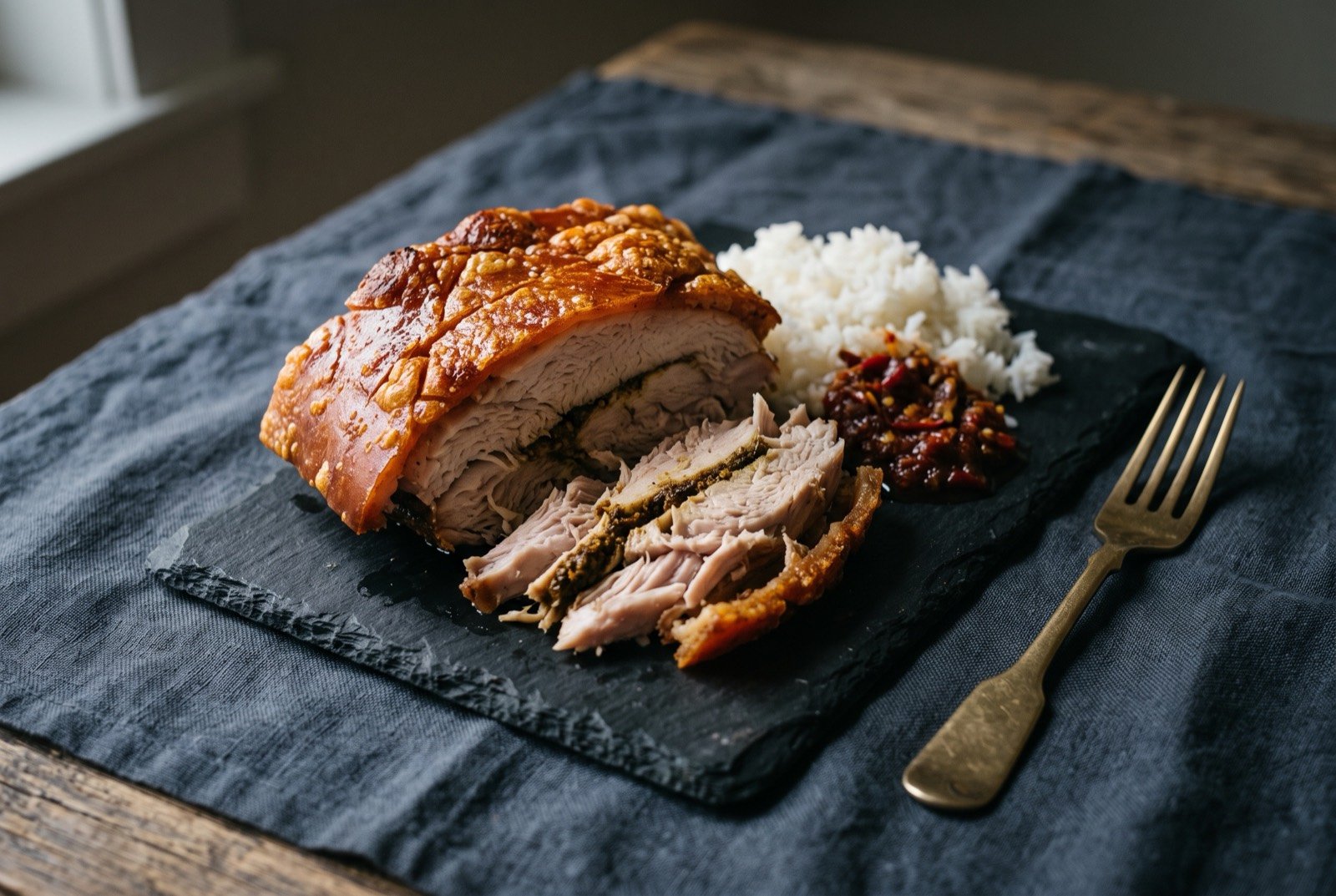
An illustration of the dish, not a photograph of it cooked.
- Time
- Hands on 4 hours · Waiting 8 hours
- Researched
- No outside sources linked
- Reviewed
- Not yet reviewed from inside the tradition
- Cooked
- Not yet cooked and reported
Whole spit-roasted pig, its cavity packed with spice paste, appears in Balinese Hindu ritual across all five branches of Panca Yadnya: worship of the divine, human life-cycle rites, appeasement of chthonic forces, ancestor veneration through ngaben and its related rites, and priestly ordination. Its history in customary ceremony runs back hundreds of years, well before its 2011 recognition as Indonesian Intangible Cultural Heritage and long before its current life as a warung specialty. Who traditionally spits, seasons and turns the pig is not recorded in any source this chapter could reach, a real and stated gap; the adjacent, well-sourced pattern for lawar and sate lilit, communal, gendered, male-led preparation, should not be silently extended to babi guling without saying that is exactly what this chapter is declining to do.
As tradition built it
Serves 12 to 14, from a whole suckling pig. About 4 hours active work, 3 hours roasting, plus overnight resting time for the skin.
Ingredients
- 1 whole suckling pig, 8 to 10kg, cleaned and gutted by the butcher
- 800g base genep (see Flavour Arsenal), plus extra for the cavity
- 4 lemongrass stalks, bruised
- 100g fresh turmeric, sliced
- 6 daun salam (Indonesian bay leaf)
- 200ml coconut oil, for basting
- to taste fine sea salt
Method
- Two days before cooking, pat the pig's skin thoroughly dry, inside and out, and season the cavity generously with salt.
- Rest the pig uncovered on a rack in the refrigerator overnight, then again the following night, so the skin dries fully; this is the single step that decides whether the finished skin cracks properly.
- On the day, pack the cavity tightly with base genep, lemongrass, sliced turmeric and daun salam, then truss closed with butcher's string or skewers.
- Spit the pig over a bed of hot coals, or set it on a rack over indirect heat if no spit is available, turning regularly.
- Roast 2.5 to 3 hours, basting the skin with thin, repeated coats of coconut oil throughout, never one thick coat, until the meat is fully cooked and the skin is deep gold and audibly crisp when tapped.
- Rest 20 minutes before carving. Serve with the pan juices, rice and a fresh sambal.
What a modern chef changes
Controlled drying and a two-zone finish, for a joint rather than a whole animal
Rung 3
Method
- Scale to a pork belly joint, skin on, rather than a whole pig, for a kitchen without a spit; score the skin lightly.
- Dry the skin in a dehydrator set to 50°C for 4 to 6 hours, or uncovered in the refrigerator for 24 hours, a controlled, measured version of the traditional overnight open-air dry, removing surface moisture far more evenly than ambient air alone.
- Cook the joint low and indirect on a Big Green Egg, packed with base genep beneath the skin where possible, at 140°C until the internal temperature reaches 88 to 90°C, then finish at full direct heat, or with a blowtorch, for the final crackling stage, a two-zone approach that separates the slow-cooking work from the crackling work the traditional single, continuous spit-roast has to do all at once.