Maritime Southeast Asia · Volume 47, The Odalan Calendar, the Base Genep and the Island That Kept Its Pig
Sate lilit
Klungkung
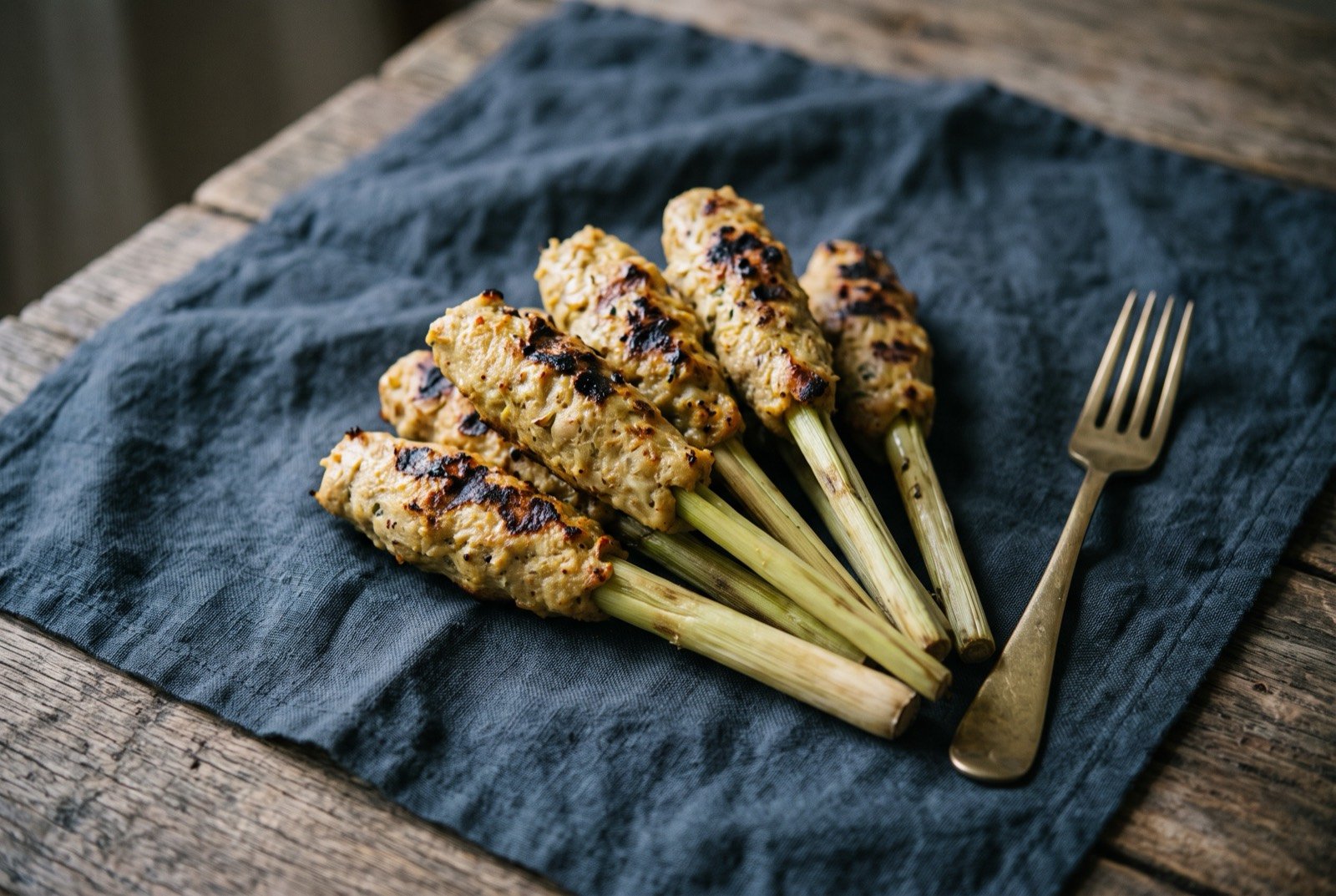
An illustration of the dish, not a photograph of it cooked.
- Time
- Hands on 45 minutes · Waiting 1 hour
- Researched
- No outside sources linked
- Reviewed
- Not yet reviewed from inside the tradition
- Cooked
- Not yet cooked and reported
Sate lilit, also known by its older name sate pusut, appears among thirteen named sate types in the historical text Lontar Dharma Caruban. Its own official heritage account traces a clean, four-step migration: ceremonial preparation around Galungan (the associated household activities are named, specifically, Ngelawar and Nyate), offering at the temple, blessing into prasadam and eating, then household food, then commercial warung and hotel food. Historically, only men were permitted to make it, from mixing the meat through to grilling, and a man's competence at sate lilit was treated as a direct, public measure of his masculinity. Historical proteins were pork and seafood; chicken and beef were added later, for tourist preference. "Lilit" means wrapped or coiled, naming the technique rather than the flavour: the meat is wound onto a thick, flat skewer, traditionally lemongrass, rather than threaded through it in the ordinary sate manner.
As tradition built it
Serves 4, about 12 skewers. 45 minutes, plus 1 hour chilling.
Ingredients
- 500g minced pork, or a firm white fish such as snapper
- 150g fresh grated coconut, roasted (rung 2)
- 100g base genep
- 1 egg
- 12 thick, sturdy lemongrass stalks, bruised at the base
- a little, for basting coconut oil, for basting
Method
- Combine the minced pork or fish, roasted coconut, base genep and egg in a bowl, working the mixture with your hands until it holds together and feels slightly tacky.
- Chill the mixture at least 1 hour, so it firms enough to mould.
- Take a portion of the mixture and press it around a lemongrass stalk, winding it on in the direction opposite to the stalk's own twist (rung 5), so the mixture grips mechanically rather than simply sitting on the surface.
- Grill over coconut husk charcoal, basting lightly with coconut oil, turning repeatedly, roughly 4 to 5 minutes per side, until lightly browned and cooked through.
What a modern chef changes
An emulsified bind and a genuinely different heat source
Rung 5, plus the sourcing note on coconut husk charcoal below
Method
- Blitz the meat, coconut and a little ice or chilled water in a high-power blender, rather than mixing by hand, for a finer, springier, more sausage-like emulsion, the same underlying principle used in European sausage-making.
- Rest the emulsified mixture in the refrigerator at least 1 hour before moulding, since a colder mixture holds its shape far better around the skewer during the initial press.
- Grill specifically over coconut shell charcoal (see Sourcing) rather than ordinary wood charcoal: it burns two to three times longer and hotter, with none of ordinary charcoal's resinous smoke character, closer to the sustained, clean heat a traditional coconut-husk fire gives than a standard UK barbecue briquette.