Maritime Southeast Asia · Volume 47, The Odalan Calendar, the Base Genep and the Island That Kept Its Pig
Lawar barak
Bali-wide, most associated with Galungan, odalan and ngaben
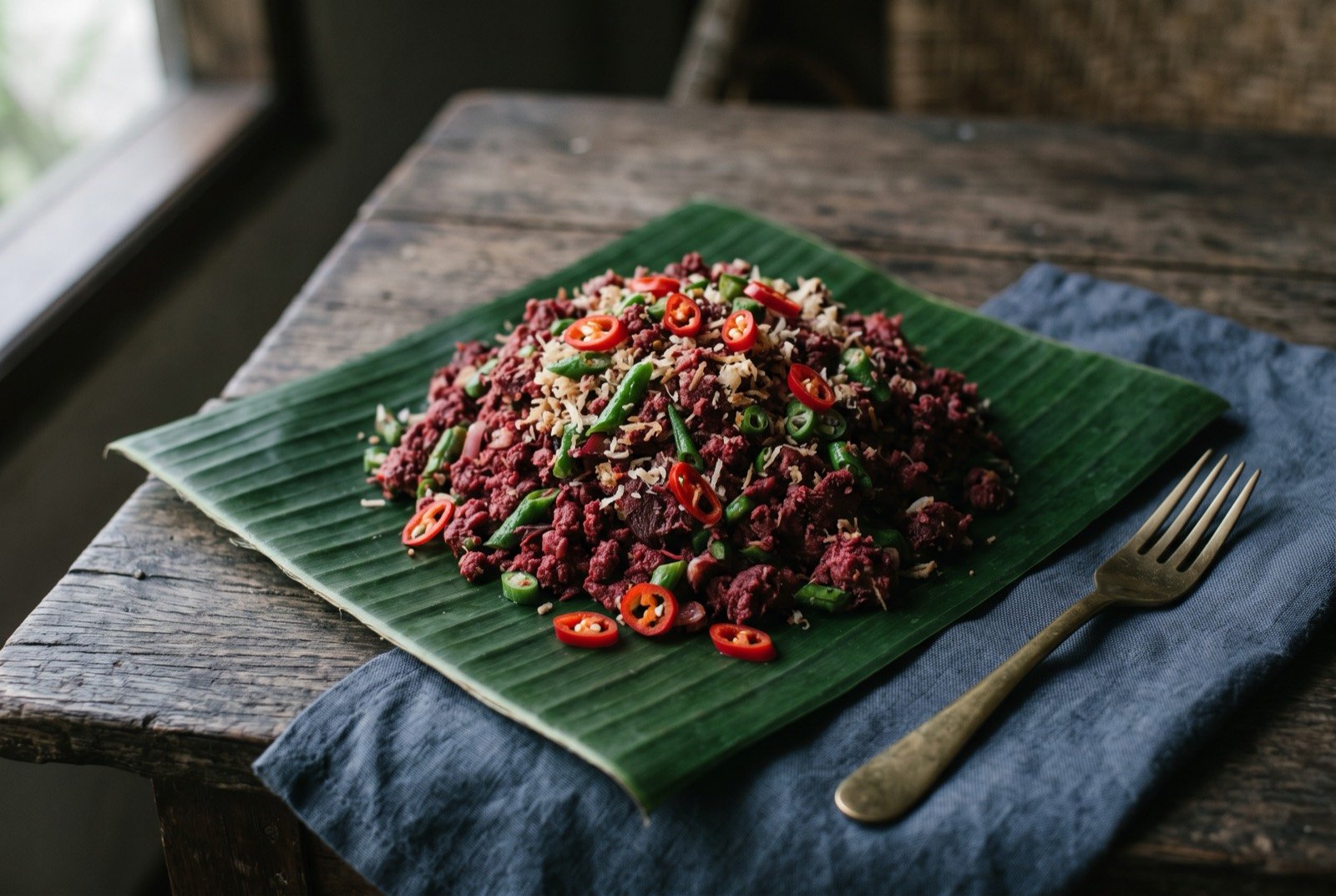
An illustration of the dish, not a photograph of it cooked.
- Time
- 1 hour
- Researched
- No outside sources linked
- Reviewed
- Not yet reviewed from inside the tradition
- Cooked
- Not yet cooked and reported
Lawar exists in genuinely distinct forms, not one dish of variable quality. Lawar merah, barak or plek uses raw blood, the version most associated with Galungan, odalan and ngaben. Lawar putih contains no blood at all, made with chicken or duck, and is traditionally the version offered specifically to Hindu or Buddhist priests, the bloodless dish being the purer, priestly register, not simply the version vegetarians happen to eat. A popular story traces lawar's ritual role to the pre-Hindu Bhairawa sect (see History in Layers above); this chapter does not repeat that story as settled fact. What is settled, and worth stating with equal weight, is that lawar today lives a genuine double life: a Balinese-language dictionary's own example sentence treats it as food bought casually from a warung with friends, the same entry that calls it, in its formal definition, always a component of ceremonial offering. Both are true.
As tradition built it
Serves 6. About 1 hour, plus the coconut roasting.
Ingredients
- 500g pork shoulder and belly, mixed, very finely minced
- 250g fresh grated coconut, roasted (rung 2)
- 150g base rajang (finely sliced turmeric, ginger, galangal, lemongrass, shallot, garlic, candlenut, see Flavour Arsenal)
- 100ml fresh pig's blood
- 2 limes, juiced
- 100g long beans, finely sliced
- 2 bird's eye chillies, sliced
- to taste salt, to taste
Method
- Roast the grated coconut to a pale gold (rung 2) and set aside to cool.
- Combine the minced pork with the base rajang, working it through by hand.
- Fold in the roasted coconut, long beans and chilli.
- Stir the blood through last, along with the lime juice, mixing until the whole dish takes on its characteristic deep red colour.
- Season with salt and serve at room temperature, always alongside rice and, traditionally, sate.
Notes
There is no fixed, traditional ratio for this dish; more than one source states plainly that Balinese cooks measure by hand, not by scale, and this chapter's own recipe is a workable starting point, not a canonical formula.
What a modern chef changes
A deliberate, measured pasteurisation, addressing a real, sourced food-safety finding rather than ignoring it
Rung 6
Method
- Divide the blood-and-a-portion-of-the-minced-pork mixture from the rest of the dish, and hold it in a sous vide bath at 65°C for 4 minutes, long enough to meaningfully reduce pathogen load in a thin layer of liquid while the mixture is still visibly raw, unset and dark red, rather than cooked through.
- Fold the pasteurised portion back through the remaining raw components (the rest of the minced pork, the roasted coconut, the base rajang) at the last moment, so the finished dish still reads, tastes and eats as raw lawar barak, but carries a materially lower measured risk than the fully raw traditional version.
- Note the substitution honestly if working outside the UK's legal blood supply: fresh liquid pig's blood cannot legally be sold to a UK home cook (see Sourcing below); a UK version built from blood curd loses the raw, silky bind this recipe is built around, and that loss should be stated rather than smoothed over, not solved by this pasteurisation step.