Maritime Southeast Asia · Volume 49, The Monopoly, the Monsoon Line and a Border Still Drawn
Jagung bose
West Timor
Illustration
- Time
- Hands on 40 minutes · Waiting 8 hours
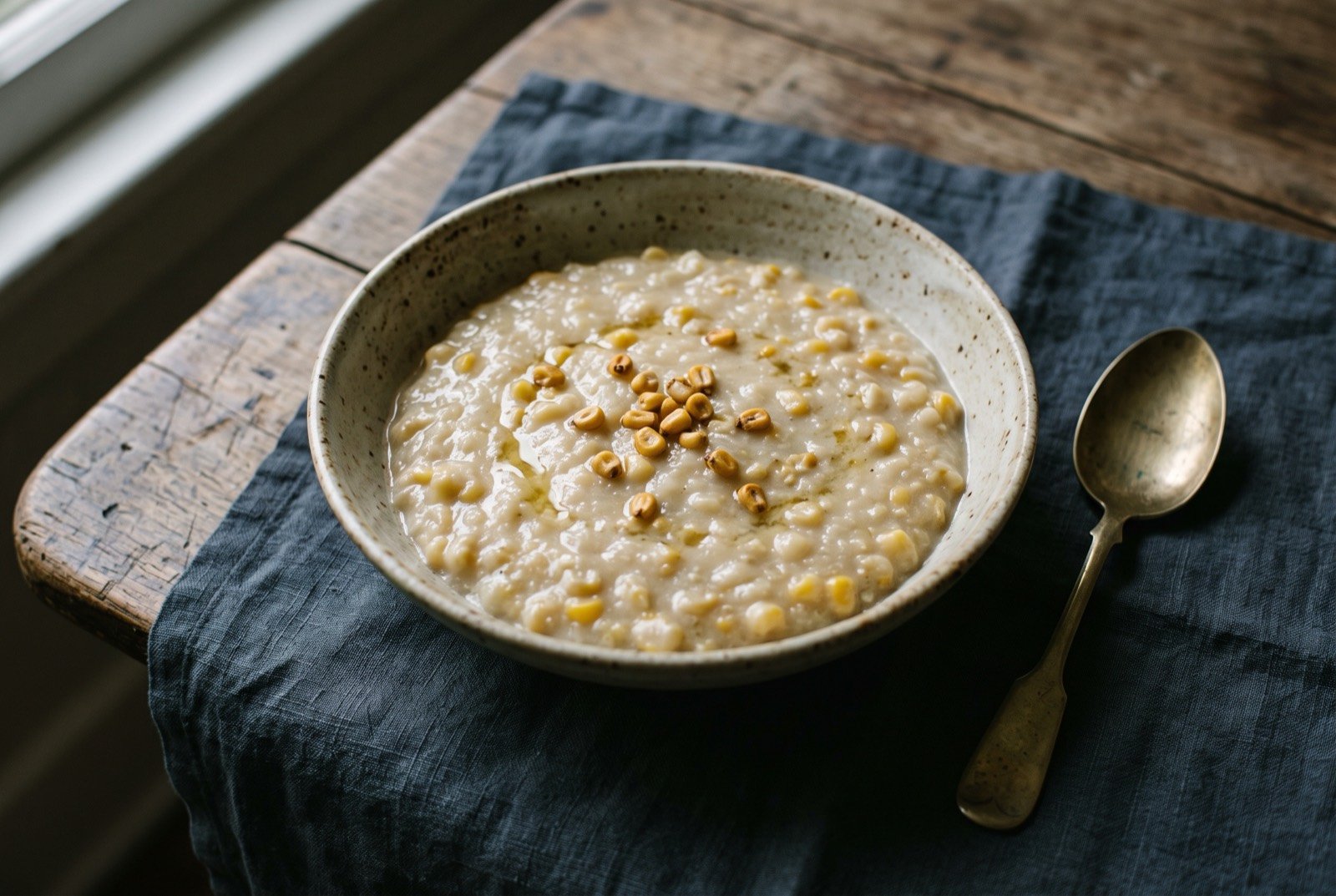
West Timor. Corn cooked slow in coconut milk to a creamy porridge, the rice substitute of a dry ecology, traditionally eaten with se'i or salted fish.
As tradition built it
Serves 4. Soak overnight, cook 30 to 40 minutes.
Ingredients
- 500 g dried white corn, soaked overnight
- 1 litre thick coconut milk
- 5 bay leaves (daun salam)
- 3 lemongrass stalks, bruised
- 2cm galangal, bruised
- 3 shallots, sliced
- 3 cloves garlic, sliced
- 2 candlenuts, roasted and ground
- to taste salt, and sugar to taste
Method
- Drain the soaked corn and blend to a rough paste. A more traditional whole-kernel version instead scrubs the corn to remove its hull and simmers it whole with red beans; either is genuinely traditional, and this chapter has kept both rather than choosing one.
- Sauté the bay leaf, lemongrass, galangal, shallot, garlic and ground candlenut until fragrant.
- Add the corn paste and stir to combine, then add the coconut milk gradually, stirring continuously to prevent it splitting.
- Cook over medium heat, stirring, until thick and creamy, seasoning with salt and sugar to taste. No exact duration is given in the sources behind this dish, which is honest to a porridge judged by texture rather than the clock.
What a modern chef changes
The corn's own starch, worked harder.
Rung 4, applied to corn rather than sago.
Method
- Cook the coconut milk down separately first, reducing it by a third, before combining with the corn, for a richer, more concentrated result than adding it at full strength throughout.
- Pass a portion of the finished porridge through the chinois for a smooth base, then fold the reserved whole-kernel version back through for contrast, combining both traditional methods named above in one bowl rather than choosing between them.
- Dehydrate a portion of the corn kernels separately until crisp, scattered over the finished porridge for a genuine textural echo of the corn's own origin.