Asia · Volume 49
Maluku, Nusa Tenggara and Timor-Leste
The Monopoly, the Monsoon Line and a Border Still Drawn
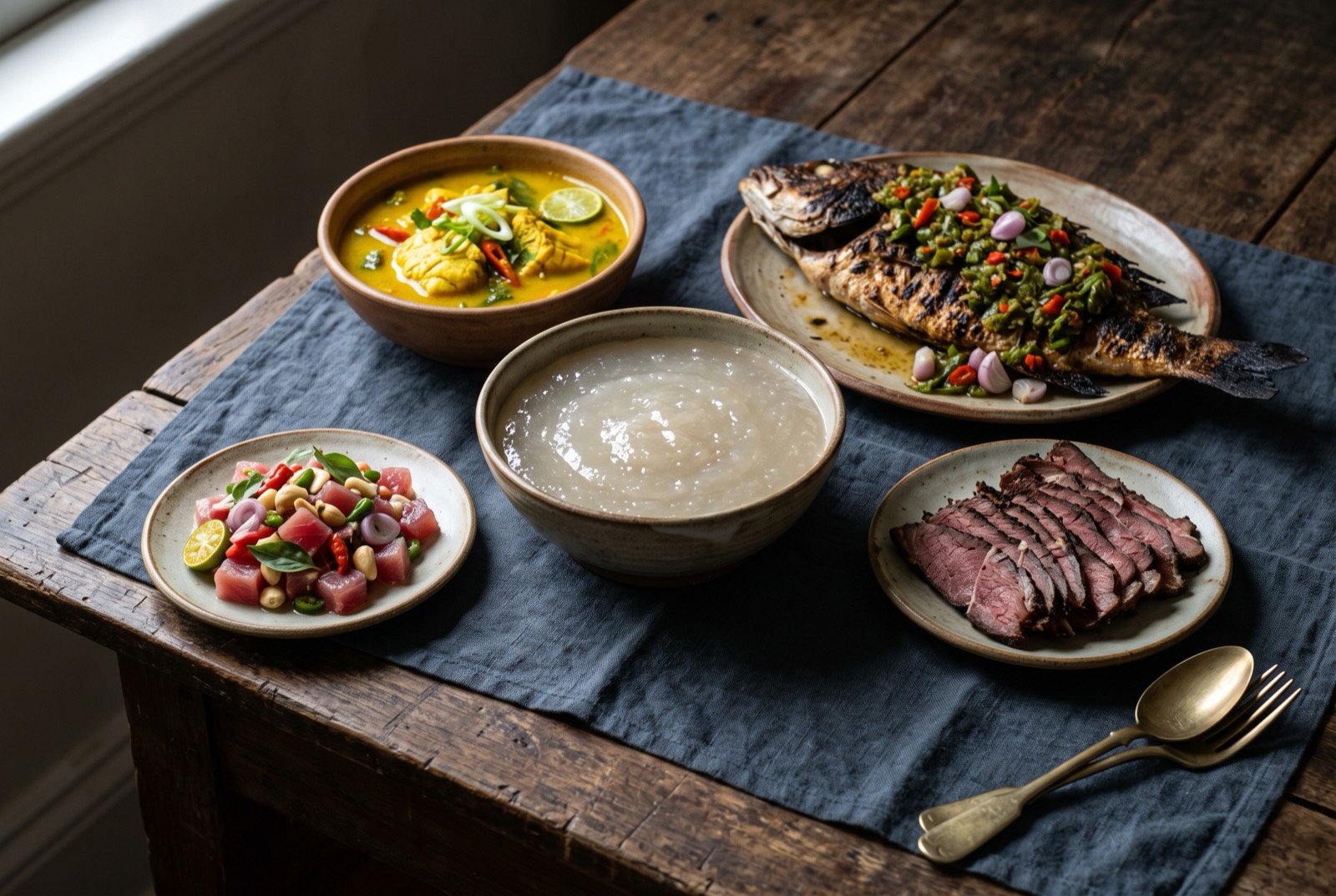
A monsoon wind decides most of what this volume is about before a single cook lights a fire. It drops its rain on Bali and Lombok, thins as it crosses to Sumbawa, and by the time it reaches Flores, Sumba and Timor there is barely enough of it left to call a wet season at all. Rice, which needs that rain, gives way to corn and sago and sorghum along exactly this line, and the line is measured, not felt: Bali gets 1,794 millimetres of rain a year, East Nusa Tenggara barely 930. Fold that ecology northward into Maluku, wetter, volcanic, and until the nineteenth century the only place on earth nutmeg and clove grew at all, and this volume covers two food worlds joined by an ocean rather than a climate. Every restaurant technique in these cuisines has an indigenous ancestor, the idea this atlas returns to in every volume, and here that ancestor is often older than any nation that later claimed it: nutmeg's monopoly is a European invention laid over a spice the region had been discreetly selling the world for a thousand years before anyone in Lisbon or Amsterdam knew which islands grew it. Timor-Leste sits at the eastern edge of this volume the way Malta sits at the edge of a Mediterranean one, close enough to share the corn-and-legume ecology of its Indonesian neighbours, distinct enough by four centuries of Portuguese rule and a war its neighbour started that it earns its own weight in this chapter rather than a footnote in someone else's. Every dish as tradition built it, then what a modern chef would change.
Sources and review · What this chapter does not assert · How we research · Spotted something wrong?
A Sense of Place
Two ecologies, one archipelago
Maluku is wet, volcanic and forested, and its food is built on things that did not need cultivating into existence. Nutmeg, with its lace-like covering, mace, grew wild and nowhere else on earth until the nineteenth century except a scatter of tiny islands in the Banda Sea. Clove grew wild and nowhere else except five small volcanic islands off Halmahera: Ternate, Tidore, Moti, Makian and Bacan. Sago, extracted rather than farmed, from the pith of a felled Metroxylon palm, is the parallel staple story, a starch that asks for no cleared field and no dry season. This is a kitchen built on trees and reefs a cook does not have to plant: sago and coconut for starch and fat, nutmeg, mace, clove, kenari nut and a small, ferociously sour local citrus called lemon cui for aromatic, and skipjack tuna, reef fish and smoked fish for protein.
Nusa Tenggara and Timor are the same archipelago running dry. A peer-reviewed study of the Lesser Sunda Islands gives the actual numbers: annual rainfall runs 1,794 millimetres on Bali, 1,499 on Lombok, 1,378 on Sumbawa, and down to roughly 930 across the whole of East Nusa Tenggara, Flores, Sumba and Timor together, a semi-arid, sharply seasonal climate with as few as two or three wet months a year. The mechanism is a cumulative monsoon rain-shadow: moisture-bearing air drops its rain on the western side of each island in the chain and arrives at the next island east with progressively less left to give. This is why rice genuinely gives way to corn, sorghum and tuber moving east, and it is worth stating as measured ecology rather than travel-writing impression. It is not, however, an absolute rule, and this chapter keeps the complication rather than smoothing it away: Manggarai, in western Flores, has real, still-functioning wet-rice terracing organised around lingko, a spiderweb-shaped communal field radiating from a single point, found nowhere else on earth, because highland Flores catches enough orographic rainfall to sustain it even inside a wider climate that has otherwise moved on. Timor-Leste, at the eastern tip of this line, shares the same dry, corn-and-legume ecology as its Indonesian neighbours across the border, carrying a different and far more recent political history on top of it.
A table of the defining logic:
| Place | Fat and starch | Aromatic base | Everyday protein |
|---|---|---|---|
| Maluku (Ambon, Banda, Ternate, Tidore) | Sago; coconut | Nutmeg, mace, clove, lemon cui, kenari nut | Skipjack tuna, reef fish, smoked fish |
| Lombok and Sumbawa | Rice; coconut | Bird's eye and curly chilli, shrimp paste, Sumbawan basil | Chicken, freshwater and coastal fish |
| Sumba | Sorghum, corn, tuber (rice imposed by policy, not ecology) | Little documented beyond a general chilli-coconut grammar | Buffalo, horse and cattle, largely undocumented culinarily |
| Flores lowland and West Timor | Corn; coconut | Turmeric, galangal, tamarind | Smoked beef (se'i), salted fish |
| Flores highland (Manggarai) | Wet rice; pork | As above, plus a genuine pork-and-Catholic-feast register | Pork, buffalo (ceremonial) |
| Timor-Leste | Corn; rice as accompaniment | Chilli, garlic, onion; a thin surviving Portuguese vocabulary | Corn and legumes daily; pork and fish for feast |
The History in Layers
A secret worth keeping for a thousand years
Nutmeg and clove were already moving in international trade by roughly the fifth or sixth century CE, carried by Chinese, Indian and Arab traders through the Persian Gulf and onward via Constantinople, Genoa or Venice into Europe. The genuinely striking part of this story is not the trade itself but the discretion around it: for the better part of a millennium, the traders who carried these spices into world commerce kept their point of origin a deliberate secret, and Europe cooked and doctored with nutmeg and clove for centuries without knowing which islands grew them, until Portuguese navigators finally located Banda and Ternate in the sixteenth century. Bugis and Makassar traders from Sulawesi were themselves a major artery out of Maluku long before any European ship arrived, in one documented case moving a thousand bahar of spice to Makassar in a single sailing season, part of the wider Bugis tradition of merantau, voluntary overseas trading migration.
Ternate's sultanate traces to 1257, one of the oldest Islamic polities in the archipelago; Tidore's first raja is dated to 1081. The two, along with neighbouring Jailolo and Bacan, fought each other for control of clove-producing territory for centuries before Europe ever entered the picture. When the Portuguese did arrive, in 1512, they allied with Ternate against Tidore and built a fortress on the promise of an annual clove supply; Spain promptly allied with Tidore in response, and two neighbouring islands spent much of the sixteenth century as proxies for two rival European crowns. Sultan Hairun of Ternate fought the Portuguese from 1550 and was assassinated by them in 1570; his son, Sultan Baabullah, avenged him, besieged the Portuguese fort for five years and forced their surrender in 1575, his influence said to have reached seventy-two islands.
1621: the massacre a monopoly was built on
This is the volume's most serious history, and it should not be softened. In 1621 the Dutch East India Company's Governor-General, Jan Pieterszoon Coen, personally led an expedition against the Banda Islands: roughly 1,600 soldiers, 300 Javanese convicts, 100 Japanese mercenaries and 286 enslaved people, against a Banda population estimated by named historians at around 15,000. The casualty figures genuinely vary between sources rather than settling to one number, and this chapter states the range rather than choosing one: at least 2,500 killed by shooting, torture or starvation in one account; 2,800 killed and 1,700 enslaved in another; a separate figure holding that of roughly 14,000 people, only 480 native Bandanese remained afterward. The archaeologist Peter Lape's own estimate, cited repeatedly in Indonesian historical writing, is that some ninety per cent of the population was killed, enslaved or deported. Indonesian sources call this what it was: genocide. Coen is remembered there as the Butcher of Banda. The purpose was explicit and entirely commercial: a monopoly on nutmeg and mace, to keep European prices, and profits, artificially high.
What followed was not a single act of violence but a nearly two-century administrative system built on top of it. The depopulated nutmeg groves, perk, were parcelled into sixty-eight plots and leased to Dutch civilian settlers, perkenier, required to hand over the harvest twice yearly to the Company at a fixed price. Because the indigenous population that had actually worked this land was gone, the perk needed imported labour, and perkenier bought enslaved people from the Company and used exiled convicts as forced labour on the plantations; a University of Gadjah Mada academic study traces this forced-labour system specifically from 1770 to 1860, nearly two hundred years after the massacre that made it necessary.
The Company enforced its monopoly against anyone, not only outsiders. Its Right of Extirpation authorised destroying nutmeg or clove trees found growing outside Company-controlled territory, to prevent oversupply from depressing prices in Europe, enforced by patrol fleets of kora-kora war canoes sweeping Ambon, Seram and the Ternate-Tidore islands. Under a 1652 agreement, Ternate itself accepted enforcement of this right and agreed clove would no longer be traded within its own kingdom outside Company channels: its own farmers lost the freedom to sell their own harvest, forced instead to sell only to the Company at fixed, low prices, and documented poverty, food shortages and heavy taxation followed, a pattern Indonesian historical writing connects directly forward to the later, harsher forced cultivation system across the wider Dutch East Indies.
The monopoly outlived its own violence, and eventually the tree itself escaped it. For nearly two centuries the Company's Right of Extirpation kept nutmeg genuinely confined to Banda, but by the nineteenth century that confinement had broken down for good. Nutmeg reached Grenada, in the volcanic Eastern Caribbean, in 1843, seed brought directly from Banda by an English settler and first planted at Belvidere Estate; the crop only became commercially significant there after 1880, accelerated by a worm infestation that devastated Banda's own harvest around 1851. Grenada is now the world's second-largest nutmeg producer after Indonesia, still visible on its national flag, and its own story, including Hurricane Ivan's destruction of some sixty per cent of its crop in 2004 and the decades-long recovery since, is told in full in this atlas's Caribbean volume, AM-15. It is worth naming here rather than only there: the same tree, the same seed lineage, planted an ocean away from the massacre that first made it worth guarding this closely.
A story worth telling with a caveat rather than as a clean fact. The popular version of what happened next, told almost entirely in Western pop-history writing, is that in 1667 England traded Run Island, the one Banda nutmeg island still outside Dutch control, for Dutch recognition of English possession of Manhattan. The Treaty of Breda was in fact a broad multilateral peace settlement ending the Second Anglo-Dutch War, organised around each side largely keeping what it currently held, not a single bilateral nutmeg-for-an-island deal, and no Indonesian-language source treating the exchange in real depth was found in researching this chapter, itself worth noting. The commonly repeated claim that nutmeg's price rose 32,000 per cent between Banda and Europe could not be corroborated in any Indonesian source either; the better-sourced Indonesian figures, from an academic journal at Universitas Khairun in Ternate and from national press, give nutmeg bought at roughly one and a half stuiver a pound in Banda against a Dutch resale price of around sixty one stuiver a pound in Europe, with cited profit margins running from 600 to as much as 1,600 per cent depending on the supply-chain stage measured. That range, not the tidier Western figure, is the honest one.
Faith, and a conflict this chapter cannot fully speak to
Catholicism arrived in Central Maluku in the early sixteenth century with Portuguese missionaries; when the Dutch displaced the Portuguese in the early seventeenth century, Catholic villages were converted to Dutch Reformed Protestantism, and colonial Maluku society divided along the resulting religious line, Christians given greater access to Dutch-run education and administration, Muslims retaining greater access to trade. Islam, separately, reached Maluku directly by sea from the Arab world rather than only through Java: the historic Arabic name for the Moluccas, Jazirat al-Muluk, land of kings, marks this direct route, and it is this trade, not the Company's, that carried kue asida, a Ramadan sweet of wheat flour and sugar, into Ambon and Ternate's iftar tables, the Middle Eastern original's samin swapped for butter and finished with cinnamon and cardamom.
The sectarian conflict of 1999 to 2002 is documented in Indonesian sources, with at least one government religious-affairs research note arguing that economic and political competition, not religion itself, was the underlying driver, religious identity serving as the fuse rather than the cause. This chapter has deliberately not asserted any specific effect of that conflict on food markets, fishing access or mixed-community eating, and no specific pattern of pork's presence or absence by community: neither was sourced in researching this volume, and inventing a plausible-sounding connection would be exactly the kind of unearned claim this atlas exists to avoid.
Royal kitchens and market women, five hundred kilometres south
Lombok's best-known dish carries a real, named local-history story, not tourist-board invention, though it is retold near-identically across enough Indonesian outlets to suggest one original source, likely a government heritage page, has been widely copied rather than independently verified by each. A historical conflict between Lombok's Selaparang kingdom and Bali's Karangasem kingdom saw Taliwang people, from west Sumbawa, brought in to help broker peace, and settled in what is now Karang Taliwang, Cakranegara; their cooks are credited with the spiced grilled chicken that carries their name. Its twentieth-century commercial rise is specific and recent: a woman named Manawiyah began selling it at Cakranegara market in the 1960s.
Nasi puyung is honestly, and usefully, not ancient at all. It is consistently and specifically attributed to a named woman, Inaq Esun, who began selling it in Puyung village, Central Lombok, in the 1970s, the dish's "racing" nickname explained either by her grandson's success at local street races or by her own famously fast service. This chapter is glad to include a dish this honestly recent rather than dress it in false antiquity.
Sumbawa turns out to have its own food, genuinely distinct from Lombok's and better documented than expected: the regency's own official cultural encyclopaedia names singang, a sour turmeric fish broth, and sepat, grilled fish dressed with a raw sour sauce over grilled aubergine, alongside susu kuda liar, wild mare's milk that naturally ferments to a yoghurt-like sourness over roughly forty-eight hours, a genuine Sumbawa-and-Bima product studied by two Indonesian universities, though the sweeping folk-medicinal claims attached to it, that it treats tuberculosis, asthma and diabetes, are folk belief rather than verified medicine.
Sumba is a genuine, honestly reported gap in this chapter, beyond one strong find. Indonesian food-policy writing documents how post-independence rice-first policy forced rice onto East Sumba's dry savanna despite corn, sorghum, millet and tuber crops suiting the ecology better, national rice consumption rising from 53.5 per cent of the population in 1954 to 97.7 per cent by 2014, and traditional staples carrying real social stigma as a result: it isn't a proper meal unless it's rice, as the saying goes. Against that thin backdrop, manggulu, dried banana pounded with peanuts and palm sugar into a travel food that keeps for months, is genuinely well documented: East Sumbanese farmers and fishermen carried it on journeys, and it was specifically favoured by Dutch colonial soldiers as provisions when entering remote East Sumba, the drying process alone taking up to two weeks. This chapter has deliberately not connected Sumba's famous horse-and-cattle pastoral culture, or its Pasola spear-fighting festival, to any documented food tradition: no source found makes that link.
Flores holds a genuine internal contrast worth keeping rather than flattening into one island. Manggarai and Ngada, in the west and centre, are majority Catholic, converted through the twentieth century while retaining animist ancestor-veneration practice alongside it, ancestral shrines and ritual buffalo sacrifice among the Ngada specifically, and keep pigs, goats, sheep and chickens as household livestock. This chapter's weakest claim, flagged honestly rather than dressed up, is the connection between that Catholicism and Flores's pork consumption against Muslim-majority Lombok and Sumbawa: it is logically plausible but rests only on general-reference sourcing, not deep local ethnography.
One island, a border, two colonial arcs
Coffee's arrival in the wider Timor region is more tangled than the tidy version usually told, and this chapter states the tangle rather than smoothing it. Java's own coffee cultivation dates to 1696 under Dutch administration, spreading from there to Sumatra, Sulawesi and Timor; a Portuguese source on the history of Portuguese coffee itself states coffee reached Timor via Java under Dutch influence, with Portugal's more clearly direct role lying in coffee's onward spread to its other colonies, Cape Verde, São Tomé, Angola. General sourcing does still describe the Portuguese expanding coffee cultivation on Timor as colonial administrators through the nineteenth century, a claim compatible with, not contradicted by, a Dutch-origin plant arriving first and being systematised later under Portuguese rule. Corn's own introduction is similarly uncertain in the academic record, with at least one source suggesting early Portuguese colonial records may have confused corn with sorghum. What is solid is corn's rise to staple-crop dominance across Timor in the early twentieth century; exactly how it got there, and via whom, is genuinely unsettled, and this chapter says so rather than asserting a clean colonial-credit story.
Timor-Leste's twentieth century is a different, and much more recent, history than the Company-era Maluku story, and it deserves the same seriousness. Portuguese Timor was a colony for over four hundred years before Indonesia invaded in 1975 and occupied the territory until 1999, followed by a UN-administered transition to independence in 2002. The Commission for Reception, Truth and Reconciliation in Timor-Leste, a Timorese-led truth commission, found a minimum estimate of roughly 102,000 conflict-related deaths between 1974 and 1999: approximately 18,600 violent killings and disappearances, and roughly 84,200 deaths from occupation-era disease and starvation, concluding that the majority of deaths resulted from Indonesian military action and that the 1999 post-referendum violence specifically was a systematic campaign orchestrated at the highest levels of the Indonesian government. The disease-and-starvation figure matters as much as the violent one for a food chapter, because it is the direct, unbroken thread to why the maize-breeding and food-security programmes covered later in this chapter carry the weight they do in Timor-Leste's own modern story, not a separate development narrative bolted on afterward.
How Timor-Leste describes its own food culture, against how outsiders describe it, turns out to be a soft finding rather than a sharp dispute. No source found stages a strong "Timorese chefs reject Indonesian framing" narrative; what exists instead is a general, low-key sense, found mostly in Portuguese-language material, that Timorese cuisine has actively and selectively drawn on its influences rather than simply summing colonisation and occupation, sitting alongside a genuinely unremarked-upon everyday popularity of Indonesian food in Dili itself. This chapter has deliberately not asserted a sharper tension than the evidence actually shows.
The Flavour Arsenal
Nutmeg and mace are used at home as well as exported, more than their export reputation suggests. The nutmeg fruit's flesh, discarded entirely in most Western nutmeg supply chains, is preserved locally as candied nutmeg (see the preserve bench below). Nutmeg's own trade carried it west into Sumatra long before it carried it across the Atlantic to Grenada. Aceh Selatan, at Sumatra's northern tip, grows a real, named nutmeg crop of its own, and Volume AS-44 treats it in full: its own signature use candies the fruit's flesh into manisan pala, associated with the town of Tapak Tuan, the opposite emphasis from Maluku's, where the seed itself is the prize. That volume rightly leaves the Banda Islands' own spice-trade history to this one; this chapter returns the courtesy rather than re-treating Aceh's dish here.
Clove is grown far more than it is cooked with in its own homeland: an estimated eighty to ninety per cent of Indonesia's clove crop is absorbed by the domestic clove-cigarette industry rather than food. That industry is itself a nineteenth-century Central Javanese invention, not a Maluku one, first used as a home remedy for chest complaints before finding its way into tobacco, and this chapter keeps that distinction clear rather than implying clove cigarettes are part of Maluku's own culinary tradition. The agronomy, by contrast, is genuinely Maluku's: buds are picked fully formed but not yet open, a harvest repeatable every ten to fourteen days across a three-to-four-month window, cured for around a day to develop their glossy brown colour, then sun-dried, three days in dry-season sun or five to six in wet weather, to a target moisture of twelve to fourteen per cent.
Sago, Maluku's own staple, is extracted rather than farmed. The pith of a felled palm trunk is shredded or pounded, water is added to separate starch from fibre, the resulting slurry is sieved through cloth, and the starch-bearing water is left to settle in a large trough for several hours before the clear water is discarded and the starch beneath collected and sun-dried. Sago grubs, the larvae of the red palm weevil that colonises decaying felled trunks after the starch is taken, are a genuine traditional food across Maluku, eaten raw, satayed or grilled, paired with grilled plantain in Jailolo specifically.
Kenari nut, likely originating further east in Melanesia, grows so thickly across eastern Indonesia that one ecological field study in Central Maluku found it the single most dominant tree species in its survey village, ahead of nutmeg or clove. Used in sweets and confectionery, and fried and crushed as a garnish over savoury dishes.
Lemon cui, a small, ferociously sour citrus grown in North Sulawesi and North Maluku, is the acid that "cooks" raw fish in this volume's own answer to ceviche, prized for sharpness rather than sweetness.
Sopi is not moke, and this chapter keeps them apart. Sopi is Maluku's own aren palm sap spirit, fermented and then pot-distilled through a bamboo or pipe apparatus to roughly thirty to forty per cent alcohol, its name said to derive from the Dutch for a dram of liquor. Moke is Flores and Nusa Tenggara's related but genuinely different spirit, typically distilled from lontar palm sap rather than aren. The two are often discussed together in tourism writing because both are eastern Indonesian palm spirits, but they come from different palms on different islands, and this chapter does not conflate them.
Colo-colo is not dabu-dabu, and older Moluccan cooks say the soy sauce in it is a later addition. Colo-colo characteristically includes sweet or salty soy sauce and lime, sometimes finished with hot shallot oil, for a sweet-sour-salty-spicy result; its North Sulawesi cousin, dabu-dabu, uses hot oil but no soy, for a sharper, purely spicy-sour one. Maluku elders quoted directly in Indonesian press say authentic colo-colo historically carried no kecap manis at all, and that the soy-sauce version is a later variant, an attribution this chapter preserves rather than flattening into one timeless recipe.
Sasak spice logic runs on charred aromatics. Shallot, garlic and chilli are blackened over open flame or coals before grinding for both ayam taliwang's paste and plecing kangkung's sambal, giving both a smoky backbone a plain fried-paste method would miss entirely, and this chapter's technique ladder below is built around exactly that difference.
The Technique Ladder
Rung 1. Char before you grind
Sasak cooks in Lombok build their spice pastes by blackening shallot, garlic and whole chillies directly over flame or hot coals before grinding, not by frying the raw aromatics gently as most Indonesian spice pastes elsewhere in the archipelago do. The mechanism is genuine Maillard chemistry pushed further than a sauté ever reaches: direct char develops bitter, smoky, deeply roasted compounds a shallow fry cannot produce, and it is the reason ayam taliwang and plecing kangkung's sambal both carry a smokiness that reads as depth rather than heat alone. What a cook does with this rung: char hard, over a naked flame or a hot dry pan, until the aromatics show real black patches, not just colour, before they ever reach the mortar or the blender.
Rung 2. Let acid do the cooking
Gohu ikan is routinely and fairly compared to ceviche or sashimi in Indonesian food writing, and the comparison is mechanically correct: lime and lemon cui's citric acid denatures the fish's surface proteins in much the same way heat does, firming and opacifying the flesh without a flame anywhere near it. Colo-colo works the same chemistry in reverse, applied to grilled fish rather than raw: its raw sambal is never cooked, deliberately, so its acid stays bright and its chilli stays sharp against the smoke of the grill beneath it. What a cook does with this rung: treat citrus as a genuine cooking method with its own timing, not a garnish added at the end, and rest the dish briefly after dressing it so the acid actually finishes its work before serving.
Rung 3. Smoke beside the fire, never over it
Se'i and ikan asar share the same discipline: the meat or fish sits at a distance from the coals rather than directly above them, so smoke does the work rather than radiant heat. Se'i is traditionally smoked over kosambi wood specifically, credited, plausibly though not independently chemically verified, with both a strong smoke flavour and with keeping the meat's surface a fresh red rather than the deep brown ordinary hot-smoking produces. What a cook does with this rung: a Big Green Egg run properly indirect, with a convEGGtor between the coals and the meat, is not an approximation of this technique, it is the same physical principle built into a piece of modern kit, and this is one dish in this chapter where the reader's own equipment maps onto tradition rather than merely standing in for it.
Rung 4. Read the sago, don't time it
Papeda's whole difficulty lives in two variables: the ratio of sago starch to water, and the temperature of the water poured in. Too little boiling water and the starch never fully gelatinises into its translucent, elastic mass; too much, or water that has cooled even slightly, and it turns lumpy and grainy rather than smooth. Indonesian sources are consistent that this is judged by eye and by the spoon's resistance, not by a stated ratio locked to the minute. What a cook does with this rung: pour the boiling water in gradually while stirring hard and continuously, and judge doneness by the mass pulling cleanly and elastically away from the spoon, not by a clock.
Rung 5. Cook the nut before you trust it
Candlenut, the honest UK substitute for kenari in every ground sauce and sambal in this chapter, must never be eaten or used raw: it carries a mild natural toxin that toasting or cooking neutralises, alongside a genuine flavour transformation from a hard, bitter raw nut to a soft, buttery, thickening one once heat has done its work. Kenari itself is treated the same way in its own home tradition. What a cook does with this rung: toast candlenut in a dry pan or the oven until it colours and softens before it goes anywhere near the mortar or blender, treating this as a safety step as much as a flavour one, not an optional toast for extra depth.
Ferment or Preserve Bench
Sopi. Aren palm sap, fermented, then pot-distilled through bamboo or pipe apparatus to thirty to forty per cent alcohol. Its cultural role in Maluku runs beyond drinking: it is used in reconciliation between families, clans and villages after disputes, and its legal status in Indonesia remains genuinely ambiguous despite widespread production.
Ikan asar. Fresh fish, commonly skipjack, split and skewered lengthwise on bamboo, arranged over a purpose-built rack and smoked over a low, smouldering fire, deliberately not a large flame, for roughly two hours or more depending on size, until browned, its oil released and the flesh dried through. This is both a way of eating fresh fish and a genuine preservation method, the smoked fish keeping considerably longer than fresh.
Manisan pala. Sliced nutmeg fruit flesh, usually discarded in Western nutmeg supply chains, steeped in sugar-water for two days, drained, then steeped a second time in fresh sugar-water for one to two more days, at which point it is ready as a wet candied preserve keeping around two years. For the dry version, the pieces are drained after the second soak, rolled in sugar and sun-dried for one further day. This is a genuine use for a part of the fruit a UK cook working from ground nutmeg alone would never see.
Tapai. Timor-Leste's own fermented rice snack, wrapped in banana leaf, sweet-sour with a mild alcoholic edge from fermentation, grilled and served with budu, a tomato, mint, lime and onion condiment. This is the clearest documented fermented food from Timor-Leste specifically, though no recipe with precise quantities was found for either tapai or budu in researching this chapter, and this chapter states that plainly rather than inventing one.
Sourcing in Britain
Nutmeg, mace and clove: easy to buy, hard to buy with any real traceability. Steenbergs (Ripon, North Yorkshire) sells Organic Nutmeg Whole, 40g, £3.12, stating only that it is “grown in Indonesia or Sri Lanka,” and Organic Mace Blades and Organic Cloves Whole, 35g, £5.78, whose own copy honestly notes clove-growing spread from the Spice Islands to India and Sri Lanka centuries ago. Natco's Whole Nutmeg (via Sous Chef), 100g, £4.20, is explicitly Indian, not Indonesian. No UK retailer names Banda or Maluku origin the way Grenada nutmeg is named by BoTree Farm's Belmont Estate line, £5.95 for 50g. A genuine Banda Islands smallholder cooperative exists under a Slow Food Presidium, but no confirmed UK stockist was found for it. This is the reverse of what the spice's own history would suggest ought to be true, and worth saying so rather than pretending otherwise. Buy whole, always: whole nutmeg keeps three to four years, while ground nutmeg's essential oils begin oxidising the moment it is milled, spent within six to twelve months. Good mace shows colour as a real origin tell, orangey-red tending Indonesian, orange-yellow tending Grenadian, and should bend like paper rather than shatter, releasing citrus-clove aroma when crushed rather than smelling dusty.
Sago is this chapter's biggest honest gap. What UK shops sell as “sago,” without exception found in researching this chapter, is tapioca, cassava starch pressed into hard, dense, pure white pearls that ship far better than true sago and have displaced it in export retail everywhere. True sago, from the Metroxylon palm's pith, has no verified UK retailer. Tapioca starch or pearls, blitzed fine if using pearls, is the realistic substitute, and this chapter says so directly rather than implying the real thing is buyable. No specialist tool is needed to cook papeda itself, an ordinary large wooden spoon does the job; a pair of wooden chopsticks or a two-pronged fork is the honest substitute for serving it in the traditional twirled style.
Kenari nut has no reliable UK supply, and the substitution splits cleanly by use. For cooked, ground use in a sauce or sambal, candlenut (kemiri) is the better substitute, genuinely and widely available in the UK (Amazon UK, The Asian Cookshop, Tuk Tuk Mart, Tradewinds, £3 to £5 for 100 to 200g) and, like kenari, always cooked rather than eaten raw (see Rung 5). For kenari eaten as a roasted snack, macadamia is the honest substitute, mainstream in any UK supermarket. Plain almonds are correct only in folk name and miss the buttery fat both real options share.
Everything else is genuinely easy. Tamarind block, fresh galangal, fresh turmeric, frozen kaffir lime leaf (never sold fresh in the UK, worth stating as the honest ceiling rather than a failure), fresh bird's eye chillies and correctly labelled Indonesian palm sugar, gula jawa, darker and more molasses-like than a generic Thai-style block sold under the same name, are all easy, mainstream buys. Kara brand coconut cream is genuinely Indonesian-made and unusually rich, near-universal in UK Asian grocers. Toko Indonesia (Letchworth, Hertfordshire) is the single most relevant UK retailer for this volume specifically, a dedicated Indonesian grocer with UK-wide delivery, stocking traditional lines including specifically Indonesian dried anchovy.
Kit. Food-grade bamboo tubing for Flores's kolo has no reliable current UK supply; banana leaf, genuinely and easily available frozen from any South or Southeast Asian grocer, wrapped around the same rice-and-coconut filling inside a steamer, is the closer honest substitute, since bamboo's own contribution is a faint vegetal aroma and moisture regulation a leaf wrap approaches more closely than an inert metal or ceramic tube would. Se'i smoking, by contrast, is a genuine, direct fit for the reader's Big Green Egg (see Rung 3 and Dish 7): kosambi wood itself is not sourceable, but apple, cherry or oak chunks give a comparably mild, sweet smoke.
No UK restaurant serving Maluku, Nusa Tenggara or Timor-Leste food specifically was found, and this chapter states that plainly. Toba (St James's Market, London) is the strongest general Indonesian restaurant checked for this volume, but its own stated focus is Javanese, Balinese, Betawi and Minang cooking, the demographically dominant western and central Indonesian traditions, and nothing on its menu represents this volume's own region. The Netherlands, not Britain, is where this region's diaspora cooking is genuinely findable in Europe, a fact worth naming rather than papering over with a substitute that does not actually represent the food.
Voices and Sources
- Indonesian national and regional press: Kompas, Kompas Food and Kompas Stori; Tirto; CNN Indonesia; Tempo; Detik; Liputan6; RRI, the Indonesian public broadcaster, particularly its Ambon and Kupang bureaux.
- Indonesian government and heritage bodies: Kemdikbud's Balai Pelestarian Nilai Budaya Maluku; Sumbawa Regency's own cultural encyclopaedia, Ensiklopedia Kebudayaan Sumbawa; Indonesia's national tourism portal, indonesia.go.id, on Manggarai's lingko rice fields.
- Indonesian universities and academic journals: University of Gadjah Mada's repository, on slavery in the Banda nutmeg plantations, 1770 to 1860; Universitas Khairun's Jurnal Pusaka, Ternate; IPB University (Bogor Agricultural University), on clove agronomy and on fermented mare's milk; Universitas Flores's AGRICA journal, on jagung katemak; Universitas Bumigora, on susu kuda liar; Universitas Hasanuddin, on smoking-duration technique.
- Slow Food Foundation, for its international Ark of Taste entries on Indonesian sago and on Hibrido de Timor coffee.
- Dutch-Moluccan community and trade sources: MOZA, a Dutch-Moluccan community publication, on Sagukenari's account of Moluccan food's own erosion within the diaspora; De Westkrant and Omroep Zwart, on Vanessa Wattimena's cultural-transmission cooking; Debic's trade-press interview with Dennis Huwaë of Restaurant Daalder, Amsterdam.
- Timor-Leste and Portuguese-language sources: the Commission for Reception, Truth and Reconciliation in Timor-Leste's “Chega!” report; Portugal's Instituto Camões, on Sabor de Timor, the Xanana Gusmão-prefaced cookbook by chef Luís Simões; a Portuguese-language dictionary of Timorese culinary terms; SBS Food (Australia), on Dilicious Timor's chef Ceasar Gaio.
- Coffee and agricultural development sources: ACIAR, CIMMYT and Seeds of Life, on Timor-Leste's maize breeding programmes; NCBA CLUSA, on Cooperativa Café Timor; World Coffee Research and a peer-reviewed paper in Euphytica, on Hibrido de Timor's global significance to coffee-rust resistance breeding.
Things this chapter has deliberately not asserted
- That the Treaty of Breda was a clean, bilateral “Run Island for Manhattan” swap. It was a multilateral peace settlement with multiple territorial provisions, and no Indonesian-language source treating the exchange in real depth was found.
- The commonly repeated claim that nutmeg's price rose 32,000 per cent between Banda and Europe. This chapter uses the better-sourced Indonesian range of 600 to roughly 1,600 per cent instead.
- The Han-dynasty clove-chewing court-protocol story, repeated across sources with no primary citation found.
- Any specific effect of the 1999 to 2002 Maluku sectarian conflict on food markets, fishing access or mixed-community eating, or any specific pattern of pork's presence or absence by community. Neither was sourced.
- That kapurung is a Maluku dish. It belongs to Luwu, South Sulawesi; Maluku's own sago-and-broth dish is papeda.
- That moke and sopi are interchangeable. They are related but genuinely distinct spirits from different palms and different islands.
- A flat claim that “the Portuguese introduced corn to Timor.” The introduction route is academically uncertain, possibly Dutch via Java; corn's rise to staple-crop dominance in the early twentieth century is solid, its precise arrival story is not.
- Any rivalry or contested-origin claim between Timor-Leste's se'i and West Timor's se'i. The sourcing treats this as one shared Rote-and-Timor tradition.
- That Timor-Leste's catemak and West Timor's jagung katemak are definitively the same dish, rather than a reasonable inference from parallel description.
- A sharp “Timorese chefs reject Indonesian framing” narrative. The evidence shows something softer: a general sense of a selectively composed Timorese identity, alongside real, unremarked-upon everyday popularity of Indonesian food in Dili.
- That Flores's Manggarai and Ngada Catholicism straightforwardly explains local pork consumption against Muslim-majority Lombok and Sumbawa. Plausible, but resting only on general-reference sourcing.
- Any documented link between Sumba's horse-and-cattle pastoral culture or the Pasola festival and a specific food tradition. None was found.
- A settled discovery date for Hibrido de Timor coffee. Sources give 1917 and 1927, and this chapter has not picked one.
- That ai-manas, Timor-Leste's chilli paste, has a verified traditional recipe. The only method found rested on a low-quality Western content site and has deliberately not been used here as an authoritative source.
- That Aceh's own nutmeg tradition and Banda's are one story told twice. Volume AS-44 covers Aceh Selatan's candied-flesh use, manisan pala from Tapak Tuan; this chapter covers Banda's seed-and-monopoly history. The two are named as a crossover, not merged into one telling.
Char before you grind
Sasak cooks in Lombok build their spice pastes by blackening shallot, garlic and whole chillies directly over flame or hot coals before grinding, not by frying...
Let acid do the cooking
Gohu ikan is routinely and fairly compared to ceviche or sashimi in Indonesian food writing, and the comparison is mechanically correct: lime and lemon cui's...
Smoke beside the fire, never over it
Se'i and ikan asar share the same discipline: the meat or fish sits at a distance from the coals rather than directly above them, so smoke does the work rather...
Read the sago, don't time it
Papeda's whole difficulty lives in two variables: the ratio of sago starch to water, and the temperature of the water poured in.
Cook the nut before you trust it
Candlenut, the honest UK substitute for kenari in every ground sauce and sambal in this chapter, must never be eaten or used raw: it carries a mild natural...
The dishes
- Papeda dengan ikan kuah kuning Maluku
- Gohu ikan Ternate
- Ikan bakar colo-colo Ambon
- Kohu-kohu Ambon
- Ayam taliwang dengan plecing kangkung Lombok
- Sepat Sumbawa
- Se'i sapi Rote and West Timor
- Jagung bose West Timor
- Batar da'an Timor-Leste
Sources and review
- Researched
- No outside sources linked
- Reviewed
- Not yet reviewed from inside the tradition
- Cooked
- Not yet cooked and reported
Where this volume comes from
3 research briefs on file for this volume, researched to the rules on How we research. Published 3 September 2026. Last changed 8 September 2026.
The brief's own account of its sources
The modernist strand drew on roughly thirty five searches. Its strongest material is genuinely local-voiced: Dennis Huwaë's own words (a Michelin-starred chef of Moluccan heritage, quoted directly from trade press), Sagukenari (a Dutch-Moluccan community education project quoted via MOZA, a Dutch-Moluccan community publication), and Vanessa Wattimena's own community-facing cooking.