Asia · Volume 51
The Moro South, Mindanao and Sulu
The Black Broth, the Sultanate and a Cuisine the Rest of the Philippines Forgot
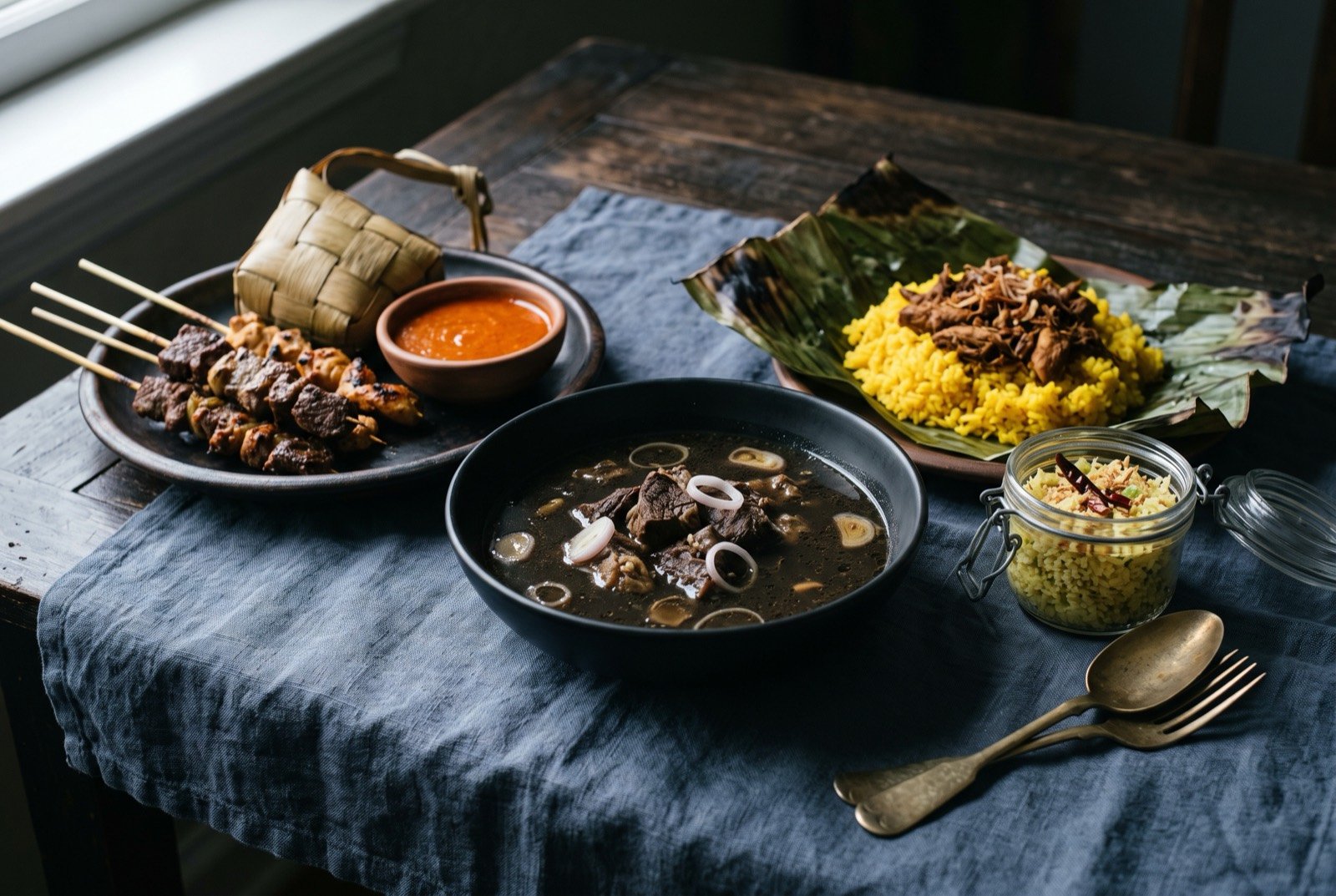
Mindanao and the Sulu Archipelago sit inside the Republic of the Philippines, but the food of the Maranao, the Maguindanaon and the Tausug people, no pork, heavy turmeric and coconut, a curry-forward grammar built on a base of pounded raw aromatics, has more in common with Brunei, coastal Sumatra and the wider Malay Muslim world than it does with the Hispanicised, Catholic, pork-and-vinegar cooking of Luzon and the Visayas across the same national line. This chapter treats the Maranao world of Lake Lanao and the Tausug world of the Sulu Archipelago in real depth, names Maguindanaon cuisine honestly where it intersects without pretending to have researched it as deeply, and gives every dish twice: once as tradition built it, once rebuilt with modernist technique.
Sources and review · What this chapter does not assert · How we research · Know this better? Tell us
A Sense of Place
Lake Lanao and the Maranao
Maranao means "people of the lake," from ranaw, lake, naming the group directly after Lake Lanao, the largest deep lake in the Philippines, sitting roughly 700m above sea level on the Bukidnon-Lanao plateau, with Marawi as the traditional centre and Lanao del Sur its core province. Wet rice cultivation is the basic mode of production, followed by corn, coconut, abaca, banana and durian; lake fishing was historically important and is now in documented decline, a fact worth taking seriously rather than treating as a romantic backdrop. The lake once held eighteen endemic cyprinid fish species; invasive species introduction has reduced that to three. Maranao political organisation never formed one state. It rests on the Pat a Pangampong a Ranao, the four confederate states of the lake, Bayabao, Unayan, Masiu and Baloi, dividing further into forty three agama states, the Lanao sultanate having seceded from the Maguindanao sultanate in the early seventeenth century.
The torogan, the pre-colonial royal house, is worth treating as kitchen infrastructure and not only architecture. Built without nails, its beams carved with okir motifs and panolong wing-shapes, it held a bantolang, a bamboo platform packed with earth and ash forming the actual firebox, datola, three-stone vessel rests set into it, a tapaan, a bamboo rack above the fire for smoking fish or meat, and balengkat, covered baskets hung from poles for storage. Feast seating was itself hierarchical, ordinary guests near the dasigan by the door, favoured guests on the sendigan mattress. This is the physical setting the feast dishes below, riyandang and pater among them, were built to be cooked and eaten in.
The Sulu Archipelago and the Tausug
The Sulu Archipelago runs from the Zamboanga Peninsula to Borneo across the Sulu, Basilan and Tawi-Tawi island groups. Tausug cuisine proper centres on Jolo, spreading to Zamboanga, Basilan and southern Palawan. The archipelago is not ethnically uniform, and this chapter does not flatten it into "Tausug" for convenience: Sama-Bajau are the dominant group of Tawi-Tawi specifically, maritime and houseboat-oriented, with their own dish tradition (see below); Yakan, on Basilan, are an inland agricultural people usually classed as distinct from Sama-Bajau despite a shared-ancestry claim.
Before the seventeenth century, Jolo was, in the words of one historical trade account, "the richest and foremost settlement in the Philippine Islands," rivalled in northeast maritime Southeast Asia only by Brunei itself: its trade carried silk, silver and porcelain from China and Japan, gold and wax from Luzon and the Visayas, gunpowder and gems from Malacca and Brunei, pepper and spice from Java, the Moluccas and Celebes. By the early twentieth century, pearl and shell exports were the Sultanate's principal industry, over half of total export value in 1905 and 1906. Rice, by contrast, was the largest single food import in the same years. This is a load-bearing fact for the whole chapter: Sulu's wealth was maritime and mercantile, not agrarian, and the Sultanate imported its own staple grain rather than growing enough of it, which is part of why cassava, not rice, is the archipelago's own non-purchased starch of record, prepared as piutu (steamed, shaped cassava), siyanglag (roasted, grated) and biyanban (steamed tapioca-flour cylinders), eaten alongside seaweed, giant clam or cured raw fish where rice would sit on a Luzon plate.
The Brunei-Sulu axis
Sulu's founding sultan, Sharif ul-Hashim, an Arab-descended sayyid born in Johor who arrived via Malacca, married into the existing Sulu royal line and formally founded the Sultanate in 1457, promulgating the Diwan legal code drawn from the Quran. When Magellan's expedition reached Brunei in 1521, Sultan Bolkiah of Brunei controlled practically the whole of Borneo, the Sulu Archipelago and neighbouring islands, Brunei the senior partner at that point. The relationship reversed in the seventeenth and early eighteenth centuries: Tausug forces from Sulu assisted Brunei during a decade-long civil war, and Brunei rewarded this in 1704 by ceding North Borneo's east coast, from Paitan and Sandakan through Lahad Datu and Semporna to Tawau, to Sulu. This is the documented origin of the Sulu Sultanate's later, still politically live claim over Sabah, and it is the clearest single piece of evidence for reading Sulu as belonging to the Malay-Islamic Nusantara world rather than to a Philippine national frame drawn centuries later by people who had never been there. No Bruneian institutional source was reached in this chapter's research, and the Brunei side of this history rests here on Malaysian secondary synthesis rather than a Bruneian primary account, a real gap named rather than smoothed over.
A table of peoples, logic and dishes
| World | Defining logic | The dishes that carry it |
|---|---|---|
| Maranao, Lake Lanao | rice and lake fish, palapa as the everyday table base, torogan feast cooking | piaparan, riyandang, pater, palapa itself |
| Tausug, Sulu Archipelago | maritime trade wealth, imported rice, cassava as the honest starch, pamapa and burnt coconut as the highest-status base | tiyula itum, piyanggang manok, satti, junay |
| Sama-Bajau, Tawi-Tawi | houseboat and reef ecology, whole-shell cooking vessels | oko-oko, rice cooked inside a sea urchin |
| Maguindanaon, Cotabato and the Pulangi river (named here, not independently researched to this volume's own standard) | the third Moro bloc, sharing dish names and technique across the ethnic line | pastil, its true home; the tinagtag/lokot-lokot fritter family |
The History in Layers
Islam arrives before the Philippines exists as an idea
Sheikh Karim ul-Makhdum arrived at Simunul island, Tawi-Tawi, from Malacca in 1380 with Arab traders, and built what is dated as the first mosque in the Philippines, and in maritime Southeast Asia generally, at Tubig-Indangan, still standing in name as the Sheikh Karimul Makhdum Mosque. This makes Sulu one of the oldest Islamic footholds anywhere in the region, predating Melaka's own conversion in some tellings and predating Spanish contact with the archipelago by over a century. Sharif Muhammad Kabungsuwan is credited with completing Islamisation of the west Mindanao coast, landing at Malabang around 1515 and founding the Maguindanao sultanate, extending Islamic influence into Lake Lanao through intermarriage and alliance; his brothers are traditionally credited with founding the Brunei and Sulu sultanates in turn, tying the whole region's conversion to one shared Malay-world family network rather than three separate events. Maranao lake settlement itself is older still, some sources placing it as far back as the thirteenth century, which means Islam arrived among an already-established lake-dwelling population rather than founding it, a distinction this chapter keeps precise rather than collapsing the two dates into one.
Never subdued
The Spanish-Moro conflict runs from first contact in 1578 through to the Spanish-American War, and Lanao specifically was never subdued. Maranao communities built kota, fortified strongholds, and repelled repeated Spanish campaigns, most notably in 1891, restricting Spanish presence to a handful of coastal garrisons. Sulu fared little better from Madrid's point of view: Spain finally occupied Jolo only in 1876, and the Treaty of Peace of 22 July 1878 formally handed control of the archipelago outside the Spanish garrisons back to the Sultan of Sulu, meaning Spanish "control" of Sulu was late and largely nominal, the Sultanate persisting as a real governing entity almost to the end of Spanish rule in the Philippines. No source consulted in this chapter's research makes the food-history connection explicit, but it is worth stating as an honest inference rather than a proven fact: the near-total absence of Spanish-derived dish names anywhere in this chapter's dish list, against the Hispanicised vocabulary, adobo, mechado, that saturates lowland Filipino cuisine, is consistent with, though not proof of, that resistance history.
American sovereignty followed in 1898; assimilation policy, including suppression of slave-trading, a structurally important Sulu institution under the old maritime economy, provoked the Moro Rebellion of 1901 to 1913. Sulu today is one of five provinces in the Bangsamoro Autonomous Region in Muslim Mindanao, alongside Basilan, Lanao del Sur, Maguindanao and Tawi-Tawi, and its inclusion has itself been politically contested within the Bangsamoro project: a BARMM government source directly addresses "Sulu exclusion" concerns, insisting "the Bangsamoro will never be the same without Sulu and its people." This chapter takes no position on that dispute and states only that it is real and current.
Marawi, 2017, and what palapa became afterwards
The five-month Siege of Marawi, May to October 2017, displaced over 369,000 people. Palapa became a documented vehicle of livelihood recovery in the aftermath, not only a condiment. UNHCR Philippines backed Palapalicious, a women's livelihood cooperative; a separate cooperative, Super Lumba, in Lumba-Bayabao, Lanao del Sur, grew from one displaced woman's improvised meal made from nothing but sakurab, ginger and chilli, and now sells packaged palapa in Metro Manila through The Good Store, supported by the #ForMindanao programme. This is the strongest, most currently documented piece of modern Maranao food history this chapter found, and it belongs in the same sentence as the recipe below, not filed separately as background.
An invisibility this chapter did not have to invent
Why does Moro food barely register in how "Filipino food" is understood, in Manila as much as in Britain? This is partly documented, not only inferred. Datu Shariff Pendatun III, an essayist-chef tracing his ancestry to the pre-Islamic rulers of Buayan, has said directly that he wants "to disabuse people of the idea that Moros are just about war, guns, and strife," arguing "the food of Muslim Mindanao has the power to connect, and not divide." Chef Miguel Cabel Moreno, on receiving the Philippines' first Michelin Bib Gourmand recognition for a Tausug restaurant, framed it explicitly as overdue honour for "Tausug hands, time, and faith," implying a prior pattern of this group's culinary labour going unrecognised. The more structural explanation offered here is this chapter's own synthesis, not a sourced assertion, though a reasonable one: "Filipino food," as codified for both domestic and export consumption, restaurants, cookbooks, diaspora identity, was built overwhelmingly around Luzon and Visayas, Hispanicised, pork-centred cooking, and halal Mindanao food sits outside that frame almost definitionally, since it refuses the pork and the colonial-Catholic reference points that dominate the national-cuisine narrative. Consistent with this: Moro food reaches mainstream Manila mostly through one cheap, portable dish, pastil, and even the most food-literate UK Filipino business found in this research, a London halal caterer, can describe tiyula itum and piaparan accurately in its own marketing copy while not actually cooking either one.
The Flavour Arsenal
Turmeric (kalawag), fresh, grated or sliced, not powdered where it can be helped, is the single most consistent marker across Maranao, Tausug and Maguindanaon cooking alike, present in palapa, pamapa, pater's kuning rice and satti's marinade. Coconut, in three distinct registers, not one. Fresh grated coconut, unremarkable, is the everyday base; toasted coconut, browned in a dry pan or over fire, gives piaparan and palapa their nutty depth; and charred coconut, deliberately blackened well past ordinary toasting, is the Tausug tradition's own high-status marker, the ingredient that gives tiyula itum and piyanggang manok their name and their colour. These three are not interchangeable, and a recipe that calls for one and receives another has changed the dish, not merely varied it. Sakurab, a native Lanao shallot, botanically distinct from the common shallot and confirmed to grow nowhere outside the country around Lake Lanao, is Maranao palapa's own aromatic, more intense than a scallion, closer to true shallot. Calamansi, the small, sweet-sour citrus, souring and finishing across the whole region. Malunggay, moringa leaf, in soups and vegetable sides. Cassava, prepared whole ways rather than as flour alone, is the Sulu Archipelago's honest starch, standing in for rice where rice had to be bought rather than grown. Bagoong/alamang, fermented shrimp paste, appears as a savoury foundation in satti's sauce, the same functional role it plays across the wider Philippines. No pork, ever, structures the whole protein grammar: beef, goat, chicken and fish carry the flavour work pork carries elsewhere in Filipino cooking, and halal slaughter is assumed rather than stated in every recipe below. This chapter could not find any Tausug- or Maranao-specific ethnographic detail on halal butchery's ritual or social structure beyond generic Islamic slaughter description, and says so rather than dressing up the generic account as locally specific.
The Technique Ladder
The argument, from inside
Five rungs, each one doing real, checkable work rather than standing in as a vague gesture at "traditional method."
Rung 1. Char the coconut past toasting, into deliberate near-carbonisation
Ordinary Maillard browning plateaus above roughly 180°C. Tausug cooking pushes the coconut meat well past that, under a broiler or over open flame, until it is genuinely black, then grinds it fine. This is the same mechanism, taken further, behind the bitter, smoky depth of dark-roast coffee or a properly charred barbecue bark: pyrolysis, not simple browning. Filipino food writers repeatedly claim the resulting stew keeps for days without refrigeration; no food-science source consulted here confirms this specifically, and it is presented as traditional belief, not verified fact.
Rung 2. Pound the aromatic base before any heat touches it
Palapa and pamapa are built the same way: sakurab or shallot, ginger, turmeric and chilli pounded, not sliced, rupturing cell walls so oil-soluble flavour compounds are already suspended and ready to bloom in fat, rather than needing slow extraction during a simmer. A high-power blender does this job faster than a mortar and pestle, but the principle, rupture before heat, not simply combine before heat, is what a blender has to be pushed hard enough to actually achieve.
Rung 3. Separate the sear from the sauce
Satti's meat is grilled hard and fast, then dressed with a separately built, simmered sauce; piyanggang manok is braised first, then finished on a hot grill for char alone. In both cases a fast, high-heat step does the Maillard and smoke job, and a slower, wetter step does the depth job. Trying to get both from one pan in one motion is exactly what these dishes are built to avoid.
Rung 4. Let the leaf cook, not just wrap
Pastil, pater and junay all steam hot rice and a shredded-meat filling inside banana leaf while the leaf is still warm and pliable, traditionally passed briefly over a flame first to release its own oils. The leaf goes on doing work after the parcel is sealed, holding in residual heat that finishes cooking the filling gently while its own aroma transfers into the rice, the same principle behind cooking en papillote.
Rung 5. Braise tough cuts low, slow, and in coconut fat, not water
Riyandang and tiyula itum both run ninety minutes to two hours of low, moist heat, breaking down collagen in brisket or stewing beef while the coconut milk's fat, rather than a thin water-based liquid, carries the charred and aromatic compounds all the way through the meat instead of leaving them to sit as loose particulate in the broth.
The Ferment and Preserve Bench
Palapa, and a correction worth stating plainly
This volume's own working notes described palapa as a fermented base. That does not survive checking. Edgie Polistico, a Filipino culinary lexicographer, describes it as pounded raw aromatics cooked briefly in a dry pan until fragrant and reduced, then jarred, a cooked and dried relish rather than a lacto-fermented one; Wikipedia's own sourced entry, citing Polistico and a 2018 ABS-CBN News feature, agrees. This chapter does not call palapa a ferment.
A second, related gap. Given the Sulu Archipelago's maritime economy, dried or salted fish preservation is very likely structurally important there, and one unverified Malay-language search snippet gave a single term, kihampau, for it. No source describing the actual Sulu-specific method, fish species or terminology was found, and this chapter does not build a preservation entry around a single unverified word.
Sourcing in Britain
Verified this research pass, September 2026. The headline finding cuts two ways, and both halves are worth stating plainly. There is no UK retail infrastructure specific to this cuisine at all: what exists is the general, modest Filipino grocery scene built to serve the far larger Luzon and Visayas diaspora, plus the pan-Asian grocery sector that happens to stock several of this chapter's ingredients anyway. Against that, several individual ingredients, calamansi chief among them, are more genuinely sourceable in Britain than a reader might expect.
The ranked list: what decides great from grim
- The burn on the coconut, for tiyula itum and piyanggang manok. This is a technique gap, not a sourcing gap, and the single highest-leverage thing separating an authentic result from a merely competent one. No product substitutes for genuinely charring fresh grated coconut black.
- Real calamansi, fresh or frozen, over a lime substitute. London Grocery imports fresh weekly; Tradewinds Oriental Shop carries the Kain-Na! frozen brand; Fine Food Specialist stocks a professional frozen Boiron puree. Real calamansi has to be ordered in, not bought on the spot, but it is genuinely buyable, and lime plus a little mandarin or sweet orange zest should be treated as a fallback, not the default.
- Fresh turmeric root, via Pound Veg or general UK Asian grocers. No compromise needed here at all.
- Frozen, not dried, malunggay/moringa leaf, via Longdan (Buenas brand) or London Grocery. Fresh leaf is not realistically obtainable in Britain; dried is a different ingredient, closer to a supplement than a vegetable.
- Banana leaf, frozen, from any UK Southeast Asian grocer. A rare, fully solved ingredient in this cuisine's shopping list.
- Glutinous rice. Fully solved, sold as a pan-Southeast-Asian staple wherever Thai or Lao sticky rice is sold; Filipino malagkit is the same grain.
Genuine gaps, named rather than papered over
No UK retailer, brand or diaspora shop sells palapa in any form, and no UK stockist or grower of sakurab, the native Lanao shallot, was found. Banana shallot plus a few spring onions is the honest approximation, not the ingredient; there is no substitute that reaches sakurab's actual flavour. Since palapa's character comes from dry-toasting rather than fermentation, no dehydrator is actually required to approximate it at home: a dry frying pan, or a Big Green Egg run indirect at low heat for the coconut-toasting stage, replicates the traditional method closely. UK Filipino grocers checked in this research (Rollan's Pinoystore, Amores Oriental Mart, Tindahang Pinoy, Longdan) stock the generic Luzon and Visayan grocery this chapter does not need, banana ketchup, adobo mixes, pancit, and nothing identifiably Moro or Mindanao-specific.
One UK restaurant is a real, findable connection, and one name is a coincidence to avoid. Bintang, Camden Town, London, open since 1987 and describing itself as the only 100% Filipino halal restaurant in Europe, has named Beef Kulma, explicitly credited by the restaurant as Tausug, and a Filipino Rendang among its most popular dishes; its current live menu could not be independently reconfirmed, but its existence and halal-Filipino identity are verified through independent directories. Moro, in Exmouth Market, London, is not related to this cuisine at all: it is a well-regarded, Michelin-listed restaurant serving Moorish, Spanish and North African food, named for the Moors of Iberia, and the coincidence of the name should not lead a reader there expecting anything Mindanaoan.
Voices and Sources
From inside the tradition
- Chef Miguel "Miggy" Cabel Moreno, born and raised in Jolo, Sulu. His two Manila restaurants, Palm Grill and Cabel, both received Bib Gourmand distinctions in the inaugural Michelin Guide for Manila, reported as the first such recognition for a Tausug chef. Palm Grill's own signature dishes, tiyula itum, piyanggang manok, the communal Dulang platter and lokot-lokot, are the clearest living, currently-operating reference point this chapter found for what this cuisine looks like taken seriously.
- Datu Shariff Pendatun III, essayist-chef and Chief Culinary Officer of Aluyan Food Group, tracing his ancestry to the pre-Islamic rulers of Buayan. His touring programme "Dulang: Gastronomy of Muslim Mindanao" and his writing for GRID Magazine and FOOD Magazine make the explicit case, stated in his own words above, that Moro food belongs inside "Filipino food," not beside it.
- Norma Abubakar Abdulla, author of The Food and Culture of the Tausug (1989, Centro Escolar University Research and Development Center). This monograph is cited, at second hand, behind much of what this chapter and its research brief know about tiyula itum and junay, and was not obtained directly in this research. It is very likely the single best source for Tausug food culture in existence, and is named here as a target for any future revision of this chapter to obtain in full.
- Julie Cortes, Executive Chef at Hiraya, Washington DC, whose StarChefs-published, fully modernist reconstruction of tiyula itum is the clearest example found anywhere in this research of a chef taking a specific Moro technique and rebuilding it as a discrete plated course with real quantities, credited directly in this chapter's own elevation of that dish. Her own personal connection, if any, to Mindanao or Tausug heritage specifically was not verified and should not be assumed.
The UK gap, named
No UK restaurant, pop-up or market stall specialising in Moro or Mindanao food specifically was found, as distinct from generic halal Filipino food that happens to name a Moro dish in passing. Vanda's Kitchen, a London halal Filipino caterer, is the clearest single example of the pattern this chapter's own "invisibility" argument describes: its own marketing copy names tiyula itum and piaparan correctly and specifically, but its actual working menu is generic halal Filipino food, adobo, sinigang, kare-kare, not the dishes it can describe. The Philippine Muslim Association United Kingdom, a registered charity formed in 2009 by Filipino Muslims "from different areas of the Philippines, particularly in Mindanao," is real evidence a Moro diaspora exists in Britain, but it is a faith and community body, not a food business, and this chapter does not overstate what it offers a cook.
The language gap, named
Direct search in both Tausug and sustained Maranao script returned almost nothing beyond dictionaries, phrasebooks and missionary translation resources, no food journalism, no recipes, no cultural writing in either language. The strongest in-tradition material behind this chapter, Abdulla's monograph, the Tausug-authored blog cited in the research brief, Pendatun's own essays, exists in English or Filipino, written by Maranao and Tausug authors, not in the languages themselves. This is stated here as a genuine finding about where this cuisine's own written record currently sits, not as a shortfall in how this chapter was researched.
Things this chapter has deliberately not asserted
- That palapa is a ferment. Every in-tradition source found describes it as cooked and jarred, not lacto-fermented, directly correcting this volume's own earlier working description.
- That tiyula itum and piyanggang manok are Maranao dishes. They are Tausug, built on pamapa, a differently composed and named base from Maranao palapa, despite the superficial resemblance between the two words.
- Satti's supposed "Shatein," or "food of Shaitan," etymology. This does not survive checking against lexicographic sources; the real etymology, per Wiktionary and the OED, is Malay or Javanese sate, from Tamil cataic, "flesh."
- Riyandang's origin story. Two versions circulate, an Indonesian scholar's 1950s marriage into a Marawi family, or an exchange between Maranao and Indonesian Hajj pilgrims in Mecca. Both rest only on commercial recipe sites, and neither is asserted as settled history here.
- Any sago or ambuyat-type dish among Sulu-side Tausug or Sama-Bajau people. Sago cookery in this research is confirmed only for the Borneo side of the strait; proximity is not evidence, and none was invented here.
- Any Tausug-, Maranao- or Maguindanaon-specific ethnographic detail on halal butchery's ritual or social structure. Only generic Islamic slaughter description was found, and it is not presented as locally specific.
- The Lake Lanao fish name "kolokabra," which appeared in this volume's working checklist and could not be corroborated in any source consulted; it does not appear in this chapter.
- A full, equally weighted treatment of Maguindanaon cuisine. This chapter names Maguindanaon food honestly where it genuinely intersects, pastil above all, but was not researched to the depth this volume gave Maranao and Tausug cooking, and does not pretend otherwise.
- The Brunei side of the 1704 cession of North Borneo. This chapter's account rests on Malaysian secondary synthesis; no Bruneian institutional source was reached.
- Real, measured traditional recipes for lokot-lokot or dagol/dodol. Both are named and described by method and occasion; neither is given a "Tradition" recipe here for want of a source giving real quantities.
Char the coconut past toasting, into deliberate near-carbonisation
Ordinary Maillard browning plateaus above roughly 180°C.
Pound the aromatic base before any heat touches it
Palapa and pamapa are built the same way: sakurab or shallot, ginger, turmeric and chilli pounded, not sliced, rupturing cell walls so oil-soluble flavour...
Separate the sear from the sauce
Satti's meat is grilled hard and fast, then dressed with a separately built, simmered sauce; piyanggang manok is braised first, then finished on a hot grill...
Let the leaf cook, not just wrap
Pastil, pater and junay all steam hot rice and a shredded-meat filling inside banana leaf while the leaf is still warm and pliable, traditionally passed...
Braise tough cuts low, slow, and in coconut fat, not water
Riyandang and tiyula itum both run ninety minutes to two hours of low, moist heat, breaking down collagen in brisket or stewing beef while the coconut milk's...
The dishes
- Tiyula itum Jolo, Sulu
- Piyanggang manok Sulu Archipelago
- Satti Zamboanga, Basilan, Sulu, Tawi-Tawi
- Piaparan Lake Lanao, Lanao del Sur
- Riyandang Lanao del Sur
- Pastil, and the Maranao pater Cotabato and the Pulangi river; Lake Lanao
- Palapa Lake Lanao, Lanao del Sur
Sources and review
- Researched
- 6 sources cited
Where this volume comes from
3 research briefs on file for this volume, researched to the rules on How we research. Published 3 September 2026. Last changed 8 September 2026.
The brief's own account of its sources
Across both passes, of roughly sixty substantive sources consulted: approximately thirty two are Philippine-published or in-tradition (Philippine government heritage and agricultural bodies, national wire services and press including Rappler, GMA News, Philippine News Agency and Philstar, UNHCR Philippines, in-tradition Filipino food publications and lexicographers, a Tausug-authored blog, and academic sources reached directly or via citation); approximately eleven are Malay-language, Malaysian or Sabah-focused sources reached through genuine Malay-language search rather than English queries