Asia · Volume 44
Sumatra, the Malay Peninsula and the Melaka Strait
The Long Reduction, the Merantau Road and the Veranda of Mecca
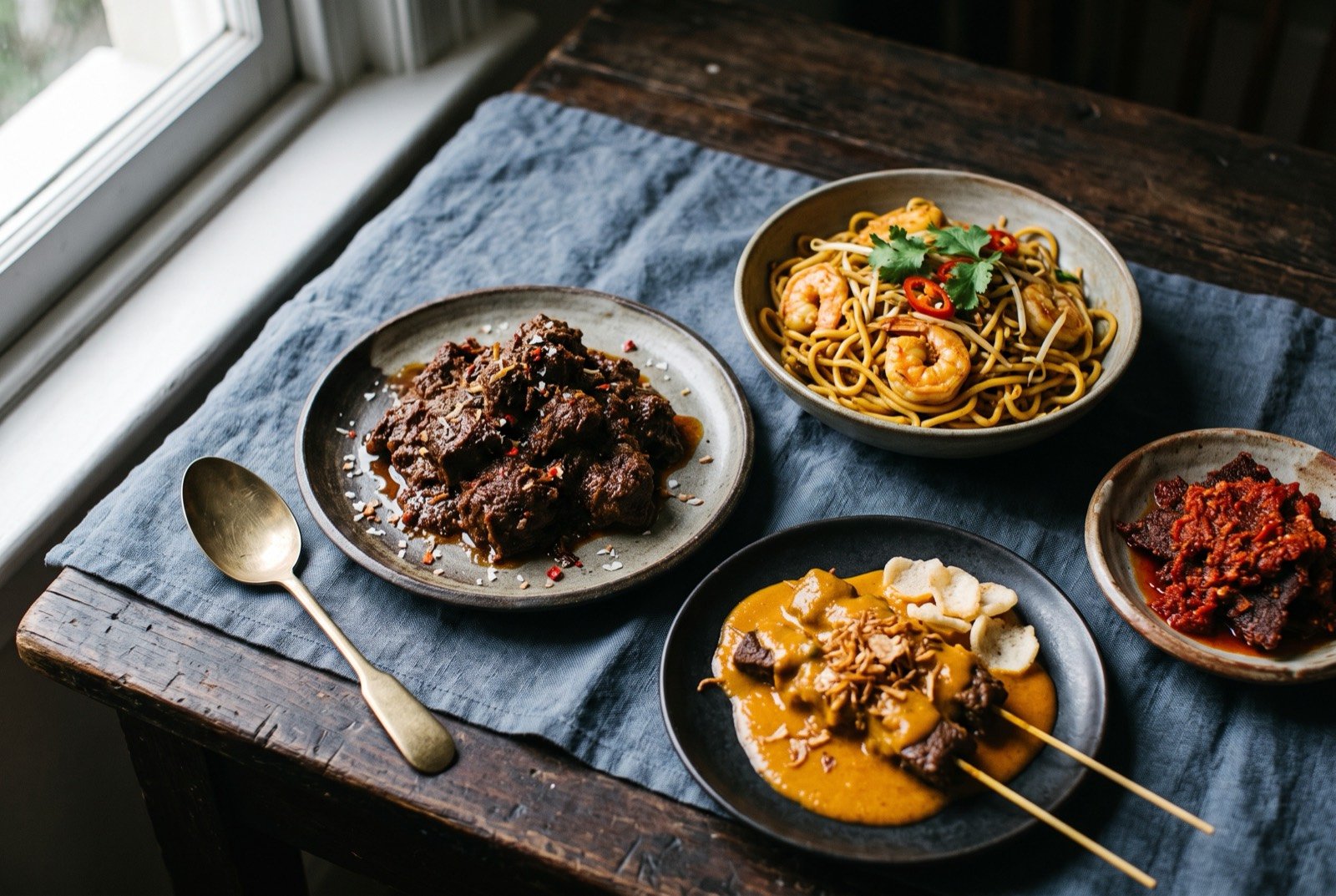
One sea, not a border. The Melaka Strait joins Sumatra's east coast to the Malay Peninsula's west coast more closely than either joins its own interior, and for most of this region's history the strait was the road, not the boundary: Minangkabau traders from the West Sumatran highlands crossed it routinely to sell food, Acehnese ships used it to reach the Indian Ocean and the wider Muslim trading world, and the modern international border cutting straight down its middle, drawn by an Anglo-Dutch treaty in 1824 and hardened into Indonesia and Malaysia in the twentieth century, is younger than several of the restaurants in this chapter. Every restaurant technique in these cuisines has an indigenous ancestor, the idea this atlas returns to in every volume, and here that ancestor is a specific piece of engineering: rendang's long, three-stage reduction of meat in coconut milk is not a rustic approximation of a French confit or a modern sous-vide-and-reduce technique, it is the same underlying physics, low water content, a fat seal, a heavy antimicrobial spice load, arrived at independently, centuries earlier, by Minangkabau cooks who needed food that would survive weeks on the road. Further north, Aceh's own claim to a heavier, more richly spiced table is real, but the popular version of the story, that its debt runs straight back to Arabia, gets the mechanism wrong: the documented carrier is Gujarati and Tamil Indian trade, reinforced rather than founded by Arab and Persian contact, and Aceh's most famous modern product, its coffee, turns out to owe nothing to the Ottomans at all. Every dish as tradition built it, then what a modern chef would change.
Sources and review · What this chapter does not assert · How we research · Spotted something wrong?
A Sense of Place
Highland, coast and strait: the ecology this chapter actually covers
Sumatra is not one food world and this chapter does not pretend it is. The Bukit Barisan mountain range runs the length of the island's west coast, and Minangkabau territory sits inland on that spine, in the cool highlands around Bukittinggi and the old royal seat of Pagaruyung: a rice-terrace and market-town ecology, matrilineal in its inheritance and its social grammar, whose food runs on chilli, coconut and a long list of aromatics ground fresh into a wet paste. It was never cut off from the sea. The same highland polity that built Pagaruyung also held ports on both coasts, Barus, Tiku and Pariaman to the west, a reach toward Jambi to the east, so spice and trade goods reached the highlands from the start rather than arriving late as a foreign graft. East of the highlands, the rivers, the Kampar, Siak, Rokan and Indragiri, drain into the strait through what is now Riau, a genuinely Minangkabau cultural sphere, the rantau, even though it sits outside West Sumatra's current provincial border, and its food, river catfish curried in a bone-in yellow broth, belongs to this chapter's argument as much as anything cooked in Bukittinggi itself.
At the strait's northern mouth, Aceh faces the Indian Ocean and the Bay of Bengal directly, and its history runs on a different clock. Islam reached Peureulak on Aceh's east coast by the eighth century CE, and Samudera Pasai, generally treated as the first fully Islamic kingdom in what is now Indonesia, was founded around 1267, centuries before Islam took hold anywhere else in maritime Southeast Asia. That head start, and the direct Arab, Persian, Gujarati and Tamil shipping that built it, gave Aceh's kitchen a different spice grammar from the rest of Sumatra: more numerous dried spices, cardamom, cumin, star anise, fennel, cinnamon, worked into a curry-format kari rather than the shorter, wet, turmeric-chilli-coconut list a Minangkabau gulai runs on. Across the strait, the Malay Peninsula's own port cities, above all George Town on Penang, built a third food world again: not an indigenous ecology at all but a creole one, laid down by centuries of Tamil Muslim, Chinese and Malay trade converging on the same docks, its defining dishes born from feeding dockworkers rather than from any single kitchen tradition.
A table of peoples, logic and dishes
| Place | Defining logic | The dishes that carry it |
|---|---|---|
| West Sumatra, the Minangkabau highlands | matrilineal adat, merantau migration, the long santan reduction | rendang, sate Padang, dendeng balado, ayam pop, nasi Padang's hidang service |
| Riau, the Minangkabau rantau | river ecology, bone-in freshwater fish, wild-caught preferred over farmed | gulai ikan patin, asam pedas |
| Aceh and the northern strait | direct Indian Ocean and Arab trade contact, curry-masala spice grammar | mie Aceh, kuah beulangong, sie kameng |
| George Town and the Peninsula's ports | Tamil Muslim mamak trade, dockworker preservation cookery, creole convergence | nasi kandar, the banjir and kuah campur service styles |
| Medan and North Sumatra | Chinese, Batak and Malay layers on a Dutch colonial trading city | bika ambon (named but not treated in full here, see below) |
The History in Layers
Aceh's early Islam, and why the epithet "Veranda of Mecca" is earned rather than borrowed
Peureulak, on Aceh's east coast, was a functioning trade port by the eighth century CE, drawing ships from Arabia, Persia, Gujarat and China; local tradition dates its Islamic kingdom to 840 CE. Samudera Pasai followed around 1267, founded by Meurah Silu, who took the name Sultan Malik al-Saleh, and absorbed Peureulak in 1292. This is centuries of continuous Arab, Persian and Gujarati Indian shipping through Aceh's ports before the Aceh Sultanate proper even existed, and it means the epithet Acehnese identity still carries, Serambi Mekkah, the Veranda of Mecca, rests on real ground: Aceh was the first entry point for Islam in the archipelago, and from at least the fifteenth century it functioned as the last waystation, where pilgrims from across maritime Southeast Asia stopped, studied and prepared before the crossing to Arabia for Hajj.
The Aceh Sultanate itself, founded in 1496 by Sultan Ali Mughayat Syah, became the dominant power on the strait and reached its height under Sultan Iskandar Muda, who ruled from 1607 to 1636: one of the largest Islamic states in Southeast Asia, a major naval and military power, a centre of Islamic scholarship, and the hub of the region's spice and pepper trade. Its rise is a direct consequence of a Portuguese decision elsewhere. When Portugal seized Melaka in 1511, Muslim traders diverted away from the strait's old centre and around Sumatra's west coast instead, and Aceh absorbed and monopolised the new route, controlling merchant access tightly and remaining the region's trading hub from roughly 1500 to 1650.
The Ottoman connection is real, and it is not culinary. An informal Ottoman-Aceh alliance existed from at least the 1530s, built on the Indian Ocean pepper trade with direct Acehnese shipments to Red Sea ports. Sultan Alauddin Riayat Syah al-Kahhar sent an envoy to Suleiman the Magnificent in 1562 or 1564 requesting military support against the Portuguese, addressing him as Caliph of Islam; after Suleiman's death in 1566, his son Selim II ordered ships, soldiers, gunsmiths and engineers to Aceh, a first fleet of fifteen galleys with artillery, and Ottoman archives preserve his letters of 1567 and 1568 on the planned expedition. This is genuine imperial diplomacy, embassies, artillery, gunsmiths, and it is worth naming honestly for what it is rather than stretching it into something it never became: no source behind this chapter extends it into a documented culinary transmission specific to Aceh.
The better-evidenced culinary vector is Gujarati and Tamil Indian trade, not Arabia directly. Gujarati merchant networks dominated the Cambay-to-Melaka run through the sixteenth century, trading cotton textiles for pepper and spices, with documented commercial links to Acehnese ports including Pidie and Pasai, and those traders are credited in the historical record with carrying Islamic teaching alongside their goods. Acehnese society today still recognises a resident community of Indian descent, mainly Tamil and Gujarati. This is the actual mechanism behind curry leaf in kuah beulangong, the curry-masala spice grammar in mie Aceh and kari, roti canai's presence in Acehnese street food, and even a piece of Acehnese vocabulary: martabak Aceh's name is credibly derived from the Indian maharaj-ba, "the king's cake." The chapter's honest correction to its own spine claim: "heavier, more Middle Eastern spicing" is the popular shorthand, but "heavier, India-inflected curry spicing, on routes that also carried Arab and Persian traders and, later, Ottoman diplomatic and military contact" is the more accurate one.
Coffee is where the popular version of Aceh's story fails outright, and it is worth stating plainly rather than repeating the tourist line. Kopi sanger, the milk coffee now synonymous with Banda Aceh, is a 1990s student invention, not an inherited tradition of any kind: cash-strapped university students asked warkop owners for a lighter, cheaper coffee, and the name is popularly explained as a contraction of sama-sama ngerti, "mutual understanding," meaning both customer and vendor knew it was a cut-price order. Gayo arabica, the coffee that has made Aceh internationally famous, is a 1908 Dutch colonial plantation crop, first planted in the Takengon highlands under a named Dutch planter, Veenhuyzen, following the Dutch occupation of Tanoh Gayo in 1904; Gayo smallholders only began planting their own coffee from around 1925 to 1930, having learned from proximity to the colonial estates. Neither drink has an Ottoman or Arab genealogy in any source this chapter's research reached. What is true, and more interesting than the myth: Aceh's warkop culture is a genuine, deep social institution that predates kopi sanger by generations, and coffee drinking as a practice did spread outward from Yemen through the Muslim world over centuries, which is where the instinct to reach for an Arab lineage is not wrong in the abstract, only wrong in the specific.
The Minangkabau highlands: matrilineal adat, and why merantau exists
Minangkabau kinship traces lineage and inheritance exclusively through the maternal line: children belong to their mother's clan, and ancestral property, especially harta pusaka, the original ancestral land, passes from mother to daughter. The rumah gadang, the great house, and its agricultural assets are held jointly by one matrilineal descent group, a sabuah paruik, literally "one womb." This is matrilineal, not matriarchal, in the sense of women holding formal political office, and Indonesian scholarship is explicit about the distinction: women hold and transmit property and lineage; men hold administrative authority. A woman's brother, the mamak, manages and safeguards the clan's property without being able to alienate or personally use it; above the level of the individual clan, the penghulu, a customary chief filled by consensus based on ability, holds administrative and political authority within the nagari, the Minangkabau village republic. Peggy Reeves Sanday's ethnography, built on twenty years of fieldwork from 1981, complicates even that reading: she argues the Minangkabau's own term for their custom, adat matriarchaat, describes not female domination but a female power to "conjugate", to knit and regenerate social ties, rooted in cosmology and ritual rather than in office-holding. Both readings are worth holding at once rather than flattened into one tidy claim.
Because inheritance of the rumah gadang and its land runs through daughters, adult men have historically held very limited claim to family property in their home nagari, and this is repeatedly given as the direct structural driver of merantau: young men leave to seek their own fortune elsewhere, because there is comparatively little to inherit or build a livelihood on at home. Mochtar Naim's 1973 sociology dissertation, later published as Merantau: Pola Migrasi Suku Minangkabau, is the scholarly anchor for merantau as a structured, named migration pattern rather than informal wandering, combining livelihood-seeking, life experience, religious and worldly knowledge, and a rite of passage into adult manhood all at once.
The mechanism by which rumah makan Padang actually spread across the archipelago and beyond was chain migration through kinship, not centralised investment. Successful owners recruited relatives or people from the same home village to work for them, and those workers, once experienced and with capital of their own, opened new establishments in turn, a self-replicating pattern that fanned out across Indonesia's cities and beyond national borders into Malaysia, Singapore, Australia, the Netherlands, Japan and Saudi Arabia. Singapore gives a datable case: Warong Nasi Pariaman, on Jalan Kandahar, is Singapore's oldest Padang restaurant, founded in 1948 and still trading over seventy five years later; Rumah Makan Minang, founded in 1954 by a Minangkabau woman, Marlian, who had herself migrated to Singapore, complicates the assumption that merantau enterprise was exclusively male. The branded phrase "Rumah Makan Padang" itself is dated to the 1960s, standing in for Minangkabau identity generally even though the cooks and owners were rarely from Padang city itself; before that, the same kind of eating house was simply called a lapau.
Negeri Sembilan is the clearest evidence that this migration carried the whole social system, not just the recipes, across the strait. Adat perpatih, the customary law still practised in Negeri Sembilan, in Naning in Melaka, and by Minangkabau-descended communities in Johor, is matrilineal exactly like its Sumatran parent, tracing its founding mythically to Datuk Perpatih Nan Sabatang, and evolved over the fifteenth and sixteenth centuries as Minangkabau migrants blended their existing system with local Malay practice, Islamic law and, over time, influence from the Peninsula's own indigenous Orang Asli. Negeri Sembilan did not receive Minangkabau recipes as a foreign import to be localised from scratch; it received Minangkabau people, under the same logic still sending men from West Sumatra itself, which is exactly why its rendang tradition reads as a genuine sibling lineage rather than a copy. See the rendang entry below for how the two versions differ in practice, and why this chapter attributes the resulting dispute rather than adjudicating it.
The Padri movement, and why Minangkabau cooking is both strictly halal and matrilineal at once
From roughly 1803, a reformist Islamic movement known as the Padri, led initially by three hajis returning from Mecca, Haji Miskin, Haji Sumanik and Haji Piobang, sought to purify local Islamic practice of syncretic and adat elements they judged un-Islamic, targeting gambling, cockfighting, opium, alcohol, tobacco and betel-chewing alongside, significantly, matrilineal inheritance itself, which the Padri regarded as inconsistent with Islamic inheritance law. This sparked direct conflict with adherents of customary adat and, eventually, the protracted Padri War of 1803 to 1838, which drew in Dutch colonial intervention. The outcome was not the abolition of matrilineal adat but its assimilation with orthodox Islamic practice, a settlement Minangkabau identity still cites today in the formula adat basandi syarak, syarak basandi Kitabullah, custom is founded upon Islamic law, Islamic law is founded upon the Qur'an. This chapter states that formula on strong convergent evidence for the reconciliation it describes, though a dedicated source giving its precise wording and date of adoption could not be independently confirmed, and it should be checked before being quoted as settled fact rather than well-attested cultural formula. The practical result is the cuisine this chapter cooks from: strictly halal, no pork, structured around halal slaughter and religious as well as adat ceremonial occasions, sitting on top of a social structure that still determines who owns the kitchen, the land and the livestock, and therefore who has to leave to make a living. The food is not Islam laid over older adat custom; it is the product of a specific, dated, contested nineteenth-century negotiation between the two.
The strait's ports, and the dockworker's curry
George Town's own defining institution, nasi kandar, was built by the same trade contact that shaped Aceh, worked out on the Peninsula's own docks. Hameediyah, founded in 1907 by Tamil Muslim trader Mohamed Thamby Rawther and still run through seven generations, is Malaysia's oldest nasi kandar restaurant, and its origin is a specific, documented labour history rather than a folk story: curries for Weld Quay's dockworkers were deliberately made more concentrated, oilier and more heavily spiced than a Tamil original, "so as to preserve the food in the heat," and local ingredients, lemongrass, pandan, soy sauce, dried shrimp, belacan, were folded in to suit the mixed dockworker clientele the port actually had. That preservation logic, independently arrived at on the trading side of the strait, is the same physics rendang's long reduction runs on further south: a hard climate and a working population that needed food to last, solved twice, in two different kitchens, without either copying the other. The dish's serving grammar, kuah campur and banjir, is covered in full in the technique ladder below.
The Flavour Arsenal
The souring family, four distinct agents, not one. Asam jawa, tamarind, is the archipelago's default sourness, fruity and familiar. Asam gelugur, dried sliced Garcinia atroviridis, carries a sharper, faintly bitter edge distinct from tamarind's fruitiness and is the correct souring agent for a proper rendang or asam pedas, not a substitute. Asam kandis, a related dried sour fruit, appears through Minangkabau cooking, in dendeng balado's boil and in gulai patin. Asam sunti, or boh seulimeng, is Aceh's own signature and functions differently from all three: made from belimbing wuluh, starfruit, soaked, sliced, salted and sun-dried across several days until it behaves like a natural vinegar, it is credited specifically with removing the fishy odour from fish and seafood dishes, a functional role tamarind does not carry, and it is scarce enough outside Aceh that Acehnese travellers carry it home as a gift. One claim worth correcting directly: asam sunti is not made from nutmeg flesh, despite one plausible-sounding version of that claim circulating; every source behind this chapter is unambiguous that it is belimbing wuluh.
The fermented bases. Belacan, the Malaysian shrimp paste, is fermented for months and pressed hard into dense blocks, markedly pungent, and needs toasting, wrapped in foil and dry-fried or held briefly over a flame, before use. Terasi, its Indonesian cousin, is often softer and more crumbly, sometimes made with a shrimp-and-small-fish mix rather than shrimp alone. Tempoyak, fermented durian paste, is Jambi and Palembang's own signature, durian flesh lightly salted and packed airtight to ferment over several days, and it is the defining pairing for river catfish, gulai tempoyak ikan patin standing alongside the plain yellow version given below.
The Minangkabau wet paste and the Acehnese dry cluster, read against each other. A Minangkabau gulai runs on a short, wet list: cili padi or curly red chilli, shallot, garlic, ginger, galangal, turmeric, lemongrass, candlenut for body, with daun kunyit, whole turmeric leaf, and lime leaf as the signature aromatics that separate this cooking from a generic curry. Aceh's kari runs longer and drier: the same base plus cardamom, cumin, star anise, fennel, cinnamon, clove and white pepper, a genuinely more numerous, masala-adjacent spice list that Indonesian food writing itself distinguishes from gulai by name, and Aceh's own cooks distinguish further still, a richer "kari Pidie" against a lighter, toasted-coconut "kari Aceh," though this particular internal distinction rests on a single source and should be treated as one writer's framing rather than settled regional geography.
Coconut milk, and why its fat content is the single most consequential ingredient decision in this whole chapter. Santan carries this cuisine's whole reduction technology: a full-fat milk, roughly 17 to 19 percent fat or higher, splits cleanly under long heat, releasing its oil and allowing a sauce to darken and concentrate properly; a low-fat "light" coconut milk never achieves this and reduces instead to a thin, watery liquid that will not become rendang no matter how long it simmers.
Sweeteners and the one nutmeg complication worth naming honestly. Gula Melaka, palm sugar from the coconut palm's flower bud, carries a smoky, caramel-toffee depth distinct from cane sugar or generic palm sugar; genuine gula Melaka is soft and crumbly rather than a hard, glassy block. Nutmeg, pala, belongs to this chapter in its own right, distinct from the Banda Islands' famous spice-trade story, which is a different volume's territory: Aceh Selatan grows a real, named regional crop, and its own signature use treats the fruit's flesh as a candied product, manisan pala, associated with Tapak Tuan, rather than the seed as a background spice, the opposite emphasis from how nutmeg usually functions.
The Technique Ladder
The argument, from inside
William Wongso, Indonesia's best-known culinary authority, gave Gordon Ramsay his rendang lesson for National Geographic's Uncharted in 2020, and his own published method is the clearest working statement of this chapter's central technique below. He has also made the sharper point that matters for the whole diaspora-elevation question this chapter asks: Indonesian restaurants abroad, in his direct and public critique, too often adjust flavour to a perceived local palate and lose their culinary identity in the process, a contrast he draws unfavourably against Vietnamese diaspora restaurants, which he says hold a harder line on authenticity. Uni Emi, head chef at a Bukittinggi-style Nasi Kapau restaurant, gave the clearest working cook's answer, during the international backlash to MasterChef UK's 2018 "crispy rendang" elimination of contestant Zaleha Kadir Olpin, to why the demand itself was a category error: "there is no way chicken rendang should be crispy," because a three-hour-plus reduction that caramelises coconut milk against spice would cause skin-off chicken to disintegrate; the skin stays on and stays soft because of, not despite, the correct process. Food writer Rahung Nasution generalised the failure further: judging a dish by the aesthetic conventions of a completely different cuisine, treating Western fried-chicken crispness as an unexamined default marker of "properly cooked."
Rung 1. The three-stage santan reduction: gulai to kalio to rendang
This is the technique the whole chapter turns on, and every source behind it, including William Wongso's own recipe, agrees on the same three named stages, working vocabulary rather than folk simplification. Gulai, the first stage: coconut milk abundant and thin, sauce reddish brown, meat beginning to take colour but not yet cooked through. Kalio, reached after roughly the first two to three hours: coconut milk has thickened and started to release oil, colour has moved to a deeper brown, the meat is fully cooked and still soft. Kalio is a legitimate finished dish in its own right in Minangkabau cooking, not a failed or interrupted rendang, commonly served and eaten exactly as it stands, wetter and glossier than what follows, and it keeps roughly three days. Rendang, the final stage, reached after seven to eight hours total, sometimes taken overnight for the driest versions: continued reduction until the santan has broken fully into oil, the sauce has all but disappeared into the meat, colour has gone near black, and the meat itself has firmed and toughened slightly against kalio's softness. Toasted grated coconut, kerisik, is folded in as the dish approaches this final dry stage. A properly finished rendang keeps two to three weeks at ambient tropical temperature; kalio does not.
Why the dry reduction is a preservation technology, not a flavour choice. As the coconut milk's oil content rises and its water content falls near to nothing, and the meat itself dries and firms, the finished dish reaches very low free water activity, substantially sealed in its own rendered coconut fat, carrying a heavy concentration of antimicrobial spice compounds, chilli, garlic, ginger, turmeric, galangal and lemongrass, driven through the meat by hours of slow cooking. This is the same basic logic as a confit or a properly rendered pâté, arrived at independently, centuries earlier, by people who needed food to survive a sea crossing and weeks of trading on the road. Rendang's rise is directly tied to merantau in the historical record: selling nasi Padang was one of the principal livelihoods for migrating Minangkabau traders, and a dish that could travel without spoiling was not incidental to that trade, it was the trade's actual technology.
Rung 2. Bumbu tumis: the paste that decides the dish before the liquid ever goes in
Every wet-paste dish in this chapter, rendang, gulai, sate Padang's gravy, mie Aceh, begins the same way: aromatics ground to a smooth paste, then fried out properly in oil, tumis, until fragrant and beginning to release its own oil, before liquid is added. This is where the dish's real flavour architecture is built, not in a finishing garnish, and it is also where the single most common failure this chapter's research found actually happens: a bottled paste or a jarred sauce cannot replicate a specific proportion of shallot, garlic, chilli, galangal, turmeric and candlenut, and it skips the blooming step that develops the base flavour before coconut milk ever enters the pot. William Wongso's own rendang formula, for one kilogram of beef, gives this paste as 150 grams curly red chilli, 40 grams shallot, 40 grams garlic, 30 grams candlenut, 1 gram clove and 60 grams galangal, ground and fried before the coconut milk goes in.
Rung 3. Balado: the coarse, cooked finish, not a raw sambal
Balado is deliberately built from cooked, softened ingredients rather than a raw pounded relish: red chillies, shallot and tomato are steamed until soft, roughly ten minutes, then coarsely, not finely, ground with salt, sugar and lime juice, and stir-fried, often reusing the oil left over from frying the accompanying meat. The coarse grind is the defining textural signature, distinguishing it from a smooth sambal, and it is worth stating for a reader with a high-power blender: pulsing this mixture to a rough, chunky texture rather than a purée is not a compromise, it is the technique.
Rung 4. The dry-fry-and-glaze preservation logic, dendeng's smaller echo of rendang
Dendeng balado runs a related but distinct preservation grammar at a smaller scale than rendang: beef is first simmered until tender, sliced thin against the grain, briefly fried and drained, marinated roughly an hour, then fried again over medium heat until dark without burning, the step that produces the dried, crisp-edged texture the dish is named for. This is not a task for a dehydrator run on the raw sliced beef; that would make jerky, not dendeng. The correct sequence, wet then dry, fried then glazed, is covered in full at Dish 3 below.
Rung 5. Hidang and banjir: two serving grammars, two different histories, the same underlying instinct
Nasi Padang's hidang system and George Town's banjir are independent inventions that arrive at a related answer: food arrives at the table as abundance, not as a sequence. In a rumah makan Padang, a server carries the full range of a kitchen's cooked dishes to the table at once, stacked along the forearm, a specific skill called manatiang, and the diner pays only for what is actually eaten, untouched plates returned to the kitchen without charge, gulai sauce ladled over rice given free. Indonesian sourcing links this directly to makan bajamba, the older Minangkabau communal eating tradition used at adat ceremonies, where profusion of dishes at a shared table is itself the marker of respect. Nasi kandar's own service style is different in mechanism though similar in spirit: kuah campur, mixing curry remnants deliberately for a deeper, more complex flavour rather than treating it as waste, and banjir, "the flood," layering multiple curries so a tangy fish curry sits on a rich meat curry, executed by a server, called "the jockey," who judges proportions to build a balanced plate to order. One is a commercialised descendant of ceremonial hospitality; the other is a dockworker's economical, deliberately layered curry service. Both belong to this chapter as technique, not decoration.
Rung 6. Communal cauldron cookery, kuah beulangong's scale as method
Kuah beulangong is cooked in a belanga, a large cauldron, in batches large enough for roughly two hundred portions, and this is the whole point of the dish rather than a home recipe scaled up: by Acehnese custom, only men cook it, and the labour and scale are central to its meaning at Maulid Nabi, Eid and weddings, not incidental to it. Before it carried this Islamic-festival role, Acehnese farming communities already cooked a related dish, kuah blang, "from the rice field," as part of a harvest-blessing ritual, Kenduri Blang, cooked in the fields themselves in clay pots fired with burning rice straw. The Islamic-festival version was layered onto an indigenous agrarian ancestor, not invented from imported trade alone, which is a stronger and more honest story than curry leaf and Nusantaran spice meeting with nothing behind either of them.
The Ferment and Preserve Bench
1. Tempoyak
Fermented durian paste, Jambi and Palembang's own signature: durian flesh de-seeded, lightly salted, packed into a sealed, low-oxygen container and left several days at ambient temperature to ferment naturally. Its defining pairing is river catfish, gulai tempoyak ikan patin standing as a fermented sibling to the plain yellow gulai patin given above.
2. Asam sunti
Aceh's own souring agent, covered in full in the Flavour Arsenal above: belimbing wuluh, soaked, sliced, salted and sun-dried repeatedly across several days until it functions like a natural vinegar and keeps for over a year. Scarce enough outside Aceh that it is carried home as a gift.
3. Belacan and terasi
The fermented shrimp bases underneath most of this chapter's wet pastes, covered in full above: belacan pressed hard and pungent, needing a toast before use; terasi softer, sometimes a shrimp-and-small-fish mix. Neither should be used raw or omitted; the savoury backbone of a gulai or sambal depends on this step.
4. Asam gelugur
Dried, sliced Garcinia atroviridis, the correct souring agent for rendang and asam pedas, distinct from tamarind's fruitier sourness and worth sourcing specifically rather than defaulting to tamarind out of convenience.
5. Dendeng
The dried, twice-fried beef technique covered in full at Dish 3 above, a smaller-scale echo of rendang's own preservation logic: wet dendeng keeps three to seven days, the fully dried and fried version up to around three weeks.
Sourcing in Britain
Verified this research pass, September 2026. The headline finding, stated plainly: coconut milk fat content is the single most consequential sourcing decision in this entire chapter, and it decides whether rendang is even achievable, not merely how good it tastes.
The ranked list: what decides great from grim
- Coconut milk fat content, for rendang above all. A "light" or low-fat coconut milk cannot physically achieve the oil-splitting stage rendang's whole technique depends on. Buy a full-fat brand carrying 17 to 19 percent fat or higher; Aroy-D, via Wai Yee Hong or Tradewinds Oriental Shop for catering quantities, is the clearest name to buy without overthinking it.
- Belacan or terasi, toasted, not raw and not omitted. Wai Yee Hong stocks three belacan brands; Toko Indonesia stocks terasi in single-use sachets. An untoasted or omitted fermented base produces a flat, one-dimensional gulai or sambal, not a lesser version of the real dish but a different one.
- Asam gelugur, rather than defaulting to tamarind. Confirmed at Toko Indonesia and Padian Foods. Tamarind is an acceptable emergency substitute; the real thing is genuinely available and worth reaching for first.
- Gula Melaka, or its close cousin gula jawa, wherever sugar is the headline flavour. Confirmed at Wai Yee Hong and Tuk Tuk Mart (Sure Rasa brand); Indonesian gula jawa via Sous Chef is the closer substitute where the specific product is unavailable, dark muscovado a workable second choice for savoury background use only.
- Cili padi, sold under its Thai name. No UK retailer stocks it as "cili padi" except IWantVeggies, which lists it by that exact name; everywhere else, buy "Thai bird's eye chilli," the same species, without hesitation.
- Fresh galangal over dried. Galangal's sharp, camphorous top note is largely lost in drying, and fresh is now genuinely easy in Britain, stocked at specialists like Fine Food Specialist; there is little excuse for the dried version here.
Genuine gaps, and two genuine surprises
Jengkol is not obtainable in Britain, in any form, and this chapter says so plainly rather than proposing a substitute that would misrepresent the dishes that use it. No UK retailer, physical or online, was found stocking it. Fresh belimbing wuluh is similarly unavailable; only dried, powdered and health-supplement forms exist, and a small amount of lime juice or underripe tamarind is the honest substitute where a recipe calls for the fresh fruit, though this affects mostly home-cooking territory outside the dishes given in full above. Indonesian or Banda-origin whole nutmeg could not be confirmed from any UK retailer; British stock is Grenada-origin, and there is a genuine historical thread worth telling rather than glossing over: Grenada's nutmeg trees descend directly from stock the British transplanted from the Banda Islands in the nineteenth century, so a Grenada nutmeg, from a specialist like BoTree Farm, carries the same tree lineage the Bandanese and Acehnese trade networks first spread through the archipelago, even grown eight thousand miles away.
Two genuinely good surprises, worth stating with equal weight against those gaps. Tempoyak, the ingredient most likely to be assumed unobtainable, is confirmed in stock at Halal Street UK, a jarred fermented durian paste from Malaysian brand Wadah Emas Solution. Petai, the stink bean, is confirmed tinned in brine, Ayam Brand, at Wai Yee Hong and The Asian Cookshop; the texture softens slightly against fresh, but the pungent flavour that defines the ingredient survives brining well. No dedicated bricks-and-mortar Malaysian or Indonesian specialist shop was confirmed in Southall or Wembley, both areas dominated by South Asian grocers instead; the realistic physical options remain London's Chinatown (SeeWoo, Loon Fung), Wing Yip's superstores in Birmingham, Manchester, Croydon and Cricklewood, and Longdan's expanding branch network.
Voices and Sources
From inside the tradition
- William Wongso, Indonesia's leading culinary authority, author of Cita Rasa Indonesia, the rendang formula behind Dish 1 above, and a direct, named critic of Indonesian restaurants abroad that adjust flavour to local palate at the cost of identity.
- Uni Emi, Rumah Makan Nasi Kapau, whose plain, mechanistic explanation of why rendang cannot be crisp is the clearest working-cook's voice this chapter found.
- Rahung Nasution, Indonesian food activist and writer, publishing as "kokigadungan," whose broader public argument is that Indonesian regional cuisines deserve the same respect as Naples, Sicily, Catalonia or Provence rather than treating themselves as lesser traditions with worse public relations.
- Marco Lim, Marco Padang Peranakan, Jakarta, whose eight to nine hour wood-fired rendang, cooked in beef loin for a softer texture than a rumah makan's tougher cuts, is the clearest documented fine-dining reinterpretation this chapter found that keeps the traditional hand-stirred method rather than abandoning it.
- Darren Teoh, Dewakan, Kuala Lumpur, two Michelin stars and Malaysia's clearest example of serious, indigenous-ingredient-led modern cooking, foraged and under-used native ingredients treated with real technical rigour; pan-Malaysian and Bornean in scope rather than centred on this chapter's own Minangkabau, Acehnese or Peninsula-creole material specifically, but the ceiling this chapter's argument is measured against.
- Beh Gaik Lean, Auntie Gaik Lean's Old School Eatery, George Town, a fourth-generation Nyonya cook awarded Malaysia's first Michelin star for homestyle, traditional technique in 2022, exactly the evidence this chapter needs that elevation does not require importing French method.
- The Hameediyah dynasty, George Town, founded 1907 by Mohamed Thamby Rawther, run through seven generations, the real, dated origin of the banjir and kuah campur techniques behind Dish 9.
- Mandy Yin, Sambal Shiok, London, Kuala Lumpur-born, Peranakan Nyonya heritage, whose own framing of her laksa, "this is my laksa, and it's my restaurant," is an honest model for how this atlas thinks about regional and family variation: not a single correct version, a real one.
- Pino Sinaga, Toba, London, North Sumatran and Batak, cooking from his late mother's recipes; his food sits adjacent to this chapter's core Minangkabau and Acehnese material rather than inside it, since Batak cuisine belongs more properly to a future North Sumatran treatment, but he is the strongest UK-based voice this chapter found cooking Sumatran food without softening it for a British palate.
- Petty Pandean-Elliott, Jakarta-born, Manado-raised, UK-based, author of The Indonesian Table (Phaidon, 2023), which organises Indonesia into eight regions including Sumatra, a genuine in-tradition further-reading source for this chapter.
Things worth naming that this research could not resolve
No named, on-record account of exactly what a specific Western or diaspora kitchen does wrong when it serves a bad rendang was found. The 2018 MasterChef UK incident is real, well documented and diagnostically useful, but it is a judging failure, not a kitchen's own confession; the wider diagnosis in this chapter, rushed reduction, bottled pastes, flavour softened for an assumed palate, is triangulated from what should happen rather than sourced to a single confessional account, and this chapter states that limitation rather than smoothing over it. Whether Marco Lim, KAUM and the small handful of other upscale Jakarta Padang restaurants named in the research briefs constitute an organised movement, or a small number of individually significant figures, is genuinely unclear, and this chapter treats the individual facts as solid while treating "a scene" as an open question.
Things this chapter has deliberately not asserted
- The precise earliest documented date for rendang. Sources place it variously in an early sixteenth century manuscript, an association with the Pagaruyung kingdom around 1347 to 1375 CE, and a circa 1550 claim tied to merantau culture's rise. None is independently verified against a primary text this chapter could check, and the safe claim is: at least pre-colonial, documented from at least the sixteenth century.
- Aceh's coffee culture as an inherited Ottoman or Arab tradition. Kopi sanger is a 1990s Banda Aceh student invention; Gayo arabica is a 1908 Dutch colonial plantation crop, first planted by a named Dutch planter. Neither has a documented Ottoman or Arab genealogy, whatever the tourism version of the story claims.
- The Malaysia and Indonesia rendang dispute, resolved either way. Indonesian sourcing is on solid documentary ground asserting Minangkabau primacy of origin; Malaysian commentary is equally on solid ground defending rendang cili api and the wider Semenanjung tradition as a genuinely rooted regional evolution, not a recent appropriation, carried across the strait by the same merantau migration this chapter's whole history section describes. Both are named here; neither is chosen.
- The philosophical reading of rendang's four ingredients, dagiang, karambia, lado and pemasak, as a settled map of Minangkabau social structure. This circulates widely and consistently across Indonesian food writing, which gives it real cultural currency, but no named ethnographer, adat authority or originating text was traced behind it, and it belongs in the chapter as popular framing, not as unimpeachable folk fact.
- The precise wording and adoption date of "adat basandi syarak, syarak basandi Kitabullah" as a quoted historical formula. Strongly and consistently implied by every source on the Padri movement's outcome, but not confirmed against one dedicated source giving the phrase and its exact date, and it should be checked before being quoted rather than paraphrased.
- Bika ambon's name. Genuinely a Medan, North Sumatran dish, not connected to Ambon in Maluku despite the name, and Indonesian press itself names at least five competing, unresolved folk explanations for why it carries that name at all. This chapter names the dish and the puzzle without giving it a full recipe treatment, since no gram-verified in-tradition ratio for it could be confirmed in the research behind this chapter.
- The date given for Gujarati trade contact behind kuah beulangong. One source states "the 1960s," which is almost certainly a reporting error given the well-documented fifteenth and sixteenth century Gujarati trade history covered above; no source found offers a corrected date, and this chapter does not repeat the wrong one as fact.
- Whether "kari Pidie" against a lighter "kari Aceh" is an established regional distinction or one food writer's own framing. It appeared in a single source, plausible and consistent with Pidie's historical trading importance, but not independently corroborated, and is stated here as one credible outlet's claim rather than settled regional food geography.
- Any precise, laboratory-verified account of rendang's water-activity or shelf-stability mechanism. The preservation-technology argument in this chapter is built from consistent qualitative description across Indonesian food-history sources, not from a food-science measurement; the underlying physics, low water activity plus a fat barrier resisting spoilage, is uncontroversial food science even without a rendang-specific citation, but the specific mechanism has not been laboratory-confirmed in any source this chapter reached.
The three-stage santan reduction: gulai to kalio to rendang
This is the technique the whole chapter turns on, and every source behind it, including William Wongso's own recipe, agrees on the same three named stages...
Bumbu tumis: the paste that decides the dish before the liquid ever goes in
Every wet-paste dish in this chapter, rendang, gulai, sate Padang's gravy, mie Aceh, begins the same way: aromatics ground to a smooth paste, then fried out...
Balado: the coarse, cooked finish, not a raw sambal
Balado is deliberately built from cooked, softened ingredients rather than a raw pounded relish: red chillies, shallot and tomato are steamed until soft...
The dry-fry-and-glaze preservation logic, dendeng's smaller echo of rendang
Dendeng balado runs a related but distinct preservation grammar at a smaller scale than rendang: beef is first simmered until tender, sliced thin against the...
Hidang and banjir: two serving grammars, two different histories, the same underlying instinct
Nasi Padang's hidang system and George Town's banjir are independent inventions that arrive at a related answer: food arrives at the table as abundance, not as...
Communal cauldron cookery, kuah beulangong's scale as method
Kuah beulangong is cooked in a belanga, a large cauldron, in batches large enough for roughly two hundred portions, and this is the whole point of the dish...
The dishes
- Rendang West Sumatra
- Sate Padang West Sumatra
- Dendeng balado West Sumatra
- Ayam pop West Sumatra, from Bukittinggi
- Gulai ikan patin Riau, the Minangkabau rantau
- Asam pedas Shared across Sumatra, the Peninsula and Singapore
- Mie Aceh Aceh, Banda Aceh's civic street food
- Kuah beulangong Aceh
- Nasi kandar George Town, Penang
- Dodol West Sumatra, ceremonial
Sources and review
- Researched
- 11 sources cited
- Reviewed
- Not yet reviewed from inside the tradition
- Cooked
- Not yet cooked and reported
Where this volume comes from
3 research briefs on file for this volume, researched to the rules on How we research. Published 3 September 2026. Last changed 8 September 2026.
The brief's own account of its sources
Part One (Minangkabau, Padang and the merantau crossing). This brief draws overwhelmingly on Indonesian-language sources: national and regional Indonesian press (Kompas, Kompas.id, Detik, RRI, Liputan6, Tempo, IDN Times, CNN Indonesia), Indonesian cultural and regional outlets (Minangsatu.