Maritime Southeast Asia · Volume 44, The Long Reduction, the Merantau Road and the Veranda of Mecca
Nasi kandar
George Town, Penang
Illustration
- Time
- 1 hour 30
- Researched
- 11 sources cited
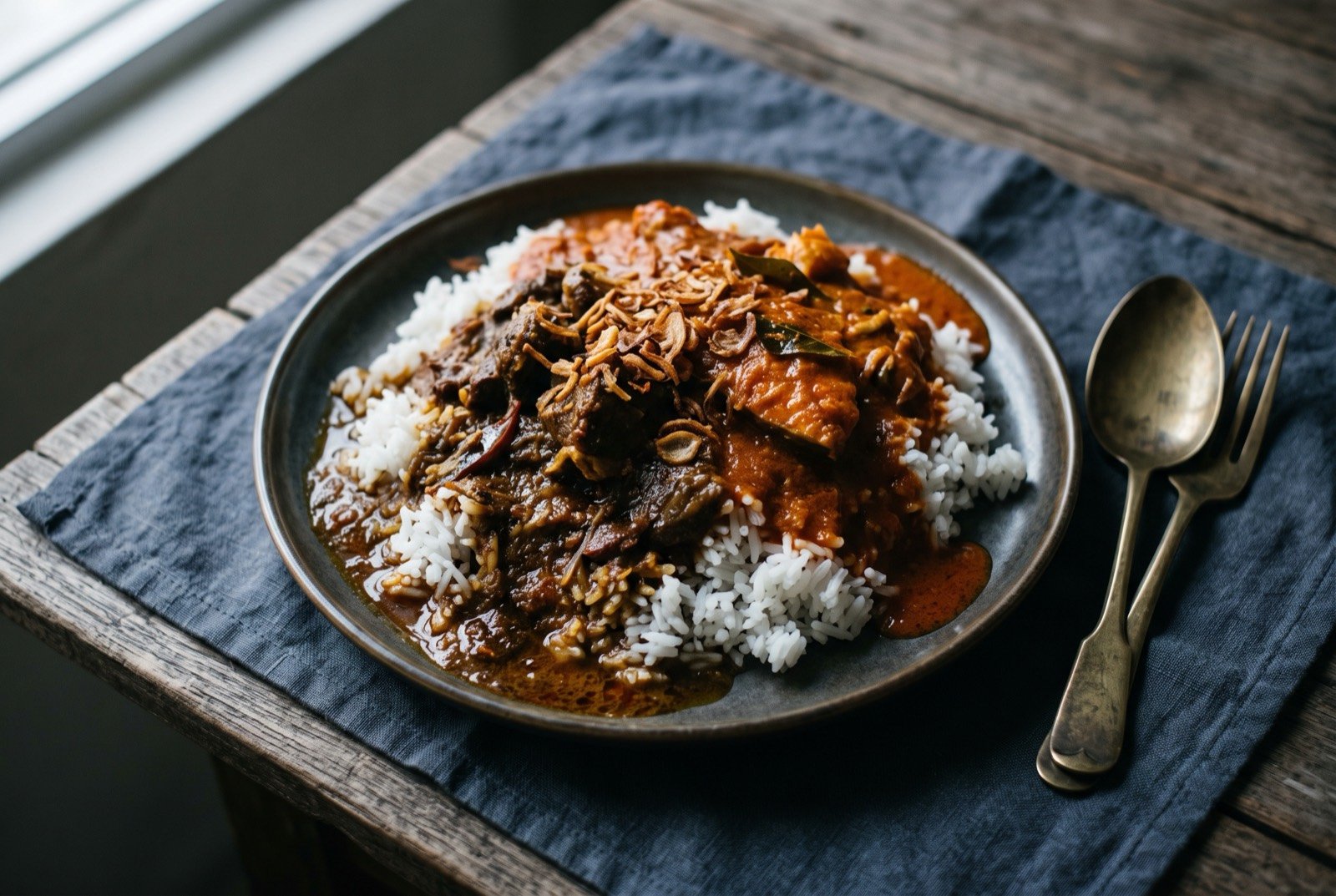
Not one recipe but a technique: two contrasting curries, built to the dockworker's own preservation logic, deliberately layered at the point of service rather than served apart.
As tradition built it
Serves 4. Two curries, roughly 90 minutes each, largely unattended.
Ingredients
The method as the tradition gives it, with the ingredients named. Quantities follow as we verify them, lead dishes first.
A rich meat curry (beef or mutton)
A tangy fish curry
Method
- Build both curries fully and separately, each reduced to its own character, the meat curry thick, dark and oily, the fish curry lighter and tangier.
- To serve, ladle rice into a bowl, then spoon a portion of the meat curry over one side.
- Banjir the plate: pour the tangier fish curry over the meat curry so the two visibly layer rather than mix, "the flood," the server's judgement in a real nasi kandar stall deciding the exact proportion.
- Kuah campur, if serving family style: combine leftover portions of both curries in one bowl for a deeper, more complex gravy, understood as a considered technique, not a waste-avoidance compromise.
What a modern chef changes
The jockey's on-the-fly judgement, replaced by a weighed ratio, not by less flavour.
Method
- Reduce each curry separately and precisely, using a thermometer and a fixed reduction time rather than judging by eye, then chinois each one before combining, so the banjir layering happens between two genuinely clean, controlled sauces.
- Cook the meat sous vide, the fish briefly and separately, protecting each curry's protein exactly as its own texture demands, before returning both to their respective reduced sauces to finish.
- Do not soften the deliberate heaviness and oiliness of the meat curry. This is a case where the traditional dish's own excess is period-correct and functional, not something a modern palate should quietly edit down.