Maritime Southeast Asia · Volume 44, The Long Reduction, the Merantau Road and the Veranda of Mecca
Dendeng balado
West Sumatra
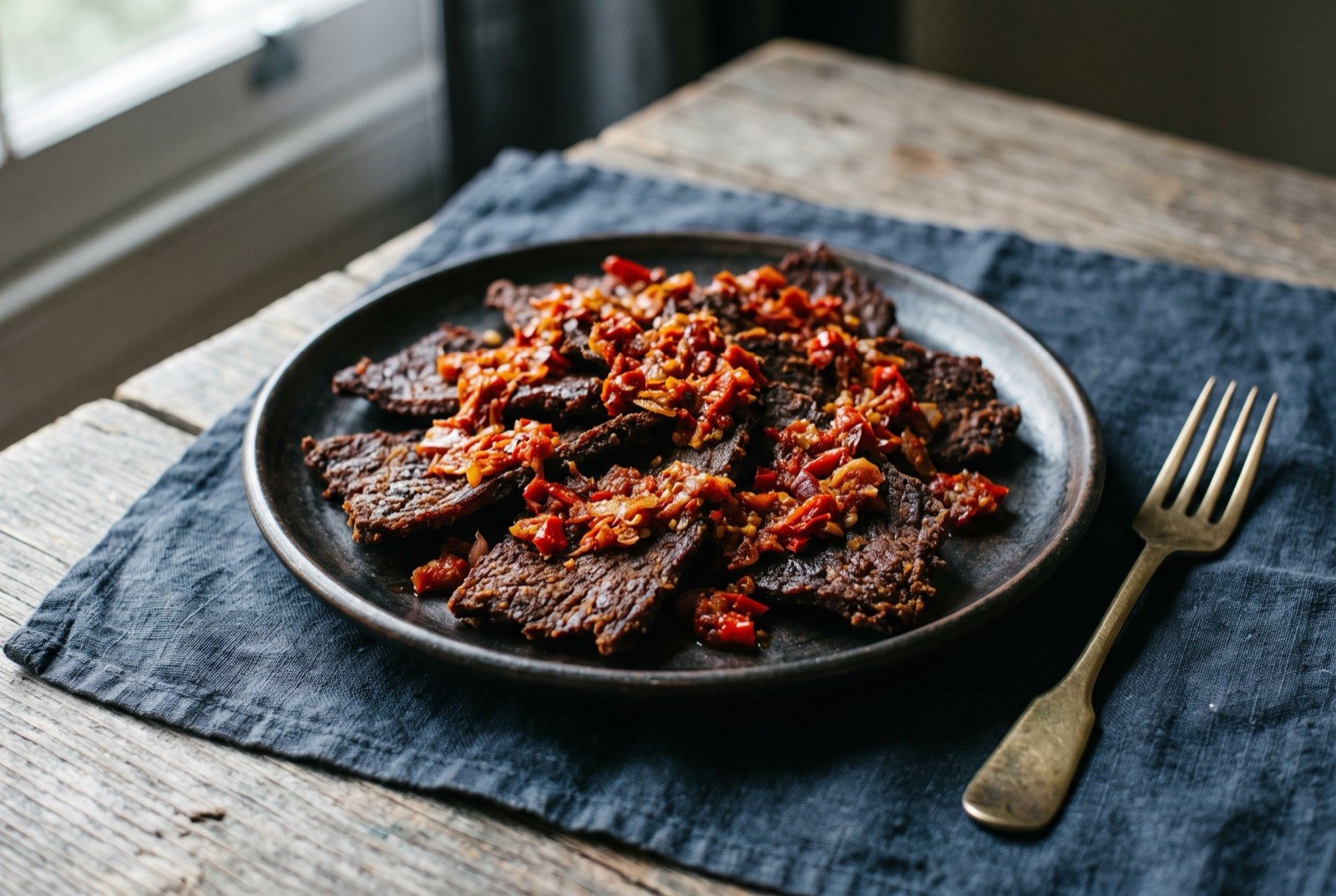
An illustration of the dish, not a photograph of it cooked.
- Time
- 1 hour 30
- Researched
- 11 sources cited
- Reviewed
- Not yet reviewed from inside the tradition
- Cooked
- Not yet cooked and reported
A two-stage preservation technique, boiled then twice-fried meat glazed in a coarse, cooked chilli relish, echoing rendang's logic at a smaller, faster scale.
As tradition built it
Serves 4. 90 minutes.
Ingredients
- 500 g beef, thinly sliceable cut
- 3 bay leaves, 1 tbsp ground coriander, 2 pieces asam kandis, salt to taste bay leaf, asam kandis, ground coriander, salt
- 8 red chillies
- 3 shallots
- 1 tomato
- to taste salt, sugar, lime juice
- as needed oil
Method
- Simmer the beef with bay leaf, asam kandis, ground coriander and salt until tender.
- Slice thinly, against the grain, once cool enough to handle.
- Briefly fry the slices, drain, then marinate roughly an hour.
- Fry again over medium heat until dark and slightly crisp at the edges, without burning (Rung 4).
- Separately, steam the chillies, shallots and tomato until soft, roughly ten minutes.
- Grind coarsely, not to a smooth paste, with salt, sugar and lime juice.
- Stir-fry the balado, often reusing the oil left from frying the meat, until it reduces and thickens.
- Combine with the fried dendeng, or heap the balado over it, and serve.
What a modern chef changes
Precision on the tenderising stage, restraint on the finish.
Rung 4
Method
- Cook the beef sous vide before slicing, low and long, for a more even, controllable tenderness than an open simmer gives, then proceed to the fry-marinate-fry sequence exactly as tradition demands.
- Pulse the balado in the high-power blender rather than fully purée it, controlling for the coarse, chunky texture that is the dish's defining signature rather than smoothing it away.
- Do not reach for the dehydrator here. A dehydrator run on the raw sliced beef, in place of the boil-then-double-fry sequence, produces jerky, not dendeng, and misrepresents the dish exactly the way a badly substituted diaspora kitchen does elsewhere in this chapter.