Maritime Southeast Asia · Volume 43, The Sweet Court, the Salt Island and the Mould Between Them
Rawon
East Java
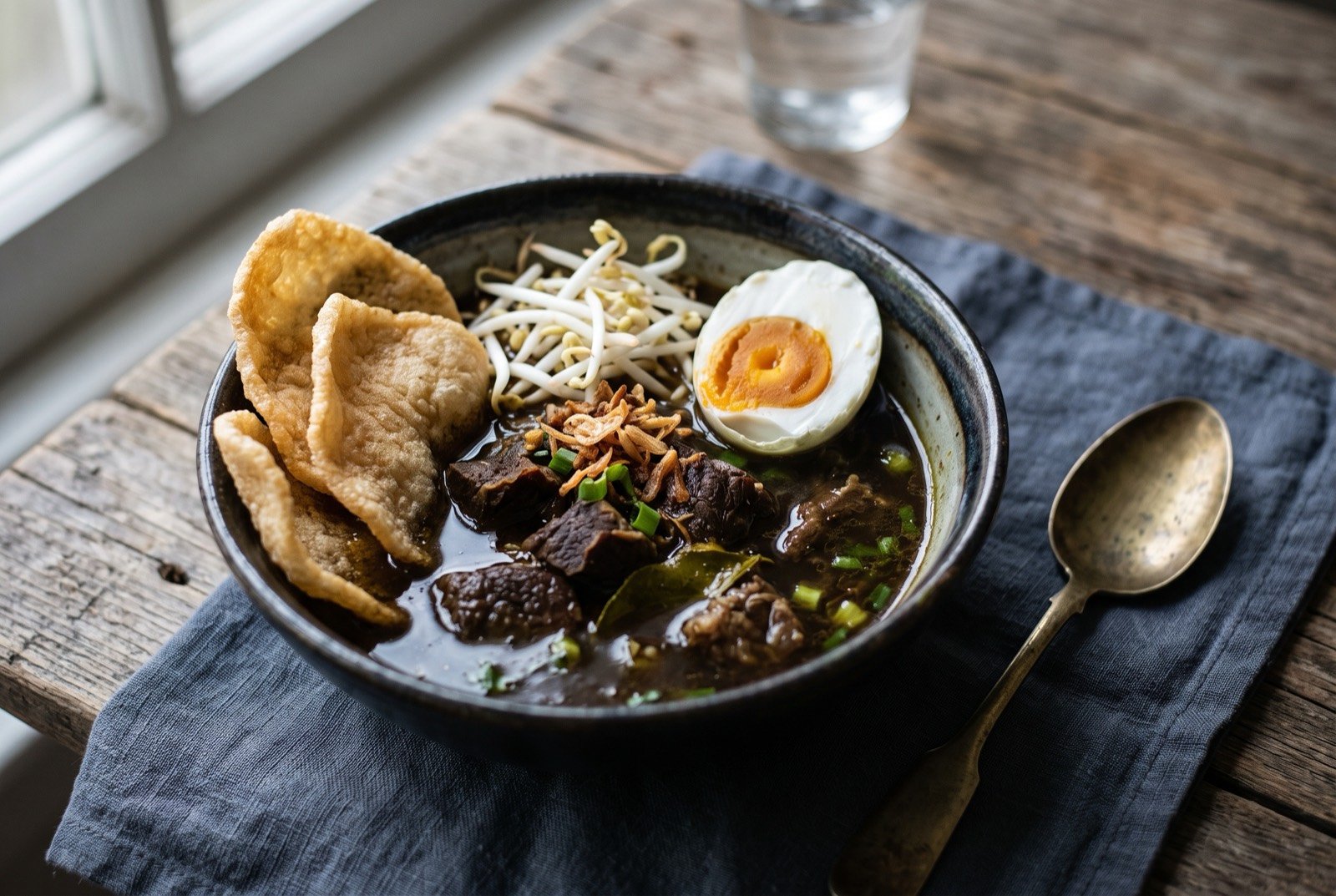
An illustration of the dish, not a photograph of it cooked.
- Time
- 2 hours
- Reviewed
- Not yet reviewed from inside the tradition
- Cooked
- Not yet cooked and reported
Properly East Java's dish, not Yogyakarta or Solo's, eaten across the whole island and treated honestly here as what it is rather than folded silently into the Mataram heartland.
As tradition built it
Serves 4 to 6. Around 2 hours, plus kluwak preparation.
Ingredients
- 500 to 700 g beef, to yield 750ml to 1 litre of broth
- 4 to 5; 1 tbsp; 8; 5 cloves; ½ tsp; 2cm; 1 tsp; 4 to 6 red chilli, terasi, shallot, garlic, coriander, turmeric, salt and processed kluwak, for the spice paste
- 2 to 3 leaves; 4 to 6 leaves; 2 stalks, bruised; 2cm, bruised bay leaf, lime leaf, lemongrass, galangal
- to taste bean sprouts, salted egg, prawn crackers, sambal and fried shallots, to serve
Method
- Simmer the beef separately in water until tender, and reserve the stock.
- Grind the chilli, terasi, shallot, garlic, coriander, turmeric, salt and processed kluwak to a smooth paste, and fry it until fragrant.
- Combine the fried paste with the reserved stock, bay leaf, lime leaf, lemongrass and galangal, and simmer.
- Return the beef to the pot, season with a little salt and sugar, and simmer until the broth has darkened fully and the seasoning has penetrated the meat.
- Serve with bean sprouts, salted egg, prawn crackers, sambal and fried shallots alongside.
Notes
A widely repeated claim this chapter deliberately does not assert. Numerous Indonesian outlets repeat that the Prasasti Taji, a copper inscription dated 823 Saka, 8 April 901CE, found in Ponorogo, East Java, names a food term "rarawwan" as rawon's direct ancestor, alongside "pecel," "pindang," "rujak" and "kerupuk." No epigraphic or academic philological source behind this claim was found in this chapter's research, only food journalism repeating itself across outlets, and no source glosses "rarawwan" as a black kluwak based soup rather than simply a food term of uncertain modern equivalence. This chapter treats "rawon may have a name with roots this old" as a widely repeated, unverified claim rather than a fact, and says so.
What a modern chef changes
No specific Javanese or East Javanese kitchen was found doing this at chef level; this chapter's own reasoned application of the same slow braise principle, stated honestly
Method
- Sous vide the beef separately at a low, controlled temperature, the same long, gentle extraction the traditional pot achieves over hours, made precise rather than watched by eye.
- Dehydrate a portion of the processed kluwak and grind it to a fine powder in the spice grinder, for a concentrated dusting garnish alongside the broth rather than only inside it.
- Strain the finished broth through the chinois, the same clarity discipline Rung applies to Soto Solo's own broth above, applied here to a much darker liquid.