Asia · Volume 43
Java and Madura
The Sweet Court, the Salt Island and the Mould Between Them
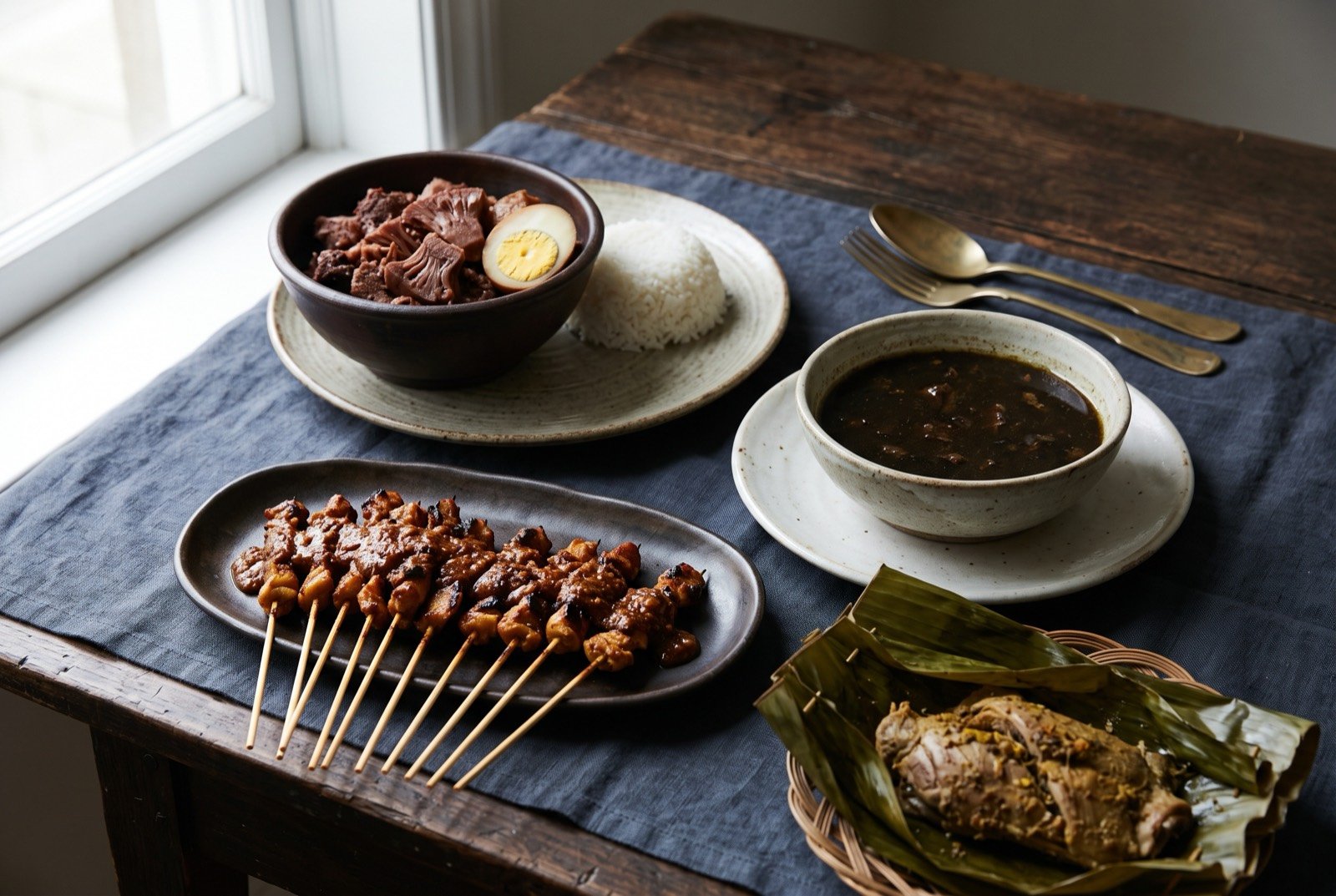
Two food worlds facing each other across a narrow strait, and the difference between them is written straight into the ground. Central Java, Yogyakarta and Solo especially, sits on some of the most fertile volcanic soil on earth, and its court kitchens built a cuisine around that abundance: sweet, patient, refined, judged by how long a cook was willing to stand over a pot. Madura, a few kilometres across the water, is limestone and salt pan, a place that grows corn where Java grows rice and cattle where Java keeps carp ponds, and it built a harder, saltier, faster food culture to match, one carried outward by traders and migrants because the island itself could not feed everyone who lived on it. Every restaurant technique in this cuisine has an indigenous ancestor, the idea this atlas returns to in every volume, and here the clearest case of it is not a dish at all but a mould: tempeh, fermented and engineered by Central Javanese households centuries before a Western fermentation lab existed to admire it. Kecap manis, the sweet soy sauce that ties the whole island together, is itself a document of that difference: a Chinese import that had to be re-sweetened because the Javanese palate on one side of it would not accept it plain. Every dish as tradition built it, then what a modern chef would change.
Sources and review · What this chapter does not assert · How we research · Spotted something wrong?
A Sense of Place
Two ecologies either side of a strait
Yogyakarta and Solo sit in the fertile volcanic heartland between Gunung Merapi and the south coast, at the historic core of the old Mataram kingdom. This is rice country in the most literal sense: abundant irrigated sawah, jackfruit and coconut trees at every household boundary, and, from the mid nineteenth century, some of the most intensively sugar-planted land on the planet. That last fact matters more than it sounds like it should, and this chapter comes back to it below.
Madura runs on a completely different base. Geologically it is a continuation of the limestone hill chain that runs along the Solo valley in Java, but lower, coarser and more rounded, merging into itself rather than standing as discrete peaks. The island has two seasons, a dry season from May to mid October and a wet season from mid October to April, with average annual rainfall of only 1,000 to 1,500mm; because the ground drains fast, it dries out again just as quickly once the rains stop. Most cultivated land is tegalan, unirrigated dry field, workable only in the rainy season, planted mainly with corn and cassava. One Indonesian university sustainability piece put the comparison as plainly as it can be put: "Afrika Kekeringan, Madura Juga," Africa has drought, so does Madura. Corn, not rice, was the historic staple across Madura and the neighbouring dry pockets of Tuban and Lamongan, precisely because it tolerates the drought that rice cannot.
Madura's other defining resource is salt. The island is nicknamed Pulau Garam, the Salt Island, and the industry is genuinely old rather than a modern tourist label: its long coastline and dry climate suit solar evaporation, and production intensified sharply under Dutch East India Company monopoly in the eighteenth century, with a dedicated trade route to Europe and an industry centre built at Kalianget, in Sumenep regency. Salt farmers along the southern coasts of Sampang, Pamekasan and Sumenep are still called locally mantong, and the traditional method, crystallising seawater completely in shallow ponds and harvesting it in layers from bottom to top, is passed down largely unchanged. Madura's longer, more reliable dry season is credited with raising the salt concentration in the brine as it evaporates, which is given as the reason the island's salt is considered higher quality than salt produced elsewhere on Java.
Add to that a genuinely distinct cattle economy. Sapi Madura, understood by Indonesian agricultural researchers as a cross between Bos indicus (Indian zebu) and the native Bos sondaicus (Bali cattle) lineage, is a small, compact, hardy breed, brick red to yellowish in colour with a white underbelly and inner thigh, bred for tolerance of poor forage and tropical heat rather than for size. It is farmed for meat, for milk and, historically, as a draught and cart animal, and cattle keeping sits close to the centre of rural Madurese life, both economically and socially: karapan sapi, bull racing, in which a pair of bulls pulls a small sled and jockey over roughly a hundred metres in ten to fifteen seconds, is registered by Indonesia's Ministry of Education and Culture as intangible cultural heritage, and status built through the arenas around it, cattle racing, cockfighting, and a code of honour called carok, sits alongside, and sometimes in tension with, the island's own strong Islamic identity, which formal religious teaching in Madura is in fact recorded as disapproving of.
One kingdom split in two
Yogyakarta and Surakarta, Solo's formal name, both descend from the same Mataram Islam royal line, and the split between them is precisely dated: the Treaty of Giyanti, 13 February 1755, divided the Mataram Sultanate into the Kasunanan Surakarta, ruled by a Susuhunan under the title Pakubuwono, and the Kesultanan Ngayogyakarta, ruled by a Sultan under the title Hamengkubuwono. Two further, minor courts, the Mangkunegaran in Solo and the Pakualaman in Yogyakarta, split off later still. Indonesian sources are consistent that the two senior courts diverge visibly in dress, court etiquette, gamelan tuning and even the shape of the keris, but a direct, systematic comparison of their food cultures specifically is thin on the ground: the strongest source found, an academic journal article from Universitas Sebelas Maret on Kasunanan food heritage, could not be extracted in readable form during this chapter's research and is named here as an honest gap rather than papered over.
What the sources agree on is a shared court philosophy that explains a great deal of what follows. Communities close to the keraton, the palace, are consistently reported to associate sweetness with harmony, contentment and refined status, so the courts' own food leaned sweet as a deliberate marker of that value, reinforced later, and separately, by the nineteenth century cash crop economics below. This is worth holding in mind through everything that follows: Central Javanese sweetness is not an absence of seasoning discipline, it is the discipline.
A table of peoples, logic and dishes
| Place | Defining logic | The dishes that carry it |
|---|---|---|
| Yogyakarta | court refinement, sweetness as status, jackfruit and coconut abundance | gudeg, brongkos, sayur lodeh |
| Solo (Surakarta) | the rival court, savoury restraint against Yogyakarta's sweetness | nasi liwet, soto Solo, tengkleng |
| Klaten and the Mataram hinterland | rural fermentation, the mould that fed a nation | tempeh |
| Surabaya and the pasisir coast | trade port acculturation, Javanese, Madurese, Arab and Chinese together | rujak cingur, tahu tek, lontong balap |
| Sidoarjo and Lamongan | the East Java shrimp and clam coast | petis, soto Lamongan, tahu campur |
| Madura | salt, cattle, drought, and migration as the answer to all three | sate Madura, bebek songkem, soto Madura |
The History in Layers
Before the sultanates: an honest ecological throughline, not a dish-by-dish inheritance
The pre-Islamic Mataram kingdom, a separate, earlier polity sharing a name with the later Islamic sultanate but not direct institutional continuity, was Hindu-Buddhist, and its ecological base, wet-rice cultivation, coconut, market culture, long predates the Islamic courts layered on top from the sixteenth and seventeenth centuries. This chapter did not find sources making a specific, non-speculative culinary link from a named Hindu-Buddhist Mataram dish to a modern Yogyakarta or Solo one, and does not assert one. What can be said with confidence is the deeper structural fact: rice, coconut and market culture as the load bearing base under both periods, Hindu-Buddhist and Islamic alike.
The Cultuurstelsel, and why Central Java tastes the way it does
Around 1830, the Dutch colonial forced cultivation system, the Cultuurstelsel or tanam paksa, compelled Javanese farmers to grow export commodities, sugarcane prominent among them, turning Central and East Java into one of the world's major sugar producing regions. Roughly 70 percent of agricultural land in Central and East Java is reported to have been converted to sugarcane under this system, with hundreds of colonial sugar mills built to process the surplus, and the resulting local abundance is given as the direct mechanism by which sugar became cheap and routine enough to become an everyday seasoning rather than a luxury.
That is one real, well evidenced mechanism, but it is not the only one, and Indonesian food writing itself treats the two as complementary rather than as rivals. The older explanation reaches back to the Majapahit era, well before Dutch cane sugar arrived: gula kelapa and gula aren, coconut and palm sugar, were already abundant, and the court philosophy of sweetness as refinement, named above, had already normalised sugar as a positive culinary value on its own terms. The honest synthesis, and the one this chapter offers the reader, is that the nineteenth century cane sugar boom did not invent Central Java's sweet tooth, it intensified a taste preference the courts and the palm groves had already established centuries earlier.
Kecap manis carries its own, separately documented history, and it is a genuinely good story about a flavour failing to travel and being remade to survive contact. Chinese traders are reported to have first brought savoury, salty kecap, soy sauce in the Chinese tradition, to the archipelago, and it reportedly did not sell well: Javanese palates were not accustomed to that sharp, salty profile. Chinese Indonesian producers adapted by adding coconut or palm sugar to the base, and what became kecap manis was the result, tuned specifically to local sweet preference rather than exported unchanged. Datings vary sharply and are not reconciled anywhere in the sourcing, from a hypothesised eleventh century Nusantara origin to the better attested reference point of Raffles's History of Java, which documents soybeans and kecap present in Java by the eighteenth century. One named, dateable commercial example anchors the more recent end of that story concretely: Kecap Piring Lombok, a Central Java trademark producer using gula aren, trading since 1930.
Tempeh: a mould, engineered rather than found
Tempeh's own dating is the single most contested date range in the whole tradition, and Indonesian food writing has not settled it, so this chapter reports both strands rather than choosing one. The most commonly repeated documentary trace is the Serat Centhini, a Surakarta court manuscript compiled 1814 to 1823 describing Javanese daily life reaching back to roughly the sixteenth century, in which the word "tempe" appears in named dishes, jae santen tempe, tempeh in ginger coconut milk, and kadhele tempe srundengan. Indonesian food scientist Prof Made Astawan reads this as evidence tempeh was already known by the sixteenth century, even though the manuscript itself was written later. A separate strand of Indonesian reporting places tempeh's documented origin more narrowly, in Tembayat, in Bayat, Klaten, with dates given inconsistently as either the 1600s or around 1700. Neither strand is reconciled with the other anywhere this chapter's research reached, and it is worth being honest about that rather than picking whichever date sounds cleanest.
What is not contested is the mechanism, and it is worth taking as seriously as any technique this atlas has ever documented. Soybeans are boiled, hulled and soaked, a step that allows natural lactic acid bacteria to lower the pH and suppress spoilage organisms before the real fermentation even begins. They are then inoculated, traditionally with spores carried on a used, tempeh-wrapping banana leaf from a previous batch rather than a purchased starter, packed, and fermented by two named moulds, Rhizopus oligosporus and Rhizopus oryzae, at 24 to 48 hours at 30 to 35°C under modern, scientifically measured conditions, or 36 to 48 hours at ambient room temperature by the older, traditional route, an initial overnight ferment typically followed by piercing the parcel to admit air for a second overnight ferment. Yap Bwee Hwa is credited as the first Indonesian to study tempeh formally and produce it under laboratory conditions, in 1958; Indonesia's own national standard, SNI 3144:2009, formally defines it as a product of Rhizopus fermentation, compact, off white, with tempeh's characteristic smell; and Central Java tempeh was recognised as Indonesian Intangible Cultural Heritage in 2017, with 6 June now marked as National Tempeh Day and a formal submission for UNESCO recognition under review as of this chapter's research. Most tempeh in Indonesia is still made at home or micro enterprise scale, reported at anywhere from 10 kilograms to 10 tonnes a day, and it is eaten by everyone in Central Java, every day, not treated as a specialist or festival food. This is a working, living industrial fermentation science that predates the phrase by centuries, and the modern chapter of that same story, a Klaten born food scientist's own grandson now running tempeh initiatives in the United States and Britain, is picked up again in the Technique Ladder below.
Migration as Madura's structural answer, and the same problem recurring abroad
Because Madura's land is dry and unproductive for much of the year, Madurese people have a long standing tradition of seafaring and migration, and satay, understood locally as closely tied to Madurese identity itself, became the trade migrants carried with them and sold across the archipelago. Migration typically worked through family and social networks, a newcomer taken in and trained by relatives already established elsewhere, and Indonesian sources date the presence of Madurese satay vendors in cities like Yogyakarta back to the Dutch colonial period. A closely related and equally well documented phenomenon, warung Madura, the ubiquitous 24 hour Madurese run convenience stalls now found across Indonesian cities, is reported to have started in the 1990s when migrants from Sumenep regency settled in Tanjung Priok, Jakarta, initially selling timber building materials before moving into general grocery retail; their round the clock hours are explained in Indonesian business press as a deliberate competitive strategy. Both phenomena share the same root cause in the sourcing: Madura's own barren terrain pushing its people toward trade and migration as a livelihood.
That same structural fact, pushed far further, recurs almost exactly when this cuisine tries to travel to Britain or the Netherlands. Multiple Indonesian press sources, not Western ones, independently name the same mechanism for why Indonesian restaurants abroad struggle and close faster than their Thai or Vietnamese counterparts: authentic Indonesian spice pastes and specific aromatics, candlenut, salam leaf, particular chilli and shallot varieties, terasi and petis, kemangi, are hard to source abroad, forcing substitution with more expensive or simply different ingredients. This relocates the usual, vaguer explanation, that diaspora cooking simply dilutes flavour, into something more specific and more useful to a British reader: it is very often not a failure of skill or of caring about the tradition, it is a failure of the supply chain a migrant cook is working inside, the same problem that sent Madurese satay sellers across the archipelago in the first place, now scaled up to an ocean.
Angkringan: correcting an assumption this chapter's own brief was given
This is worth stating plainly, because it cuts directly against the popular assumption, including the one this chapter's own research began with, that angkringan is a Yogyakarta institution. Indonesian sources are specific: the format was pioneered by Mbah Karso Djukut, a migrant from Desa Ngerangan, Bayat, Klaten, who began selling food from a shoulder pole in Solo around 1930, given his chance by a man named Mbah Wono in 1940. Before the word "angkringan" existed, the Solo trade was known as hik, and the format expanded rapidly from the 1950s onward via a network of fellow Ngerangan migrants, reaching Yogyakarta specifically in that decade, where the word "angkringan" itself was coined for what had arrived from Solo as hik. The correct framing, and the one this chapter uses: the trade format and the hik name are Solo's, via Klaten; the word "angkringan" and its full cultural flowering as a nightly Yogyakarta institution are genuinely Yogyakarta's own contribution. Both cities have a real claim, just not the same claim.
Rujak cingur: a dish claimed by three different stories at once
Surabaya's rujak cingur, sliced fruit and vegetables, fried tofu and tempeh, and boiled cow snout in a thick petis dressing, sits inside a genuine, three way attribution conflict this chapter reports rather than settles. Indonesian sources describe it as belonging to the "Arekan" cultural sub region, Surabaya's own dialect and cultural zone. Separately, Surabaya local history commentators date the dish's modern popularity in the city to the 1930s, credited to Madurese migrants who sold it as a livelihood, originally using cakalang, skipjack tuna, petis in the Madurese style before adapting to shrimp petis to suit the taste of Surabaya's largely ethnic Javanese population. A third, older and more legendary strand traces it to a folk story about a royal cook named Abdul Rozak serving the dish to a king in Masiran, a story one Indonesian outlet's own headline poses directly as "Surabaya or Egypt." Multiple sources describe the finished dish as a genuine acculturation product of four communities present in the city at once, Javanese, Madurese, Arab and Chinese, which is probably the most honest single sentence any source offered about it, and this chapter leaves the three origin stories exactly where it found them, named and unadjudicated.
The Flavour Arsenal
Ferments and preserved proteins. Tempeh, covered in full above, is this chapter's central case study, but it sits alongside two other fermented or reduced condiments a reader must not conflate. Terasi is a dried, dark, crumbly block of fermented shrimp or shrimp and anchovy, the closer analogue to Malaysian belacan or Thai kapi. Petis is a genuinely different, unfermented product: shrimp, fish or, in some East Java variants, tiny clams called kupang, boiled for an extended time to extract a stock, then seasoned with salt and sugar and reduced by cooking until it thickens into a black, glossy, savoury sweet paste closer to a shrimp caramel than to a ferment. Petis is East Java's own condiment, associated above all with Sidoarjo, the region's shrimp farming centre, and comes in two named varieties there, petis hitam (black, sweetened with palm sugar) and petis putih (white, sweetened with granulated sugar). Kecap manis, the sweet soy sauce covered in the History above, is the third and most ubiquitous of the trio.
Seeds, pods and nuts, one of which will kill you if you are careless with it. Kemiri, the candlenut, is the standard thickener and richener for spice pastes across the island. Kluwak, the black souring nut behind rawon and brongkos, is genuinely toxic raw: it contains cyanogenic glycosides, and Indonesian sources describe several processing routes to neutralise it, peeled seeds soaked one to two days with the water changed periodically, traditional full fermentation buried in earth and ash for around forty days, or a shorter route of boiling for fifteen to thirty minutes. Even correctly processed, sources caution that trace toxic residue remains and heavy consumption is inadvisable, a point this chapter states plainly given how central kluwak is to two of the dishes below.
Chillies, aromatics and souring agents. Cabai keriting, curly red chilli, and cabai rawit, bird's eye chilli, do most of the heat work; kencur, aromatic ginger, daun salam, Indonesian bay leaf, daun jeruk, kaffir lime leaf, and serai, lemongrass, carry the aromatic base most spice pastes share. Belimbing wuluh, the sour bilimbi fruit, and asam jawa, tamarind, carry the sour register that kluwak carries in its own, darker way.
Starches and staples. Rice runs through the whole island, but not uniformly: Rojolele Delanggu, a specific Central Javanese variety prized for a soft texture and pronounced aroma, is named repeatedly as the rice behind Solo's own nasi liwet. Corn, cracked and cooked as nasi jagung, was the historic staple of Madura and the drought prone pockets of neighbouring Tuban and Lamongan, precisely because it needs far less water than paddy rice. Nangka muda, young jackfruit, is gudeg's whole reason for existing. Kacang tolo, black eyed peas or cowpeas, anchor brongkos.
Sugar and salt, the island's two defining seasonings, each with its own real geography. Gula jawa and gula aren, palm and coconut sugar, are Central Java's sweetener of record, for the reasons set out above. Madura's own salt, produced by solar evaporation in shallow coastal ponds around Kalianget, Sumenep, is the island's namesake industry and, by most accounts, genuinely higher quality salt than salt produced elsewhere on Java, thanks to the island's longer, more reliable dry season concentrating the brine further before harvest.
Part Two
The Technique Ladder
The argument, from inside
Chef Ragil Imam Wibowo, of Nusa Indonesian Gastronomy in Jakarta, Asian Cuisine Chef of the Year 2018 and chair of Indonesia's own Culinary Committee, gave Kompas the single clearest statement of this whole atlas's argument found anywhere in this chapter's research, speaking about a viral deconstructed gado-gado plating trend: "Dekonstruksi itu soal presentasi, bukan soal rasa. Rasanya harus tetap sama," deconstruction is about presentation, not about taste, the flavour must stay the same. The public reaction is just as useful as the quote. A real strand of Indonesian social media pushback greeted that trend with irritation, not at any change in flavour, but at the presumption of dressing up an everyday street dish in fine dining clothes. That tension, between elevating a technique and disrespecting the dish it came from, is not a problem this chapter can solve, but it is the correct frame for reading every "elevation" below: the test is whether the flavour survived, not whether the plate looks expensive.
Against that, Namaaz Dining, Jakarta's self taught, molecular gastronomy pioneer under chef Andrian Ishak, is the clearest example this research found of the opposite pole, spherification, liquid nitrogen and rotary evaporation applied to Indonesian flavour as imported Western technique rather than as an indigenous method refined. Both restaurants are real, both are respected, and this chapter treats them as two different projects rather than pretending "modern Indonesian" is one movement.
Honest gap, named rather than smoothed over. Jakarta has a real, documented modern-Indonesian fine dining scene; Yogyakarta, on this chapter's own research, does not, not yet at the same level. Gudeg is being modernised at the production end, reduced sweetness for changing palates, gudeg manggar made with banana blossom in place of jackfruit, canned and instant versions for national distribution, but that is food industry adaptation, not a chef led restaurant movement, and this chapter says so rather than manufacturing a Yogyakarta parity with Jakarta that the evidence does not support. No Javanese or East Javanese restaurant was found publicly discussing sous vide technique applied to rawon or soto at chef level either; general Indonesian hospitality trade coverage confirms sous vide is used commercially in the country for slow braised meat, and this chapter draws the reasonable inference for the dishes below, but it is this chapter's own inference, not a claim about a named kitchen, and the Elevation sections say so explicitly wherever that is the case.
Rung 1. The bumbu is the technology, not the seasoning
Every dish below starts with a ground spice paste, bumbu, and the tool that makes it, the cobek and ulekan, a stone mortar and a curved, saddle shaped pestle genuinely different in profile from a round Thai style pestle, is built for a rocking, crushing motion rather than straight pounding. This is not decoration: a paste ground this way emulsifies its own oils differently from one blitzed smooth in a blender, and Indonesian food press describes hand grinding as non negotiable even among chefs otherwise happy to innovate elsewhere on the plate.
What a cook does with this rung. Use the real cobek and ulekan where the recipe below calls for one, and treat the high power blender this reader already owns as a genuine, honest alternative for volume, not a silent substitute; the difference in hand feel and final texture is real, and this chapter says so rather than pretending the two tools are interchangeable.
Rung 2. The sealed banana leaf parcel is sous vide's actual ancestor
Botok, garang asem and bebek songkem below all share one technique: a filling wrapped tightly in banana leaf and steamed, sealed against its own moisture and aromatics for the whole cook. This is, functionally, exactly what a vacuum bag and a water bath do, low, even, moist heat, sealed against the outside world, and this chapter states that plainly rather than treating sous vide as a foreign import onto this cuisine. The banana leaf did the job first.
What a cook does with this rung. Where a recipe below calls for a banana leaf parcel, a sous vide bag is not a modernisation of the technique so much as a literal restatement of it in a different material, and this chapter's Elevation sections use it accordingly.
Rung 3. Neutralise the kluwak before you build the dish around it
Covered in full in the Flavour Arsenal above: raw kluwak is genuinely toxic, and every dish that depends on it, rawon and brongkos below, depends on that neutralisation step happening properly and first. This is not a flavour rung, it is a safety rung, and it earns its place on this ladder because two of this chapter's nine dishes cannot be attempted without it.
What a cook does with this rung. Buy kluwak already peeled and, ideally, from a supplier who can confirm proper processing (see Sourcing, below), and do not shortcut the soak.
Rung 4. Areh: coconut cream held together with egg white
Nasi liwet's finishing element, and gudeg's own areh gravy in its Yogyakarta form, both rely on the same trick: thick coconut cream whisked with egg white until it thickens into a stable, pourable emulsion, spooned hot over the finished dish. The egg white is doing real emulsifying work here, not just enriching the cream, and it is the reason a good areh clings rather than separating into oil and liquid the moment it cools.
What a cook does with this rung. Whisk the egg white in fully rather than folding it gently; this is an emulsion being built, not a meringue, and the areh wants vigorous, not delicate, treatment.
Rung 5. Fermentation, engineered rather than left to chance
Tempeh's own science, covered in full above, is this chapter's clearest technique set piece, and it has a direct line to the most celebrated fermentation programme in contemporary Western fine dining. David Zilber, formerly head of Noma's fermentation lab in Copenhagen, has spoken publicly about working on tempeh technique specifically, framing controlled fermentation as a way to extend shelf life without pasteurisation, exactly the same underlying science Central Java industrialised centuries before a Copenhagen restaurant made it famous. 1945 Restaurant, at the Fairmont Hotel Jakarta, hosted a documented "Six Hands Dinner" on 20 November 2019 that put this argument on a plate directly: three chefs, Ragil Imam Wibowo of Nusa, Adhitia Pratama Julisiandi of 1945, and Philip Walasary of TWG Tea Salon, built a seven course tasting menu entirely around tempeh, soybean, corn, black soybean, mung bean, winged bean and red bean versions across the courses, treating it as a technique and an ingredient family rather than one fixed product. Chef Ragil's own dish that night, Lodeh Tempe Kulat Pelawan, a blended lodeh and tempeh purée topped with organic black soybean tempeh, is the clearest single example this chapter found of exactly what CLAUDE.md asks for: elevating traditional things deliberately, not importing French method.
What a cook does with this rung. A dehydrator, held at a low, steady temperature, is a genuinely credible home substitute for the warm, humid incubation box professional tempeh producers use; Tempehtation, a UK maker, sells a lab tested starter culture with a published guide aimed at exactly this kind of home fermenter (see Sourcing, below).
Part Three
The Ferment and Preserve Bench
1. Tempeh
Covered in full above: soaked, boiled, hulled soybeans inoculated with Rhizopus oligosporus or Rhizopus oryzae and fermented 24 to 48 hours at 30 to 35°C, or 36 to 48 hours at ambient room temperature by the traditional route. Indonesia's national standard, SNI 3144:2009, and its 2017 recognition as Intangible Cultural Heritage make this the single best documented ferment in the whole tradition, and one worth treating with the same seriousness this atlas gives any of its ferment benches.
2. Petis
The East Java shrimp or fish stock, boiled down and sweetened rather than fermented, covered in full in the Flavour Arsenal above. Not a substitute for terasi, and not interchangeable with it: petis is glossy, thick and savoury sweet where terasi is dry, dense and sharply pungent.
3. Kecap manis
The sweet soy sauce covered in full in the History above: soybeans fermented with brine and palm or coconut sugar, then simmered for 4 to 5 hours before being blended again with further sugar to thicken. A named, dateable commercial example, Kecap Piring Lombok, has traded since 1930.
4. Madura salt
Solar evaporated in shallow coastal ponds around Kalianget, Sumenep, harvested in layers from bottom to top by farmers locally called mantong. Not a ferment, but a genuine, geographically determined preservation craft this chapter includes on the bench for the same reason a good stock earns its place: everything else on this island's table depends on it.
Sourcing in Britain
Verified this research pass, September 2026.
The ranked list: what decides great from grim
- Kecap manis, by name, not generic "sweet soy." ABC is the dominant, widely stocked brand, via Sous Chef, Oriental Mart, Tuk Tuk Mart and Tradewinds Oriental Shop; Bango is available but narrower, via Marina Market. Supermarket "sweet soy sauce" from a generic Asian aisle is very often a thinner, Chinese or Malaysian product, not kecap manis, and this chapter recommends buying the named bottle rather than whatever sits nearest.
- Petis and terasi, bought as the correct, separate product. ABC Terasi Udang, in single use sachets, is stocked at Toko Indonesia; petis udang specifically, under the Jeeny's brand, is stocked at The Asian Cookshop and Thai Food Online, a genuine, if narrow, UK source for the East Java product by name rather than a generic shrimp paste standing in for it.
- Kluwak, a real and narrower gap than expected. Toko Indonesia stocks peeled kluwek at 100g. This is realistically a specialist, order ahead purchase, not a routine one, and no credible single ingredient substitute exists for its black, earthy flavour; where it genuinely cannot be sourced in time, that gap should be stated to the reader plainly rather than papered over with a false equivalent.
- Tempeh, fresh and UK made, not imported frozen. Impulse Tempeh, Somerset, hand making since 1989; Protempeh, Cambridgeshire; Tempeh Meades, Bristol; Tiba Tempeh, Newcastle. Fresh UK tempeh beats a frozen imported block on both flavour and the visual quality marker, a tight, even white mycelium with no grey or black patches.
- Candlenut, well stocked, macadamia the honest substitute. Sous Chef, The Asian Cookshop and Yau Brothers all carry it; macadamia is the standard substitute for texture and richness, though it does not replicate candlenut's own faint bitterness, and this chapter says so rather than claiming a perfect match.
- The cobek and ulekan itself. Toko Indonesia and the specialist Indo Food Store both sell genuine Indonesian granite sets; the curved, saddle shaped ulekan pestle is a real, different tool from a round Thai style pestle, and worth sourcing correctly if the technique in Rung 1 above is to translate.
- Palm sugar, tamarind, daun salam, kaffir lime leaf and tinned young jackfruit. All comfortably available through Toko Indonesia and the wider specialist Southeast Asian trade; tinned young jackfruit in brine, not the ripe sweet fruit sold as a snack, is the correct form for gudeg.
Genuine gaps, named rather than papered over
Fresh nangka muda, live from the tree, is not realistically available in Britain; tinned or frozen young jackfruit in brine is the correct, honest substitute, and this chapter states it as the standard form to buy rather than a compromise. A genuine Indonesian tempeh starter, for a reader who wants to ferment their own rather than buy it ready made, is sold by Tempehtation, a UK maker, with a published home guide, a credible route for Rung 5's own dehydrator based incubation method above. No dedicated bricks and mortar Indonesian grocer was confirmed outside London; Toko Indonesia's mail order plus New Loon Moon and other pan-Asian shops in Chinatown cover London with real depth, and the honest statement for the rest of the country is that this is a mail order cuisine, not a walk-in one, outside the capital.
Voices and Sources
From inside the tradition
- Prof. Murdijati Gardjito, food scientist, Universitas Gadjah Mada, since 1966, founder of UGM's Center for Traditional Food Studies, author of Kuliner Yogyakarta: Pantas Dikenang Sepanjang Masa, an eight chapter, over 500 recipe study of Yogyakarta's everyday, market, ritual and royal food culture. Recognised by the Governor of DIY (2012), Indonesia's Ministry of Education and Culture (2013) and given the Ubud Food Festival Lifetime Achievement Award (2019). The single strongest named academic authority this chapter's research found; her book itself could only be reviewed through secondary description, not read directly, and is named here as the first thing to chase down before any future revision of this chapter.
- Fadly Rahman, food historian, Universitas Padjadjaran, author of Jejak Rasa Nusantara (2016) and Rijsttafel: Budaya Kuliner di Indonesia Masa Kolonial 1870-1942.
- William Wongso, born Malang, East Java, 12 April 1947, culinary advisor for Indonesia's national team at the G20 Summit, November 2022, a general Indonesian culinary authority rather than a Yogyakarta or Solo specialist.
- Prof F.G. Winarno, Klaten born food scientist, former president of the WHO-FAO Codex Alimentarius Commission, credited as Indonesia's father of food science; his daughter Wida Winarno and grandson Amadeus Driando Ahnan-Winarno, co-author of The Tempeh Bible and a founder of tempeh initiatives in the United States and Britain, extend that same lineage directly into the diaspora sourcing above.
- Chef Ragil Imam Wibowo, Nusa Indonesian Gastronomy, Jakarta, whose principle, that deconstruction is presentation and the flavour must stay the same, anchors this chapter's own Technique Ladder.
The Yogyakarta gap, named
No Yogyakarta restaurant or chef doing modern-Javanese fine dining at a level comparable to Jakarta's August or Nusa was found in this chapter's research. Yogyakarta's own modernisation of gudeg is happening at the production and packaging level, not the chef's table, and this chapter states that as a real finding rather than manufacturing a parity the evidence does not support.
The language gap, named twice more
This chapter's Central Java and Madura research was conducted entirely in Bahasa Indonesia, and reached no Javanese-language or Madurese-language primary source. Given how much of this material is genuinely Javanese court culture, gudeg, kraton food terms, angkringan and hik, and how much of Madura's own vocabulary, cengor, lalak, mantong, survives only embedded inside Indonesian-language sources quoting it, a targeted pass in Javanese and Madurese specifically, not just Indonesian, would likely surface material this chapter could not reach. The Netherlands section of this chapter's modernist research is, separately, sourced entirely through English-language diaspora commentary, not Dutch national press or Indonesian language sources on the Dutch-Indonesian community, a real limitation stated honestly rather than dressed up as fuller sourcing than it is.
Things this chapter has deliberately not asserted
- That Prasasti Taji, the 901CE Ponorogo inscription, names an ancestor of rawon. Widely repeated across Indonesian food journalism, traced to no identifiable epigraphic or academic source in this chapter's research.
- Tempeh's exact origin date and place. A sixteenth century Serat Centhini literary trace and a specific, later Tembayat, Bayat, Klaten origin dated to the 1600s or around 1700 both circulate in Indonesian sources, unreconciled with each other, and neither is chosen here.
- A direct, systematic comparison of Kasunanan Surakarta and Kesultanan Yogyakarta court cuisine. The one dedicated academic source found for this could not be read in full during this chapter's research and is named as a follow up rather than a settled claim.
- That Madurese food is measurably saltier than East Javanese food generally. This specific comparative claim currently rests only on an English-language tertiary source, not a primary Indonesian one, and this chapter treats it as plausible, given the salt industry facts around it, but not independently verified.
- That sate Madura is distinctively grilled over coconut shell charcoal. The sourcing instead shows wood charcoal as the everyday commercial standard, with coconut shell as a higher quality but not clearly dominant alternative.
- Karapan sapi's own origin story. Kyai Pratanu spreading Islam through bull racing, and Syekh Ahmad Baidawi instituting it as a harvest thanksgiving, are both reported in Indonesian sources, and neither is adjudicated here.
- Which of rujak cingur's three attribution claims is correct, Arekan Surabaya identity, Madurese migrant popularisation, or the Abdul Rozak folk legend. All three are named; none is chosen.
- Whether tahu campur and tahu tek "belong" to Lamongan or to Surabaya. A live, sourced local dispute, reported as such.
- A direct, sourced causal link between Madura's unusually strong Islamic identity and specific food practices, beyond the general and unremarkable fact of halal observance.
- Sayur lodeh's own origin date, a tenth century Merapi eruption survival story against Fadly Rahman's sixteenth century estimate tied to the Portuguese introduction of long beans, both genuinely circulating and neither reconciled.
The bumbu is the technology, not the seasoning
Every dish below starts with a ground spice paste, bumbu, and the tool that makes it, the cobek and ulekan, a stone mortar and a curved, saddle shaped pestle...
The sealed banana leaf parcel is sous vide's actual ancestor
Botok, garang asem and bebek songkem below all share one technique: a filling wrapped tightly in banana leaf and steamed, sealed against its own moisture and...
Neutralise the kluwak before you build the dish around it
Covered in full in the Flavour Arsenal above: raw kluwak is genuinely toxic, and every dish that depends on it, rawon and brongkos below, depends on that...
Areh: coconut cream held together with egg white
Nasi liwet's finishing element, and gudeg's own areh gravy in its Yogyakarta form, both rely on the same trick: thick coconut cream whisked with egg white...
Fermentation, engineered rather than left to chance
Tempeh's own science, covered in full above, is this chapter's clearest technique set piece, and it has a direct line to the most celebrated fermentation...
The dishes
- Gudeg Yogyakarta
- Nasi liwet Solo Solo
- Soto Solo (soto ayam khas Surakarta) Solo
- Brongkos Yogyakarta
- Tempe jae santen Klaten and the Mataram hinterland
- Sate Madura Madura
- Rawon East Java
- Rujak cingur Surabaya
- Bebek songkem Sampang, Madura
Sources and review
- Reviewed
- Not yet reviewed from inside the tradition
- Cooked
- Not yet cooked and reported
Where this volume comes from
5 research briefs on file for this volume, researched to the rules on How we research. Published 3 September 2026. Last changed 8 September 2026.
The brief's own account of its sources
Of the roughly 30 substantive source URLs cited in this section, the large majority are Indonesian national press with dedicated regional/food desks (Kompas, Detik, and their regional sub-editions such as Detik Jatim and Detik Jabar, Liputan6, kumparan, Tempo, Tirto), which sit above generic Western SEO content but below true local/specialist press or academic sourcing in the house style's hierarchy.