Asia · Volume 48
Sulawesi, the Bugis, Makassar and Toraja World
The Phinisi Route, the Kluwak Pot and the Buffalo’s Horn
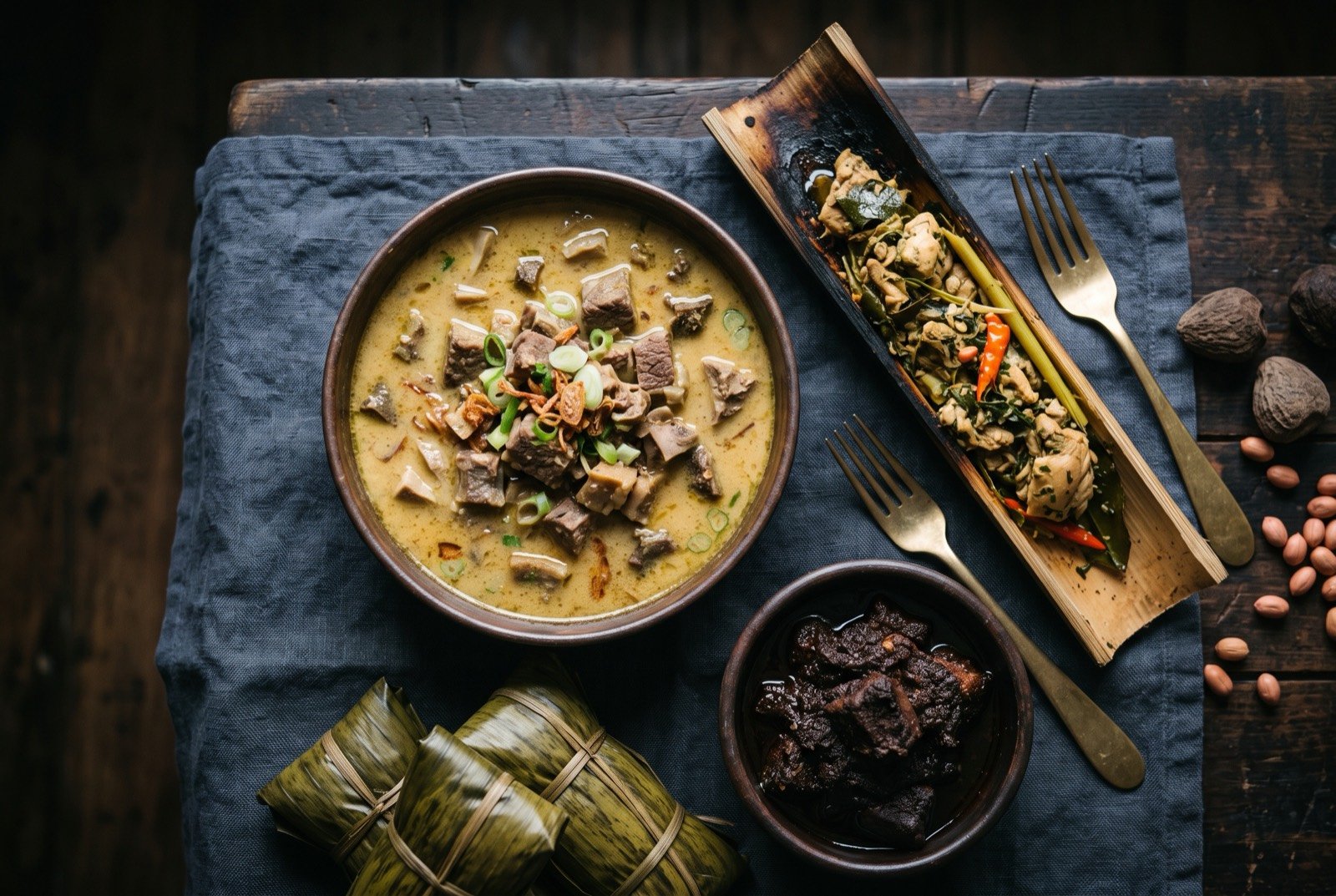
One island, two entirely different theories of how to survive. On the coast, the Bugis and the Makassarese built ships, sailed them to Australia and the Malay Peninsula and beyond, and made a fortune moving rice, salt fish and spice through a port the Dutch eventually had to fight a war to control. A day's drive inland, in mountains the same Dutch mostly could not be bothered to reach for two centuries, the Toraja built a world almost entirely turned inward: wet rice terraced into karst hillsides, a funeral economy where a single buffalo can be worth more than a car, and a belief system old enough that Christianity, when it finally arrived, had to learn to sit alongside it rather than replace it. Every restaurant technique in this cuisine has an indigenous ancestor, the idea this atlas returns to in every volume: a controlled starch reduction, a deliberately blackened and detoxified souring seed, a bamboo tube doing the work of an oven. Both worlds cook with the same blackened, faintly bitter souring nut, kluwak, and neither one learned it from the other by any route this chapter can actually prove. Every dish as tradition built it, then what a modern chef would change.
Sources and review · What this chapter does not assert · How we research · Spotted something wrong?
A Sense of Place
Sulawesi is shaped like nothing else in the archipelago, four long peninsulas radiating from a mountainous core, and that shape is not incidental to this chapter. It means the island never had one obvious centre of gravity the way Java or Bali did. What it had instead was a southwestern peninsula facing the Makassar Strait and the whole east-west shipping lane between the Indian Ocean and the Pacific, and, an inland climb behind it, a highland pocket the coast itself mostly left alone.
South Sulawesi's own ethnography names four major peoples, and only one of them is not defined by the sea. The Bugis are the demographic majority and the archipelago's most widely dispersed shipbuilders and sailors; the Makassarese are traders and sailors concentrated around the old port city that bears their name; the Mandarese, to the north, are traders and fishers with their own smaller maritime reach. The Toraja, in the mountainous interior, are farmers, and a doctoral thesis on Toraja social and economic history states the contrast plainly: Toraja's own early external relationships ran downward, toward the Bugis, Makassar and Mandar peoples on the coast, rather than sideways toward other highland communities, because there mostly weren't any close enough to matter. This chapter's whole spine sits inside that one sentence: a trading world that faced outward across open water, and a farming world a day's climb away that mostly faced itself.
Ecology explains the split before history does. The southwestern peninsula's lowlands, especially the Maros plain, are genuine rice country, flat, well irrigated and close enough to a deepwater port that a surplus could actually be shipped rather than only eaten. Tana Toraja and Toraja Utara sit instead across a highland belt running from roughly 150 to over 3,000 metres, karst limestone peaks and terraced sawah, under a rainfall pattern the Oldeman climate classification records as two to three consecutive wet months against two to three dry, agrarian enough to live on but never generating the kind of surplus that turns a farming economy into a trading one. Buffalo, pigs and, from the colonial period on, coffee filled the gap rice could not.
A table of peoples, logic and dishes
| People and place | Defining logic | Carried by |
|---|---|---|
| Bugis (archipelago-wide, Wajo especially) | Pasompe, sailor-merchant migration; shipbuilding at Bulukumba; the largest ethnic diaspora in the archipelago | The phinisi trade fleet; jalangkote and mie titi's Chinese-Bugis-Makassar port creole |
| Makassar (Gowa, Tallo, the port itself) | Entrepôt trade, Somba Opu's foreign trading offices, rice-for-spice exchange with Maluku | Coto Makassar, pallubasa, sop saudara, burasa |
| Mandar (northern South Sulawesi coast) | Trade and fishing, a smaller maritime reach alongside the Bugis and Makassarese | Named here for completeness; not separately treated in this volume |
| Toraja (Tana Toraja, Toraja Utara) | Wet-rice terracing, buffalo and coffee; Aluk Todolo's ancestral ritual calendar; historic isolation from the coastal trade world | Pa'piong, pantollo pamarrasan, Rambu Solo's funerary feast, Toraja coffee |
This is not a clean line, and the chapter should not pretend it is. Luwu, the highland-adjacent kingdom around modern Palopo, sits geographically and historically between the two worlds: Bugis historical tradition understands it as the oldest of South Sulawesi's kingdoms, and its own staple, sago rather than rice, ties it as much to the forest as to either the coastal trade economy or the Toraja highlands proper. Kapurung, Luwu's own sago dish, appears later in this chapter precisely because it will not sit neatly on either side of the coast-versus-highland line the rest of the volume draws.
The History in Layers
The coast's own founding fact is a fortress, and the fortress exists because of a war fought a thousand miles away. The Portuguese capture of Malacca in 1511 displaced the Muslim traders who had run that strait's own entrepôt, and a real number of them relocated east to Makassar, laying the foundation for what became, across the sixteenth century, a new eastern trading hub. Benteng Somba Opu, Gowa's own fortress and port, grew into exactly that: foreign trading communities kept representative offices, loji, directly at the port, Portuguese first, then Dutch from 1607, English from 1613, Spanish from 1615, Chinese and Danish both from 1618. A port that cosmopolitan needed a genuine export to justify the traffic, and the sourced trade good is rice, not fish: Gowa's rulers used rice supplied from Maros and Sumbawa to buy spices from Maluku, and Makassar's whole entrepôt position rested on that rice-for-spice exchange as much as on anything caught in its own waters.
Islam arrived at the top and worked down, on a date this chapter can give precisely. Karaeng Matoaya, the fourteenth ruler of Tallo, converted on 22 September 1605 under the Sumatran missionary Datuk ri Bandang, and the conversion then extended across the merged Gowa-Tallo state. The twin kingdoms had formally merged in 1528 and reached their peak under Sultan Hasanuddin from 1653. It is a reasonable inference, though this chapter has not found a named historian stating it directly, that formal Islamisation is connected to South Sulawesi cuisine's own halal dietary logic; the chapter states the inference as an inference, not as sourced fact.
The Bugis answer to a crowded, competitive coast was to leave it, and the migration has its own name. Pasompe, sailor-merchants who moved island to island, built Bugis colonies from at least the seventeenth century across eastern and southeastern Kalimantan, Pontianak and the southwestern Malay Peninsula, particularly Johor, the Wajo sub-group pioneering the Kalimantan settlements specifically. A Hasanuddin University sociologist frames pasompe as a culturally conditioned pursuit of a better life through challenge; more circumspect regional press coverage stresses that plenty of migrants describe themselves as economically forced to leave, given how little cultivable land the home coast actually offered a commoner, ata, against a noble, arung. Both readings are real and this chapter holds them together rather than picking the more romantic one.
The phinisi is the coast's own defining object, and its popular history does not survive close checking. Almost every Indonesian tourism and news source repeats the same account: that the fourteenth century Bugis prince Sawerigading of Luwu built the first pinisi to sail to China, as recorded in the vast Bugis epic I La Galigo, the name itself supposedly a corruption of "Venesia." Horst Liebner, a German maritime anthropologist who has spent decades inside Bugis and Makassar shipbuilding and navigation, argues against every part of this in his own paper on the icon's real creation: the word "pinisi" appears nowhere in the I La Galigo's roughly 300,000 lines, nor in any eighteenth or nineteenth century record of Sulawesi shipping, and its first documented appearance in writing is 1917, in a Dutch colonial journal. What is solid, and does not depend on the Sawerigading story at all, is the boatbuilding tradition itself: pinisi-rigged hulls are built today by the Konjo people of Ara, Bira, Lemo-Lemo and Tana Beru, in Bulukumba regency, largely without formal blueprints, launched with a Konjo-language ritual, Annyorong Lopi, "the boat that is pushed." UNESCO inscribed the craft itself, not a claim about its age, onto the Representative List of Intangible Cultural Heritage in December 2017. This chapter treats the fourteenth century origin as the coast's own cherished story, and Liebner's twentieth century dating as the better supported one.
The same coast reached south, and the contact is real, dated and unusually well documented from both sides. From at least 1720 until 1907, Makassarese fishermen sailed each December on the west monsoon to Marege' (Arnhem Land) and Kayu Jawa (the Kimberley) to harvest trepang, sea cucumber, for the Chinese medicine and food markets, in fleets running to roughly a thousand sailors a year at the trade's peak. Aboriginal traders and workers supplied trepang, turtle shell and pearls in exchange for cloth, tobacco, metal tools, rice and gin, and some worked directly inside the Makassarese processing camps. Makassarese loanwords survive today in the Yolngu languages of northeast Arnhem Land. The trade did not decline naturally. South Australia, which then administered the Northern Territory, began imposing licensing fees from 1883, added import tariffs by 1882, and by 1906 the combined burden made the voyage unprofitable; the last Makassarese prau left Arnhem Land in 1907, a deliberate colonial strangulation of a two century old trading relationship rather than its quiet end.
The Chinese layer arrived through the same port and stayed inside the food rather than beside it. Tauco, fermented soybean paste, sits at the centre of coto Makassar's own signature sambal, and the etymology of "coto" itself is genuinely, credibly contested between a Hokkien root meaning roughly "spiced offal" and a separate Makassarese reading, "a cut," referring to the chopped meat and offal at the dish's centre; no source this chapter has found settles it either way, and it should not be settled here. Two of the coast's best documented dishes are Chinese-Makassarese inventions with named founders and real dates rather than court legends: mie titi, crisp fried dry noodles under a thick sauce of chicken, prawn, mushroom, liver and squid, created by Ang Kho Tjao in the 1950s and popularised under his daughter Titi's name from the 1970s; and jalangkote, the coast's thin, crisp-skinned pastry, which multiple Indonesian sources trace to nineteenth century Iberian contact bringing empanada technique into the archipelago, the same shared ancestor behind the Philippines' own empanada and pastel. Makassar's food identity is real, and it has never once been ethnically sealed.
Somba Opu's cosmopolitan century ended in a single treaty, and the coast's political story after that is one of contraction, not growth. The Bongaya Treaty, signed 18 November 1667 between Sultan Hasanuddin and VOC admiral Cornelis Speelman after the 1666 to 1667 Makassar War, forced Gowa to recognise VOC trade monopoly inside its own territory, reduced its sovereign land to its core, and imposed war reparations. Every Indonesian source consulted for this chapter is consistent that the treaty ended Makassar's role as a free, multi-national entrepôt and handed trade control to the VOC. What this chapter has not found is a source connecting the treaty to a specific, dated shift in the food itself, beyond the reasonable, and reasonably obvious, inference that a port stripped of its own foreign trading offices loses some of the cosmopolitan ingredient access that had shaped its kitchen.
A day's climb inland, none of this happened, and that absence is itself the highland's history. The Dutch are described in Indonesian secondary sources as having largely left the central Sulawesi highlands alone for roughly two centuries, not from restraint but because the terrain was difficult and the land held little the colonial economy judged worth fighting for, the exact inverse of why Gowa's coast was fought over so hard. Formal Dutch administration reached Tana Toraja only from 1902, and the Dutch Reformed missionary Antoine Aris van de Loosdrecht is named specifically as beginning evangelisation there from 1913, three centuries after Karaeng Matoaya's own conversion on the coast. Mass conversion followed over the following decades; Indonesian government statistics cited in secondary sourcing today put roughly eighty per cent of the Toraja population as Christian, Protestant and Catholic combined, and around twelve per cent as Muslim, leaving Aluk Todolo, the indigenous belief system, a minority within its own ancestral homeland. In 1970 the Indonesian state extended legal recognition to Aluk Todolo by administratively classifying it under Hinduism, the compound term "Hindu Alukta" surviving from that bureaucratic accommodation.
What survived conversion is the reason Rambu Solo still fills a bowl with buffalo meat today. A 2023 study by Sammuel Moris and Darman Manda, published in Universitas Negeri Makassar's ALLIRI Journal of Anthropology, argues that Aluk Todolo remains genuinely embedded in the North Toraja worldview even where Christianity has formally displaced much of its religious content, and frames the two systems' coexistence as continuous, active negotiation carried out by religious leaders and communities together, not a settled question with a fixed answer. That negotiated coexistence, not a clean survival and not a clean replacement, is the honest reason a devout Christian Toraja family can hold a full-scale, buffalo-sacrificing Rambu Solo funeral without experiencing it as a contradiction, and it is the frame this chapter uses for everything in the Toraja section below.
The Flavour Arsenal
The two theories of thickening a broth
Air tajin, the starchy water produced specifically by boiling rice, not the plain rinse water used to remove dust, is coto Makassar's own thickener, folded through the stock alongside finely ground roasted peanut so that starch gelatinisation and peanut fat and protein emulsify together into a body thick enough to coat a spoon without a single spoonful of cream or flour going anywhere near the pot. Pammais, roasted grated coconut, is pallubasa's answer to the same problem, and it works by a genuinely different mechanism: some is blended fully into the broth for colour and thickness, some left coarse and sprinkled over the finished bowl, so a spoonful carries both a smooth, dark base and a distinct textural crunch that coto's peanut emulsion never gives. Neither dish shares the other's thickener, and a reader should not treat "Makassar beef soup" as one dish with two names; the class distinction is real too, coto originating as Gowa's own court food, pallubasa as the cheaper dish of the common table.
Kluwak, and the chemistry that actually matters
Kluwak (also kluwek, keluak, or locally pangi and pamarrasan; botanically Pangium edule), the blackening, faintly bitter souring seed at the centre of this volume's darkest broths, is genuinely dangerous before it is processed and genuinely safe once it has been. Fresh, the seed carries cyanogenic glycosides at levels documented in Indonesian food science coursework at roughly 1,834 micrograms of hydrogen cyanide per gram on a dry basis, lethal without treatment. The traditional detoxification, boiling followed by roughly forty days of fermentation classically buried in ash, banana leaf or soil, leaches the water-soluble toxin out through the same process that darkens the kernel and builds its deep, savoury, faintly sweet flavour; separate research on the seed's use as a folk preservative confirms real antimicrobial properties in the same fermented compound, which is not superstition, it is the same fermentation logic behind cassava detoxification or a properly cured olive. This volume's kluwak dish, confirmed against a named source, is Toraja's pantollo pamarrasan, where "pamarrasan" is the local term for the fermented black spice paste itself. Sop konro's dark broth is widely associated with kluwak in general Indonesian food writing, but the specific spice list this chapter's research could confirm for sop konro, coriander, nutmeg, turmeric, kencur, cinnamon, lemongrass, clove, bay leaf, did not name kluwak among it, so this chapter does not assert it as a kluwak dish.
The trade cupboard
Terasi, shrimp paste, and tauco, fermented soybean paste, sit side by side in coto Makassar's own sambal, one indigenous to the archipelago's whole fish-sauce world, the other a direct Chinese trading inheritance. Candlenut (kemiri) thickens the shared spice paste behind coto, pallubasa and sop konro alike, ground with shallot, garlic, coriander, cumin, galangal, ginger, kaffir lime leaf, bay leaf and lemongrass into the base every one of these broths starts from. Sago, extracted from the pith of Metroxylon palms, is Luwu's own staple starch rather than rice, scalded with hot water into the chewy, translucent mass kapurung is built on. Asam patikala, a sour fruit named by sources as growing specifically around Palopo, gives kapurung a locally rooted sourness with no easy substitute; a British kitchen without it should reach for tamarind and accept the flavour is close rather than identical.
The highland's own register
Buffalo (tedong) is Toraja's central ritual protein, and the market runs on genuine, documented genetics: two prestige coat patterns, tedong bonga (piebald) and the rarer, more symmetrically patterned tedong saleko, trace to two distinct mutations identified by Ronny Rachman Noor, professor of animal breeding and genetics at IPB University, working with Indonesia's national research agency BRIN, Uppsala University and the Swedish University of Agricultural Sciences. A single saleko can sell for up to roughly one billion rupiah, around £48,000 at typical 2026 rates, and Mongabay Indonesia reports that some seventy per cent of South Sulawesi's whole buffalo population is consumed by ceremonial sacrifice, a real and named population sustainability concern, not a footnote. Toraja coffee, arabica grown across the Kalosi and Sapan highland districts, is a genuine global commodity with a dateable modern history, not only a tourist reputation. Miana (also bulunangkulu), a slightly bitter leaf used to wrap pa'piong's filling before it goes into the bamboo, has no meaningful UK availability, a genuine sourcing gap this chapter names honestly under Sourcing below. Ballo' (tuak), palm wine tapped from the sugar palm, functions as the highland's own social bonding drink, served at essentially every Rambu Solo and Rambu Tuka' ceremony alike, a single tree yielding around forty litres a day.
The Technique Ladder
Six rungs, each doing real, explicable work, three from the coast and three from the highlands.
Rung 1. Build body with a controlled starch reduction, not a splash of cream
Air tajin is not simply "the water rice was cooked in." It is a deliberate starch extraction, gelatinised amylose and amylopectin suspended in liquid, and folding it through a stock alongside finely ground roasted peanut lets the starch and the peanut's own fat and protein emulsify together into real body. Treat it the way this atlas's other volumes treat a dashi or a bouillon reduction: measure it, do not eyeball it, and taste the peanut paste's own roast level separately before it goes anywhere near the pot, since under-roasted peanut gives a thin, raw-tasting broth however much air tajin is added on top of it.
Rung 2. Detoxify and blacken kluwak as a deliberate cure, never as a shortcut
Every kluwak sold as a food product, in Indonesia or in Britain, has already been through boiling and extended fermentation before it reaches a kitchen; a home cook is handling a fully cured ingredient, the same way a jar of properly cured olives is handled, not a raw foodstuff needing further detoxification. What a kitchen can still control is how the cured kernel is worked once opened: ground fresh into a paste with shallot, garlic, chilli, ginger and galangal rather than bought pre-mixed, the paste fried briefly before liquid goes in, exactly the way this chapter's other spice bases are built, so the kluwak's own faintly bitter, savoury depth actually blooms rather than sitting inert in a simmering pot.
Rung 3. Pack a bamboo tube for even convection, not for show
Pa'piong's bamboo is not a serving vessel, it is the cooking apparatus, and the technique only works if the tube is packed and turned correctly: seasoned meat or fish mixed with chopped miana or bulunangkulu leaves, aromatics folded through, then packed into green bamboo set over an open fire on a wooden rig and turned regularly through roughly one to two hours so the contents cook evenly by radiant heat and trapped steam rather than direct flame, judged done in part by the bamboo's own exterior blackening. The leaf wrap matters mechanically as much as for flavour: it holds the filling's own moisture inside the tube rather than letting it scorch dry against hot bamboo walls.
Rung 4. Choose the thickener that matches the dish's own class, coconut against peanut
Pallubasa's pammais, roasted grated coconut, and coto's ground peanut are not interchangeable techniques for the same broth. Roasting coconut to the point it can both blend smooth and stay coarse enough to sprinkle is a genuinely different skill from roasting and grinding peanut to a fine, emulsifiable paste, and a kitchen working both dishes in the same week should treat them as two separate disciplines rather than one broth-thickening technique with two ingredient options.
Rung 5. Wrap rice for keeping, not only for shape
Burasa, rice cooked in coconut milk and salt then wrapped in banana leaf and boiled, is called locally "the migrant's provisions," bokong na passompe, for a real, mechanical reason: a boiled, leaf-wrapped rice cake keeps far better unrefrigerated than plain cooked rice, the leaf's own tannins and the boil's own heat both working against spoilage on a multi-day sea voyage. Treat the wrap as a preservation technique with a shape, not a shape with an incidental preservation side effect, and understand that the same logic scales down to a modern kitchen: a properly wrapped and boiled parcel holds its texture for service far longer than a bowl of rice ever will.
Rung 6. Finish with a raw egg yolk as a live emulsion, not a garnish
Pallubasa's raw kampung egg yolk, cracked directly into the hot broth at the point of serving, is not decoration. It cooks gently in the bowl's own residual heat and its fat and lecithin bind into the broth's surface, a final, live emulsification step distinct from anything built earlier in the pot. Time it deliberately: the yolk should go in only once the broth itself is at serving temperature, hot enough to visibly begin setting the yolk's edge within a few seconds, cool enough that it does not fully cook through and lose its binding effect.
Part Two
The Ferment and Preserve Bench
1. Kluwak's own detoxification
Boiling followed by roughly forty days of fermentation buried in ash, banana leaf or soil, is the single most consequential ferment in this chapter, and it is worth a reader understanding fully rather than only buying the finished product: the process is what turns a genuinely dangerous seed into a safe, deeply flavoured one, the same fermentation logic behind cassava detoxification elsewhere in this atlas. A home kitchen should not attempt this from scratch; every kluwak sold commercially, in Indonesia or Britain, has already been through it.
2. Tuak/ballo'
Palm wine tapped from the sugar palm and left to ferment naturally from its own sweet sap, is Toraja's own social ferment rather than a food one, worth naming here for completeness: a single tree can yield around forty litres of sap a day, and a Universitas Hasanuddin public health study documents it as the drink served at essentially every Toraja ceremony, funeral and celebration alike.
3. Tauco
Fermented soybean paste, sits in coto Makassar's own sambal as the coast's clearest edible trace of its old Chinese trading offices, worth keeping a jar of on hand the way this chapter's dishes assume a reader keeps miso or gochujang for other volumes.
Sourcing in Britain
Verified September 2026. Where a supplier could not be fully confirmed, that is said rather than smoothed over.
The ranked list: what decides great from grim
- Kluwak, genuinely more available than expected. Toko Indonesia (tokoindonesia.co.uk, Letchworth, Hertfordshire, UK-wide shipping) stocks kluwek in four forms: whole shell-on nuts from around £4.99 to £7.99 per 100g, peeled dried nuts from around £9.99, a dried fruit form, and a powder. Buy the shell-on whole nuts first, the closest form to what a Makassar or Toraja cook would actually buy. Every form sold commercially has already been through the traditional detoxification before export; a reader is handling a fully cured ingredient, not a raw one requiring further processing at home, and this chapter states that plainly rather than either omitting the seed's real toxicity or implying a home cook has a detox step left to perform.
- Candlenut, and what genuinely stands in for it. Candlenut has no true substitute for its specific starchy, faintly bitter richness; macadamia is the closer stand-in by fat content, raw cashew a weaker one. The Asian Cookshop (theasiancookshop.co.uk) stocks candlenut with UK delivery.
- Terasi, and not defaulting to the Malaysian jar. Indonesian terasi udang is typically saltier and more pungently fermented than the more familiar Malaysian belacan. Toko Indonesia stocks ABC (Mama Suka) terasi udang in twenty single-portion sachets, the most practical form for a home kitchen. Where Indonesian terasi cannot be found, Malaysian belacan is a workable substitute, but tell the reader it is a substitute, not an equivalent.
- Palm sugar, tamarind, kaffir lime leaf, galangal, lemongrass. All reliably available: palm sugar (gula jawa) via Sous Chef and the Aster brand through Thai Food Online and Tuk Tuk Mart, buying the dark, moist form rather than a paler Thai-market puck; tamarind via Sous Chef or Toko Indonesia's own Javanese-labelled block; galangal, lemongrass and kaffir lime leaf fresh or frozen through Wing Yip, larger Waitrose, Ocado and Asda, preferring fresh or frozen over dried whenever possible.
- Toraja coffee, genuinely findable but easy to buy generic. The Love of Coffee (Braintree) and Finest Coffee and Tea both list a Celebes Kalossi Toraja coffee, though one was out of stock at the time of this research and neither names a specific growing district or cooperative; a reader wanting a verifiably single-estate lot should treat both as a starting point to contact directly, since named single-origin Sulawesi lots move in and out of UK speciality roasters' stock the way any speciality green coffee does.
- Sago, and the tapioca substitution that quietly happens. Almost everything sold in Britain as "sago pearls," including in South Asian and Southeast Asian grocers, is actually tapioca; Tuk Tuk Mart's own listing states this plainly in its own product name. A reader wanting genuine sago flour rather than tapioca should look specifically for products labelled sago flour or sagu through Southeast Asian specialist grocers, and this chapter could not confirm a UK retailer selling verified genuine sago starch with certainty; treat this as an honest gap.
- Buffalo meat, the right species in the wrong role. Water buffalo is genuinely farmed in Britain, The Buffalo Farm in Fife, Manor Farm in Hampshire and Langthorne's in North Yorkshire among them, but UK farmed buffalo is raised young for tender steak and dairy, not the older working or ceremonial animal Sulawesi's long-simmered dishes are built on. Ask a UK buffalo farm directly for shin, shank, tendon or tripe rather than standard cuts; where that is impractical, beef shin, oxtail or beef tripe is the honest, workable alternative, presented here as a substitution, not an equivalent.
Named shops and delis
Toko Indonesia (Letchworth, Hertfordshire) is the most useful single stop this chapter found, the only confirmed UK stockist of kluwak in multiple forms, alongside Indonesian-specific tamarind, terasi and daun salam. Warung Padang (East Ham, London), trading online since 1998 by its own account as one of the first dedicated Indonesian retailers in the UK, is a name worth recording, but its website was mid-relaunch and showing only a holding page at the time of this research; its current stock could not be verified live. Wing Yip and Longdan, the two biggest pan-Asian chains, are reliable for generic Southeast Asian staples but are Chinese and Thai-leaning in their actual depth of stock; Longdan's own search returned only a single, sold-out terasi product, a fair marker of how thin their Indonesian range runs against their Thai and Chinese one.
No dedicated bricks-and-mortar Indonesian grocery shop was confirmed anywhere in the UK in this research. Indonesian ingredient sourcing here runs almost entirely through a small number of online specialists and the Indonesian corner of broader Southeast Asian retailers, not through the kind of dedicated physical shop culture that exists for Thai, Vietnamese or Chinese ingredients in London. This chapter states that plainly: Sulawesi sourcing in Britain is a genuinely larger ask than Thai or Vietnamese sourcing, not because the individual ingredients are all unavailable, several of the headline ones turned out to be more available than expected, but because there is no critical mass of physical Indonesian retail behind them.
Honest gaps
Miana and bulunangkulu, pa'piong's own leaf, has no confirmed UK availability at all; the modernist recipe above offers a named, honest approximation rather than a claimed substitute. Genuine Metroxylon sago starch, as against tapioca sold under the sago name, could not be confirmed with a named UK retailer. A UK speciality coffee roaster with a direct relationship to a specific Toraja cooperative or estate was not found. Asam patikala, kapurung's own souring fruit, has no UK stockist this research could find; tamarind is offered as the honest, imperfect substitute above.
Voices and Sources
From inside the tradition
- Horst Liebner, a German maritime anthropologist who has lived and worked inside Bugis and Makassar shipbuilding and navigation scholarship for decades, whose paper on the phinisi's real, twentieth century icon-formation is this chapter's clearest single corrective to the coast's own popular origin story.
- Ronny Rachman Noor, professor of animal breeding and genetics at IPB University, whose work with BRIN, Uppsala University and the Swedish University of Agricultural Sciences identified the genetic basis of Toraja's own prestige buffalo coat patterns, the clearest primary scientific voice behind this chapter's buffalo economics.
- Sammuel Moris and Darman Manda, Universitas Negeri Makassar, whose 2023 study on Aluk Todolo and Christian coexistence in North Toraja is the strongest single academic source this chapter found for how Toraja food ritual actually survives inside a formally Christian population today.
- H. Abdullah (H. Dollahi), founder of sop saudara, and the Ang Kho Tjao family, creators of mie titi, both genuine, dated, named restaurant founders rather than court legends, and both worth the chapter treating as honestly as any Michelin chef elsewhere in this atlas.
- Eelke Plasmeijer and Ray Adriansyah, chefs of Nusantara by Locavore, Ubud, whose pan-archipelago tasting menu carries the one confirmed fine-dining treatment of a South Sulawesi dish this chapter's research found anywhere, konro bakar served with peanut sauce.
- Toby Alice Volkman and Kathleen M. Adams, US-based anthropologists whose long-term ethnographic monographs, Feasts of Honor and Art as Politics, remain the standard English-language scholarly references on Toraja funeral ritual and its negotiation under tourism; named here as outside-tradition scholarship that supplements, rather than replaces, the Indonesian sourcing above.
The gap, named rather than papered over
No named Makassar or Toraja chef or restaurant doing deliberate, technique-forward elevation of coto Makassar, pallubasa, sop konro or pantollo pamarrasan was found anywhere in this chapter's research, in Makassar itself, in Jakarta or Bali fine dining, or in any Michelin, 50 Best or James Beard coverage reached. The one confirmed exception, Nusantara by Locavore's konro bakar, sits inside a pan-Indonesian tasting menu in Bali, built by a Dutch-born and an Indonesian chef working together, not a Sulawesi-focused kitchen. No dedicated Bugis, Makassar or Toraja restaurant was found in the UK, the Netherlands, Australia or the United States, despite the Netherlands alone recording 392 Indonesian restaurants as of 2022, every one of them running the general rijsttafel format rather than a regionally distinct Sulawesi offering. This chapter states both absences as fact rather than working around them. No Buginese or Makassarese-language primary source, and no Toraja-language primary source, was reached in this chapter's research; every source cited above is in Indonesian or English, and a further pass specifically targeting local-language material, transcribed lontara manuscripts especially, would likely strengthen the etymology and origin-story sections considerably.
Things this chapter has deliberately not asserted
- That the phinisi was invented in the fourteenth century by Sawerigading, as recorded in the I La Galigo. The word "pinisi" appears nowhere in that epic and is first documented only in 1917, per Horst Liebner's own research; the popular account is presented here as cherished cultural memory, not settled history.
- That coto Makassar carries "forty spices" as a literal ingredient count. Rampa patang pulo is named consistently across Indonesian sources as a metaphor for unity and diversity, not a recipe with forty distinct spices in it.
- That coto Makassar was founded in 1538 by a named royal cook, Toak, as settled fact. Both competing origin stories rest on repeated, unattributed Indonesian journalism with no named chronicle or archive behind them.
- That sop konro is a kluwak dish. Its sourced spice list did not confirm kluwak among its ingredients, so this chapter's tradition recipe leaves it out rather than asserting a colour source it cannot verify.
- That dried and salted fish was Makassar's primary historic trade export. Rice, not fish, is the far better documented commodity behind Gowa's rice-for-spice exchange with Maluku; dried fish is treated here as a real, everyday domestic preservation tradition, not a major historic export.
- That the 1605 Islamisation of Gowa-Tallo directly caused a specific, documented dietary shift. This is a reasonable inference from a Muslim sultanate's halal dietary law, not something this chapter found stated directly by a named historian.
- That the 1667 Bongaya Treaty had a specific, documented effect on the food itself, beyond the reasonable inference that a port stripped of its foreign trading offices loses some of the ingredient access that had shaped its kitchen.
- That Rambu Solo is "the world's most expensive funeral." This superlative recurs across Indonesian tourism-adjacent sites but traces to no verifiable source; the real, sourced material, costs running into the hundreds of millions of rupiah, a single prestige buffalo worth up to roughly one billion, does the descriptive work honestly without it.
- That the specific Rambu Solo ceremonial tier names and their exact buffalo-count thresholds are fully verified. They come from a single aggregated secondary source and should be treated as indicative pending further primary sourcing.
- That pa'piong and Borneo's ayam pansuh share a demonstrated historical lineage. Both use bamboo-tube cooking, but no source found establishes a documented transmission route between the two; this chapter treats them as parallel, independently developed techniques rather than one derived from the other.
- That there is a serious Bugis, Makassar or Toraja diaspora restaurant scene anywhere in the UK, the Netherlands, Australia or the United States. All four were searched; none was found, and that absence is stated as fact.
Build body with a controlled starch reduction, not a splash of cream
Air tajin is not simply "the water rice was cooked in." It is a deliberate starch extraction, gelatinised amylose and amylopectin suspended in liquid, and...
Detoxify and blacken kluwak as a deliberate cure, never as a shortcut
Every kluwak sold as a food product, in Indonesia or in Britain, has already been through boiling and extended fermentation before it reaches a kitchen; a home...
Pack a bamboo tube for even convection, not for show
Pa'piong's bamboo is not a serving vessel, it is the cooking apparatus, and the technique only works if the tube is packed and turned correctly: seasoned meat...
Choose the thickener that matches the dish's own class, coconut against peanut
Pallubasa's pammais, roasted grated coconut, and coto's ground peanut are not interchangeable techniques for the same broth.
Wrap rice for keeping, not only for shape
Burasa, rice cooked in coconut milk and salt then wrapped in banana leaf and boiled, is called locally "the migrant's provisions," bokong na passompe, for a...
Finish with a raw egg yolk as a live emulsion, not a garnish
Pallubasa's raw kampung egg yolk, cracked directly into the hot broth at the point of serving, is not decoration.
The dishes
- Coto Makassar Gowa, Makassar
- Pallubasa Makassar
- Sop Konro Lapangan Karebosi, Makassar
- Burasa Bugis-Makassar coast
- Jalangkote Makassar
- Mie Titi Makassar
- Sop Saudara Pangkep, by way of Makassar
- Kapurung Luwu, around Palopo
- Pa'piong Tana Toraja
- Pantollo Pamarrasan Tana Toraja
Sources and review
- Reviewed
- Not yet reviewed from inside the tradition
- Cooked
- Not yet cooked and reported
Where this volume comes from
3 research briefs on file for this volume, researched to the rules on How we research. Published 3 September 2026. Last changed 8 September 2026.
The brief's own account of its sources
Rough split. Of the roughly 30 distinct sources cited above, the substantial majority (perhaps 20 to 22) are Indonesian-language sources: national and regional Indonesian press (Kompas, Kompas regional/Makassar edition, Detik and its Sulsel edition, ANTARA News, RRI as Indonesia's public broadcaster, kumparan), Indonesian government and cultural heritage bodies (Kemdikbud's own Direktorat Jenderal Kebudayaan, the Balai Pelestarian Nilai Budaya Sulawesi Selatan, the Jalur Rempah Kemdikbudristek spice-route project, Bulukumba regency's own government site), academic and semi-academic Indonesian