Maritime Southeast Asia · Volume 48, The Phinisi Route, the Kluwak Pot and the Buffalo’s Horn
Mie Titi
Makassar
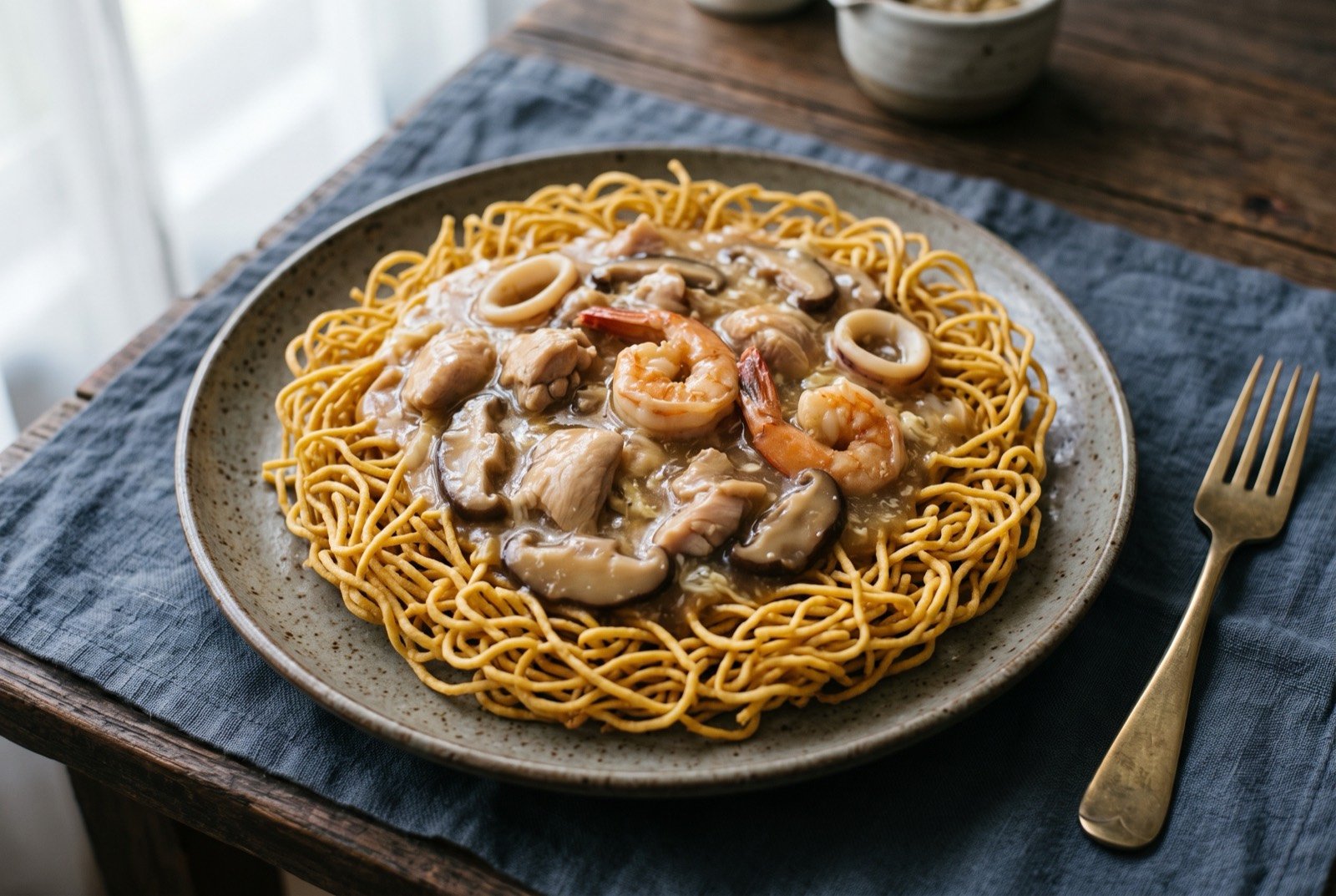
An illustration of the dish, not a photograph of it cooked.
- Time
- 45 minutes
- Reviewed
- Not yet reviewed from inside the tradition
- Cooked
- Not yet cooked and reported
Mie titi's history is unusually precise for a South Sulawesi dish: created by Ang Kho Tjao, a Chinese-Makassarese cook, in the 1950s, and passed down to his three children, Hengky, Awa' and Titi, the dish becoming known under Titi's own name specifically because her version of the family stall became the most popular from the 1970s onward. This chapter treats it plainly as a Chinese-Indonesian dish woven into Makassar's food identity, not a Bugis or Makassar dish by ethnic origin, the cleanest single proof in this whole volume that the coast's cooking was never sealed off from outside technique.
As tradition built it
Serves 4. About 45 minutes.
Ingredients
- 400 g dried egg noodles
- as needed oil, for deep frying the noodles
- 200 g chicken, sliced thin
- 150 g prawns, peeled
- 100 g squid, sliced
- 100 g chicken liver, sliced
- 100 g mushrooms, sliced
- 4 garlic cloves, chopped
- 700 ml chicken stock
- 2 tbsp cornflour, slaked
- 1 tbsp oyster sauce
- to taste white pepper and salt, to taste
Method
- Deep fry the dried noodles in hot oil in small batches until crisp and golden; drain and set aside.
- Fry the garlic until fragrant, then add the chicken, prawn, squid and liver in sequence, searing each briefly.
- Add the mushrooms and stock, bring to a simmer, and season with oyster sauce, white pepper and salt.
- Thicken with the slaked cornflour to a glossy, coating sauce.
- Pour the hot sauce over the crisp fried noodles just before serving, so the noodles stay crisp under a hot, thick topping.
What a modern chef changes
A smoked chicken component and a properly clarified sauce
Rung 1's reduction discipline applied to a Chinese-style sauce rather than a Sulawesi broth
Method
- Smoke a portion of the chicken over applewood on a Big Green Egg before slicing it into the topping, a genuine textural and flavour contrast against the seared prawn, squid and liver, offered here as this chapter's own extrapolation rather than a documented Ang Kho Tjao family technique.
- Reduce the stock by a third before thickening it, concentrating the sauce's own savoury depth rather than relying on cornflour alone to build body, the same measured-reduction logic rung 1 sets out for coto's own broth.
- Fry the noodles in two heights of oil temperature, a lower pass to cook them through, a brief hotter pass to finish the colour, for a more even, less patchy crispness across the whole nest than a single fry gives.