Maritime Southeast Asia · Volume 48, The Phinisi Route, the Kluwak Pot and the Buffalo’s Horn
Kapurung
Luwu, around Palopo
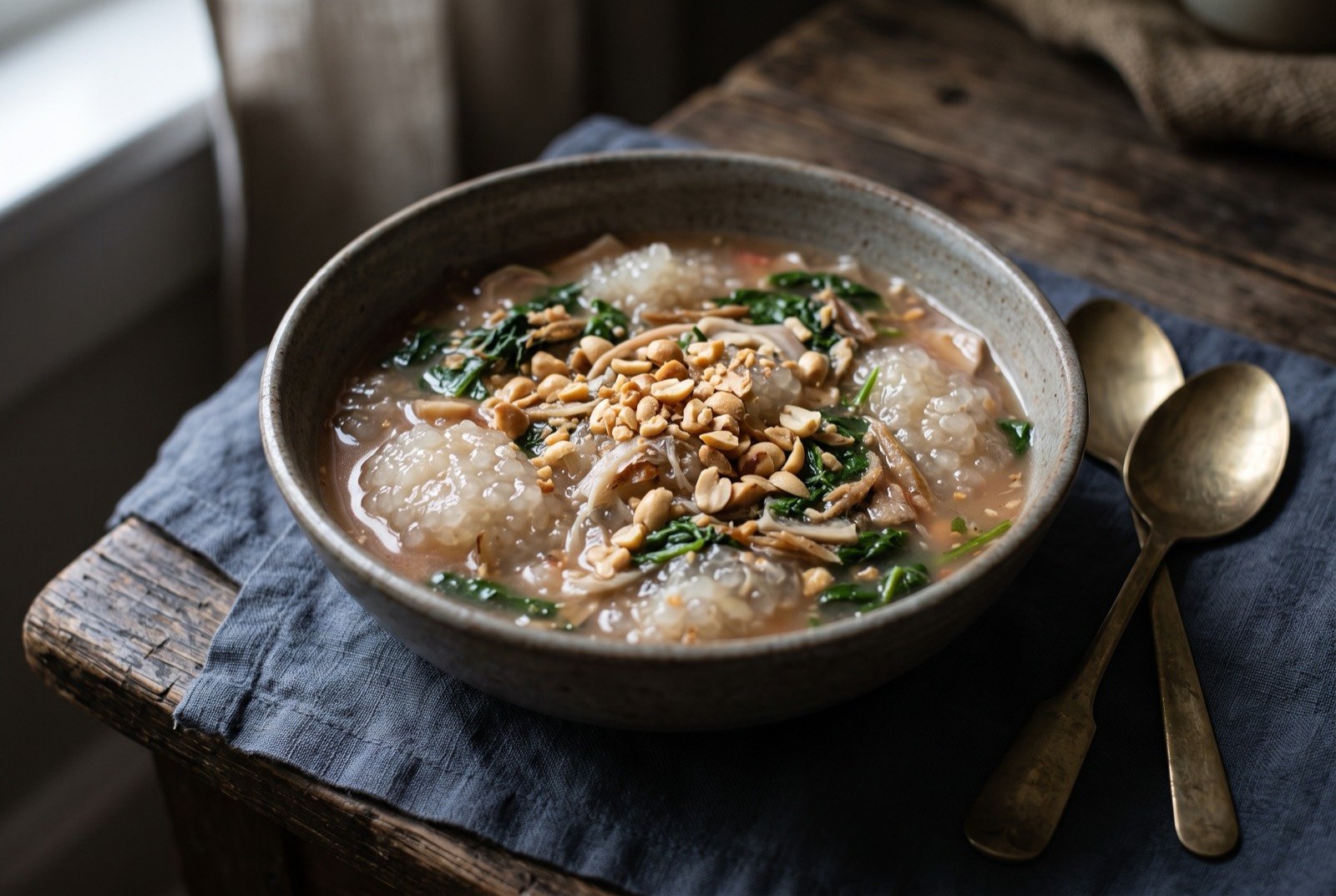
An illustration of the dish, not a photograph of it cooked.
- Time
- 45 minutes
- Reviewed
- Not yet reviewed from inside the tradition
- Cooked
- Not yet cooked and reported
Kapurung belongs to Luwu, understood by Bugis historical tradition as the oldest of South Sulawesi's kingdoms, and its own staple, sago rather than rice, marks it apart from both the coastal rice economy and the Toraja highlands proper. A named regional historian cited by Indonesia's public broadcaster RRI explains the dish's origin pragmatically: the wider Luwu region is naturally rich in sago palm, and its people built a staple food economy around processing it into flour and granules long before kapurung became a single named dish, RRI's own framing calling it "not merely food, but a trace of Luwu people in the past who survived by using every plant living around this region."
As tradition built it
Serves 4. About 45 minutes.
Ingredients
- 200 g sago flour
- 500 ml boiling water
- 200 g small dried fish (or dried anchovy, as a UK substitute for ikan mairo)
- 100 g spinach
- 100 g banana blossom, sliced
- 4 shallots
- 3 garlic cloves
- 0.5 tsp white pepper
- 50 g peanuts, fried and roughly ground
- 2 tbsp tamarind pulp (a substitute for asam patikala, see Flavour Arsenal)
- to taste bird's eye chilli, to taste
Method
- Scald the sago flour with the boiling water, stirring constantly, until it forms a stretchy, translucent, gelatinous mass. Set aside.
- Grind shallot, garlic, white pepper and chilli to a paste and fry briefly.
- Add the dried fish, spinach and banana blossom, with enough water to make a light soup, and simmer 10 minutes.
- Stir in the tamarind pulp to taste.
- Add the scalded sago in spoonfuls to the hot soup, stirring through, and finish with the ground fried peanut.
What a modern chef changes
A precision-controlled sago texture and a home-cured dried fish
Rung 1's starch discipline applied to sago instead of rice
Method
- Scald the sago in a measured ratio in a high-power blender jug rather than by eye, checking the exact stretch and translucency of the result against a target consistency before it goes into the soup, the same controlled-starch logic rung 1 sets out for air tajin.
- Dry and lightly salt a batch of fresh anchovy in a dehydrator to approximate ikan mairo's own small, intensely savoury dried fish, since the genuine species is not available in Britain; state this plainly as a substitute rather than a claim of equivalence.
- Reduce the tamarind with a little extra sourness from lime to compensate for asam patikala's own missing top notes, a named, honest adaptation rather than a claimed match for a fruit this chapter could not source.