Southern Africa · Volume 21, The Most Layered Plate
Bredie
Cape Muslim
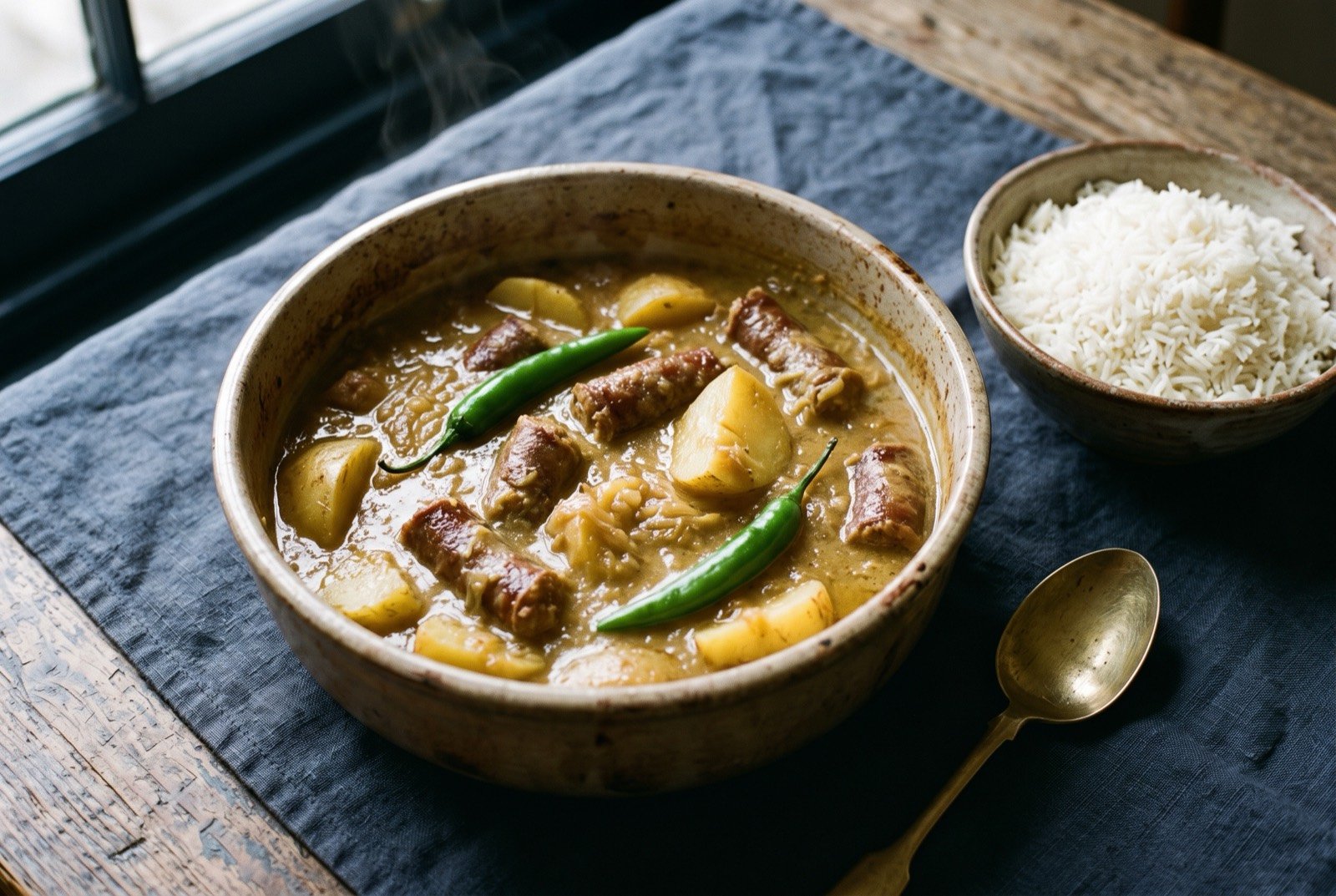
An illustration of the dish, not a photograph of it cooked.
- Time
- 45 minutes
- Reviewed
- Not yet reviewed from inside the tradition
- Cooked
- Not yet cooked and reported
A bredie is a slow stew in which one vegetable dominates and gives the dish its name: tamatiebredie, green bean bredie, waterblommetjiebredie, cabbage bredie, sago bredie. Cape Muslim writers describe bredies as langsouskos, food that stretches: economical stews in which vegetables were made to carry expensive meat further, under conditions of enslavement and poverty. That economic fact is why the technique exists, and it belongs before the recipe rather than after it.
As tradition built it
Serves 6. About 45 minutes.
Ingredients
- 1 kg lamb or beef sausage, cut into pieces
- 4 tbsp oil
- 3 onions, finely chopped
- 6 to 8 potatoes, peeled and quartered
- 3 whole chillies
- 1 garlic clove, finely chopped
- 1.5 cups water, in two additions
- to taste salt and black pepper
Method
- Heat the oil over medium high. Brown the onions well.
- Add the chillies, garlic and half a cup of water. Cook the onion mixture 10 minutes.
- Add the sausage, salt, pepper and potatoes. Cook about 8 minutes, stirring occasionally.
- Add one cup of water and cook until the potatoes are soft.
- Serve with white rice and atchar.
Notes
Fatima Sydow's sausage bredie, soesys kos, from her own site, and as plain a statement of the method as exists in print.
The technique inside that recipe. Watch what happens after the onions brown: half a cup of water goes in and the onions cook for a further ten minutes. This is the defining Cape move, and it appears in Cass Abrahams's waterblommetjie bredie in the reverse order, onions simmered in water first until it evaporates, then oil added and the onions browned. Either way, the onion is taken through a wet stage and a dry stage, never one or the other.
Why it works. Simmering in water hydrolyses onion cell walls and drives off the sulphurous, pungent volatiles at a temperature well below frying. Browning an already softened, already sweetened onion then gives deep, even Maillard colour in a fraction of the time, with no scorched edges around raw centres. Deglazing browned onion with water and re-reducing does the same from the other direction: it lifts and redistributes the fond and rehydrates the onion so it collapses into the sauce instead of staying in shreds. Either sequence produces the thing a bredie lives on, which is onion as a sauce rather than onion as an ingredient.
And the chillies go in whole, which flavours the pot without dispersing capsaicin through it. A bredie is warm, not hot. That is the line between a bredie and a curry, and Cape cooks hold it deliberately.
What a modern chef changes
Both onion sequences run at once, a real stock, and the pot closed
Rungs 5 and 1
Method
- Run the wet stage and the dry stage in both directions. Sweat half the onion in water until translucent and the water has gone, then brown it hard. Brown the other half from raw, then deglaze with water and reduce. Combine. Two Maillard profiles in one sauce, with more depth than either method alone.
- Build a stock from the sausage trim and bones and use it instead of the second cup of water. Every bredie in the repertoire is limited by the fact that water is the liquid. Nothing in the tradition forbids stock; it was an economy, not a principle.
- Close the pot for the potato stage. Rung 1: lid on, low heat, potatoes above the meat, liquid low. They steam rather than boil, hold their shape, and do not shed starch and cloud the sauce.
- Stage the whole spice. Cinnamon, cardamom pod, clove and bay into the onion at the wet stage, lifted out before serving. This is the richer bredie, and the whole spice never reaches the eater's teeth.