Africa · Volume 21
South Africa, Lesotho & Eswatini
The Most Layered Plate
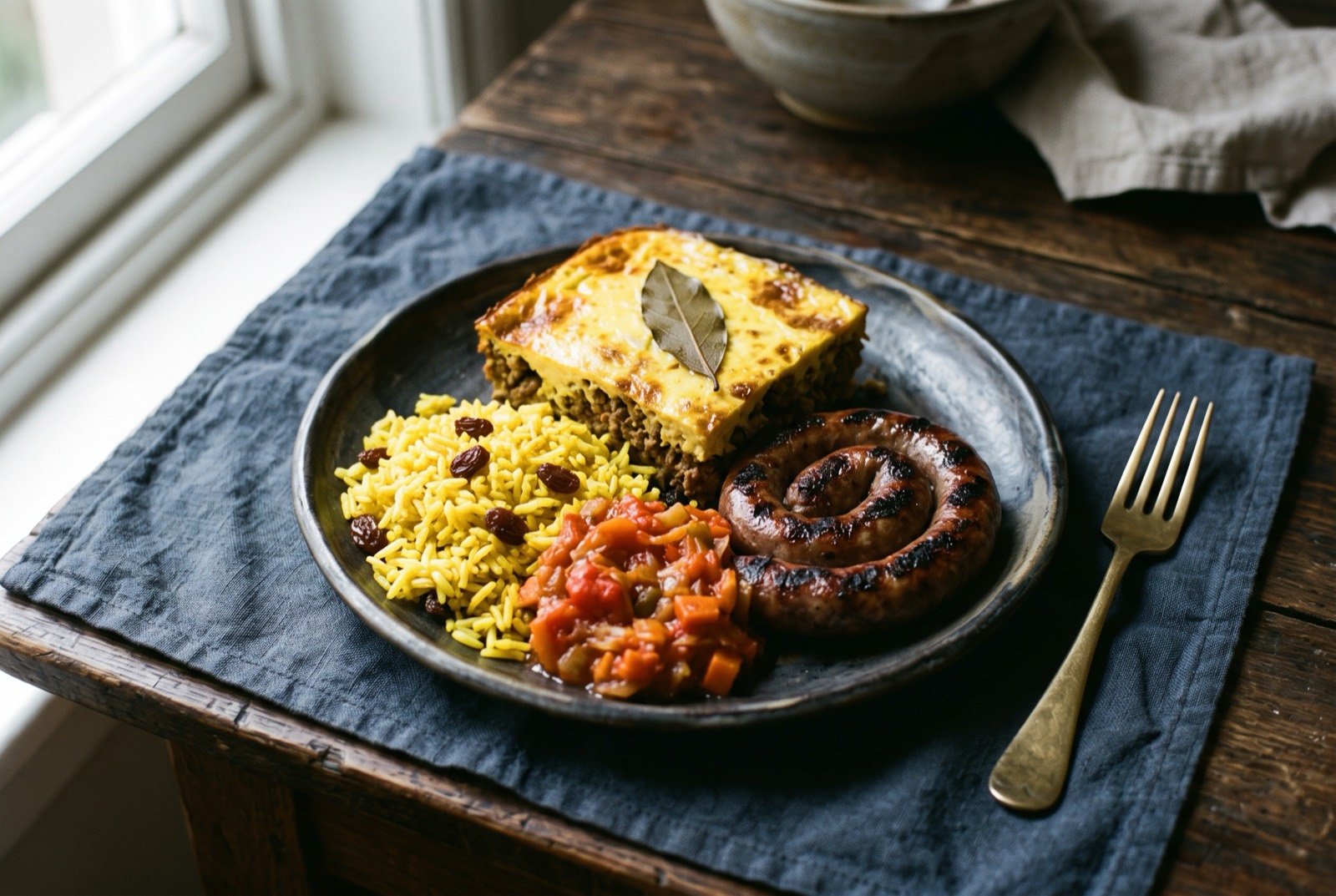
Three countries and nine kitchens, taken seriously. The traditional canon as the communities who own it actually cook it, a technique ladder built from inside those communities rather than borrowed, and every dish as tradition built it, then what a modern chef would change.
Sources and review · What this chapter does not assert · How we research · Spotted something wrong?
A Sense of Place
In this volume the map is not geography. It is community, and the communities were made by force.
Every other chapter in this series opens with ecology: a lagoon, a forest band, a savanna. That reading fails here. Provincial borders predict very little about what is on a South African plate. What predicts it is who your great grandparents were, whether they arrived enslaved, indentured or armed, and which line on the apartheid map they were standing on when the Group Areas Act came into force. A chapter that presents this food as a happy rainbow of influences is lying by omission. The layering is genuinely the richest on the continent, and it was produced by enslavement, indenture, migrant labour and forced removal. Both things are true and this chapter holds both.
The Cape Muslim kitchen
Bo-Kaap, District Six, and the Cape Flats that District Six was emptied into. Descendants of those enslaved and exiled by the Dutch East India Company from the Indonesian archipelago, the Malay peninsula, the Indian subcontinent, Ceylon, Madagascar and the East African coast, together with later Indian Muslim arrivals and Khoekhoe ancestry.
Fat: ghee, butter, mutton fat. Thickener: long reduction and collapsed onion above all, then potato, and mashed potato worked into doughs. Aromatic: warm spice used with restraint, kaneel, cardamom, clove, cumin, coriander, aniseed, turmeric, mace, plus tamarind, dried apricot, naartjie peel, bay and lemon leaves, and sugar treated as a seasoning. Starch: basmati rice, yellow rice with raisins, roti, white bread. Signature: bredie, denningvleis, bobotie, sosaties, breyani, akhni, pickled fish, koesister, boeber.
The defining logic is sweetness and sourness held in deliberate tension against the spice. This is the only South African tradition that reaches for dried fruit as a savoury seasoning as a matter of course. The cuisine is known internationally as Cape Malay, a term many inside the community reject; the history section deals with that properly rather than in a footnote.
The Xhosa Eastern Cape
The amaXhosa, amaMpondo, abaThembu and the wider southern Nguni. Fat: very little, and marrow. Thickener: none, because the starch is the body of the dish. Aromatic: salt, sour milk, wild greens, wood smoke, and the meat. Starch: umngqusho, whole white maize, sorghum (amabele). Signature: umngqusho, umphokoqo, imifino, inyama yenhloko, umqombothi.
This is the most austere and the most technically demanding cuisine in the volume, because there is nowhere to hide. Seasoning is salt and time. Ray Mahlaka, writing in Daily Maverick about his grandmother Nomalizo's umngqusho, gives the best short statement of it: the family ate it plain, with no stew and no gravy, and she joked that meatless food was the best way to move a guest along.
The Zulu and Natal midlands
The amaZulu and the northern Nguni. Fat: minimal. Thickener: none, except pumpkin and beans cooked to collapse. Aromatic: amasi, salt, smoke. Starch: white maize as pap and as steamed bread, and sorghum.
The defining logic is steam and slow moist heat rather than fat. The steamed dumpling bread is the technical centre and it is the direct counterpart of the Cape breyani lid: cooking by trapped vapour, not by liquid. Two communities who were never allowed to eat in the same room arrived at the same physics. This is also the worst served community in the research behind this chapter, so it prints very few isiZulu dish names and cooks none as a named recipe. That is a documentation failure, not an absence of cooking, and the final section says so.
The Sotho, Tswana and Pedi interior
Free State, North West, Limpopo, and the Gauteng townships. Fat: little, with groundnut in Limpopo. Aromatic: controlled souring, this region's signature move and the deepest technique in the volume. Starch: sorghum (mabele) and white maize. Signature: ting, motoho, papa le moroho, dikgobe, mopane worms and edible termites in the lowveld, mala mogodu.
Where the Cape reaches for tamarind and vinegar, the interior reaches for a two day ferment. Lactic acid is a seasoning, a preservative and a nutritional strategy at once, and motoho has been characterised microbiologically by the CSIR and the University of Pretoria.
The Afrikaner and Cape Dutch farm kitchen
Afrikaners, and, inseparably, the enslaved and later Coloured farmworkers who did most of the actual cooking in Cape Dutch kitchens. Any account that leaves the second group out is describing a menu, not a kitchen.
Fat: sheep tail fat, butter, lard, kaiings. Thickener: reduction, potato, and apricot jam as glaze and sweetener. Aromatic: koljander, coriander seed, above all, then cloves, nutmeg, allspice, brown vinegar, brown sugar. Starch: pap, potato, potbrood, beskuit. Signature: boerewors, potjiekos, braai, biltong and droëwors, tamatiebredie, waterblommetjiebredie, vetkoek, braaibroodjie, melktert, malvapoeding.
The defining logic is preservation and fire. Coriander seed does a job here it does nowhere else in the world at this dosage: it is the single defining aromatic of both boerewors and biltong, and one of very few threads running through every community in this volume.
The Durban Indian kitchen
Descendants of the 152,184 indentured labourers who arrived in Natal between November 1860 and 1911, plus the passenger Indian merchant class who paid their own way. Fat: sunflower oil, ghee. Thickener: onion and tomato cooked to a paste, potato, lentils. Aromatic: masala, and masala here means chilli, plus curry leaf, mustard seed, soomph, jeera, tamarind and dhania. Starch: rice, roti, and, crucially, white bread. Signature: bunny chow, mutton curry, crab and prawn curry, breyani, samoosa, dhal, mango achar.
The defining logic is heat as the leading edge with aroma behind it. Durban masala is not an Indian curry powder that travelled; it is a South African blend built on a chilli base at a proportion no Indian regional blend uses. Ishay Govender, who writes this cuisine from inside it, describes it as a hybrid of techniques from more than one region of India combined with locally available ingredients, developed in virtual isolation.
The Basotho highlands
Lesotho: the highest country in the world measured by its lowest point, a short growing season, fat tailed sheep and wool. Starch: sorghum first, maize second. Signature: papa, stirred with a wooden paddle called a lesokoana; moroho; likhobe; motoho at breakfast; sekoto.
And here is the honest position. There is no dish level food journalism from Lesotho that this chapter could reach, no weighed Basotho recipe, and no fine dining scene. What exists, documented in the national press, is a training infrastructure: the Dona@Balos school in Maseru, which offers an Advanced Diploma in Culinary Arts and has won continental awards, and a chefs' association that has repeatedly lobbied government for support. Lesotho's contribution here comes through technique and staple, above all through motoho, and this chapter will not pad it.
Eswatini
Highveld, middleveld and lowveld in a country you can cross in two hours, so the cooking is genuinely seasonal and altitudinal. Thickener: ground groundnut, the clearest link in this volume to the wider African groundnut sauce belt. Aromatic: emasi, pumpkin, pumpkin leaf. Signature: sishwala, incwancwa, sidvudvu, umbidvo wetintsanga, tinkhobe, umncweba and umkhunsu, emahewu, tjwala.
Eswatini punches far above its size here for one reason: its two central ferments have been measured. Simatende, Siwela and Gadaga, at the University of Eswatini and the University of KwaZulu-Natal, sampled household produced emasi and emahewu and published pH, titratable acidity and organism counts. That is the only measured fermentation chemistry from any of the three countries in the research behind this volume, and it comes from the smallest one.
The Khoe and San substrate
Everywhere, acknowledged almost nowhere. Veldkos: sour figs, dune spinach, waterblommetjies, wild honey, tubers and bulbs, marula, buchu, rooibos, shellfish and small game. Sadr, at the University of the Witwatersrand, puts the arrival of herding at roughly 2,000 years ago, by migration and local adoption together rather than by one incoming wave.
Two techniques central to this volume are very probably Khoe or San and are routinely credited to Europeans: drying and salting meat in strips, and souring milk in a skin or gourd. Those two account for biltong, droëwors, amasi, emasi and mafi, which is a large fraction of everything this chapter is about. Cass Abrahams's insistence that Cape cuisine is food from Africa, carrying KhoeKhoe influence, is the in-tradition version of that argument. There is no Khoe or San voice anywhere in the research behind this chapter, and that absence is itself the point the ownership section makes.
The History in Layers
The indigenous foundation
Herding arrives roughly 2,000 years ago, and the two preservation techniques above are Khoe and San before they are anyone else's.
Wild greens and insects are not famine food, and writing them as poverty markers is the standard failure of writing about this cuisine. A survey of edible termites in Vhembe District, Limpopo, by Netshifhefhe, Kunjeku and Duncan of the University of the Witwatersrand and the University of Venda, covered 104 people across 48 villages: three Macrotermes species eaten, frying preferred by 77.55 per cent of respondents, harvesters mostly over 60, and annual income from termite sales between ZAR 2,040 and ZAR 17,680 in 2015 to 2016. Their conclusion is that the indigenous knowledge used in harvesting and processing needs prioritising for transmission to younger generations. That is a Limpopo scholar saying the knowledge is the endangered thing, not the insect.
The VOC, enslavement, and the making of the Cape kitchen
The Dutch East India Company established its refreshment station at the Cape in 1652 and began importing enslaved labour almost immediately. It is not possible to reconstruct the origins of the enslaved population accurately. The best estimates give roughly equal proportions of Malagasy, Indian, Southeast Asian and continental African people, and South African History Online adds captives from the Philippines, Japan, Macau, Malacca, the West Indies, Brazil and possibly New Guinea, noting how many were skilled: silversmiths, milliners, cobblers, singers, masons and tailors. Political exiles are a separate stream: Sheikh Yusuf al-Maqasari, a Makassarese scholar from Sulawesi, arrived on 2 April 1694 with 49 other Muslim exiles, and Tuan Guru was imprisoned on Robben Island from 1780, where he wrote out a book of Islamic law from memory. Britain banned slave imports at the Cape in 1808, and in 1836 the colonial authorities estimated the Malay population at around 5,000 out of a total Cape population of 130,486.
The kitchen consequence. Enslaved cooks ran Cape Dutch kitchens. They cooked with what the VOC's spice monopoly made available and adapted dishes they could not reproduce. The Indonesian words surviving in Cape Afrikaans, sop, pisang, blatjang, sambok, ghoema, show, in Rustum Kozain's phrase, "both roots and the loss of roots".
C. Louis Leipoldt, the most cited authority on Cape cookery, credited Malay cooks with being the most potent influence on it while rarely acknowledging that they were enslaved. That gap is the historiography this chapter is trying to correct, and it is why the recipes below are attributed to named Cape Muslim cooks wherever a named Cape Muslim cook exists.
Indian indenture in Natal, from 1860
152,184 indentured labourers arrived in Natal between November 1860 and 1911, when the system was stopped. Roughly 26.85 per cent of indentured men returned to India and the majority stayed. The first arrivals came on the Truro from Madras and the Belvedere from Calcutta. Indians were forced to carry passes from 1888 and moved into designated townships under the Group Areas Act from 1950. The 2022 census records 1,697,506 people classified Indian or Asian, 1,157,542 of them in KwaZulu-Natal. Those are South African History Online's figures, used here in preference to the rounder 200,000 that circulates elsewhere.
The kitchen consequence is a rupture, not a transplant. Indenture broke regional and caste kitchen boundaries, plantation rations dictated what could be cooked, and the available chilli was local and cheap. Govender's account of the ration list is the useful detail: dholl, dried fish, oil and rice, and when rice was scarce, dried maize was crushed to make mealie rice, and maize meal was fermented to make sour porridge. Local Zulu ingredients came in: running chickens, madumbis and amasi. Ghee, coconut oil and mustard oil were replaced by cheap vegetable oil. Potatoes went into breyani, which is unheard of in India.
Read that ration sentence again. Within a generation of arriving, an Indian community in Natal was fermenting maize meal into sour porridge, an Nguni and Sotho technique, because the rice ran out. The Durban kitchen is a genuinely new South African cuisine that happens to be made of Indian parts.
The Afrikaner and British layers
The Voortrekker migration from the 1830s took the cast iron pot, the dried meat and the fried dough into the interior, and Afrikaner nationalism later did a great deal of work turning practical objects into ethnic symbols. That is why a three legged pot is now a flag. The British culinary layer is thin: the Sunday roast served with rice, fish and chips built on hake and snoek, the meat pie. British colonial economics did far more than British cooking: the sugar estates that brought indenture, the mines that created the migrant labour system, and the maize milling industry that industrialised the staple and pushed sorghum out.
That last is the single most under-told fact in South African food history. Sorghum is the older staple across this region and every soured porridge in this chapter is a survival of the pre-maize grain regime. A 2022 review by Nelson Mandela University, the Agricultural Research Council and the Department of Agriculture, Land Reform and Rural Development argues that sorghum remains marginalised in research, breeding, production scale and policy support despite its resilience to heat and drought. The retreat of sorghum in favour of maize is a colonial and industrial story, not a culinary preference.
Apartheid as a food geography
The Group Areas Act, 1950 commenced on 30 March 1951 in the Cape, Transvaal and Natal and on 31 October 1952 in the Orange Free State, and was repealed on 30 June 1991. It empowered the state to designate areas for a single racial group. Sophiatown was cleared on 9 February 1955 by around 2,000 police, its residents moved to Meadowlands and the suburb rebuilt as a whites only area named Triomf, Triumph. District Six was declared a white area in 1966 and its residents dispersed to the Cape Flats. Durban's Grey Street Casbah, the home of the bunny chow, was whittled down to a few square blocks; Grey Street is now Dr Yusuf Dadoo Street.
Five culinary consequences, each of which returns later as a technique or a dish.
- Dispersal broke transmission. Gabeba Baderoon's formulation is the one to use: forced removal created "silos in which dearly held cultural codes are either locked or lost".
- Segregated eating produced portable food. One account of the bunny chow turns on Black customers not being served inside Indian owned establishments, so the food had to leave the building.
- Migrant labour created chakalaka in miners' hostels around the Johannesburg gold mines.
- Women's brewing went underground and became the shebeen economy.
- The Gatsby is a Cape Flats invention of 1976, which is to say an invention of the place people were moved to: Rashaad Pandy's foot long roll of slap chips and masala steak, made in Athlone to feed workers renovating his shop, and named by a worker who called it a Gatsby smash after the film then showing at the local cinema.
Who owns which dish, and why this chapter refuses to say
The intellectual centre of the volume. The method is applied consistently: name the claim, name the claimant, name where they are speaking from, and do not adjudicate.
Bobotie has four origin claims. Cape Muslim cooks claim it as their own. Afrikaner households cook it as a staple. C. Louis Leipoldt traced it to Roman patinam ex lacte in Apicius by way of a dish circulating in seventeenth century Europe. And some sources assert an earliest recorded recipe in a Dutch cookbook of 1609, an attribution that does not survive checking. The etymology is contested between Malay boemboe and Indonesian bobotok. The Cape Muslim position, as reported in Daily Maverick, is the honest one: determining an originator "becomes futile because food inspiration travelled between conquered lands".
Koesister and koeksister are two different pastries with a name collision, and the collision is not innocent. The Cape Muslim koesister is a spiced yeasted dough enriched with mashed potato, fried, dipped in boiling syrup for one minute, rolled in coconut, eaten on Sunday mornings. The Afrikaner koeksister is a plaited dough, fried, plunged into ice cold syrup, crisp and glassy. Same operation, opposite goals, two entirely different pastries. The koesister is the older and more distinctive of the two and it is routinely subsumed under the better known Afrikaner name in international writing. This chapter uses both spellings deliberately and never as variants of one another.
Biltong is a European vinegar overlay on a Khoikhoi technique. It is claimed as an Afrikaner invention and celebrated as a Boer War provision, but salting and air drying meat in strips predates the Dutch, and the horse sweat origin story does not survive dating, because horses postdate the practice. The siSwati umncweba is the same product without vinegar and is very likely the ancestral form.
Bunny chow has at least four accounts and every one is an apartheid story. One: G.C. Kapitan, a Bania merchant, served bean curry in a hollowed quarter loaf in the 1940s, and "Bania's chow" became bunny chow. Two: sugar estate labourers needed a portable lunch. Three: golf caddies were not permitted to carry knives. Four: Black customers could not be served inside, so the food went out in bread. So many Durban restaurants claim the invention that the origin is unrecoverable, and a further live question is whether the Black South African kota, the quarter, descends from it or developed alongside it. Descendants of the indentured population are still arguing about who owns it, and this chapter will not settle an argument that belongs to them.
Chakalaka's mineworker origin is generally accepted but nothing else is. Whether the makers were Mozambican, Sotho or Zulu is unsettled, and the etymology is unknown: proposals include Setswana, isiZulu for something hacked together, and Fanagalo, the mine pidgin.
Potjiekos has three incompatible origin stories and none comes from a historian this chapter could reach: a Voortrekker invention, a descendant of Dutch hutspot by way of the 1574 Siege of Leiden, or a cast iron cooking technology that reached Bantu speaking peoples through Arab and Portuguese traders before the Dutch arrived. This chapter calls potjiekos an Afrikaner tradition built on a technology widespread in the region, and says the priority question is unresolved.
The braai and Heritage Day. Heritage Day, 24 September, was rebranded as National Braai Day in 2005 with Archbishop Desmond Tutu as patron, on the argument that the braai is the one thing all South Africans share. It has been criticised in the South African press for flattening a day about cultural heritage into a historically Afrikaner coded practice, and for reducing heritage to ash. The counter argument is that South Africans of every background genuinely do braai. Both are true. And shisa nyama is not a derivative of the suburban braai but a parallel institution: isiZulu for burn meat, it names a braai attached to a butchery, where you buy the meat at the counter and the fire and grid are provided. Collapsing it into "braai" erases the form.
Rooibos is the sharpest live case. Aspalathus linearis is endemic to the Cederberg and was commercialised by Pieter le Fras Nortier in the 1930s with, on the record, a crucial contribution from an unnamed elderly Khoi woman who showed him an ant nest seed granary. The EU granted it protected designation of origin in May 2021. There is a widely reported traditional knowledge benefit sharing agreement between the industry and Khoi and San representatives, which would be the single most important fact for the ownership argument, and which this chapter could not verify.
And the general principle, stated once so it can govern the rest. In a society built on forced displacement, "who invented it" is often the wrong question. "Who was paid for it, who was credited for it, and who was allowed to sell it" is the right one.
The modern moment
The real change of the last two decades is not restaurants. It is documentation from inside the tradition. Cass Abrahams, who died on 8 August 2026 aged 82, is the pivot figure: a biologist and science teacher who moved into food at 38, married into the Cape Muslim community without being able to cook or speak Afrikaans, was taught by her mother in law, was deliberately given incomplete ingredient lists by neighbours, worked the recipes out anyway with a scientist's method, wrote them down with weights for the first time, and then had the community come and ask her how she made hers. Faldela Williams wrote the first mainstream cookbook by a Cape Muslim cook in 1988. Fatima Sydow published three bestsellers, sold her own spice blends and died on 19 December 2023; her site remains the best in-tradition Cape Muslim source available. Mogau Seshoene, The Lazy Makoti, publishes the umngqusho below. Apiwe Nxusani-Mawela is reframing umqombothi as "indigenous science that has been passed on", judged by hand rather than by thermometer, and insists it cannot be reduced to one fixed recipe because "it all depends on preferences and what you're brought up to make."
The Flavour Arsenal
If you buy nothing else, buy whole coriander seed, a proper maize meal, and something live and sour.
The spice blends, which are three different arguments
| Blend | Community and source | Composition and dosing |
|---|---|---|
| Durban masala | Durban Indian home cook, published in her own name | Over 80 per cent chilli powder by weight, with cumin, coriander, garam masala, soomph, turmeric, cardamom and cinnamon making up the rest. Roast and grind each seed separately. Keeps 1 month cool, 6 months frozen |
| Mother in law masala | Durban Indian | The hotter blend. Heat from piri piri, black pepper, cayenne and mustard seed; colour from Kashmiri chilli and paprika; aroma from fennel, cumin, cardamom, cinnamon, nutmeg, fenugreek, bay and curry leaf. A Durban invention, not an Indian import |
| Cape masala | Cape Muslim | Dish specific, not universal. Fatima Sydow sold masala spice, breyani masala and fish masala as three separate blends. Mild, cinnamon and cardamom led, chilli a minor note. No weighed formula reached this chapter and none is printed |
| Bredie spicing | Cape Muslim | Not a masala at all: salt, black pepper, whole chillies left whole, garlic, and in richer versions cinnamon stick, cardamom pod, clove, bay and allspice |
| Koesister spice | Cape Muslim | Aniseed leads at 2 tbsp per 4.5 cups flour, then cinnamon, ginger, cardamom, mixed spice and naartjie peel powder |
| Boerewors spice | Afrikaner | Per 3 kg meat: coriander 45 ml, allspice 10 ml, black pepper 15 ml, brown sugar 10 ml, cloves 5 ml, nutmeg 2 ml, vinegar or red wine 125 ml |
| Biltong spice | Afrikaner, on a Khoi technique | Equal parts by volume rock salt, lightly roasted whole coriander, coarse black pepper and brown sugar |
Read the first row against the sixth. A Durban masala is over 80 per cent chilli. A boerewors mix is dominated by coriander at roughly ten times the dose a European sausage carries. Neither is a variation on the other and neither is a curry powder. And read the third row honestly. There is no weighed Cape masala here because none could be obtained from a Cape Muslim source, and inventing one is what this series exists to avoid. Cape spicing is layered in during cooking rather than blended in advance, which is a large part of why no fixed formula exists.
The sweet and sour axis, the souring agents and the dairy
Dried apricot, threaded between meat on a sosatie, cooked into bobotie, folded into breyani, rehydrates in the cooking liquid and, being unusually high in pectin, slightly thickens the sauce as it collapses. Apricot jam is the Afrikaner counterpart, a batter ingredient in malvapoeding and a basting glaze on snoek. Blatjang, the Cape chutney, from Malay belacan, is served with bobotie as a matter of course. Raisins and sultanas go into bobotie at about 60 g per kilo of mince. And naartjie peel, dried and ground, is the single most distinctive Cape Muslim aromatic and the hardest to buy in Britain, used by Sydow at 3 tsp per 4.5 cups of flour.
The souring agents divide cleanly by tradition. Tamarind, Cape Muslim, in denningvleis and sosatie marinades. Brown and malt vinegar, Afrikaner, in biltong, boerewors, pickled fish and malvapoeding. Cape sorrel, suring, in waterblommetjiebredie. Lemon and green mango in Durban. And lactic fermentation across the Nguni, Sotho and Swazi kitchens: amasi, emasi, mafi, mageu, emahewu, ting, motoho, incwancwa, umqombothi. That is the deepest and oldest layer, and the only one with measured numbers behind it.
The dairy, briefly. Amasi (isiZulu, isiXhosa), emasi (siSwati), mafi (Sesotho): spontaneously soured whole milk, pH about 4.68, titratable acidity about 0.9 per cent, 2 to 3 days at ambient in clay or calabash, and not yoghurt. Mageu, emahewu, amahewu, mahleu: soured thin maize porridge drunk cold, pH about 3.62, under 1 per cent ethanol. Sitfubi (siSwati): fresh milk cooked and thickened with maize meal, sweet rather than soured, and a different thing again.
The greens
Collectively imifino (isiZulu, isiXhosa), morogo (Sesotho, Sepedi, Setswana), moroho (Lesotho), umbidvo (siSwati). Walter Sisulu University in Mthatha reviewed 22 species across 12 genera and 10 families, with Amaranthus species, Cucurbita pepo, Bidens pilosa and Solanum nigrum the most prevalent. Agricultural Research Council survey work found amaranth and pumpkin most popular across all age groups, cowpea valued as a dried leaf product with a long shelf life, and only pumpkin and cowpea deliberately cultivated. Men favoured more bitter preparations, women and children milder ones.
| Vernacular | Botanical | Character |
|---|---|---|
| Thepe, imbuya, utyuthu | Amaranthus hybridus and relatives | Wild amaranth, the default green. Sweet, spinach-like, softens slowly |
| Ihlaba (isiXhosa, "spike") | Dandelion leaf | Bitter and peppery, fried with onion and salt |
| Morogo wa dinawa | Dried cowpea leaf | Savoury, umami, dried for the out of season months |
| Ucetshana, lephotshe, umliba | Pumpkin leaf | Fuzzy, iron and vitamin A rich; the flowers are eaten too |
| Irhawu | Stinging nettle | Naturalised in the Eastern Cape. Steeped in boiling water first to destroy the hairs |
Why "a little fat and salt" is the right instruction and not a lazy one. These greens are high in beta-carotene and other fat soluble compounds that are not bioavailable without lipid, and most are mildly oxalate rich, which a short cook and a discarded first water manages. The tradition of adding groundnut, in Eswatini's umbidvo wetintsanga and in Limpopo morogo, is supplying the fat that unlocks the nutrition, which is the same solution the West African leaf sauce belt reaches with groundnut paste, arrived at from the other end of the continent.
Insects, grains, larder and fats
Mopane worms, Gonimbrasia belina: mashonzha in Xitsonga and Tshivenda, madora in Zimbabwe, phane in Botswana. Harvested by women and children some weeks into the rains, just before pupation, from the lower branches only, both because the upper ones are held to be unripe and to protect the tree's future yield. Degut, then boil and dry: the optimised figures are boil 20 minutes, dry at 40°C, giving protein at 49.4 per cent of dry weight, fat 20.2 per cent and iron 19.0 mg per 100 g. To rehydrate: soak 1 hour, simmer 10 minutes in salted water. Degutting is not squeamishness, because the gut is packed with tannin rich mopane leaf and leaving it in ruins both flavour and shelf life; and drying at 40°C rather than in full sun protects the 20 per cent fat from oxidising, which is what makes badly dried mopane worms taste rancid. These figures come from a paper this chapter could not open and are flagged in the final section.
The grains. Sorghum: mabele (Sesotho, Setswana), amabele (isiZulu, isiXhosa), emabele (siSwati), red for beer and white for porridge. White maize in three forms that matter: super maize meal for smooth pap, coarse braai pap meal, which gives krummelpap its crumb, and samp, stamped and dehulled broken kernels, not milled. Sugar beans are the standard partner to samp, where the sugar is a name and not a sweetness. And one etymological fact worth a sentence: the English word samp comes from the Narragansett nasàump, adopted by colonists in New England and carried to southern Africa. The English name for the defining Xhosa staple is Algonquian; the isiXhosa name, umngqusho, owes it nothing.
The Cape larder and the fats. Rooibos, from roughly 60,000 hectares of the Cederberg, holding EU protected designation of origin since May 2021; buchu; sour fig; waterblommetjies, picked in July and August; marula; snoek. Sheep tail fat and kaiings in the Karoo, ghee and butter in the Cape Muslim and Durban Indian kitchens, groundnut in Eswatini and Limpopo, and marrow, cooked into umngqusho, supplying the fat that dish otherwise lacks entirely.
Part Two
The Technique Ladder
First, an honest problem
The Michelin Guide does not publish a guide for South Africa. There is no Michelin inspection of Cape Town, Johannesburg or Durban. Every South African chef described in the press as Michelin trained or Michelin starred earned that abroad: Jean Delport at Restaurant Interlude in Sussex, Jan Hendrik van der Westhuizen at JAN in Nice, Wandile Mabaso on the team that won two stars at Le Meurice Alain Ducasse in 2016.
So this chapter does not use Michelin as its benchmark. The domestic benchmark is the Eat Out Woolworths Restaurant Awards, judged in South Africa, and the 2026 results announced in June 2026 are the list to cite. Restaurant of the Year: FYN, Cape Town. Chef of the Year: Johannes Richter, The LivingRoom, Pinetown, for the second consecutive year. Chefs' Chef: Ryan Cole, Salsify at the Roundhouse. Three stars: FYN, La Colombe, La Petite Colombe, MERTIA, Pier, Salsify at the Roundhouse, and The LivingRoom at Summerhill Guest Estate, Pinetown, the only three star restaurant outside the Western Cape.
That list tells you the geography honestly: overwhelmingly Western Cape, one dominant KwaZulu-Natal outlier, Johannesburg at rising star level. Lesotho has no fine dining scene at all. Eswatini has one chef making a serious modernist argument and no verifiable restaurant behind him.
But the problem is smaller than it looks. Unlike Volume 04, where no starred kitchen anywhere in the world was cooking that food, this volume has a domestic fine dining scene explicitly making the argument this series exists to make. It is just not making it inside a French guidebook.
The argument, from inside
Three cooks state the thesis unprompted, from three communities.
Peter Tempelhoff at FYN, on the abalone his kitchen cooks sealed inside kelp stems:
thousands of years ago, the locals would cut the kelp stems and stuff them with tough seafood, then put them on the fire so they would almost pressure cook.
Sive Bhembe in Eswatini, who builds fine dining desserts from umsobo berries, strained emasi and millet, and whose argument is that these ingredients have been "unfairly overlooked because they were viewed as weeds or 'poverty foods'". His technical note is worth stealing outright: strained emasi develops the consistency of cream cheese.
Mmabatho Molefe at Emazulwini, whose ten seat menu at Makers Landing keeps the isiZulu names on the card: "It's the food we grew up eating, prepared in a modern way." Look at what is on it. Igwinya nopholoni, vetkoek with house made chicken polony. Ulimi noshatini, corned beef tongue with amasi. Ipapa neklabishi, braised beef heart with creamy pap and beef heart biltong shavings. Incwancwa, fermented maize porridge served as dessert. Pap, offal, sour milk, fermented maize and dry cured heart: five of the six rungs below on one ten seat menu, and none of them imported.
Rung 1. Layer, add almost no liquid, cook by trapped steam, and never stir
This is the spine of the volume, and it is the same technique in two communities kept apart by law for four decades.
A potjie is a round, three legged cast iron cauldron set directly in coals. The parameters, from a Cape Town cast iron maker: hardwood only, burned down 30 to 45 minutes to white grey coals; meat browned in the pot and left where it is as the bottom layer; root vegetables above it; soft vegetables on top; 1 to 2 cups of liquid only, poured down the side, not enough to cover; lid on; 2 to 4 hours, with chicken at 1.5 to 2, lamb or beef at 2.5 to 3 and oxtail at 3 to 4 minimum. Managed by ear: a quiet simmering sound is correct, silence means add coals, hard bubbling means take coals away.
Now read Cass Abrahams on breyani, published in Woolworths TASTE. She calls it the hardest dish in the Cape repertoire to master, precisely because everything must be layered, cooked through by steam alone, and left untouched until a crusty brown spiced rice layer forms on top. "There's nothing better than eating that crust."
Two communities, two centuries, one principle. One arrived by ox wagon with a cast iron pot and one arrived in a slave ship carrying a memory of the Indian Ocean rice kitchen, and they built the same machine.
Why it works. Layering is a heat gradient made physical. The heat comes from below: meat on the bottom sits in the hottest zone and braises in its own rendered juices, the layer above it steams, and the aromatics at the top perfume the condensate that drips back down. You are running three cooking methods at once in one vessel, and a spoon averages all three into one. Almost no added water is what makes it concentrated, because with 1 to 2 cups in a sealed pot the vapour rising through the stack carries aromatic compounds upward but almost no soluble solids, which is why the layers still taste of themselves after three hours. Cast iron's thermal mass then holds the base in the collagen conversion window for hours even as the coals fluctuate, so the meat never boils hard. And the crust is the point, not a side effect: direct contact between the bottom layer and hot cast iron, with fat present and water activity low at that interface, gives Maillard browning and starch dextrinisation. It is the same physics as Persian tahdig, and it only forms if you leave it alone.
Translation for a British kitchen. A heavy cast iron casserole, lid on, oven at 140 to 150°C, or a real potjie on a thin bed of dense hardwood coals. Layer in cooking time order. One to two cups of liquid, no more, poured down the side. Do not lift the lid to stir. Lift the whole pot and swirl it if you need reassurance.
Rung 2. Manage the braai as a fire with zones and a wood choice, not as a barbecue
A braai is cooked over coals from wood you burned yourself. Not gas, and usually not briquettes. Wood dominated historically and there has been a deliberate return to it since the state's invasive species clearance programme started supplying rooikrans and Port Jackson as firewood.
The four woods. These reach Britain sold by species with published burn characteristics. Kameeldoring, camel thorn, Vachellia erioloba, is extremely dense: it drops to high heat coals in about an hour and then holds them like glowing rock for hours, with very little smoke and a musky aroma. This is the potjie wood, because a thin layer of its coals under cast iron gives hours of steady heat without feeding the fire. Sekelbos is dense and oily and burns exceptionally hot: the steak wood. Mopane is one of the heaviest woods in southern Africa, with extraordinarily long lived coals. Rooikrans is the Cape wood, giving usable coals in about 40 minutes and burning over an hour where charcoal gives about thirty: the fish and shellfish wood. All of it sold in Britain should be at 20 per cent moisture or less, and Namibian sourced stock is sun dried as low as 0 to 1 per cent.
Why it works, in three mechanisms British cooks confuse. Fuel moisture governs flavour, not just ignition: water in wood boils off before pyrolysis can proceed cleanly, so a wet log smoulders in the 200 to 300°C range that produces acrid, phenol heavy, creosote-like smoke, which is what people mean when they say barbecue tastes bitter. Dry wood goes straight to clean combustion and gives heat plus a thin, aromatic smoke, so the 20 per cent figure is a flavour specification, not a convenience. Density governs coal life: a dense hardwood packs more cellulose and lignin into the same volume, so the charcoal bed it leaves has more carbon per unit area and radiates longer at a stable temperature. And the aroma difference is species chemistry: legume hardwoods of the Vachellia and Dichrostachys type carry different extractive and resin profiles from oak or birch. Substituting British oak for kameeldoring is not a small change; it is a different aromatic family.
The zone discipline, which is the actual skill. Build the fire at one end and rake coals across, so you have a searing zone, a cooking zone and a holding zone. Wors on the medium zone, never the hot one. Steak on the hot zone. Chicken on the cool zone. Heat control here is horizontal, not vertical, which is why South African braai grids are hinged and turned as a whole surface, and why the burn down is not impatience management but the removal of the raw smoke phase. Never braai over flame. The technique is coal management; the fire is only the machine that makes coals.
One thing to print as a claim rather than a fact. Kameeldoring is a protected tree in South Africa and it is also the wood most prized for firewood. UK sellers state that they harvest only naturally fallen deadwood from trees that live 200 years. That is plausible, and it is the seller's claim.
Rung 3. Control pap texture deliberately, because it is one flour making four dishes
The best numbers in this volume, from Jan Hendrik van der Westhuizen, using super maize meal and volume measures throughout, each serving 4:
- Slappap, soft and pourable, breakfast. 500 ml water, 5 ml salt, 190 ml maize meal. 30 minutes.
- Stywe pap, stiff and sliceable, the braai partner. 500 ml water, 5 ml salt, 250 ml maize meal. 30 minutes.
- Krummelpap, crumbly and forkable. 250 ml water, 5 ml salt, 500 ml maize meal. 40 minutes.
Read those three lines again. Between slappap and krummelpap the meal to water ratio inverts completely, from roughly 0.4 parts meal per part water to 2 parts meal per part water. A fivefold swing. Nothing else changes: same grain, same salt, same pot. Every other variable in this cuisine looks small next to that one. Add uphuthu, the Zulu crumb, drier still, with amasi poured over it, and umphokoqo, the Xhosa version, eaten cold. And in Eswatini, liphalishi lemabele, the sorghum version, which the Times of Eswatini gives as meal mixed to a smooth paste with water, stirred gradually into boiling salted water, then cooked gently 30 to 45 minutes.
Why the three methods work. Maize starch gelatinises in a narrow band around 62 to 72°C and, unlike wheat, has no gluten to hold structure, so texture is governed almost entirely by how much water each granule gets and how much shear you apply. In slappap there is water to spare: granules swell fully, burst, and release amylose into a continuous sauce that never sets on cooling. In stywe pap the water is just enough to gelatinise everything and no more, so granules swell, jam against each other, and the concentrated leached amylose re-associates on cooling into a sliceable gel. In krummelpap there is deliberately not enough water to hydrate all the meal: some granules gelatinise and bind small clumps, the rest stay dry and floury, and the result is a crumb. That is why krummelpap must be steamed under a lid rather than boiled, and why you must not stir after the initial rest. Stirring turns crumb into paste, irreversibly. That partial hydration explanation is this chapter's own and is unsourced; see the final section.
And the long cook is not optional. Thirty to forty five minutes at a bare simmer completes gelatinisation of the granule cores, drives off the raw cereal volatiles, and lets amylose retrogradation begin, which firms the pap and lets it hold a shape. Ten minutes gives you a chalky, raw tasting porridge that collapses on the plate, and that is the single most common failure in British attempts at this dish.
The one instruction to obey. For krummelpap, add all the meal at once to boiling water and leave it alone for five minutes before touching it. Every failure of krummelpap is a stirring failure.
Rung 4. Learn controlled souring, because this cuisine sours four different substrates
Milk, maize, sorghum and beer, and in every case the sour is structural rather than incidental. Emasi and emahewu, measured in Eswatini households by Simatende, Siwela and Gadaga:
| Emasi, fermented milk | Emahewu, fermented cereal drink | |
|---|---|---|
| pH | 4.68 | 3.62 |
| Titratable acidity | 0.9 per cent | 0.4 per cent |
| Lactic acid bacteria | 8.25 log CFU/mL | 8.10 log CFU/mL |
| Dominant organisms | Lactococcus lactis subsp. lactis, Leuconostoc mesenteroides, plus Lactobacillus plantarum, L. paracasei, L. brevis | Lactobacillus species, Weissella confusa, Leuconostoc mesenteroides, L. fermentum, L. acidophilus |
Notice the counter-intuitive pair. Emahewu is markedly more acidic by pH but has less titratable acidity than emasi. That is a buffering effect, milk protein and phosphate resisting pH change, and it is why emasi tastes far less sharp than its bacterial load suggests. Two ferments a meter and a tongue would rank in opposite orders.
And ting, the Tswana and Pedi soured sorghum, characterised by Sekwati-Monang and Gänzle: ten samples at pH 3.5 to 4.0, lactic acid bacteria at 1.2 x 10^8 to 1.2 x 10^10 cfu/g, yeasts below 10^5 and Enterobacteriaceae below 10 cfu/g, with only 2 to 4 dominant strains, mostly Lactobacillus reuteri, L. fermentum and L. plantarum, and lactate, acetate and ethanol as the major products. Traditional processing takes 2 to 3 days to reach pH below 4. Defined starters got there in 8 hours.
Why it works. Four things at once. Acid is a seasoning that does not read as sour: at pH 3.5 to 4.0 you have roughly 1 to 1.5 per cent titratable acidity, mostly lactic, and lactic acid is soft and rounded against acetic or citric, so on a starch background it reads as savour and length rather than tartness. A pap and amasi plate is a sour dish nobody describes as sour. Acid does structural work on starch: mild acid promotes amylose leaching and raises paste viscosity, so a soured porridge sets firmer and cleaner than a neutral one, which is why incwancwa can be plated as a set element and why motoho has a body plain papa does not. A short, dominant strain list means reproducible flavour: lactate gives clean acidity, acetate the sharp top note, and the small ethanol and diol fraction a fruity background. That is a flavour system, not a spoilage accident. And it is a safety mechanism: pH below 4.0 at that bacterial load is hostile to enteric pathogens, which is why fermenting the grain was the standard way to hold porridge overnight in a hot climate. If you are making your own, hit pH 4.0 or below and check it with a meter.
Practical route for a British kitchen: backslop. Keep 10 per cent of a finished sour batch to inoculate the next. That is what the traditional method is, and it turns a three day wild ferment into a next day one, exactly as the defined starters did. The clay pot or gourd does the same job by another route: its porous, never scoured surface holds a biofilm that reinoculates each batch. The vessel is the culture bank, and washing it out properly would be vandalism.
Rung 5. Roast whole spice, bloom it in fat, and season in stages
Two traditions, kept apart here because the communities keep them apart. Cape Muslim: Cass Abrahams's documented method is to layer spices at successive stages of cooking rather than adding a single masala at the start, working the aromatic warm end of ginger, cardamom, star anise, cloves and nutmeg. "They make it flavourful. That's why I say a good curry is a work of art." Durban: hot, dry roasted, chilli forward, built on a long cooked onion and tomato masala with fresh curry leaves, finished so the oil separates and floats. Mr Manilal Patel, 76, the last of his family at Patel's Vegetarian Refreshment Room, opened 1932, names three variables and only three: "the secret is the oil, fresh masala and how you cook your onions and garlic." Salma Patel adds the fourth: "fresh, aromatic curry leaves are what separate Durban Indian cookery from that of the Cape Malay curries."
Why it works, in three parts. Dry roasting: heating whole seed to roughly 130 to 160°C drives Maillard chemistry between the seed's own sugars and amino acids, generating pyrazines and furans not present in the raw seed and thermally cracking the terpene fraction, which is why roasted coriander smells nutty and of orange peel where raw coriander smells green and soapy. Roast until the seeds smell, not until they colour, because colour means bitter pyrolysis products. Blooming in fat: almost every important aroma compound here, and almost all the capsaicin and piperine, is lipophilic, so dropping ground spice into water suspends it while dropping it into hot oil extracts it. 120 to 140°C for 30 to 60 seconds pulls the aroma out of the particle and disperses it through the whole fat phase, which then coats everything added afterwards. This is why the Durban oil slick is a quality marker rather than a fault: if the oil has not separated, the spice is still locked in the solids. And staging: whole warm spice added early survives a long braise and gives depth, ground spice added early loses its top notes entirely, and fresh curry leaf, coriander leaf and green chilli added at the end preserve volatile terpenes a braise would have driven off. Abrahams's layering is that principle applied by ear long before anyone wrote it down as chemistry.
The salt version of the same rule. Salt added early penetrates the meat by diffusion and by disrupting muscle protein structure; salt added late sits on the surface and reads as sharp. Salt the meat, salt the sous, salt the pap, and correct at the end. The single late hit is why a lot of diaspora cooking tastes harsh rather than deep, and correcting it costs nothing.
Rung 6. Dry cure by weight loss, and understand that the vinegar is doing a specific job
Biltong is not jerky. Jerky is heated to at least 71°C. Biltong is air dried with no heat lethality step at all, which is why the process specification matters and why "it looks dry" is not a doneness test.
The validated process. Gavai, Karolenko and Muriana inoculated raw beef with four strain cocktails of E. coli O157:H7, Listeria monocytogenes or Staphylococcus aureus, deliberately acid adapted so the process would be tested against acid tolerant organisms. The meat was vacuum tumbled 30 minutes in vinegar, salt and spices, then dried at 23.9°C at 55 per cent relative humidity, giving a greater than 5 log reduction in 6 to 8 days, with internal water activity below 0.85 at that point.
The Stellenbosch numbers on what drying loss buys you. Jones, Arnaud, Gouws and Hoffman: at about 50 per cent weight loss, about 50 g/100 g moisture, 7.49 g/100 g salt and water activity above 0.81. At 65 per cent weight loss, 30 g/100 g moisture, 7.14 g/100 g salt and water activity below 0.78. Vinegar dropped the pH to 4.91, delayed total viable count growth and reduced coliforms, but did not control yeasts and moulds.
Why it works, and where the risk sits. Four hurdles, none sufficient alone. Acid: vinegar drops surface pH to around 4.9, not a kill step on its own but low enough to slow Gram-negative growth through the vulnerable first 48 hours before water activity has fallen. Salt and water activity: salt at about 7 g/100 g plus 50 to 65 per cent moisture loss drives water activity down, and the number that matters is 0.85, below which Staphylococcus aureus cannot produce enterotoxin and virtually nothing pathogenic grows. Time at controlled humidity: 23.9°C at 55 per cent RH is not arbitrary, because too humid and the surface stays wet and moulds, too dry and you get case hardening, where the outer millimetre dehydrates into a barrier that traps moisture inside at a water activity that supports growth. Case-hardened biltong is the classic home drying failure and it is genuinely dangerous. And coriander: a 2017 study found coriander oil at 1.6 per cent killed 10 of 12 bacterial strains tested, and roasting moves its aroma from soapy to nutty while the antimicrobial effect survives.
Consequence: weigh the meat before and after. Dry to 55 to 65 per cent weight loss for something shelf stable. Accept that 50 per cent gives a wetter, better tasting product above 0.81 that lives in the fridge and gets eaten within days. Droëwors is the same logic on a thin sausage, so the same target applies and the timeline collapses on surface to volume ratio.
And the elevation this unlocks is not a snack. Molefe shaves beef heart biltong over braised beef heart and pap. Johannes Richter shaves cured eland heart over foraged porcini with a lacto-fermented venison sauce. In both cases the cure is a concentrate of the same animal, added back to a dish made from that animal. Dry curing used as a seasoning rather than as a snack is the single most transferable idea in this chapter, and it costs almost nothing.
Part Three
The Ferment and Preserve Bench
Four ferments, and between them the oldest layer in the volume. This is where the Khoe, San, Nguni and Sotho contribution is most complete and least acknowledged, and it is where the measured numbers are.
1. Amasi, emasi, mafi
Raw or non-UHT whole milk, left to ferment spontaneously in a clay pot or a gourd at ambient temperature for 2 to 3 days. The whey is drawn off and the thick soured curd is what is eaten. The targets, from the Eswatini household survey: pH 4.68, titratable acidity 0.9 per cent, lactic acid bacteria at 8.25 log CFU/mL, led by Lactococcus lactis subsp. lactis and Leuconostoc mesenteroides.
Why those numbers are the right ones. Lactococcus lactis is a mesophile: it works best at roughly 25 to 30°C, which is southern African ambient, and it acidifies fast enough to exclude spoilage organisms before they establish. It drops the pH through casein's isoelectric point at about 4.6, which is what makes the milk set, and the measured 4.68 sits exactly there. Safe raw milk in a hot climate with no refrigeration, and a substantial reduction in lactose. Amasi is not yoghurt: yoghurt is fermented by thermophiles at 42 to 45°C and tastes of them, while amasi is mesophilic, closer to buttermilk or crème fraîche, with a distinct buttery note from Leuconostoc diacetyl production.
To make it in Britain. Backslop whole raw or non-UHT milk with 10 per cent of a live cultured dairy, hold at 22 to 26°C for 24 to 48 hours, and stop when it tastes right. Check with a meter: 4.6 to 4.7. Keep the sourest of each batch as the next starter. The times, temperatures and vessels here are not from a published paper; only the pH, acidity and organisms are. And strained, it becomes an ingredient: two to four hours in muslin takes it to cream cheese, which is Sive Bhembe's technique and the most useful single note in this chapter. The substitution ladder for Britain is in the sourcing section, because amasi is the one ingredient here with no supplier at all.
2. Motoho, ting and incwancwa
The soured grain line, and the deepest technique in the volume. Motoho is the Basotho and interior South African soured sorghum beverage and breakfast porridge, ting the Tswana and Pedi counterpart, incwancwa the siSwati and Nguni version made from maize meal.
Method. Slake 250 g of sorghum or maize meal with 750 ml water in a non-reactive container. Cover loosely. Leave at room temperature 2 to 3 days, stirring once a day, until it smells sharp and clean and a meter reads below 4.0. Then cook it out as a porridge for 30 to 45 minutes, or thin it and drink it. Backslop to shorten it: traditional processing takes 2 to 3 days to reach pH below 4, while defined starters got there in 8 hours, and keeping 10 per cent of a finished batch does most of that.
A warning from the scientists rather than from a cook. The CSIR and University of Pretoria group's conclusion about motoho is that spontaneous fermentation "results in products with inconsistent microbiological and sensory quality." That is the scientific statement of what every cook knows about a wild ferment, and it is the argument for the pH meter.
3. Umqombothi
The most technically interesting ferment in the volume, and functionally a decoction mash reached independently. Grist: equal measures of maize meal, crushed maize malt and crushed sorghum malt. Liquor: four measures of warm water.
- Day 1. Mix in a cast iron potjie and leave overnight. Lactic souring begins; bubbles and a sour smell appear.
- Day 2. Remove and reserve a portion of the wort. Cook the remaining mash down until a crusty sediment, isidudu, forms. Cool.
- Day 3. Combine the cooled isidudu with the reserved raw wort, add a handful each of fresh sorghum malt and maize malt, stir with a wooden paddle, cover with a lid and a blanket, keep warm overnight.
- The test. Hold a lit match near the surface. If it goes out fast, the carbon dioxide evolution says it is ready.
- Strain through intluzo, a tube shaped woven grass strainer, stirring the sediment back in for body.
- Result: cloudy, sour, actively fermenting, usually under 3 per cent ABV, high in B vitamins.
A South African microbiologist and brewer's version, with volumes: 1 to 1 malted red sorghum and white maize into 5 litres of lukewarm water, soured overnight, boiled 1 hour with more grain stirred in, cooled, pitched, fermented about 2 days warm, strained with some grain retained for body, and rested 2 to 3 hours before drinking. Up to 5 days in total.
Why the split mash matters, and it is genuinely clever. Sorghum starch gelatinises at a higher temperature than barley's, and sorghum malt is relatively amylase poor. Boil the whole mash and you gelatinise the starch but destroy the enzymes; boil none of it and the enzymes survive but the starch never becomes accessible. Holding back part of the raw wort and cooking only the rest solves both: the boiled fraction is fully gelatinised, the reserved fraction carries live enzyme, and recombining them saccharifies the lot. The overnight lactic souring beforehand is a safety step as much as a flavour one.
Brewing is women's work and always has been. And the endangered part is not the recipe: Slow Food's Ark of Taste entry flags that the intluzo is at risk because younger people are not learning to weave it. The knowledge disappearing is a craft skill attached to the ferment, which is the same finding the Limpopo termite survey reached about a completely different food.
4. Emahewu and mageu
The drinking form, and the easiest thing here to make. Thin maize porridge soured by lactic bacteria, historically with wheat flour as the inoculum, at under 1 per cent ethanol. The Eswatini measurements give pH 3.62 and titratable acidity 0.4 per cent, with Lactobacillus species, Weissella confusa, Leuconostoc mesenteroides, L. fermentum and L. acidophilus dominant.
Method. Cook 100 g maize meal into 1 litre of water as a thin porridge, 20 minutes. Cool below 40°C. Inoculate with 2 tablespoons of wheat flour, or 10 per cent of a previous batch. Cover and leave at room temperature 24 to 36 hours until sharp. Strain if you want it smooth. Drink cold.
Why its pH is so much lower than emasi's and it still tastes gentler. Emahewu is more acidic by pH and has less titratable acidity, because milk protein and phosphate buffer emasi against pH change while a maize slurry does not. It is the best illustration in this chapter of why you measure and taste rather than choosing between them.
Sourcing in Britain
Verified August 2026. Prices and delivery figures will drift.
British South African retail has an unusual shape. There is a large, well capitalised South African grocery and butchery trade here, some of it decades old, and almost no South African restaurants. The diaspora here built retail, not restaurants. The practical consequence is good for you: the ingredients are easier to buy than for most cuisines in this series.
The one ingredient with no supplier: amasi
No UK retailer of amasi could be found. It is a chilled dairy product and it does not travel through the ambient import trade. This is the biggest sourcing gap in the chapter, and because the sour is the counterweight to everything else on the plate, it is the gap that does the most damage when left unfilled.
The substitution ladder, ranked. The target is a thick, sharply lactic, live cultured whole milk with a clean acid.
- Whole milk kefir, strained through muslin for 2 to 4 hours until it thickens. Closest on both acidity and live culture, and the mild yeast note is not wrong. This is the answer.
- Real cultured buttermilk, not the acidified supermarket kind. Right acid, too thin, so strain it.
- Whole milk natural yoghurt of the Balkan or Greek type, not strained Greek-style, thinned with whole milk to pouring consistency and left at room temperature 4 to 6 hours to sharpen. The easy answer, and acceptable.
- Make it, as in the ferment bench: backslop, 22 to 26°C, 24 to 48 hours.
What does not work: crème fraîche, where the fat is far too high and the acid is wrong; soured cream; and lemon juice in milk, which gives curdled milk and no lactic depth at all.
Maize meal, which decides the plate
Iwisa is the reference brand and is properly distributed here: Super Maize Meal for smooth pap, Coarse Braai Pap for krummelpap, Maize Rice & Samp for umngqusho, and Monati Mabela for sorghum meal, all from The South African Shop in 1 kg to 10 kg at roughly £3.69 to £19.99. Buy 2.5 kg minimum, 10 kg if you are serious, because per kilo it is half the price.
Avoid Italian polenta, British cornmeal and Caribbean cornmeal. All three are different grinds of a different maize with a different degerming, and none behaves like super maize meal. Instant quick pap has been pre-gelatinised and cannot be made to firm properly. For samp, hominy or Mexican pozole maize is essentially the same product and easier to buy here; pearl barley is not a substitute. Quality markers: super maize meal should be talc-fine and bright white, with no bran flecks and no yellow cast, smelling faintly sweet and of nothing else. It carries residual germ oil, goes rancid and is a mycotoxin substrate, so buy a size you will finish in three months.
Braai wood, and the rest of the shopping
Let's Braai imports South African and Namibian hardwood by species: kameeldoring, mopane, rooikrans and sekelbos, plus restaurant grade lumpwood charcoal. Kameeldoring runs about £9.80 for 10 kg and £35.49 for a 30 kg box, with free UK mainland delivery on 30 kg boxes and orders over £190, which makes the box the sensible unit. Woodsure Ready to Burn, 20 per cent moisture or less. Avoid supermarket briquettes, which contain binders and burn to a flat, aroma-free heat. Wood should sound dull rather than ringing when knocked and should not smell of mould. The honest compromise is British kiln dried oak or beech, which gives the right coal behaviour and the wrong aroma; gas and softwood give neither.
The South African Shop, trading as Jumbo Importers since 2003, is the default, and it is a walk-in warehouse as well as an online shop: Unit 17, Coln Industrial Estate, Old Bath Road, Colnbrook SL3 0NJ, Monday to Friday 7am to 4pm and Saturday 9am to 3pm. This is the one to drive to, because it is where you buy maize meal in 10 kg and spice in bulk. Delivery to England and Wales runs £6.99 to £8.99. The Savanna, trading since 2005, has fourteen London stores, most of them in stations, and makes its fresh meat at the Wimbledon butchery. Biltong St Marcus, established 1983, is the oldest name in the British trade: grass fed British Aberdeen Angus, air dried in small batches and sliced fresh to order, which is the correct way to buy it. Outside London and the South East the practical answer is mail order, with dedicated shops in Kendal, Bournemouth, Liverpool, Crediton and Sussex.
For Durban masala, do not go to a South African importer. Any well stocked Indian grocer, on Belgrave Road in Leicester, Ladypool Road in Birmingham, Wilmslow Road in Manchester or in Southall, will sell you whole coriander, cumin, fennel, fenugreek, curry leaf and Kashmiri chilli fresher and cheaper, and the masala is a blend you should be making yourself anyway. If you want the jar, Osmans Hot Special Curry Powder at about £4.90 is the genuinely Durban product available here, and Rajah in Hot or Medium, never Mild, is the household standard.
Meat is the part Britain does well. The braai cuts are ordinary British butchery: sirloin and rump, lamb rib and chops, beef short rib, flattened whole chicken, oxtail for the potjie. For the game register, a British game dealer will supply roe, fallow and red deer, and the fat profile and the way it takes a cure are close enough that the technique transfers directly.
Rooibos should be bought loose leaf, not in bags, for cooking: Carmién sells bulk, Tick Tock and Dragonfly are the established British brands, and green unoxidised rooibos is a genuinely different ingredient, grassier and less sweet. Good leaf is needle-fine and uniformly deep russet; dusty, pale or brown-grey leaf is old or mostly stalk. And the colour is not what you think. Rooibos "fermentation" is not microbial. It is enzymatic oxidation driven by the plant's own enzymes: an ARC and Stellenbosch study heat treated green rooibos at 170°C for 30 minutes to denature them, after which the phenolic composition did not change significantly during simulated fermentation. Aspalathin and nothofagin degrade and eriodictyol glucosides form. Its low tannin means it does not go astringent when reduced, which is why it works as a smoking medium and a braise liquid where tea does not.
What is genuinely unobtainable, said plainly
Umsobo, num-num, sour fig, waterblommetjies, soutslaai, buchu, indigenous kelp and wild imifino or morogo. No UK retailer for the first three could be verified and none is listed here. Three legitimate responses, and pretending otherwise is not one of them. Substitute by function and say so: marsh samphire or sea purslane for soutslaai, both British foreshore succulents with the same salt and crunch role; young nettle, fat hen or chard tops for imifino; asparagus tips and artichoke hearts for waterblommetjie, for the vegetal and tannic axis rather than the flavour. Buy dried where a dried form exists: buchu is sold here as a herbal tea. And do not fake kelp: wild harvested British kelp is available from foraging suppliers and is a genuine like for like for the FYN technique, one of very few indigenous techniques here that transplants exactly.
The kit, and the ranked list
The kit is short. A braai with an adjustable grid height and space to burn wood down beside the cooking area, because a kettle barbecue with a fixed grate cannot do zone cooking with wood. A long handled coal rake. A three legged cast iron potjie, No. 3 or No. 4, where the leg height is calibrated to the coal bed. Digital scales kept on the bench during curing, because biltong doneness is a weight loss percentage. A pH meter for amasi, motoho and incwancwa, where below 4.0 is the target and taste is not a reliable proxy. A water activity meter if you are serious, because 0.85 is the whole safety argument. A dedicated spice grinder. And muslin, for taking kefir or amasi to cream cheese, which you will use more than anything else on the list.
- The fuel. Real wood, burned to coals, dense species, 20 per cent moisture or less. Nothing else changes as much, and Britain substitutes it away by default.
- Pap cooked long enough at the right hydration. Thirty to forty five minutes, and a ratio that gives a stiff porridge. Pap is the plate. If it fails, the meal fails.
- Something sour on the plate. Amasi, or strained kefir standing in for it. Its absence is why British versions of this food taste heavy and one-note, and almost nobody diagnoses it.
- Freshly roasted, freshly ground, freshly bloomed masala. The Durban oil slick is a diagnostic, not a fault.
- Biltong sliced fresh from a stick by someone with turnover. Water activity below 0.85, weight loss 55 to 65 per cent, coriander visible. A Czech retail survey of 39 jerky and 7 biltong samples found total viable counts over 8 log cfu/g in some products, with average salt over 3 per cent.
- Boerewors with a coarse grind, a natural casing and coriander in the lead, cooked over coals on the medium zone and never over flame.
- Salt applied in stages. Four times, not once. The difference between deep and harsh, and it costs nothing.
- The right maize meal grade. Super for smooth, coarse braai pap for crumb, polenta for neither.
- Fresh curry leaf, added late. Freeze it; do not dry it.
- Whole coriander seed, roasted. The through-line of the entire cuisine: in the wors, the biltong, the masala and the bredie.
- Mrs Ball's chutney or an equivalent sweet-sour. Not a joke ingredient. It is the acid and sugar counterweight to grilled fat.
- Real rooibos, loose leaf, as a smoking medium and a braise liquid, not just as a drink.
And one failure that is about the book trade rather than the kitchen. Lesotho and Eswatini are erased. South African food in Britain means biltong, boerewors and Mrs Ball's, which is one community's food from one part of one of the three countries. Basotho sorghum cooking and Swazi indigenous ingredients have effectively zero commercial presence here.
Voices and Sources
From inside the tradition
- Cass Abrahams (1944 to 2026), Cape Town. Biologist, science teacher, and the first South African Muslim author to argue in a cookbook that this cuisine is fundamentally African. Two technique claims used throughout: that spices are layered at successive stages rather than added once, and that breyani is built in layers and not stirred, for the crust. "There's nothing better than eating that crust."
- Fatima Sydow (died 19 December 2023), Cape Town. Three cookbooks, her own spice blends, and a site that remains the best in-tradition Cape Muslim source available. The koesister and the sausage bredie here are hers, with her quantities. Faldela Williams, whose The Cape Malay Cookbook (1988) was the first mainstream cookbook by a Cape Muslim cook.
- Rustum Kozain, Cape poet and writer: "As a child, I learned that 'Cape Malay' was an apartheid term." Gabeba Baderoon, author of Regarding Muslims, on what forced removal did to culinary transmission: it created "silos in which dearly held cultural codes are either locked or lost".
- Ishay Govender, South African food writer of Durban Indian descent, who writes both the Cape Muslim and Durban Indian kitchens and is the source for the indenture ration list. Mr Manilal Patel, 76, Patel's Vegetarian Refreshment Room, opened 1932: "the secret is the oil, fresh masala and how you cook your onions and garlic." Salma Patel: "fresh, aromatic curry leaves are what separate Durban Indian cookery from that of the Cape Malay curries." The standing reference book is Erica Platter and Clinton Friedman's Durban Curry: So Much of Flavour (PawPaw Press, 2014).
- Mogau Seshoene, The Lazy Makoti, whose umngqusho is cooked here, and Ray Mahlaka on his grandmother Nomalizo and hers, eaten plain.
- Mmabatho Molefe, Emazulwini, Cape Town. Ten seats at Makers Landing, an all Black, all female kitchen, isiZulu names on the card, and the flattest statement of the thesis in the volume: "It's the food we grew up eating, prepared in a modern way."
- Peter Tempelhoff and Ashley Moss, FYN, Eat Out Restaurant of the Year 2026 and winner of the Flor de Caña Sustainable Restaurant Award at The World's 50 Best in June 2023. Johannes Richter, The LivingRoom, Pinetown, Chef of the Year 2026 and 2025, on the constraint that produced his technique: "The limit of cooking seasonally means we often have to think out the box." Ryan Cole, Salsify at the Roundhouse, Chefs' Chef 2026. James Gaag, La Colombe. Wandile Mabaso, Les Créatifs, Johannesburg, who calls what he cooks "Afrique moderne".
- Kobus van der Merwe, Wolfgat, Paternoster, on his own method: "hyper-local, considered, heritage, slow, seasonal Strandveld food", arrived at through "a naturalist approach and minimum intervention". He has begun cultivating foraged species on a nearby plot specifically to take pressure off an endangered vegetation type, which is the opposite of the extractive foraging fashion.
- Sive Bhembe, Eswatini: umsobo gel, whipped strained emasi, millet granola, and a millet tuile shaped to resemble Nguni cowhide markings. Apiwe Nxusani-Mawela and Thembisile Ndlovu on umqombothi as indigenous science and on brewing as women's work. Vumile Mavimbela, Times of Eswatini, on emabele as a forgotten staple.
- Patrick Williams and Amy Corbin, Kudu, 7 Moxon Street, London W1U 4EP: opened in Peckham in 2018, a Bib Gourmand, three sites including a braai-led grill, consolidated into one central London restaurant in 2025. The only serious braai-led restaurant in Britain. Nokx Majozi, from Zululand, head pie maker at The Pie Room at Holborn Dining Room until September 2025. Jean Delport, Restaurant Interlude, Sussex, Michelin starred since 2019 and retained in the 2026 guide.
The gaps, named
There is no Khoe or San voice anywhere in the research behind this chapter, in a volume whose two oldest techniques are almost certainly Khoe or San. That is not an oversight in one afternoon's searching; it is the structural fact the ownership section is about. There is no dedicated isiZulu source either, and the Zulu kitchen reaches this chapter only through Molefe's menu, amasi, uphuthu and shisa nyama. And there is no Afrikaans language source anywhere in it, in a chapter whose braai, biltong, boerewors, potjie and bredie vocabulary is entirely Afrikaans. Netwerk24, Rapport, Maroela Media, LitNet and Renata Coetzee are the obvious next commission, along with Isolezwe and Ilanga in isiZulu and the Sesotho and siSwati broadcasters.
Things this chapter has deliberately not asserted
The section that makes the rest of it trustworthy.
- That the Michelin Guide does not cover South Africa, as a statement of Michelin's own policy. Every South African source consulted uses Eat Out as the domestic benchmark and describes Michelin stars as things South African chefs win abroad, which is consistent with there being no guide. No Michelin statement confirming territorial coverage could be loaded. This chapter says there is no Michelin guide to South Africa and does not attribute that to Michelin.
- That Jan Hendrik van der Westhuizen was the first South African chef to hold a Michelin star. Widely repeated in the South African press. Only the existence of Restaurant JAN in Nice and its own description of itself as starred could be verified. The "first" is unverified and is not printed.
- That the legal minimum meat content of boerewors is 90 per cent. Commonly cited, and flagged where it appears in dish 10, but the compositional regulation itself could not be obtained. Nor could the legal definitions of super, special, sifted and unsifted maize meal, their extraction rates or their fortification requirements, which is why no maize meal extraction percentages appear anywhere in this chapter.
- The bobotie quantities, and the 1609 Dutch cookbook. The weighed bobotie in dish 5 comes from a source whose provenance could not be established; the quantities are internally coherent and the custard ratio technically sound, which is why they are printed with a warning, but they are not from an in-tradition source. Separately, the claim that the earliest recorded bobotie recipe appears in a Dutch cookbook of 1609 is attributed second hand to a food writer and is flagged as unverified by the reference work carrying it. The safe form, used above, is that a dish of this shape was circulating in seventeenth century Europe and that Leipoldt traced its ancestry to Apicius.
- The origins of potjiekos, bunny chow and chakalaka. Three dishes, three sets of incompatible stories, and in each case the accounts reach this chapter through foreign or generalist media rather than through a historian. This chapter prints all of them and settles none, which is the correct outcome rather than a failure.
- The rooibos benefit sharing agreement. The EU protected designation of origin from May 2021 is confirmed, and so is the account of the unnamed Khoi woman and the ant nest seed granary. The widely reported industry-wide traditional knowledge benefit sharing agreement between the rooibos industry and the Khoi and San councils could not be verified, and it is the single most important fact for the ownership argument this chapter is making. No date and no percentage is printed.
- A weighed Cape masala, and a weighed chakalaka. Neither could be obtained from a source this chapter would trust: Sydow's three named Cape blends are commercial and unpublished, and every chakalaka formula encountered was a generalist recipe blog, several of them foreign. Both are described as methods and neither is given a formula. Faldela Williams, Cass Abrahams, Cariema Isaacs, Mogau Seshoene, Zola Nene, Lesego Semenya and Dorah Sitole are where those gaps get closed.
- Every isiZulu dish name, and the Zulu section's depth. Ujeqe, idombolo, isidudu, isijingi, inyama yenhloko and umleqwa were encountered in research, and only dombolo and isidudu appeared in a source that could be read in full. Before printing any of the others, an isiZulu speaker should check spelling and meaning. Getting a dish name wrong in print is exactly the failure this volume exists to avoid, so this chapter names very few and cooks none. The Zulu kitchen is the worst served community in the research behind this volume, by some distance.
- Every Basotho and Swazi quantity. There are none. Descriptions exist, and for Eswatini there is real fermentation chemistry and one weighed staple method from the national press. There is no verified timing or weighed formula for a single Lesotho dish anywhere in the research behind this chapter. Nyekoe, lesheleshele and sekoto appear with inconsistent transliteration and are not cooked here. The groundnut greens proportions in dish 3 are a reconstruction from a described method and are labelled as such in the recipe itself.
- That there is any documented Basotho fine dining or serious restaurant cooking. There is not. Lesotho Times and Sunday Express both cover chefs, chef schools and food festivals, and neither covers dishes. The Lesotho material in this chapter is thin and it says so rather than padding.
- The amasi fermentation parameters, as published science. The pH of 4.68, the titratable acidity of 0.9 per cent, the 8.25 log CFU/mL and the organism list are from the Eswatini household study and are solid. The fermentation times, the 25 to 30°C, the vessel descriptions and the 2 to 3 day figure are not from that paper. The wider South African amasi literature sat behind paywalls and none of it was read in full.
- The mopane worm processing numbers. The 20 minute boil, the 40°C drying and the composition figures come from a paper that sat behind a reCAPTCHA and was not read. They are internally consistent and plausible and are printed with that caveat. The frequently quoted 60 per cent protein figure is a wet against dry basis confusion and is not printed at all.
- The krummelpap mechanism. Every source says krummelpap is made with very little water. Nobody explains why that produces a crumb. The partial hydration explanation in Rung 3 is this chapter's own and is unsourced. It is almost certainly right, and the way to settle it is to weigh and test it.
- The braai as a set of parameters. The wood species and burn down times are published, including by the UK importer, which is a commercial source with an interest. There are no measured grid temperatures, no coal bed depths and no timings for specific cuts anywhere in the research behind this chapter. Everything about zone management, grid turning and horizontal heat control is synthesis from mechanism. Jan Braai and Justin Bonello, both South African and both published, are where that gets settled.
- That the kameeldoring sold in Britain is harvested only as naturally fallen deadwood. SANBI confirms the tree is protected in South Africa and prized for firewood. The harvest chain and the legal basis for export could not be verified. It is presented above as the seller's claim, which is what it is.
- That "Cape Malay" is or is not the right term. Rustum Kozain calls it an apartheid term. Cass Abrahams used it in a book title and simultaneously argued the food was African. Fatima Sydow led with neither label. Under the Population Registration Act of 1950, "Malay" was a legal subcategory of "Coloured", applied inconsistently and subjectively by officials, and the people so labelled descend from the Indonesian archipelago, the Malay peninsula, India, Ceylon, Madagascar, East Africa and the Khoekhoe. This chapter uses "Cape Muslim" as its primary term, records that "Cape Malay" is used by many cooks inside the community and is how the cuisine is known internationally, and does not resolve the question. It is not this chapter's to resolve.
Volume Twenty One of Not Just Stew. Research briefs: vol21-tradition.md and vol21-modernist-sourcing.md. Sourcing verified August 2026.
Layer, add almost no liquid, cook by trapped steam, and never stir
This is the spine of the volume, and it is the same technique in two communities kept apart by law for four decades.
Manage the braai as a fire with zones and a wood choice, not as a barbecue
A braai is cooked over coals from wood you burned yourself.
Control pap texture deliberately, because it is one flour making four dishes
The best numbers in this volume, from Jan Hendrik van der Westhuizen, using super maize meal and volume measures throughout, each serving 4:
Learn controlled souring, because this cuisine sours four different substrates
Milk, maize, sorghum and beer, and in every case the sour is structural rather than incidental.
Roast whole spice, bloom it in fat, and season in stages
Two traditions, kept apart here because the communities keep them apart.
Dry cure by weight loss, and understand that the vinegar is doing a specific job
Biltong is not jerky. Jerky is heated to at least 71°C. Biltong is air dried with no heat lethality step at all, which is why the process specification matters...
The dishes
- Pap, three ways Afrikaner, and then everywhere
- Umngqusho Xhosa Eastern Cape
- Liphalishi lemabele, with umbidvo wetintsanga Eswatini
- Potjiekos Afrikaner, on a cooking technology older than the claim
- Bobotie Cape Muslim, Afrikaner, Dutch and Roman, depending on whom you ask
- Bredie Cape Muslim
- Koesister Cape Muslim, Cape Town
- Durban masala, and the mutton curry it exists for Durban Indian
- Bunny chow Durban Indian, and an apartheid story whichever version you believe
- Boerewors Afrikaner
- Biltong A Khoikhoi technique with a European overlay
Sources and review
- Reviewed
- Not yet reviewed from inside the tradition
- Cooked
- Not yet cooked and reported
Where this volume comes from
3 research briefs on file for this volume, researched to the rules on How we research. Published 26 August 2026. Last changed 8 September 2026.
The brief's own account of its sources
Count: 89 unique URLs cited. The breakdown: 32 are South African, Lesotho or Eswatini publications, producers or institutions. Daily Maverick (5), Times of Eswatini (5), Wanted Online (4), Lesotho Times (3), plus Mail & Guardian, Cape Times, Sowetan, Sunday Times Lifestyle, IOL, Winemag.co.za, Ishay Govender's own site, Sunday Express (Maseru), Eat Out and its awards microsite, SANBI, the Southern African Grain Laboratory, Premier FMCG, FYN and Salsify.