Southern Africa · Volume 21, The Most Layered Plate
Bunny chow
Durban Indian, and an apartheid story whichever version you believe
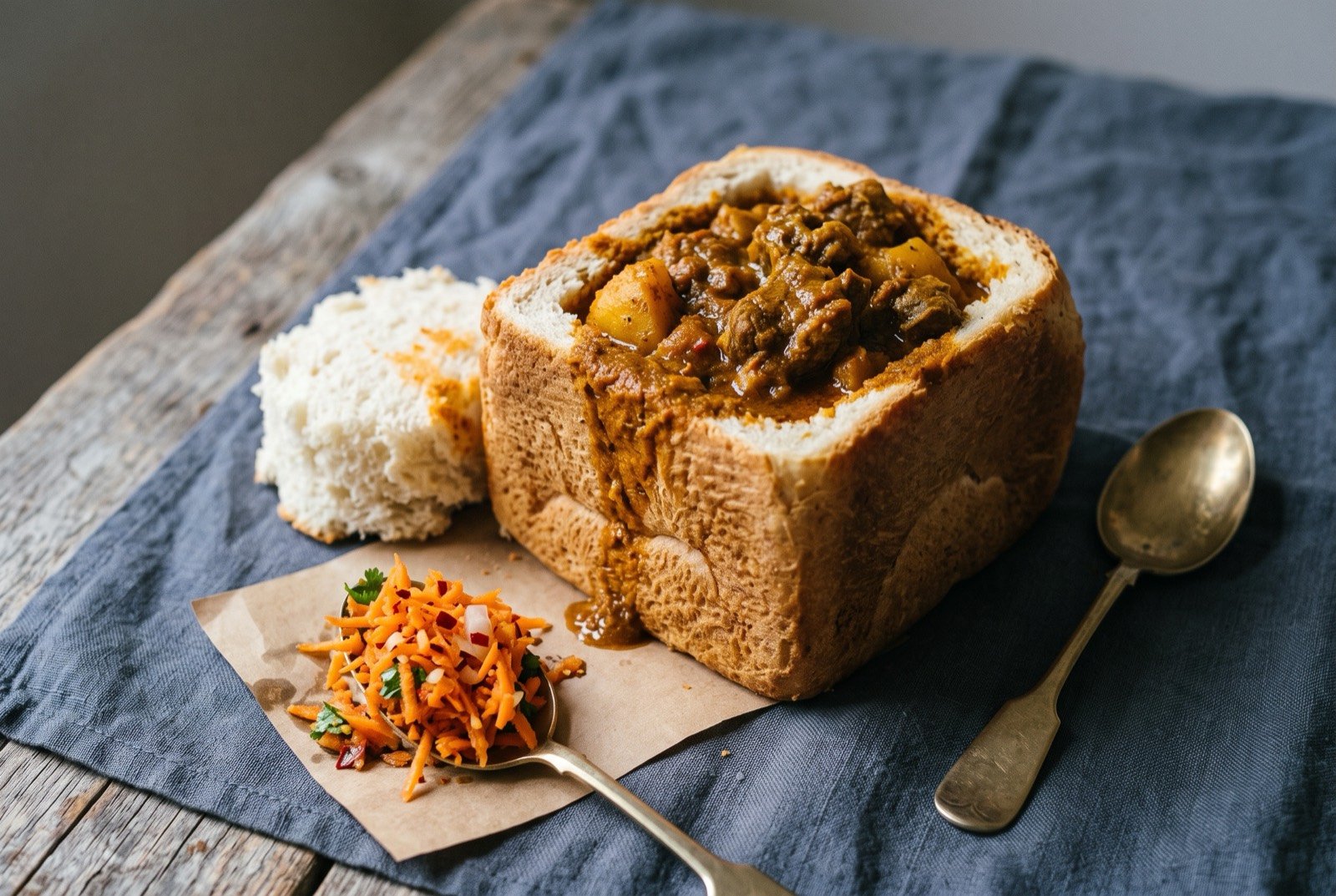
An illustration of the dish, not a photograph of it cooked.
- Time
- 10 minutes
- Reviewed
- Not yet reviewed from inside the tradition
- Cooked
- Not yet cooked and reported
The origin is unrecoverable and the ownership section gives all four accounts. What is recoverable is the construction, and the construction is good engineering.
As tradition built it
Serves 4. 10 minutes, once the curry exists.
Ingredients
- 1 unsliced white loaf
- 1 L mutton or bean curry from dish 8, thick
- to serve carrot and chilli sambal, to serve
Method
- Cut the loaf into quarters, halves, or leave it whole. A quarter is the standard Durban portion, which is why the Black South African version is called a kota, quarter.
- Cut down into the crumb from the cut face and pull the centre out in one piece. That piece is the lid, sometimes called the virgin.
- Ladle the curry into the cavity until it soaks well into the walls. This is not overfilling, it is the point.
- Cap with the pulled out crumb.
- Eat it with your hands, alongside the carrot and chilli sambal. There is no cutlery and there is no plate.
Notes
At Patel's Vegetarian Refreshment Room on the old Grey Street, the standard bowl is about four thick slices deep, sells for roughly a dollar, and the family sells about 800 a day; the proprietor's father starts work at 1.30 a.m. Ritesh Patel, third generation: "A bunny chow is to Durban what a pizza is to New York, the food of the people."
Why the construction is technically correct. Commercial white bread is a soft, high hydration open crumb inside a set crust. The crust is a rigid, largely waterproof shell that holds hot liquid for the twenty minutes it takes to eat. The crumb inside is a sponge that absorbs gravy without dissolving, because the gluten network is already set and the starch already gelatinised. The lid insulates and becomes the tool you scoop with. It is a bowl, a spoon and a napkin that you eat at the end.
What a modern chef changes
A better loaf, a curry adjusted for the vessel, and the acid put where the eater controls it
Rungs 1, 5 and 4
Method
- Bake or buy a loaf with a thicker crust and a tighter crumb than a British supermarket tin loaf. A soft crusted tin loaf collapses at about the eight minute mark; a properly baked white loaf holds for twenty. This is the only structural component of the dish and it is the one nobody upgrades.
- Thicken the curry deliberately for the bread. Reduce it further than you would for rice and let the potatoes break slightly. A thin curry runs straight through the crumb, saturates the base and blows the bottom out.
- Dry the cavity walls before filling. Ten minutes at 160°C with the cut faces up sets the crumb surface and buys real time before it goes to mush. It costs nothing and it is the best single thing you can do to a bunny chow.
- Put the acid on the side and keep it adjustable. The carrot sambal is grated carrot, chilli, vinegar and salt, left 20 minutes to weep. The sour is a component of the plate and the eater decides how much goes in with each scoop.